

 NP
NP
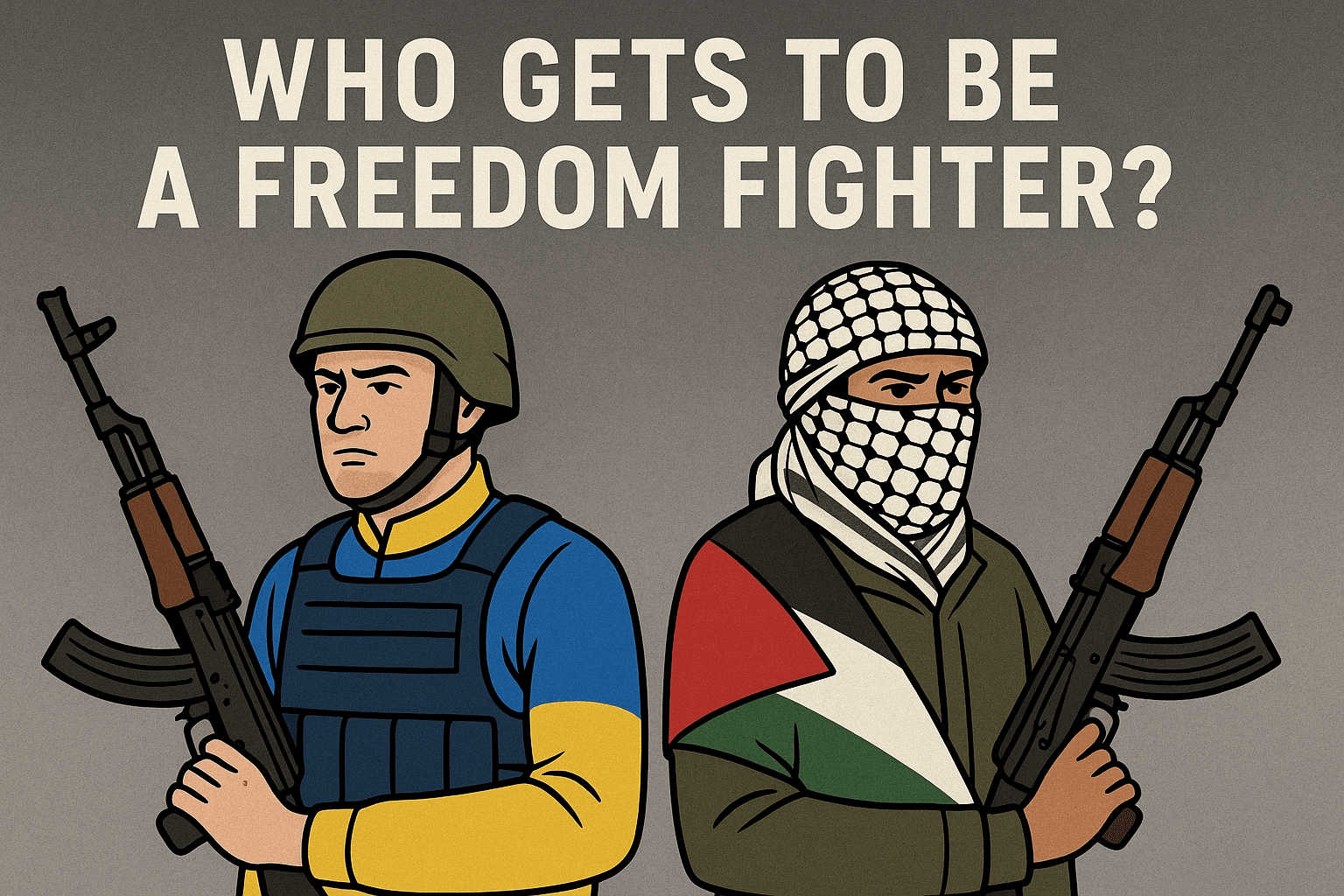
In a world increasingly shaped by media narratives and political alliances, the question of who is seen as a freedom fighter and who is labeled a terrorist reveals more about global power dynamics than it does about the nature of resistance itself. Take, for instance, the war in Ukraine. When Russian forces invaded in 2022, Ukrainian civilians who took up arms to defend their homes were almost instantly hailed as heroes. Western governments showered Ukraine with billions in military aid, political support, and humanitarian sympathy. Images of elderly citizens training with wooden rifles, women weaving camouflage nets, and children taking shelter in subway stations were circulated globally as testaments of bravery and democratic spirit. In short, the Ukrainian struggle was not only seen as legitimate—it was celebrated as a moral imperative.
Contrast this with how Palestinian resistance is portrayed, particularly in the context of the Israeli–Palestinian conflict. Palestinians who resist decades of military occupation, land seizure, and systemic discrimination are rarely afforded the same narrative dignity. Whether they protest peacefully in the West Bank or engage in armed struggle from Gaza, they are more often than not framed as “militants,” “radicals,” or “terrorists.” Their motivations are buried beneath headlines about security concerns, while their historical and political context is frequently ignored or reduced to accusations of extremism. When Israeli airstrikes flatten homes in Gaza or military operations in the West Bank kill civilians, the international response is often muted or couched in phrases like “Israel has a right to defend itself”—a courtesy not always extended to Palestinians.
This double standard is neither new nor accidental. Throughout modern history, labels such as “freedom fighter” or “terrorist” have been used selectively, depending on who controls the narrative and where geopolitical sympathies lie. During the Cold War, the U.S. armed Afghan Mujahideen fighters against Soviet forces, hailing them as defenders of liberty. Years later, many of these fighters formed extremist groups that would be condemned globally. Nelson Mandela, now widely celebrated as a champion of peace, was for decades branded a terrorist by the very nations that later erected statues in his honour. The Irish Republican Army (IRA) was seen as either a liberation force or a terrorist organization, depending largely on whether one stood with Irish independence or British rule.
Today, the discrepancy is even starker in the age of real-time media. The framing of the Ukrainian resistance has benefited from widespread Western media support, cultural proximity, and political alignment. It is easy for the West to identify with Ukraine’s European image and its aspirations for liberal democracy. Thus, their acts of defiance are framed as noble, necessary, and just. Journalists are embedded in Ukrainian cities, reporting stories of individual heroism, civilian loss, and national pride. The world rallies in solidarity with blue and yellow flags.
Palestinians, however, continue to struggle for the same principles—dignity, sovereignty, and the right to exist free from domination—but their cause is often buried beneath political taboos and media asymmetry. When they resist, even through international law-sanctioned means, they are met not with global solidarity but with suspicion, surveillance, and often silence. Peaceful protests in Sheikh Jarrah, for example, were met with violent crackdowns. Civil society organizations are outlawed, and children face military tribunals. Meanwhile, acts of collective punishment—such as the cutting of electricity, bombing of civilian infrastructure, and mass displacement—rarely lead to meaningful international consequences for the occupying power.
The October 7, 2023, attack by Hamas on southern Israel, which killed over 1,100 people, was rightly condemned for its brutality. But the military response that followed—resulting in the deaths of more than 56,000 Palestinians as of mid-2025, the vast majority of whom were civilians—has not drawn the same scale of outrage from Western governments. Instead, the same states that demanded international accountability in Ukraine have continued to arm and fund Israel, excusing its actions as “self-defense,” despite growing evidence of disproportionate force, war crimes, and humanitarian catastrophe in Gaza. The glaring imbalance of empathy and outrage reveals a deeper problem: Western support for resistance is conditional, and its moral clarity often ends where its strategic interests begin.
International law affirms the right of people under occupation to resist. But in practice, this principle is rarely upheld with consistency. While Ukrainians are praised for their defense of democracy, Palestinians asking for basic rights are accused of destabilizing peace. The inconsistency not only undermines international law but erodes the credibility of those who claim to defend a rules-based order. It creates an environment where justice becomes selective and moral outrage transactional.
Language plays a powerful role in this disparity. A Ukrainian father carrying his wounded child is a symbol of war’s tragedy; a Palestinian mother doing the same is too often an anonymous casualty in a statistical report. One resistance is valorized with flags and funding; the other is criminalized and dehumanized. Even tech platforms have participated in this disparity, with pro-Palestinian content frequently censored or shadow-banned under vague “community guidelines.”
To be clear, this is not to excuse or romanticize violence by any group. Attacks targeting civilians, whether in Tel Aviv, Kyiv, or Gaza City, are reprehensible and must be condemned unequivocally. But condemnation must not be selectively applied. The humanity of one people should not come at the cost of denying another’s. If the global community truly values freedom, dignity, and resistance against oppression, then it must have the courage to confront its own inconsistencies.
The time has come to ask difficult questions: Why is freedom only celebrated when it aligns with Western political goals? Why are some struggles amplified while others are suppressed? And most importantly, how can we claim to uphold universal values if those values are only extended to a chosen few?
Until we address these questions with honesty and consistency, the world will remain divided not just by borders, but by narratives—where one people’s hero is another’s criminal, and where justice is not a principle, but a privilege.
