

 NP
NP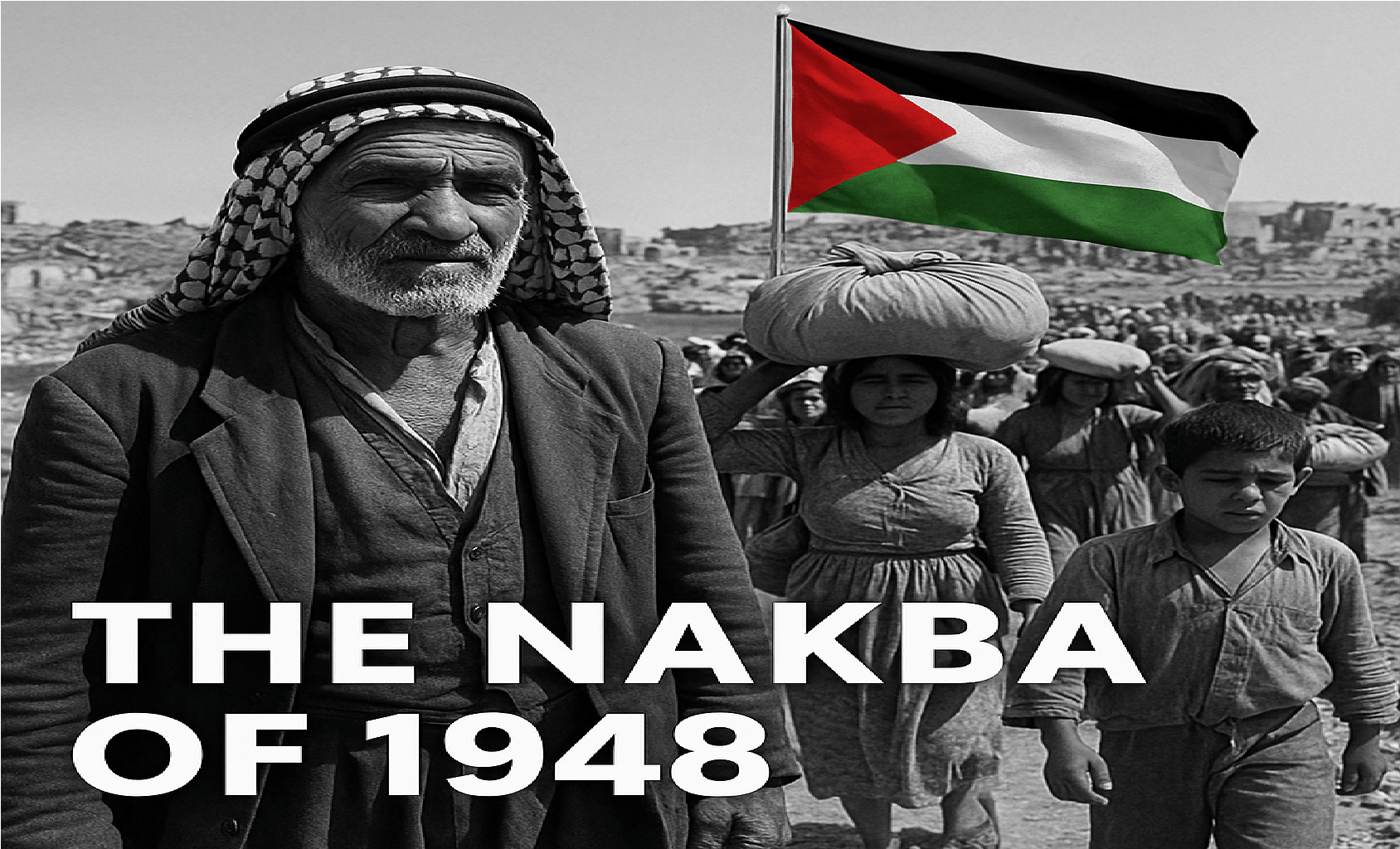
The term Nakba—Arabic for “catastrophe”—refers to the mass displacement and dispossession of Palestinians that accompanied the creation of the State of Israel in 1948. Recognized by historians worldwide as a defining event in the Israeli-Palestinian conflict, the Nakba marked the destruction of Palestinian society as it had existed for centuries and set the stage for decades of conflict, refugee crises, and contested narratives. While interpretations of the causes and intentions vary, the facts of the events themselves are well-documented through historical records, eyewitness accounts, and both Israeli and Palestinian archives.
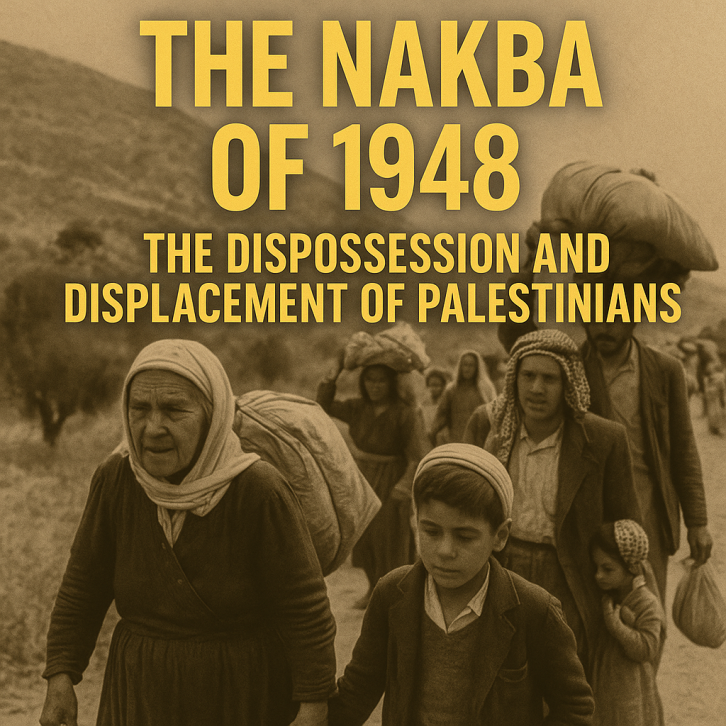
Between late 1947 and 1949, during and after the first Arab-Israeli war, an estimated 700,000 to 750,000 Palestinians—roughly half of the Arab population of Mandatory Palestine—were expelled or fled from their homes. Over 400 to 530 villages and towns were depopulated or destroyed, many razed deliberately to prevent the return of refugees. Cities like Jaffa, Haifa, Lydda (Lod), and Ramle saw mass expulsions of residents, while dozens of rural communities ceased to exist entirely. Key expulsions occurred in operations such as Operation Dani, which forcibly removed tens of thousands from Lydda and Ramle, and Operation Hiram in the Galilee, which cleared dozens of villages in a matter of days.
The process began even before the official establishment of Israel. Following the United Nations Partition Plan of November 29, 1947 (UN Resolution 181), which proposed dividing Palestine into separate Jewish and Arab states, violence escalated between Jewish and Arab communities. The British, who administered the territory under a Mandate, announced their withdrawal, leaving a power vacuum. Zionist militias—primarily the Haganah, along with more radical groups such as the Irgun (Etzel) and Lehi (Stern Gang)—launched military operations to secure territory allotted to the Jewish state and beyond.
One of the most infamous incidents was the Deir Yassin massacre on April 9, 1948, when over 100 Palestinian villagers, including women and children, were killed by Irgun and Lehi fighters. Though condemned by the Jewish Agency leadership, news of the massacre spread rapidly and caused widespread panic, prompting many Palestinians to flee their villages. Other massacres and killings, such as in Tantura, Safsaf, and Al-Dawayima, have been documented by both Palestinian and Israeli historians, including in declassified Israeli military archives.
The exodus accelerated after May 14, 1948, when Israel declared independence and neighboring Arab armies intervened. While some Palestinians fled in fear of the fighting, a significant portion were forcibly expelled. The Israeli leadership’s intentions have been a matter of historical debate. The traditional Israeli narrative long held that Palestinian leaders encouraged the population to leave, expecting to return after an Arab military victory. However, extensive research by Israeli “New Historians” such as Ilan Pappé, Benny Morris, and Avi Shlaim—drawing from Israeli archives—demonstrates that planned expulsions were a central part of the conflict.
The Plan Dalet (Plan D), approved by the Haganah in March 1948, authorized the capture of Arab towns and villages, with provisions for the expulsion of populations deemed hostile. While historians disagree on whether this constituted an explicit policy of ethnic cleansing, the practical outcome was the same: a permanent displacement of hundreds of thousands of Palestinians, most of whom were never allowed to return despite Israel’s obligations under UN General Assembly Resolution 194 (December 1948), which called for the right of return for refugees wishing to live in peace.
The newly founded Israeli state quickly moved to consolidate control over depopulated areas. Many Palestinian homes were confiscated under the Absentees’ Property Law, and new Jewish immigrants were settled in emptied Arab neighborhoods. Hundreds of villages were demolished, their lands repurposed for Jewish settlements or reforested by the Jewish National Fund, erasing traces of Palestinian life.
For Palestinians, the Nakba was not just a loss of homes but a cultural and national disintegration. Families were split across borders, and entire communities were uprooted. Today, there are more than 5.9 million Palestinian refugees registered with UNRWA (United Nations Relief and Works Agency), living across the West Bank, Gaza, Jordan, Lebanon, and Syria, many still carrying deeds and keys to homes lost in 1948.
For Israelis, the 1948 war, known as the War of Independence, symbolizes the survival and establishment of a Jewish homeland after centuries of persecution, including the Holocaust. The clash of these narratives—Israel’s war for statehood versus the Palestinian experience of dispossession—remains central to the intractability of the conflict.
The Nakba is not only a historical memory but an ongoing reality for many Palestinians. Land confiscations, settlement expansions, and military occupations in the West Bank are often described by scholars as a continuation of the same process of displacement that began in 1948. Every year on May 15, Palestinians commemorate Nakba Day, mourning what they view as the beginning of a process of systematic dispossession that has yet to end.
The facts of the Nakba are not in serious dispute: hundreds of thousands were displaced, villages were destroyed, and a permanent refugee crisis was created. What remains contentious is the interpretation of motives, with Israel continuing to reject the accusation of premeditated ethnic cleansing, while Palestinians and many historians argue that demographic engineering was essential to creating and maintaining a Jewish-majority state. What is undeniable, however, is that the Nakba reshaped the Middle East, creating a refugee crisis that endures to this day and leaving a legacy of trauma, grievance, and unresolved claims that continue to fuel one of the world’s longest-running conflicts.