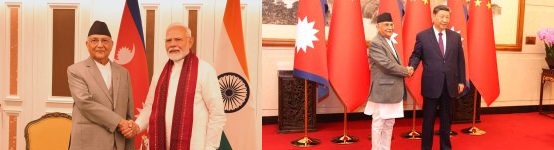
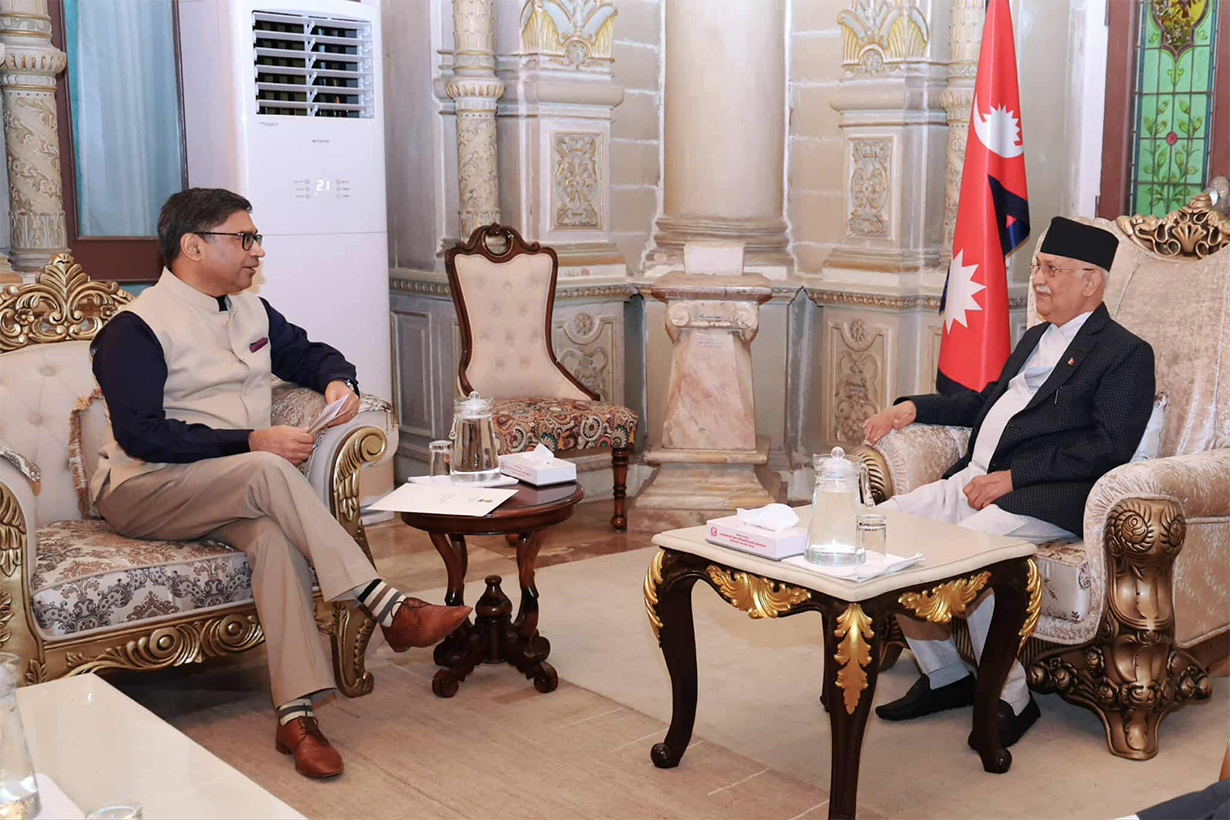
Kathmandu- Prime Minister KP Sharma Oli and Chinese President Xi Jinping have pledged to advance mutually beneficial cooperation in the coming days, according to the Embassy of Nepal in Beijing. President Xi reaffirmed China’s continued support to Nepal and expressed commitment to work together at bilateral as well as multilateral forums such as the United Nations and the Shanghai Cooperation Organization (SCO).
The Embassy stated that Xi promised ongoing assistance to Nepal and reiterated China’s pledge to implement the high-quality Belt and Road Initiative (BRI) projects already agreed upon. Prime Minister Oli, on his part, requested President Xi’s support for Nepal’s full membership in the SCO, as Nepal currently holds only dialogue partner status.
Xi highlighted that the BRI has brought the peoples of Nepal and China closer, noting that the two countries are bound by mountains and rivers, and have shared a friendship for generations. He said that the 70 years of bilateral ties have been marked by a history of good neighborliness and trust.
During the talks, Oli drew Xi’s attention to the need for faster implementation of 10 agreed projects under the BRI and sought further cooperation in areas such as fertilizer supply, petroleum exploration, human resource development, climate resilience, and strengthening people-to-people ties. He also urged China to help reopen blocked border points, according to Oli’s economic advisor Dr. Yubaraj Khatiwada. Xi reportedly assured support in helping Nepal transform from a landlocked to a land-linked country and pledged to facilitate smooth border operations.
According to the Chinese Foreign Ministry, Oli stated that Nepal–China relations have withstood tests and challenges, becoming stronger over time. He reaffirmed Nepal’s commitment to the “One China Policy,” opposition to “Taiwan independence,” and assured that Nepali soil will never be used against China’s interests. Oli emphasized Nepal’s dedication to development and expressed readiness to strengthen cooperation with China in trade, investment, agriculture, science and technology, tourism, and climate change while jointly building the BRI.
Xi expressed China’s willingness to upgrade the traditional friendship with Nepal and promote a new phase of strategic partnership for development and prosperity. He stressed enhancing strategic mutual trust, supporting each other’s core interests, deepening win–win cooperation, and advancing the BRI together.
Xi further assured that China will continue supporting Nepal’s industrial development and believes that the BRI will boost connectivity in ports, roads, energy grids, aviation, and communication. He noted that cooperation under the BRI should also extend to industry, agriculture, livestock, renewable energy, environmental protection, oil and gas, artificial intelligence, education, healthcare, law enforcement, and security.
Copenhagen – Hungarian Foreign Minister Peter Szijjarto has accused the European Union of focusing on prolonging the Russia-Ukraine conflict rather than pursuing peace. Writing on X after a meeting of EU foreign ministers in Copenhagen on Saturday, Szijjarto said Brussels is prioritizing Ukraine’s interests over those of its own member states.
He stated that the EU and most of its members are “preparing for a long war,” allocating tens of billions of euros to fund Ukraine’s military and state operations, including weapons, drones, and soldiers’ salaries. He also noted pressure for Ukraine’s fast-tracked EU membership, new sanctions on Russian energy, and an additional €6 billion ($7 billion) in arms support.
Szijjarto criticized the European Commission for ignoring concerns about Hungary’s energy security and the rights of ethnic Hungarians in Ukraine’s Transcarpathia region. Tensions between Budapest and Kiev have escalated following Ukrainian strikes on the Druzhba oil pipeline, a key supply route for Hungary and Slovakia.
Hungary has consistently refused to send weapons to Ukraine, opposed EU and NATO membership for Kiev, and rejected sanctions on Russia. Meanwhile, EU foreign policy chief Kaja Kallas reaffirmed that the bloc would continue arming Ukraine and step up pressure on Moscow.
Russia has denounced Western military aid to Ukraine, calling it a NATO proxy war and condemning what it sees as the EU’s growing militarization.
White House Accuses Europe of Blocking Ukraine Peace Efforts
White House believes some European governments are quietly undermining peace in Ukraine by urging Kiev to make unrealistic demands, despite publicly supporting President Donald Trump’s peace plan.
US officials say they are frustrated with Europe’s “maximalist” stance, accusing the EU of relying on Washington while contributing little. A senior official warned that if Europe pushes to prolong the war, it risks turning potential victory into defeat. Another official said some European leaders are acting “in a fantasy world” by ignoring the need for compromise.Trump has reportedly voiced dissatisfaction over Zelensky’s unwillingness to consider concessions and the EU’s refusal to support what the White House considers a “realistic” outcome.
Putin Envoy Accuses EU of Blocking Ukraine Peace
Kirill Dmitriev, Russian President Vladimir Putin’s special economic envoy, accused the EU of “sabotaging real peace efforts” in Ukraine by pushing Kiev to make “impossible demands.” Dmitriev urged the EU to abandon “failed logic” and stop prolonging the conflict.
Yemen – The Houthi movement in Yemen has confirmed that its self-declared Prime Minister, Ahmed Ghaleb Nasser al-Rahawi, was killed in an Israeli airstrike on Thursday in the capital, Sanaa. Several senior Houthi ministers also died in the strike, though not all names were revealed. Saudi outlet Al-Hadath reported the deaths of the Houthis’ foreign, justice, youth and sports, social affairs, and labour ministers.
The office of Houthi president Mahdi al-Mashat said other ministers were injured and announced that Deputy Prime Minister Muhammad Ahmed Miftah would replace Rahawi. Rahawi, who took the role in August 2024, was largely viewed as a figurehead rather than a key strategist.
The Israel Defense Forces confirmed the attack, saying Rahawi and other senior officials were “eliminated” within hours of receiving intelligence. Israel has increased strikes on Houthi-held areas in response to missile and drone attacks by the group, which has targeted Israel and commercial shipping routes since the war in Gaza began.
Ankara- Turkiye has announced a complete halt to trade and economic relations with Israel, along with restrictions on air and sea access, in response to Israel’s ongoing military campaign in Gaza.
Foreign Minister Hakan Fidan told parliament on Friday that Turkiye has shut its ports to Israeli ships and barred Turkish-flagged vessels from entering Israeli ports. He also said Israeli flights carrying weapons or ammunition are banned from Turkish airspace, while container ships with military cargo are no longer allowed to dock at Turkish ports.
Meanwhile, commercial carriers can still transit, but port authorities now require shipping agents to confirm that vessels have no Israeli links and are not transporting arms or hazardous goods.
An Israeli official told that Ankara had previously announced similar restrictions, but trade continued despite earlier bans.
Relations between Turkiye and Israel have sharply worsened since the Gaza war erupted in October 2023. Ankara accuses Israel of genocide, while President Recep Tayyip Erdogan has called Prime Minister Benjamin Netanyahu “the butcher of Gaza,” comparing his actions to those of Adolf Hitler, a charge Israel rejects.
Kathmandu — Prime Minister KP Sharma Oli met with Chinese President Xi Jinping. The meeting took place at the Tianjin Guest House in China, where Oli had arrived to attend the Shanghai Cooperation Organization (SCO) Summit.
During the discussion, the two leaders talked about bilateral relations and cooperation between Nepal and China.
Oli was welcomed by senior Chinese officials, as well as China’s Ambassador to Nepal, Dr. Krishna Prasad Oli, and other dignitaries including Chen Song.
Parsa — Former President Bidhya Devi Bhandari has said that the time has come to prove that women are equally capable of leading society. She made this remark while addressing the inaugural session of the “Women: Power, Dedication, and Dignity” National Women’s Conference 2082, organized by the Birgunj Chamber of Commerce and Industry on Saturday in Birgunj.
Bhandari pointed out that women’s contributions have not yet received the recognition they deserve. She emphasized that society must now create an environment where women can confidently lead, run businesses, and drive social transformation.
Highlighting women’s continuous role in building families, business, education, healthcare, and social progress, she said that women are not only part of change but also the foundation of overall development. She noted that women’s growing involvement in business and entrepreneurship in trade hubs like Birgunj strengthens not only individual success but also the national economy.
Bhandari called for greater respect and encouragement for women entrepreneurs, urging them to inspire future generations by overcoming gender inequality, prejudice, and barriers. She stressed that institutional recognition of women’s strength, sacrifice, and dedication is essential to achieve equality, sustainable development, and a prosperous Nepal.
She also underlined Nepal’s potential, citing its natural resources, skilled manpower, and cultural diversity. She said sustainable use of these resources could help build a self-reliant economy. To reduce the growing trade deficit, she recommended import substitution policies and promotion of domestic industries in agriculture, herbal and Ayurvedic products, small and medium enterprises, tourism, energy, and information technology. According to her, this would stabilize the economy and create more jobs.
Speaking about the role of Birgunj in economic development, she said proper management of the Birgunj-Pathlaiya industrial corridor, Simara Special Economic Zone, and Sirsiya Dry Port could make the area a strong industrial hub. She also highlighted the agricultural potential of Bara district, mentioning fish farming, banana cultivation, sugarcane, vegetables, and grain production, along with the tourism opportunities at Simraungadh, Gadhimai Temple, and Parsa National Park.
Bhandari warned about the impact of uncontrolled exploitation of the Chure region, which has increased floods, erosion, and desertification in the Terai, lowering groundwater levels and harming agriculture and livelihoods. She also raised concerns about sugarcane farmers not getting fair prices or timely payments, which discourages farmers and affects agro-based industries.
She further pointed to the problem of loan sharks exploiting people in the Terai-Madhes and urged the government to strictly regulate lending practices, simplify complaint procedures, ensure transparency, and provide affordable loans for poor families.
On the issue of cooperatives, she said many people lost their savings due to unsafe investments lured by high-interest promises. She suggested transparency, strict regulation, compensation for victims, and institutional reforms as urgent measures.
Kathmandu — The House of Representatives on Friday passed the Land Bill 2082, which amends several existing laws related to land. Speaker Devraj Ghimire announced the bill’s approval after it was endorsed by a majority vote.
Minister for Land Management, Cooperatives and Poverty Alleviation, Balram Adhikari, had presented the proposal for decision. He explained that the bill was introduced to provide land to landless Dalits, squatters, and unmanaged settlers, aiming to regulate settlement patterns across the country. According to him, families living in risky areas will be relocated to integrated settlements through coordination with local governments.
However, some lawmakers criticized the bill. Rajkishor Yadav of the JASAPA argued that the intended groups may not benefit as expected, while lawmaker Prakash Adhikari claimed that the bill lacked constitutional analysis and could favor land mafias. Maoist chief whip Hitraj Pandey said some provisions were impractical and would not serve the general public’s interest. Similarly, Maoist whip Rupa Sosi Chaudhary, though supporting the provision of land to Dalits and squatters, accused the bill of including arrangements that would benefit real estate businesses.
When Russian President Vladimir Putin, Chinese President Xi Jinping, and North Korean leader Kim Jong Un stand side by side at Beijing’s upcoming Victory Parade, the world will be watching closely. What might appear to be a ceremonial commemoration of World War II has transformed into a geopolitical statement,one that points toward a reshaping of global power.
For China, the parade is more than a remembrance of history. It is a demonstration of strength and legitimacy. Xi Jinping has tied his vision of “national rejuvenation” to the idea that China deserves recognition as a central world power. Hosting Putin and Kim allows him to project Beijing as the hub of an alternative international order, one not bound by Western dominance. For Putin, the optics are equally valuable. Isolated from the West after the war in Ukraine and weighed down by sanctions, Moscow needs to show it still matters. By standing with Xi, Putin can present Russia as a co-architect of a multipolar world, not a diminished state. Even if the partnership is uneven, with China the stronger side, it provides him recognition and leverage. Kim Jong Un, meanwhile, gains something priceless, legitimacy. His presence alongside Putin and Xi places North Korea at the table of global politics. For Beijing and Moscow, including him underscores their willingness to embrace states ostracized by the West.
At its core, the parade reflects the shared conviction of Beijing and Moscow that the unipolar era dominated by the United States is fading. China’s rapid rise, Russia’s persistence as a military power, and the willingness of countries in Africa, the Middle East, and Latin America to engage with both suggest the world is becoming more fragmented and multipolar. For Xi, this shift is essential. His global projects, from the Belt and Road Initiative to new financial institutions, are built on the idea of creating alternatives to Western-led systems. For Putin, it is about survival and the assertion that Russia cannot be excluded from shaping the future, no matter how much pressure comes from Washington or Brussels.
Military parades in China are not just about showcasing weapons. They are carefully choreographed political theater, aimed at both domestic and international audiences. Domestically, they reinforce the Communist Party’s authority as guardian of the nation. Internationally, they project China’s growing military confidence and diplomatic reach. Inviting Putin and Kim gives the event global weight. It sends a message that Beijing can convene leaders who openly challenge the Western order, offering a stage that Washington cannot control.
Yet beneath the unity, there are limits. Russia does not want to be seen as a junior partner to China, and China does not want to be dragged into Russia’s conflicts. Their partnership is pragmatic, born of necessity rather than deep trust. Economic asymmetry is stark. China’s economy is ten times larger than Russia’s, and Moscow has become increasingly dependent on Beijing for energy sales and trade. Still, for now, the relationship works. China gains secure energy supplies and a strategic partner against U.S. pressure. Russia gains economic survival and diplomatic cover. Together, they project enough strength to unsettle Western capitals.
For the United States and its allies, the Beijing parade is a reminder that attempts to isolate Russia and contain China have not prevented them from drawing closer. Instead, they may have encouraged it. The sight of Putin and Xi together will resonate in regions where Western influence is already contested. It does not mean a formal alliance is forming, nor that their interests always align. But it does highlight the reality that a multipolar world is no longer a distant idea, it is taking shape in visible ways.
The Victory Parade in Beijing will be remembered less for the weapons on display than for the leaders who share the stage. Xi and Putin, joined by Kim, are signaling their intent to challenge the global order built after the Cold War. Whether their vision of multipolarity will lead to stability or deeper conflict is unclear. But the message is unmistakable, Beijing has become a stage where the foundations of a new order are being laid, and the world must pay attention.
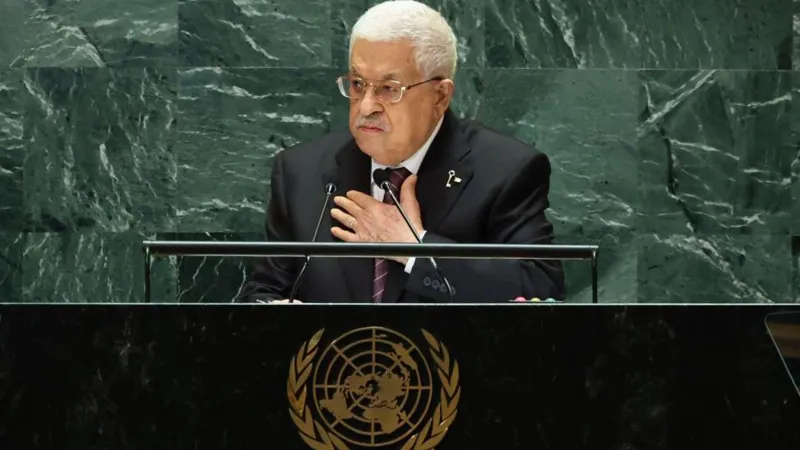
Washington- Palestinian President Mahmoud Abbas will not be able to attend the upcoming UN General Assembly in New York after the US State Department revoked his visa along with those of about 80 other Palestinian officials.
US Secretary of State Marco Rubio accused Abbas and his delegation of undermining peace efforts and pursuing unilateral recognition of a conjectural Palestinian state. The move, strongly welcomed by Israel, is unusual since the US is generally expected to ensure access for all delegations to UN headquarters.
The decision comes as France pushes international efforts to recognize a Palestinian state during the UN session, a step opposed by the Trump administration.
Palestinian ambassador to the UN Riyad Mansour had earlier confirmed Abbas would attend as head of his delegation, but the State Department later clarified that members of both the Palestine Liberation Organization (PLO) and Palestinian Authority (PA) were affected by the visa ban.
While Rubio said Palestinian representatives at the UN mission in New York can still participate under the UN Headquarters Agreement, it remains unclear if the US move complies with that treaty, which obliges the US not to restrict foreign officials’ access to UN meetings regardless of political relations.
Abbas’ office condemned the decision, calling it a violation of international law and the UN Headquarters Agreement, noting that Palestine holds observer status at the UN. The office urged Washington to reverse the measure.
Meanwhile, Israel’s Foreign Minister Gideon Saar welcomed the US action.
Kathmandu — At the invitation of Chinese President Xi Jinping, Prime Minister KP Sharma Oli has left for China on a five-day official visit.
Oli will be in China until Wednesday, the 18th of Bhadra, to participate in the Shanghai Cooperation Organization (SCO) Summit, which is scheduled to be held on the 15th and 16th of Bhadra in Tianjin, northern China.
The Prime Minister’s delegation includes his wife Radhika Shakya, Education Minister Raghujii Pant, Tourism Minister Badri Prasad Pandey, Nepali Congress Vice President Purna Bahadur Khadka, Prime Minister’s economic advisor Dr. Yubaraj Khatiwada, lawmaker Chhabilal Bishwakarma, along with other senior officials.
During his visit, Oli will hold a separate meeting with Chinese President Xi and is also scheduled to address the SCO Plus Summit in Tianjin on the 17th of Bhadra. He will also meet with leaders of various countries during the program.
Additionally, Prime Minister Oli is expected to attend the Beijing Victory Parade. This is his second visit to China since assuming office as Prime Minister.
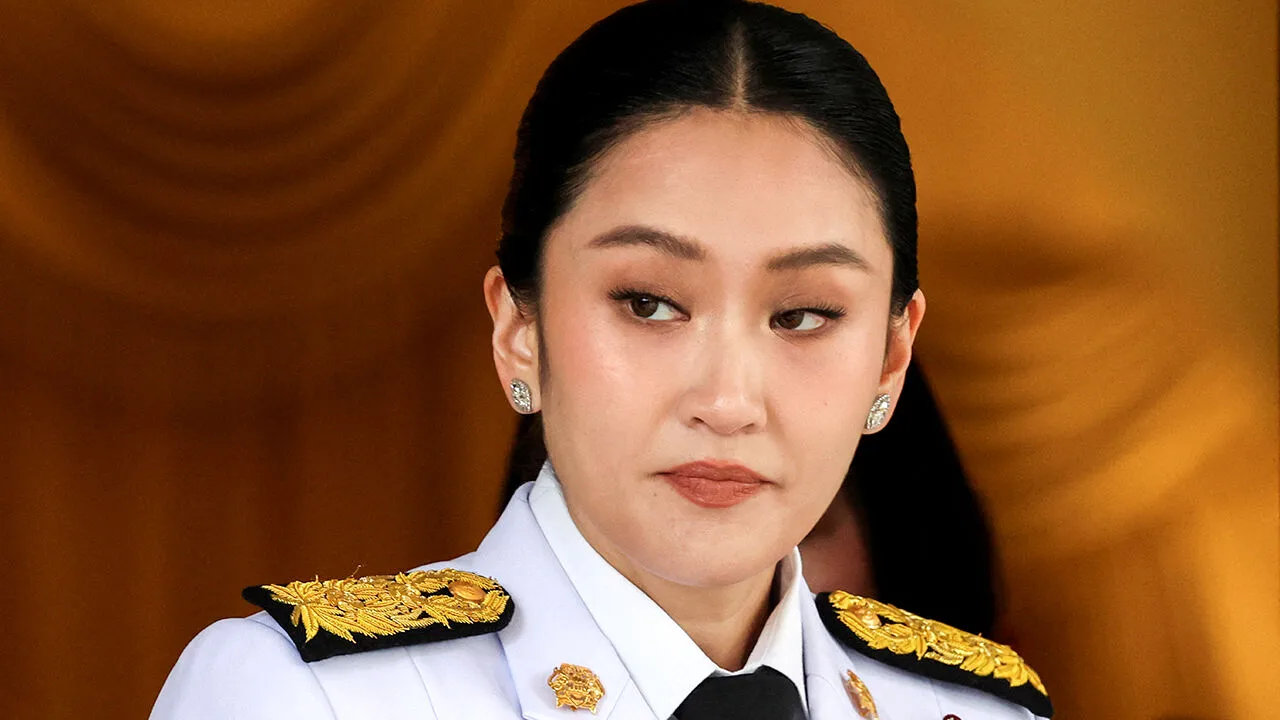
BAngkok- Thailand’s Constitutional Court has dismissed Prime Minister Paetongtarn Shinawatra after ruling that she violated ethics during a leaked phone call with Cambodia’s former leader Hun Sen. In the June call, she referred to Hun Sen as “uncle” and criticized the Thai army while border tensions with Cambodia were rising.
The court said her remarks suggested personal ties that could align with Cambodia’s interests over Thailand’s, casting doubt on her loyalty. By a six-to-three vote, judges concluded her actions breached ethical standards required of her office.
Paetongtarn, daughter of former prime minister Thaksin Shinawatra, becomes the fifth Thai leader removed by the court since 2008 and the third Shinawatra forced out of office. She defended her actions as an attempt to prevent violence during the conflict, which later escalated into five days of clashes that killed dozens and displaced hundreds of thousands.
Her removal comes just months after she rose to power following the dismissal of her predecessor, Srettha Thavisin. Soon after the ruling, the conservative Bhumjaithai Party said it had secured enough support to form a new government under leader Anutin Charnvirakul.
The Shinawatra family, long dominant in Thai politics, now faces another major setback, raising questions about the future of their influence.
Kathmandu — The Election Commission has decided to hold by-elections in Manang Constituency-1 (Province Assembly-2) and Rupandehi Constituency-3 on Kartik 17.
The Manang Province Assembly-2 seat became vacant after representative Rajiv Gurung, also known as Deepak Manange, was dismissed from his position following a Supreme Court order. On June 18, a constitutional bench comprising Chief Justice Bishwambhar Prasad Shrestha and Justices Sapana Pradhan Malla, Kumar Regmi, Hari Prasad Phuyal, and Kumar Chudal ruled to disqualify Gurung, stating that he was ineligible to contest and had misrepresented details to obtain the position.
After the Supreme Court recently released the full text of the verdict, the government published a notice in the Nepal Gazette, initiating the process of setting the election date.
Similarly, the commision will hold the election in Rupandehi-3 on the same date.
Kathmandu — The Kathmandu District Court has ordered the release of Rastriya Swatantra Party central member and environmentalist Dr. Araniko Pandey on bail.
The order was issued by Judge Dhruvaraj Karki’s bench. Pandey had been arrested on Wednesday on charges of verbally abusing a woman through social media. The court had earlier extended his custody by four days for further investigation.
Dr. Pandey joined the Rastriya Swatantra Party under Rabi Lamichhane’s leadership in August 2022. In 2023, while the party was in government, he also served as a member of the National Planning Commission.
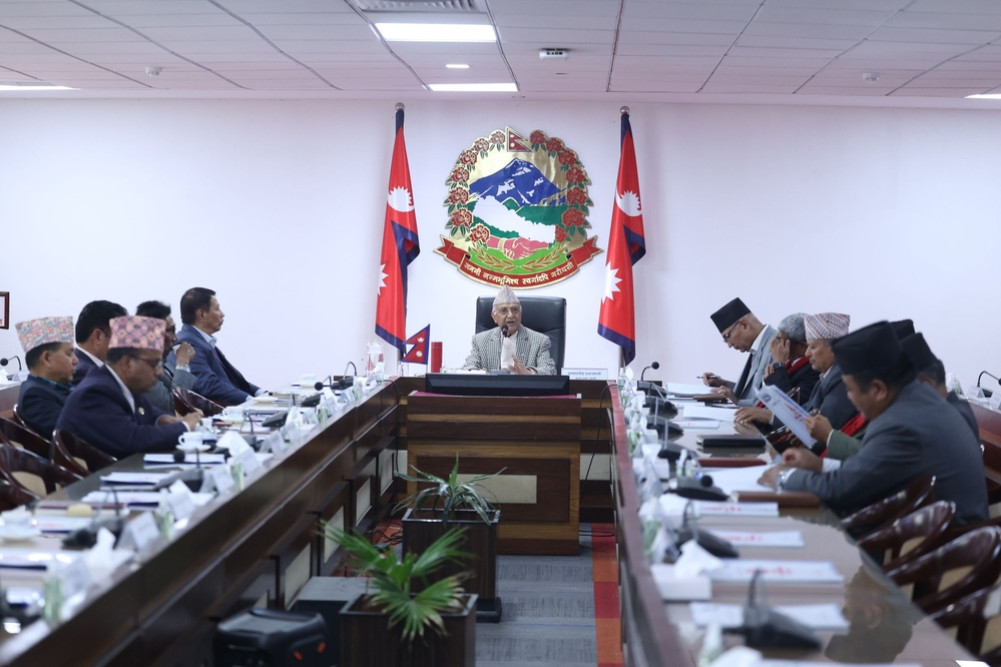
Kathmandu – AIG Khapung, former Chief of the Central Investigation Bureau (CIB) of the Police, has been appointed as the Inspector General of Nepal Police (IGP) as per the decision of the Council of Ministers of the Government of Nepal.
With this decision, Khapung will assume responsibility as the 32nd Inspector General of Nepal Police from Bhadra 18. Born in Tehrathum, Khapung joined the police service in 2052 BS.
55-year-old Khapung has previously held positions including Chief of Security to the Prime Minister, serving twice in the United Nations Mission in Haiti (UN), and Chief of Personnel Administration at the Police Headquarters.
He has received security-related training from Italy, Korea, Vietnam and China.
Budapest-Hungary has filed a lawsuit against the European Union over its decision to use frozen Russian assets to fund military support for Ukraine, despite Budapest’s opposition.
After the escalation of the Ukraine conflict in 2022, Western nations froze roughly $300 billion in Russian assets, including around €200 billion held by the Brussels-based clearinghouse Euroclear. These funds have accrued billions in interest, and EU authorities have explored using the revenue to finance military aid to Kiev.
The legal challenge targets the European Council’s decision last year to channel military assistance through the European Peace Facility (EPF), which reimburses countries supplying weapons to Ukraine. Implemented in February, the measure allocates 99.7% of interest earned from frozen Russian central bank assets to Ukraine, generating an estimated €3–5 billion ($3.5–5.8 billion) annually.
Hungary initially filed the case with the EU Court of Justice, which later transferred it to the General Court. Budapest is seeking to “annul the decision on allocating funds to assistance measures for supplying military support to the Ukrainian Armed Forces” and demands that the defendants cover legal costs.
Budapest argues that the EPF bypassed its veto rights, claiming that Hungary, as a member state, was unjustly deprived of its right to vote. “As a result, the principle of equality between Member States and the principle of the democratic functioning of the European Union were infringed,” the filing states.
Hungary opposes unconditional EU support for Kiev and advocates for peace negotiations over continued fighting. It has repeatedly used its veto to block EU financial and military aid, including a contested €50 billion package at the end of 2023. This resistance has prompted other EU members to explore ways to circumvent Budapest’s objections.
Russia has condemned the freeze as “robbery” and a violation of international law. Senior Kremlin official Maksim Oreshkin warned that the move undermined trust in Western financial systems, while President Vladimir Putin cautioned that seizing these assets could accelerate a global shift toward alternative payment systems.
Berlin- German Chancellor Friedrich Merz has stated that a direct summit between Russian President Vladimir Putin and Ukrainian President Volodymyr Zelensky is “obviously” not going to happen and impossible amid rising tensions.
US President Donald Trump has been advocating for such a meeting following his recent summit with Putin in Alaska, framing it as a potential step toward peace. While Moscow has expressed openness to talks with Zelensky, it insists that meaningful progress in negotiations must precede any summit.
“There will obviously not be a meeting between President Zelensky and President Putin,” Merz told journalists ahead of a meeting with French President Emmanuel Macron in Besançon, France, on Thursday. “This is unlike what was agreed upon between President Trump and President Putin last week in Washington.”
Merz, who recently joined Zelensky and Ukraine’s key European NATO backers for talks with Trump in the White House, noted that the US president even called Putin during the session. Since then, Kiev and its Western European allies have increasingly emphasized the need for “security guarantees” for Ukraine.
Trump has ruled out granting Ukraine NATO membership and stressed that he will not commit US troops in the event of a ceasefire. However, he indicated that Washington could support European allies willing to deploy forces on the ground. “Europe is going to give them significant security guarantees,” Trump said, clarifying that the US would play a supporting role.
Moscow has firmly rejected the idea of NATO troops in Ukraine, whether framed as peacekeepers or otherwise, warning that such a move could provoke a direct confrontation with the West. Russia has long portrayed the conflict as a proxy war orchestrated by the US-led military alliance.
Russian Foreign Minister Sergey Lavrov further criticized Kiev, claiming the Ukrainian government is not genuinely interested in peace but is instead seeking anti-Russian military alliances to protect what he described as its “neo-Nazi, Russophobic regime.”
Kathmandu – The ruling party has backed off from amending Nepal Police regulations to remove the 30-year service limit for officers, citing delays in obtaining consent from the Public Service Commission and concerns over potential court challenges.
Inspector General of Police (IGP) Deepak Thapa is set to retire in a week. Earlier, the government had prepared to remove the 30-year service provision under Rule 127 (g) of the Police Regulations 2071. However, according to a senior Home Ministry official, the process was not advanced as top leaders realized it might not succeed. Preparations for the amendment had started two weeks ago, but a lack of clarity from the government caused delays.
“The Police Regulations can only be amended with the opinion of the Ministry of Law and mandatory consent from the Public Service Commission. With no amendment, IGP Thapa and Additional IGPs Tek Prasad Tamang and Sudip Giri, among others, will retire on 18 Bhadra due to service limits.
In March 2014, the Supreme Court issued a directive against arbitrarily amending police service tenure through regulations, instructing that service and retirement matters be settled through legislation rather than regulations. Although the government presented the Nepal Police Bill in Parliament seven months ago, it has not yet been finalized. When the government attempted to amend regulations while the bill was still under discussion in the Parliamentary State Affairs and Good Governance Committee, it raised concerns.
The Police Bill, tabled on 15 Magh 2081, proposes removing the 30-year service limit, allowing retirement based solely on position tenure or age limit. Currently, the regulations stipulate a four-year term, 30-year service limit, or age 58 for the IGP, with retirement based on whichever comes first. Additional IGPs and DIGs have a 56-year age limit and five-year term, while SSPs and SPs have a 55-year age limit and six- and ten-year terms respectively. Critics argue that including service and term provisions in the regulations has made transfers, promotions, retirements, and career development in the police force non-transparent.
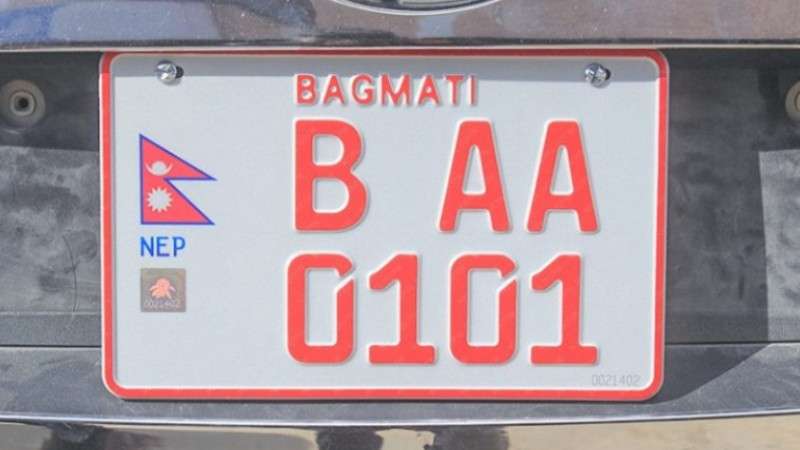
Kathmandu – Fifty-three organizations have expressed their opposition to the Nepalese government’s decision to issue embossed vehicle number plates with only English letters. At a joint meeting held on Thursday, these organizations urged the government to take notice of the issue and implement embossed number plates in the Nepali language.
In a statement issued after the meeting, the organizations requested that the government respectfully include Nepali letters on the number plates. The statement noted that the unilateral decision to remove Nepali letters from vehicle number plates contradicts the Constitution, government notices published in the gazette, and the sentiments of the Nepalese people. It emphasized that the government should immediately correct the decision and use Nepali letters with due respect. The statement also warned that the government would be fully responsible for all consequences if the decision is not amended.
UK, France and Germany have launched the process to restore major UN sanctions on Iran, using the 2015 nuclear deal’s “snapback” mechanism. The move could reimpose sanctions within 30 days unless Iran shifts course.
The three countries said Iran has failed to meet its commitments under the 2015 accord and accused Tehran of deliberately breaching limits by stockpiling highly enriched uranium with “no civilian justification.” They warned that Iran’s nuclear program poses “a clear threat to international peace and security.”
Iran denounced the step as a “provocative escalation” that would undermine its work with the International Atomic Energy Agency. It insisted its program is peaceful and promised to respond appropriately, while also expressing readiness for further talks.
The 2015 deal had lifted crippling sanctions in exchange for limits on Iran’s nuclear program, but collapsed after Donald Trump withdrew the US in 2018 and reimposed sanctions.
The E3 letter to the UN Security Council sets a 30-day deadline to decide whether sanctions relief will continue. Britain’s Foreign Secretary David Lammy said Iran had made “no substantive effort” to address concerns. The US welcomed the move, saying it remains open to direct talks with Tehran to find a lasting resolution.
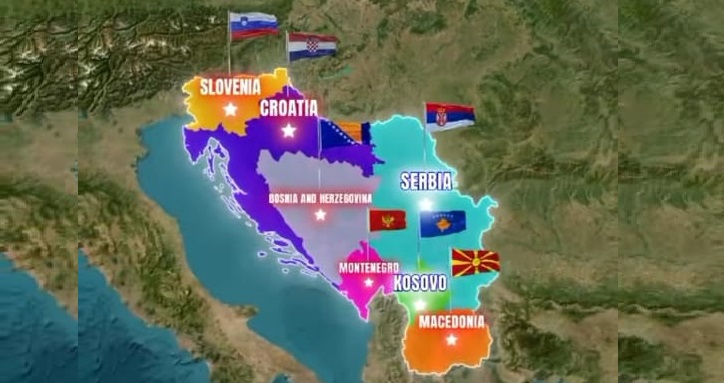
The disappearance of Yugoslavia from the world map remains one of the most dramatic geopolitical shifts of the late 20th century. Formed after World War I and strengthened after World War II as a federation of six republics and two autonomous provinces, Yugoslavia was a unique multi-ethnic state in Europe. But in the early 1990s, Europe watched a country vanish. Yugoslavia, once a proud federation of six republics and two autonomous provinces, a nation born out of antifascist struggle and unity, was slowly dismantled in blood and fire. The breakup did not occur in isolation. It was not simply the result of old ethnic rivalries, as many leaders in the West conveniently claimed. It was fueled and accelerated by outside powers that saw opportunity in its collapse and chose to intervene in ways that turned fault lines into frontlines. What followed was not only the death of a country but one of the darkest chapters in post-World War II Europe.
The Kingdom of Serbs, Croats, and Slovenes was established in 1918 following the collapse of the Austro-Hungarian Empire and the Kingdom of Serbia’s expansion after World War I. In 1929, it was renamed the Kingdom of Yugoslavia, meaning “Land of the South Slavs.” This state was intended to unify Serbs, Croats, Slovenes, Bosniaks, Montenegrins, and Macedonians under one national identity, but ethnic differences and rivalries persisted from the start. Tensions between centralized Serbian dominance and the aspirations of Croats and Slovenes for autonomy created cracks that never fully healed.
World War II deepened these divides. Nazi occupation and collaboration by local factions left scars across the region. After the war, Yugoslavia re-emerged under the leadership of Josip Broz Tito, who established a socialist federation consisting of six republics, Slovenia, Croatia, Bosnia and Herzegovina, Serbia, Montenegro, and Macedonia and two autonomous provinces within Serbia, Kosovo and Vojvodina. Tito’s government pursued a distinct socialist path, independent from the Soviet Union, and successfully held the nation together for decades despite its diversity. Tito relied on a careful balance of federalism, repression of nationalist movements, and a unifying ideology of “Brotherhood and Unity.” His rule provided relative stability, modernization, and international prestige, with Yugoslavia becoming a founding member of the Non-Aligned Movement.
However, beneath the surface, unresolved national questions remained. Tito’s death in 1980 exposed the fragility of the system. Without his authority, the collective leadership structure failed to maintain cohesion. The 1980s brought worsening economic decline marked by debt, inflation, unemployment, and a growing black market economy. Regional disparities increased, with Slovenia and Croatia resenting that their wealth was redistributed to poorer republics like Kosovo and Macedonia. Nationalist rhetoric resurfaced, exploiting economic hardship and the absence of a unifying leader.
The rise of Slobodan Milosevic in Serbia symbolized this new era of nationalism. He championed Serbian dominance within the federation, stripping Kosovo and Vojvodina of their autonomy and asserting control over the federal system. This alarmed Slovenia and Croatia, who saw their autonomy eroding. At the same time, other nationalist leaders such as Franjo Tudman in Croatia and Alija Izetbegovic in Bosnia and Herzegovina emerged, each with competing visions for their republics’ futures. The weakening of central authority and the competing nationalist agendas set the stage for disintegration.
The collapse of communism across Eastern Europe further accelerated Yugoslavia’s unraveling. Multiparty elections held in 1990 brought nationalist parties to power in most republics. Slovenia and Croatia declared independence in 1991, prompting the Yugoslav People’s Army, dominated by Serbs, to intervene. The brief Ten-Day War in Slovenia ended with minimal casualties, but Croatia descended into a bloody conflict as ethnic Serbs within its borders, backed by Belgrade, opposed independence. By 1992, the war in Croatia had become one of the bloodiest conflicts in Europe since World War II.
Bosnia and Herzegovina’s declaration of independence in 1992 triggered the most devastating conflict of the Yugoslav wars. With its mixed population of Bosniaks, Serbs, and Croats, Bosnia became the battleground for ethnic cleansing, mass atrocities, and genocide. The siege of Sarajevo and the massacre at Srebrenica shocked the world and highlighted the brutal consequences of ethnic nationalism. International intervention came late and hesitantly, with United Nations peacekeepers often powerless to stop the violence. NATO eventually intervened with airstrikes, and the war ended with the US-brokered Dayton Agreement in 1995, which established a fragile peace by dividing Bosnia into two autonomous entities.
The conflicts did not end there. In Kosovo, tensions between the Albanian majority and Serbian authorities escalated throughout the 1990s, culminating in the 1999 NATO bombing campaign against Yugoslavia after Milosevic’s forces carried out mass atrocities. Kosovo was placed under UN administration and eventually declared independence in 2008, though Serbia and several other countries still refuse to recognize it. Montenegro also voted for independence in 2006, peacefully dissolving its union with Serbia. By the 21st century, Yugoslavia had completely vanished from the world map, replaced by Slovenia, Croatia, Bosnia and Herzegovina, North Macedonia, Montenegro, Serbia, and Kosovo.
The dissolution of Yugoslavia carried enormous consequences. The wars of the 1990s left over 140,000 people dead, millions displaced, and deep scars of ethnic hatred that remain unresolved. Economically, the region suffered massive destruction and fell behind in development compared to Western Europe. Politically, the legacy of Yugoslavia continues to shape the Balkans, with disputes over borders, minority rights, and EU integration. Bosnia and Herzegovina remains divided and dysfunctional, Kosovo’s status is contested, and Serbia struggles with its role in the wars and its European future. At the same time, Slovenia and Croatia have successfully joined the European Union and NATO, marking a stark contrast with their neighbors.
The fall of Yugoslavia was not caused by a single event but by a complex interplay of nationalism, economic crisis, weakened leadership, and international factors. Tito’s system had postponed but never resolved ethnic rivalries. Once his authority was gone, and once global communism crumbled, the federation could not withstand the centrifugal forces pulling it apart. The attempt to impose Serbian dominance only intensified resistance from other republics. International indecision in the early years of the conflicts allowed violence to escalate, prolonging the wars and their devastation.
Throughout these wars, Washington, Berlin, London, and Brussels spoke the language of peace while acting with double standards. They armed factions, imposed sanctions selectively, and legitimized certain leaders while demonizing others. The fragmentation of Yugoslavia was not merely the collapse of a failed socialist experiment. It was a dismemberment overseen and hastened by powers that preferred a fractured Balkans aligned with Western interests over a united, independent federation.
Today, Yugoslavia exists only in memory, its place on the world map erased. But the story of its disappearance is not only a tale of internal collapse. It is also a story of how Europe and the United States, in the wake of the Cold War, chose to back certain wars, reward certain leaders, and allow destruction to run its course when it suited their interests. It is a story that should remind us that nations do not simply vanish, they are torn apart, sometimes from within, but often with decisive help from outside.
Washington-The United States plans to use frozen Russian assets as a bargaining tool in negotiations over the Ukraine war rather than seizing them outright and handing them to Kiev, Treasury Secretary Scott Bessent said on Wednesday.
Speaking to press, treasury Secretary Scott Bessent outlined Washington’s position on more than $300 billion in Russian assets blocked in Western financial institutions since 2022. While most of the funds are held under EU jurisdiction, the US controls about $5 billion. Moscow has condemned the freeze as “theft.”
Bessent said the assets are “part of the negotiation and argued against immediate seizure. He suggested they could eventually contribute to Ukraine’s reconstruction, depending on the outcome of talks.
The debate over confiscating Russian assets has divided Western allies. Ukraine has pressed for swift transfer, but some European leaders and experts warn outright seizure could breach international law, undermine global financial trust, and rattle markets.
For now, the EU has chosen to redirect profits and interest earned on the frozen funds, expected to yield over $3 billion annually, to Ukraine. The US, while legally empowered by Congress to seize Russian sovereign assets, has refrained due to legal and financial risks. Instead, Washington joined the G7 in approving a $50 billion loan to Ukraine backed by interest from the frozen funds.
Kremlin spokesman Dmitry Peskov said Russia will never abandon its claim to the assets and warned of “serious judicial and legal consequences” if they are confiscated and transferred to Ukraine.
Beijing- North Korean leader Kim Jong Un will join Russian president Vladimir Putin and China’s leader Xi Jinping at a military parade in Beijing, a rare and symbolic moment that underscores Xi’s growing diplomatic reach.
For Xi, it is more than a commemoration of Japan’s surrender in World War Two. It is a display of Chinese power and influence at a time when he wants to project Beijing as both an economic and diplomatic heavyweight.
The parade comes as Xi prepares to host Putin, while the United States struggles to push Moscow toward ending the war in Ukraine. At the same time, Kim’s presence is significant. It is his first appearance at a Chinese parade since 1959, reaffirming ties with Beijing despite speculation he was moving closer to Moscow.
Kim’s reliance on China is deep, with Beijing providing nearly 90% of North Korea’s food imports. Standing alongside Xi and Putin not only gives him legitimacy but also highlights Xi’s ability to shape conversations around both North Korea and Russia.
The timing also matters for Washington. President Donald Trump has suggested he wants another meeting with Kim after past summits ended without progress. The White House has signaled Trump may travel to the region in October for possible talks with Xi, with trade disputes, tariffs, and even TikTok on the agenda.
China has tried to appear neutral on the Ukraine war but is accused by the US and allies of quietly aiding Russia. Xi’s meetings with both Putin and Kim position him as a central player who could influence future negotiations.
For Trump, any talks with Xi will now involve a leader who already has the ear of both Putin and Kim, giving Beijing added leverage. Some even wonder if a meeting involving all four leaders could be on the horizon.
Kathmandu – Dr. Govinda KC has announced that he will begin a hunger strike on Sunday, September 1 (Bhadra 15), demanding reforms in medical education.
Dr. KC, who has long been campaigning through hunger strikes and pressure movements for improvements in Nepal’s medical education system, said he is resuming his protest in response to the government’s recent decision.
The government had approved an increase in seats at private medical colleges, a move widely criticized as favoring private institutions over public ones. Dr. KC had urged the government to reverse the decision and instead increase seats in public medical colleges. With the demand ignored, he has decided to restart his hunger strike.
EU- The European Union is considering fresh action against countries it believes are helping Moscow sidestep Western sanctions.
After years of restrictions targeting Russia directly, Brussels is now turning its attention to third states accused of facilitating sanctions evasion. EU foreign ministers are scheduled to meet in Copenhagen later this week for informal talks on stronger steps, including use of the “anti-circumvention tool” adopted in 2023. That measure would allow the EU to block exports or supplies of certain goods to countries suspected of channeling them to Russia.
The bloc has already passed 18 sanctions packages, the most recent just last month, after overcoming objections from Slovakia. Work on a 19th package is underway and could be finalized next month. Possible new steps may also target Russia’s oil, gas, financial sectors, and trade in specific goods.
Despite repeated rounds of sanctions, Moscow insists the restrictions have failed to weaken its economy, noting it has redirected much of its trade toward Asia, the Middle East, and other regions. EU officials have pushed US President Donald Trump to adopt tougher measures on Russia’s trade partners, though Washington has so far refrained from expanding its sanctions list.
Beijing- China has firmly rejected Washington’s call to join nuclear arms reduction talks with the United States and Russia, arguing that the idea is both unreasonable and unrealistic.
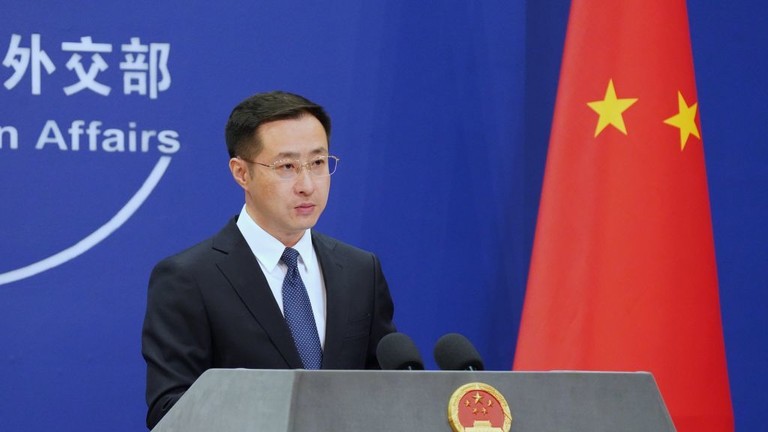
Foreign Ministry spokesperson Guo Jiakun said on Wednesday that China maintains only a limited nuclear arsenal strictly for national defense and cannot be compared with the massive stockpiles held by Washington and Moscow.
“The country with the world’s largest nuclear arsenal should take the lead in disarmament,” Guo stated, pointing at the United States. He added that Beijing upholds a strict “no first use” policy and has no intention of entering an arms race.
US President Donald Trump recently suggested that China should join discussions on reducing nuclear weapons after his talks with Russian President Vladimir Putin in Alaska. Trump claimed China could close the gap in nuclear capabilities within five years.
Data from the Stockholm International Peace Research Institute (SIPRI) shows a stark imbalance. Russia possesses about 2,591 warheads in storage and 1,718 deployed, while the US holds 1,930 in storage and 1,770 deployed. China’s arsenal is much smaller, with an estimated 576 warheads, of which only 24 are deployed. In comparison, the UK and France have 120 and 280 deployed warheads, respectively.
The US and Russia remain bound by the New START treaty, which limits deployed warheads to 1,550 each. Although extended until 2026, Russia suspended its participation in 2023 in response to US military support for Ukraine, though it said it would continue to observe the treaty’s limits.
Kathmandu – The government is preparing to involve manpower agencies and other relevant stakeholders in negotiating bilateral labor agreements with foreign countries.
The recently released National Labor Migration Policy states that “a model framework for bilateral labor agreements will be developed and implemented based on meaningful participation of labor service providers, NGOs, and other stakeholders.”
Previously, Nepal handled labor agreements with countries such as Malaysia, Qatar, Japan, and South Korea solely through the government. Under the new policy, however, private agencies and other stakeholders will have the opportunity to provide input during the drafting process.
Officials and migration experts have expressed differing views on the policy. The Ministry of Labor, Employment, and Social Security has emphasized that the approach reflects a holistic societal perspective, aiming to involve all relevant stakeholders.
Some experts, however, have raised concerns that this could create additional complications in the foreign employment sector. While stakeholder involvement is positive, there is a risk of conflicts of interest if private parties prioritize their own gains.
Kathmandu – A government formed committee has recommended that the private sector be allowed to participate in electricity trade in Nepal. The recommendation was submitted to Minister for Energy, Water Resources, and Irrigation, Deepak Khadka, by the Electricity Trade Study and Recommendation Committee led by former Energy Secretary Dinesh Kumar Ghimire.
The committee, formed on July 10 with the mandate to study electricity trade including private sector involvement, concluded that private companies should also be granted licenses for electricity trading.
According to the report, the private sector has played a significant role in electricity generation in Nepal. However, its contribution has so far been limited to production. The committee noted that involving private entities in electricity trade has become necessary to further develop the energy sector.
The report highlighted that the absence of adequate legal provisions has prevented private participation in electricity trading until now. It mentioned that the Electricity Regulatory Commission Act, 2017 already provides a regulatory framework for licensed entities, while the Electricity Bill, 2080 BS , currently under consideration in the federal parliament, seeks to amend and integrate existing laws to address electricity trade more comprehensively.
With rising electricity production, the committee stressed that involving the private sector in electricity trading is essential to manage domestic demand and supply, as well as to export surplus electricity to neighboring countries.
Moscow- For the first time, Chinese and Russian diesel-electric submarines carried out a joint patrol in the Asia-Pacific region earlier this month, according to a statement released by Russia’s Pacific Fleet and reported by Russian media on Wednesday.
The patrol began in early August, shortly after the conclusion of the China-Russia Joint Sea 2025 naval drills in the Sea of Japan. Russia’s Pacific Fleet submarine Volkhov and a submarine from China’s People’s Liberation Army (PLA) Navy patrolled a designated route in the Sea of Japan and the East China Sea before returning to their respective bases.
While Beijing has not yet officially announced the submarine patrol, Chinese state media confirmed the broader Joint Sea 2025 exercise and a follow-up joint maritime patrol in the Western Pacific. According to China Central Television (CCTV), the joint maritime patrol, which began on August 6, concluded on August 20.
During the joint drills, Chinese and Russian forces conducted exercises in air defense, naval warfare, anti-submarine operations, and anchorage defense in waters near Vladivostok.
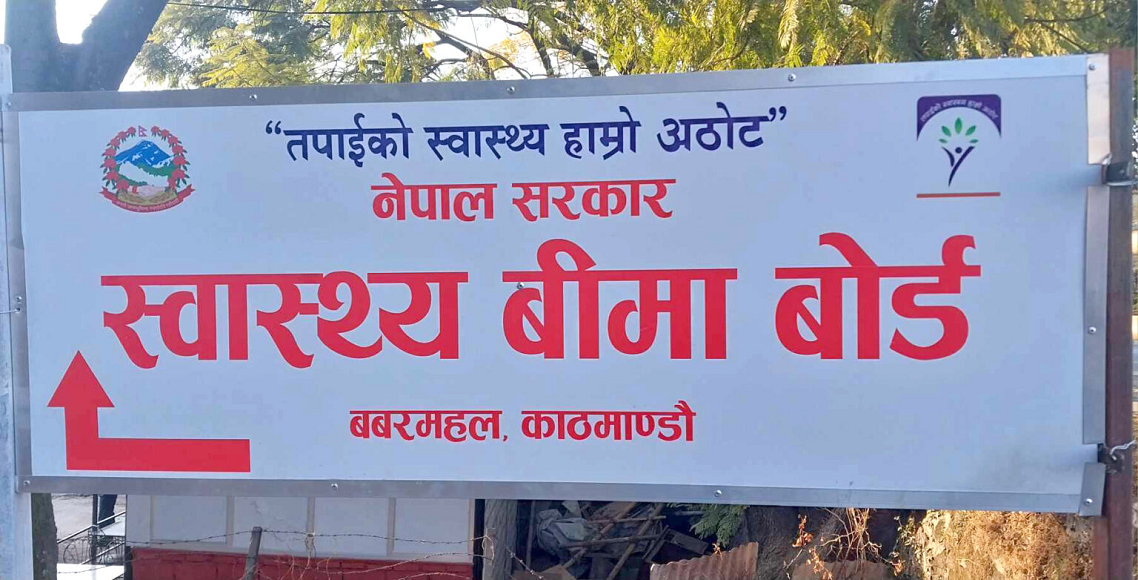
Kathmandu – The Health Insurance Board has decided to impose additional fees on those who fail to renew their health insurance on time. The board stated in a notice released on Wednesday that insurance not renewed by October 17 (Asoj 31) will be subject to late fees.
According to the board, individuals who fail to renew their insurance for up to three years will have to pay a fee equivalent to four times the contribution amount.
The notice states, “Families who previously had health insurance but did not renew it will get a one-time waiver of the late fee. However, those renewing after November 16 (Kartik 31) will have to pay the applicable late charges.”
For those renewing by the end of October (Asoj), the renewal can be done at the original contribution amount without any extra fees.
The notice also specifies:
Renewal within three months of expiry will incur a 10% additional fee.
Renewal within six months will incur a 30% additional fee.
Renewal between six months and one year will incur a 50% additional fee.
Renewal after one year will incur a 100% additional fee.
Renewal delayed up to two years will require payment equal to three times the contribution amount.
Renewal delayed over three years will also require payment equal to three times the contribution amount.
The board has urged all insured families to renew their health insurance on time to avoid unnecessary additional charges.
Kathmandu – Police have said that Rastriya Swatantra Party (RSP) central member Dr. Araniko Pandey, arrested on charges of verbally abusing a woman on social media, will be presented before the court today for a remand extension.
Pandey was taken into custody yesterday after a woman filed a complaint accusing him of abusing her online. He had appeared at the Cyber Bureau in connection with the case before being arrested.
Pandey is also a former member of the National Planning Commission. He joined RSP in 2079 BS. and was appointed as a member of the National Planning Commission in 2080 BS.
In a separate cybercrime case, CPN-UML central member Ain Mahar was released on Wednesday within a few hours of arrest.
Kathmandu – Nepal’s public debt increased by more than Rs 14 billion during the first month of the current fiscal year 2082/83 , according to the Public Debt Management Office.
The report shows that total government debt stood at Rs 2.669 trillion at the beginning of the fiscal year and reached Rs 2.684 trillion by mid-August. This figure accounts for 43.94 percent of the country’s gross domestic product (GDP).
Out of the total debt, 52.26 percent, Rs 1.42 trillion, is external borrowing, while the remaining 47.74 percent, or Rs 1.264 trillion, is domestic borrowing.
The government has set a target of raising Rs 595 billion in debt this fiscal year. By the end of Shrawan , Rs 44.57 billion, 7.48 percent of the annual target, had been raised, which includes Rs 40 billion from domestic loans and Rs 4.57 billion from external loans.
Meanwhile, Rs 36.68 billion has already been spent on interest payments from the Rs 411 billion allocated for debt servicing in the current budget. This amount represents 8.93 percent of total government expenditure.
Kathmandu – The government has directed all social media platforms operating in Nepal to complete registration within seven days. A Cabinet meeting on Monday decided that platforms failing to comply within the given time will be deactivated in Nepal.
Government spokesperson and Minister for Communication and Information Technology, Prithvi Subba Gurung, informed about the decision on Wednesday. He said the move aims to regulate the use of social media in line with the Social Media Directive 2080 and the order of the Supreme Court, making users and operators more accountable.
According to the decision, the Ministry of Communication and Information Technology will instruct the Nepal Telecommunications Authority to deactivate non-registered platforms. However, once registered, those platforms will be immediately reactivated.
Delhi-US President Donald Trump’s steep 50% tariffs on Indian goods have officially taken effect, weeks after he imposed an additional 25% penalty over India’s purchases of Russian oil and weapons. The move makes India one of the most heavily targeted countries in the world by US tariffs, despite being a key partner in the Indo-Pacific.
The decision is expected to hurt exports and growth in India, the world’s fifth-largest economy, as the US was until recently its biggest trading partner. In response, Prime Minister Narendra Modi has promised major tax relief to cushion the economic shock. He announced that a “massive tax bonanza” will be delivered to ordinary citizens and small businesses, which he described as the backbone of Asia’s third-largest economy.
During his Independence Day speech at Delhi’s Red Fort, Modi urged citizens to adopt self-reliance by promoting “Swadeshi” or “Made in India” goods. “We should become self-reliant, not out of desperation but out of pride,” he said, stressing that India must not allow others to control its economy.
His message has been repeated in several public speeches, seen as a direct response to Trump’s tariffs that threaten millions of jobs across India’s export-driven sectors, from textiles to gems and seafood.
While Modi’s “Make in India” campaign has struggled, with manufacturing stuck at around 15% of GDP despite subsidies and incentives, experts believe tax reforms could soften the impact. After announcing a $12 billion income tax package earlier this year, Modi is now pushing for a major overhaul of India’s goods and services tax (GST) to simplify and reduce rates, aiming to put more money in people’s hands and encourage domestic spending.
Washington- US President Donald Trump warned that Washington could impose sanctions and tariffs on both Russia and Ukraine if they fail to make progress in ending hostilities. Speaking at the White House on Tuesday, Trump said resolving the conflict “takes two to tango” and suggested that Ukraine’s President Zelensky “was not exactly innocent.”
Trump emphasized the human cost of the war, noting that “thousands of young people are dying every single week,” and said he could act through sanctions or tariffs to influence the situation. He reaffirmed his willingness to impose further economic restrictions on Russia, stressing that his goal was to avoid a wider war.
Trump criticized his predecessor, Joe Biden, calling him “grossly incompetent” for allowing the conflict to escalate, and downplayed Moscow’s concerns about Zelensky’s legitimacy, calling much of the posturing “bullsh*t.”
Meanwhile, Russian Foreign Minister Sergey Lavrov told that any peace deal must be signed by someone with legal authority, describing Zelensky as the “de facto head of the regime.”
KATHMANDU-The government has decided to establish 23 new Area District Administration Offices (DPOs) across different districts to improve the delivery of public services. The decision was discussed in a cabinet meeting on Monday and has now been forwarded to the Cabinet’s Administration Committee for further review.
According to the Ministry of Home Affairs, the main goal of opening these new offices is to make public services more accessible and effective. The new DPOs are expected to reduce existing gaps in population coverage, geographical access, and service delivery.
The MoHA said the new offices will help balance the workload and make it easier for people in remote or underserved areas to access administrative services. The ministry also mentioned that more Area DPOs will be established in the future in regions where such gaps continue to exist.
Kathmandu – Nepal Rastra Bank (NRB) has announced new rules on carrying foreign currency. From now on, travelers entering or leaving Nepal can carry a maximum of 5,000 US dollars in cash. Any amount above this must be declared in advance with customs.
The bank has also banned the carrying and use of Indian currency notes of 200, 500, and 2,000 rupees. Nepali citizens are not allowed to take Indian currency to countries other than India. In addition, the use of old Indian notes of 500 and 1,000 rupees, already demonetised by the Government of India, remains strictly prohibited.
According to NRB, these rules are enforced under the Foreign Exchange (Regulation) Act 1962, the Money Laundering Prevention Act 2008, and a notice published in the Nepal Gazette. The government says the move is part of wider efforts to get Nepal removed from the Financial Action Task Force’s (FATF) grey list.
The FATF’s September 2023 report had pointed out that Nepal lacked a proper cash declaration system and warned of rising smuggling of cash, gold, and silver through its porous borders.
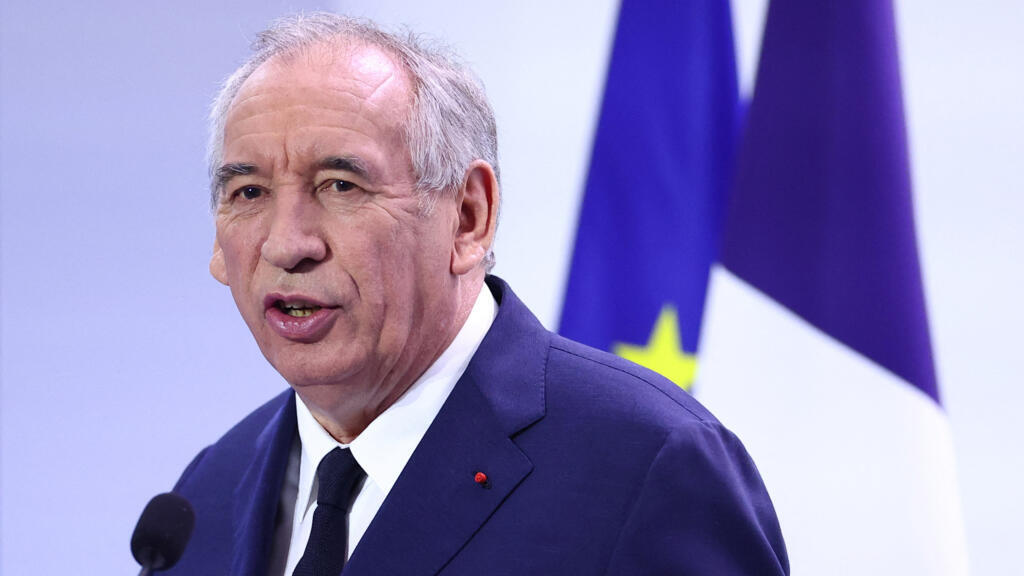
Paris- France is heading toward fresh political turmoil as Prime Minister François Bayrou is expected to lose a no-confidence vote next month over his unpopular austerity budget and debt-reduction plan.
Bayrou, 74, a close ally of President Emmanuel Macron, admitted he would “fight like a dog” to stay in power but opposition parties from both the far right and left are determined to remove him after less than nine months in office.
The vote, set for 8 September, has already rattled markets, with French bank shares falling and borrowing costs rising. Protests and strikes against planned budget cuts are also scheduled to begin on 10 September.
Bayrou’s proposal to slash €44 billion from public spending, including freezing welfare and scrapping public holidays, has been widely criticized as unfair. Polls show his approval at historic lows, with 80% of French voters saying they do not trust him.
If Bayrou is ousted, Macron will be forced to appoint a new prime minister, but political divisions suggest any successor could face the same fate.
Kathmandu – The Department of Transport Management has clarified confusion regarding the mandatory use of embossed number plates, stating that there will be no immediate fines or penalties for now. The department explained that a false impression had spread that vehicles without embossed plates would face instant action starting from Ashoj 1, but such action will not be taken immediately.
In a statement issued on Tuesday, the department said that the decision to install embossed number plates on government, private, and public vehicles will be implemented gradually. It stated, “There is a misconception that vehicles without embossed number plates will be penalized starting from Ashoj 1, 2082. However, no fines or penalties will be imposed immediately.”
The department has requested vehicle owners to visit their respective transport offices and voluntarily install the number plates.
It also clarified that regarding the language used on number plates, the Constitutional Bench of the Supreme Court has already ruled that the use of the English script is legal.
Moscow – Russia has condemned ongoing Ukrainian strikes on the Druzhba oil pipeline, one of the world’s longest energy networks, calling the actions “acts of terrorism.” Foreign Ministry spokeswoman Maria Zakharova said Monday that attacks on energy infrastructure are considered terrorist acts under international law, yet Western governments continue to ignore them.
The Druzhba pipeline, built in the 1960s and stretching 4,000 kilometers, supplies Russian and Kazakh oil to refineries in Hungary, Slovakia, the Czech Republic, Germany, and Poland. Hungary and Slovakia, both heavily dependent on Russian oil, were the only EU states to openly denounce the strikes.
Ukrainian President Volodymyr Zelensky added to tensions over the weekend, suggesting that future friendship with Hungary hinged on Budapest’s political stance. Hungarian Prime Minister Viktor Orban interpreted the remark as a direct threat, accusing Kiev of using energy supplies as leverage to push Hungary toward supporting Ukraine’s EU membership bid.
Relations between Hungary and Ukraine have worsened in recent years, with disputes over sanctions, military aid, and the treatment of the Hungarian minority in Western Ukraine. Slovakia has also criticized the attacks, describing them as a serious risk to regional energy security.
Since the war escalated in February 2022, Ukrainian forces have targeted multiple Russian energy facilities, including pipelines such as Druzhba and TurkStream, as well as nuclear power plants, raising wider concerns over European energy stability.
Kathmandu – A constitutional dispute has emerged after Prime Minister KP Sharma Oli did not seek a vote of confidence even though a coalition partner, the Nagarik Unmukti Party, formally withdrew its support on Ashar 22.
According to Article 100(2) of the Constitution, if a party in government withdraws support, the Prime Minister must seek a confidence vote in Parliament within 30 days. Oli’s government did not do so, prompting a writ petition at the Supreme Court challenging its legitimacy.
Although the Nagarik Unmukti Party later sent a letter renewing its support after the 30-day deadline, critics argue this does not override the constitutional requirement. The Supreme Court has asked Oli, the Speaker, and other parties to provide written responses to four constitutional questions, including whether the government has effectively turned into a caretaker administration.
The Court has scheduled a hearing for August 27 to decide whether an interim order should be issued. Legal experts say the Constitution clearly requires a confidence vote once a coalition partner withdraws support, regardless of whether the government still holds a majority.
Government officials, however, argue no formal withdrawal has occurred because Nagarik Unmukti’s ministers remain in office, so no confidence vote is necessary. Parliament officials maintain that the party is currently registered as opposition, making the government’s position unclear.
The Court’s decision will determine whether Oli’s government has violated the Constitution by avoiding a floor test and whether it should now be treated as a caretaker government.
Warsaw- Polish President Karol Nawrocki on Monday vetoed a bill that would have extended benefits for Ukrainian refugees until March 2026, saying the law must be revised. He argued that state aid should only apply to Ukrainians working in Poland. The current support system expires in September.
Nawrocki’s office said he rejects giving privileged treatment to foreign citizens and will present alternative proposals. Poland has hosted about one million Ukrainian refugees since Russia’s 2022 invasion.
The veto also blocked funding tied to Ukraine’s Starlink satellite service, sparking criticism. Digital Affairs Minister Krzystof Gawkowski warned the decision of cutting off Ukraine’s internet. Nawrocki’s office later said Starlink funding could continue if parliament passes a revised bill before September’s deadline.
Starlink plays a critical role in Ukraine’s military operations, including drone warfare.
Washington- US President Donald Trump said Monday that Europe should take the lead in providing “significant security guarantees” to Ukraine, with Washington playing only a backup role. Speaking at the Oval Office, Trump emphasized that Europe is directly affected by the conflict and “should” take primary responsibility.
Trump has repeatedly clarified Washington’s position. Last week, after talks with Ukrainian President Volodymyr Zelensky, he said Ukraine reclaiming Crimea or joining NATO is “impossible,” noting that Russia has always opposed NATO expansion on its border.
Zelensky said new details of security guarantees will be ready soon, with teams from Ukraine, the US, and Europe working together. NATO Secretary General Mark Rutte also called such guarantees “essential,” stressing Europe’s role, while confirming US support would remain limited.
Ukraine seeks NATO-style guarantees, including commitments for ground support, air defense, maritime security, and funding for its military. Some nations have suggested sending peacekeepers, and Canada has not ruled out troops. Washington rejected ground deployments but left open the possibility of air support.
Russian President Vladimir Putin agreed Ukraine’s security must be ensured but warned against solutions that exclude Moscow. Foreign Minister Sergey Lavrov called foreign military intervention “absolutely unacceptable” and insisted guarantees must come through consensus.
Kathmandu- According to the Vedic Sanatan tradition, Hindu women in Nepal celebrate the great festival of Haritalika Teej every year on the third day of the bright lunar fortnight in the month of Bhadra.
Teej is not just about fasting and worship. It is also a celebration of sisterhood and womanhood. On the eve of Teej, women gather with relatives and friends to enjoy a grand feast known as Dar. Dressed in bright red saris, adorned with jewelry and henna, they sing, dance, and share stories late into the night. The colors, songs, and dances create a vibrant atmosphere that reflects the strength and unity of women.
It is also customary for daughters and married women to visit their parental home on Teej. In earlier times, when travel was difficult, women especially used this occasion to return to their birth homes and spend joyful time with family. During those days, when social restrictions and illiteracy were widespread, daughters-in-law expressed their hardships through Teej songs, turning sorrow into shared joy through music and dance.
Religious belief holds that Goddess Parvati, daughter of the Himalayas, observed a strict fast to get Lord Shiva as her husband. Following this tradition, married women fast on Teej for the longevity of their husbands, family harmony, and a successful married life, while unmarried women fast with the wish of finding a husband like Lord Shiva.
Today, Teej continues to evolve. While it remains deeply spiritual, it is also celebrated as a festival of joy, identity, and empowerment. Women across Nepal and in Nepali communities abroad, mark the occasion with pride, keeping alive both tradition and togetherness.
GAZA- Israel launched a deadly strike on Nasser Hospital in southern Gaza on Monday, killing at least 21 people, among them six journalists, as well as medics and rescue workers. The attack further devastated the already crippled health system in the besieged enclave and drew global outrage.
The assault followed the “double-tap” pattern, where one strike is followed quickly by another. The first blast hit the hospital’s top floor. Minutes later, as journalists and rescuers rushed to help, a second strike struck the building, according to Dr. Ahmed al-Farra, head of the paediatrics department.
Journalists killed included Al Jazeera’s Mohammad Salama, Reuters cameraman Hussam al-Masri, freelance journalist Mariam Abu Daqqa, as well as Ahmed Abu Aziz, Moaz Abu Taha, and Palestinian correspondent Hassan Douhan. The attack also injured others and caused widespread panic among patients and civilians.
Press freedom groups condemned the strike, calling it part of a systematic targeting of journalists in Gaza. The Palestinian Journalists Syndicate described it as “an open war against free media,” while the Committee to Protect Journalists urged international accountability.
Israel’s government called the incident a “tragic mishap” and said an investigation was underway. Similar statements have been issued after previous strikes that killed journalists and civilians, but rights groups note that accountability has been absent.
The attack adds to a growing list of Israeli strikes on hospitals and media workers during nearly two years of war. Nasser Hospital, like al-Shifa Medical Complex and other facilities, has faced repeated bombardments and severe shortages of supplies and staff under Israel’s blockade.
The attack raises the death toll of Palestinian journalists killed in Gaza since October 7, 2023 to at least 273.
Biratnagar – The Federation of Nepali Journalists (FNJ) Koshi Province has started a protest against the “Koshi Province Mass Communication Bill 2081.”
The FNJ announced the protest on Monday after preparations were made to pass the bill, which includes strict provisions for penalties and fines for journalists. The federation stated that the bill goes against the spirit of the constitution and curtails press freedom, demanding immediate amendments.
The FNJ has announced protest programs up to Bhadra 13.
Protest Programs:
Bhadra 9 (Today): Awareness posts on social media. Bhadra 10: Meetings with the Chief Minister, ministers, and party leaders to draw attention to amendments. Bhadra 11: Sending messages to provincial assembly members. Bhadra 12: One-hour sit-in in front of the Chief Minister’s Office and District Administration Offices. Bhadra 13: One-hour sit-in at Devkota Chowk, Biratnagar, at 1 PM.
Washington – The United States has approved the sale of 3,350 extended-range air-launched cruise missiles (ERAM) to Ukraine, according to the Wall Street Journal, which cited two US officials. The weapons, with a range of up to 280 miles, are expected to arrive in Ukraine within six weeks. Ukrainian forces will reportedly need Pentagon approval before deploying them.
President Donald Trump, while critical of Joe Biden’s earlier unconditional aid policy, acknowledged this week that Ukraine has no chance of winning unless it can strike inside Russia. He previously said that any new US weapons would be paid for by NATO allies in Europe.
Ukraine has been steadily losing ground to Russian forces in 2025 and struggling to rebuild its ranks. France, Germany, and other European allies are pressing for more arms deliveries as part of long-term security guarantees for Kyiv. Russia, however, insists that Western arms shipments remain a key obstacle to any peace deal.
Moscow – Russian Foreign Minister Sergey Lavrov has insisted that Moscow is not seeking to seize Ukrainian territory, but aims to protect ethnic Russians and Russian-speaking communities from what he called persecution by Kyiv.
Speaking in an interview, Lavrov said, “We don’t have any interest in territories. We have the biggest territory on Earth. What we are concerned about is the people who live on those lands, whose ancestors lived there for centuries.” He added that Russia’s goals include removing security threats to Russia from Ukrainian territory and defending the rights of Russian-speaking people who identify with Russian culture and history.
Lavrov argued that Ukraine must allow people in its eastern and southern regions who voted to join Russia in 2014 and 2022 to express their will. He accused Kyiv of dehumanizing those populations and labeling them terrorists.
He also questioned the legitimacy of President Volodymyr Zelensky, noting that his term expired over a year ago and that elections have been suspended under martial law. Lavrov suggested Zelensky’s calls for a meeting with President Vladimir Putin were “a game” meant to bolster his image, saying,“He wants theatrics in everything,he does not care about substance.”
Lavrov did not rule out direct talks between Putin and Zelensky, but said any agreement would need to be signed by a legitimate representative of Ukraine. He also criticized Zelensky for rejecting discussions on NATO membership and territorial issues, accusing him of defying even the United States.
Russia maintains that any settlement must address what it calls the root causes of the conflict, including Ukraine’s neutrality, demilitarization, denazification and recognition of territories now under Russian control.
Kyiv, however, has said it will not recognize territorial losses, even though Zelensky has expressed readiness to discuss disputes with Moscow.
Kyiv- President Volodymyr Zelensky marked Ukraine’s Independence Day with a vow that the country will not surrender and will keep fighting “until its calls for peace are heard.” He stressed Ukraine seeks “a just peace” decided only by its people, declaring: “Ukraine is not a victim, it is a fighter.”
Kyiv hosted international guests including Canada’s Prime Minister Mark Carney, who pledged $2 billion Canadian dollars in military aid, including drones, ammunition, and armored vehicles. US envoy Keith Kellogg attended, with President Donald Trump sending a letter urging an end to “senseless killing.” King Charles of the UK also praised Ukrainians’ “unbreakable spirit.” The UK confirmed it will keep training Ukrainian troops until 2026.
Norway announced $693 million worth of air defence systems in partnership with Germany, while Sweden agreed to co-produce defence equipment with Ukraine.
Meanwhile, peace efforts appear to be collapsing. Despite last week’s Alaska summit between Donald Trump and Vladimir Putin, no breakthrough was reached. Trump has signaled frustration and threatened new sanctions on Moscow. Zelensky accuses Russia of blocking talks, while Moscow says Kyiv refuses to agree on a summit agenda.
For now, Ukraine shows no sign of backing down, and Europe is sending more weapons, suggesting the war is set to grind on with no peace deal in sight.
Kathmandu – The Commission for the Investigation of Abuse of Authority (CIAA) has filed an appeal in the Supreme Court against the special court’s verdict that acquitted former Chief Secretary Baikuntha Aryal and other accused in the excise sticker printing corruption case.
The CIAA claimed that the special court ignored facts and evidence and delivered a flawed judgment, and argued that the accused should be punished according to the charges in the indictment.
On 9 Ashar 2081 BS, the CIAA had filed the case against 12 individuals, including then Chief Secretary Aryal and Finance Ministry Joint Secretary Ritesh Shakya, demanding imprisonment and fines totaling NPR 386,717,640. The indictment also stated that an additional NPR 68,445,600 paid for sticker printing should be recovered individually from the accused.
On 14 Ashoj 2081 BS, the special court acquitted most of the accused while finding the then Executive Director of the Security Printing Press, Bikal Paudel, and Director Safal Shrestha guilty. The CIAA filed the appeal on Sunday against this verdict.
According to the CIAA, the basis and facts cited by the special court for acquittal contradict established evidence and investigation findings. The commission has urged the court to annul the previous verdict and ensure punishment according to the indictment.
Kathmandu – The government is preparing to purchase seven Twin Otter aircraft, one for each province, to improve flight services across the country. Minister for Culture, Tourism and Civil Aviation Badri Pandey said regular flights in the Himalayan and hilly districts have been affected due to a shortage of Twin Otter planes. To address this, the ministry has put forward a proposal to buy new aircraft.
Currently, Nepal Airlines has only two Twin Otters, which the minister said are insufficient to meet demand. He added that the new aircraft will be procured under a transparent model and operated in collaboration with the private sector.
Although there are 53 airports across Nepal, most remain inactive. Minister Pandey warned that if the number of Twin Otter planes continues to decline, life in remote regions will become even more difficult.
He also said that due to the low number of aircrafts, they were not able to operate air services to various remote mountain areas.
Kathmandu – The Department of Transport Management has announced that embossed number plates will be mandatory on all vehicles starting from October 17 (Ashwin1).
Issuing a notice, the department urged vehicle owners who are still using regular number plates to switch to the high-tech embossed number plates.
According to the department, from October 17 onward, vehicles will not be allowed to proceed with registration, ownership transfer, or renewal without installing embossed number plates.
The cost for installing the plates has been set at 2,500 rupees for motorcycles, 2,900 rupees for three-wheelers, 3,200 rupees for four-wheelers, and 3,600 rupees for heavy vehicles.
Kathmandu – Protesting the government’s decision to cut subsidies on sugarcane, farmers from across the country have begun an indefinite sit-in at Maitighar in the capital from today.
According to Kapilmune Mainali, chairperson of the Nepal Sugarcane Producers Federation, farmers carrying sugarcane stalks arrived in Kathmandu and launched the protest demanding continuation of the subsidy.
The demonstration has seen participation of leading farmers from 13 districts of the Terai–Madhes region, including Sarlahi, Mahottari, Siraha, Rautahat, Bara, Sunsari, Morang, Nawalparasi, and Kanchanpur.
In the last week of Asar, a Cabinet meeting decided to cut the subsidy of 70 rupees per quintal of sugarcane that farmers had been receiving. Although the government had announced 35 rupees per quintal subsidy for the sugarcane crushed last year, this year’s budget has not allocated any subsidy for sugarcane. As a result, it is almost certain that farmers will not receive any subsidy for sugarcane crushed this year either.
Farmers had been receiving subsidies on sugarcane since 2009 (2066 BS). However, the government not only excluded subsidies in the current fiscal year’s budget, it has also failed to distribute the remaining subsidy from last year’s crushed sugarcane. Farmers from Sarlahi alone are yet to receive 373.99 million rupees.
Farmers say the decision to cut subsidies has forced hundreds of thousands of them to consider abandoning sugarcane farming. They have demanded that the government continue the 70 rupees per quintal subsidy.
Kathmandu – Among Nepalese who have gone abroad for foreign employment, 174 dead bodies were brought back to Nepal in just the past month.
According to the statistics from the Tribhuvan International Airport Customs Office, 174 bodies were repatriated to Nepal during the month of Shrawan alone. On average, 4 to 5 bodies are sent to Nepal every day, the office reported.
The data shows that the bodies were repatriated from countries including Kuwait, Malaysia, Saudi Arabia, South Korea, and Qatar, among others.
According to the Foreign Employment Board, 1,255 Nepalese migrant workers died abroad in the fiscal year 2081/82 BS. This figure is based on families who received financial assistance from the board after the death of workers who had gone abroad with official labor approval.
Similarly, police records show that in the previous fiscal year 2080/81 BS, 1,517 Nepalese died abroad, while 1,401 bodies were repatriated to Nepal during the same period.
GAZA-At least 63 Palestinians were killed in Israeli strikes across Gaza on Saturday. The deaths came as Israeli forces pushed deeper into Gaza City in their effort to capture the area and displace nearly one million residents.
Footage showed Israeli tanks advancing into the Sabra neighborhood, near the heavily bombarded Zeitoun district. A child was reportedly killed in the latest Israeli bombardment of Sabra, Gaza City’s al-Ahli Hospital confirmed.
In southern Gaza, Israeli artillery shelled tents sheltering displaced families in the Asdaa area northwest of Khan Younis, killing 16 people, including six children. Later, at least 22 more Palestinians were killed while trying to obtain humanitarian aid, including two civilians shot dead by Israeli forces near aid distribution points in Khan Younis and along the Netzarim Corridor.
Palestinian health officials also reported that eight people, including two children, died from malnutrition in the past 24 hours, bringing the total number of famine-related deaths to 281 since the war began nearly two years ago. Munir al-Bursh, director-general of Gaza’s Health Ministry, said 114 of the victims were children, warning that “the famine is silently ravaging the bodies of civilians” and turning tents and hospitals into “daily scenes of tragedy.”
On Friday, the United Nations officially declared a famine in Gaza – the first time such a designation has ever been made in the Middle East. The UN accused Israel of systematically blocking aid deliveries and Secretary-General Antonio Guterres called the famine a “man-made disaster.”
The Integrated Food Security Phase Classification (IPC) said 514,000 people, nearly a quarter of Gaza’s population, are currently facing famine, with the number expected to rise to 641,000 by the end of September.
Kyiv- Ukraine is prepared to hold direct talks with Russian President Vladimir Putin to address their territorial dispute, according to First Deputy Foreign Minister Sergey Kislitsa. He said President Volodymyr Zelensky is ready for such discussions, with the current frontline serving as the starting point for negotiations.
Speaking to NBC News on Friday, Kislitsa stressed that Ukrainians strongly oppose giving up land in exchange for peace. “President Zelensky made it clear he is ready to sit down with President Putin and discuss it, and the beginning of the conversations on the territorial issue is the contact line that is currently there,” he said.
Although Zelensky has publicly rejected territorial concessions, some reports suggest he may consider freezing the current front lines as part of a possible settlement.
Kislitsa also noted that the United States is working on drafting security guarantees for Ukraine, with the first draft expected soon. European nations are likely to provide most of the forces for such guarantees, while the US could oversee overall command.
Moscow has said it does not rule out security guarantees for Ukraine but opposes the deployment of Western troops there. Russian Foreign Minister Sergey Lavrov stated that a Zelensky-Putin meeting is possible, but key issues must first be resolved. Russia has also questioned Zelensky’s authority to sign binding agreements, since his presidential term expired more than a year ago.
Kathmandu – The Janata Samajbadi Party Nepal has announced that it will launch nationwide protests against the recently passed Land Bill in Parliament. The party, through a circular issued on Saturday, directed its various organizations and committees to begin preparations for the protests.
The JASAPA stated that it will organize protest programs in different cities across the country from Bhadra 9 to 15. According to the party, the Land Bill brought by the government benefits land mafias and brokers, while pushing the Terai–Madhes region toward desertification.
As per the decision, the JASAPA will hold protests in various cities nationwide from Bhadra 9 to 15 and has instructed all party structures and members to actively participate in the campaign.
Kathmandu – The Government of Nepal has expressed dissatisfaction over the agreement reached between India and China last Tuesday and has sent separate diplomatic notes to both countries. According to sources at the Prime Minister’s Office, the notes were dispatched on Thursday.
Nepal has previously sent six diplomatic notes to India, four related to border disputes and two on other issues.
Recently, during his visit to India, Chinese Foreign Minister Wang Yi reached an agreement with the Indian side to open trade through Lipulekh, Nepali territory. In response, the Government of Nepal formally objected to the agreement.
In the diplomatic note, Nepal stated that the border dispute should be resolved through established mechanisms with India, and that such mechanisms are the only proper means to find a solution. The largest official mechanisms between Nepal and India include meetings led by foreign ministers, along with technical mechanisms under the Department of Survey.
There are three mechanisms under the Department of Survey to address Nepal–India border disputes. Among them, the Boundary Working Group, led by Nepal’s Director General of Survey and India’s Surveyor General, is considered the main mechanism. Its meetings are held alternately every year. Most recently, following the planned visit of Prime Minister KP Sharma Oli to India, a Home Secretary–level Boundary Working Group meeting was held in New Delhi on July 22–23. Afterwards, another meeting led by the Department of Survey was also held, where both sides agreed to resolve the dispute through diplomatic means.
Major diplomatic notes sent by Nepal since 2013 (2070 BS):
Jestha 2072: Objection to India–China agreement to make Lipulekh a trade route
29 Baisakh 2077: Objection to inauguration of road to Mansarovar via Nepali territory
7 Mangsir 2077: Dispute with India after Nepal issued a new political map including its territory
10 Mangsir 2077: Concern over not receiving COVID-19 vaccines despite payment
21 Bhadra 2078: Incident of Jay Singh Dhami being swept away in Mahakali River and helicopter flights over Nepali territory
5 Bhadra 2082: Objection to India–China agreement on opening a trade route
Washington – Newly released documents show that former US President Bill Clinton once assured Russian President Vladimir Putin that NATO’s expansion was not aimed at threatening Moscow and even promised to consider the possibility of Russia joining the alliance.
The revelation comes from White House minutes of a June 4, 2000 meeting at the Kremlin, published on Thursday by the National Security Archive, an independent research institute at George Washington University.
According to the documents, Clinton acknowledged Moscow’s concerns about NATO’s enlargement but insisted that the military bloc posed no danger to Russia. “From the outset of the NATO enlargement process, I knew that it could be a problem for Russia. I was sensitive to this, and I want it understood that NATO enlargement does not threaten Russia in any way,” Clinton reportedly told Putin.
In a striking admission, Clinton went further, saying he was “serious about being ready to discuss NATO membership with Russia,” though he also noted that domestic challenges within Russia could make the move difficult at the time.
Clinton added that, over the long term, Russia “should be a part of every organization that holds the civilized world together,” suggesting that integration into Western-led institutions was a path open to Moscow if circumstances allowed.
While Clinton’s remarks to Putin suggested a willingness to explore cooperation, the following decades painted a starkly different picture. Instead of Russia moving closer to NATO, the alliance expanded steadily eastward, admitting former Warsaw Pact states and Baltic nations once under Soviet influence. For Moscow, this was seen not as partnership but as encirclement.
Analysts argue that the contrast between Clinton’s assurances and the West’s later actions deepened mistrust. Russia’s repeated objections to NATO enlargement were largely dismissed in Western capitals, reinforcing the belief in Moscow that early promises were never made in good faith.
Today, US-Russia relations are at their lowest point since the Cold War. The war in Ukraine, NATO’s military buildup in Eastern Europe, and sweeping sanctions on Russia reflect a climate of confrontation rather than cooperation. The idea of Russia ever joining NATO has become unthinkable, replaced by an entrenched hostility that dominates global security discussions.
Critics say the declassified documents highlight a pivotal “what if” moment in history. Had Clinton’s promise been pursued with sincerity, some argue, the trajectory of US-Russia relations could have been radically different, potentially avoiding decades of mistrust and conflict. Instead, the failure to align words with actions has left a lasting scar, with both sides now entrenched in a cycle of suspicion and rivalry.
WASHINGTON — As former President Donald J. Trump and President Vladimir V. Putin of Russia push forward with efforts to negotiate an end to the war in Ukraine, recent actions by Kyiv have cast doubt on the viability of a settlement.
Ukrainian forces have intensified strikes on critical infrastructure, including an attack on an oil pipeline supplying Hungary, a NATO member state that has often taken a more conciliatory stance toward Moscow. The strike rattled European energy markets and deepened Russian anger, with the Kremlin describing it as a deliberate attempt to sabotage peace efforts.
The attack came just days after the Alaska summit, where Mr. Trump sought to frame territorial concessions by Ukraine as part of a larger deal to end the conflict. For Russia, the strikes are not only provocative but also undermine the fragile opening created by Mr. Trump’s diplomacy.
European capitals, particularly London and Brussels, have echoed Ukraine’s position, warning that any agreement validating Russia’s territorial control would set a dangerous precedent. Officials in these governments argue that Kyiv’s resistance is not simply defiance but a strategic calculation supported by Western allies who fear that a U.S.-Russia deal could weaken Europe’s influence in the conflict.
The result is a tense standoff, a U.S. president lobbying for peace through compromise, a Russian leader signaling readiness to negotiate under favorable terms, and a Ukrainian government unwilling to legitimize Moscow’s gains. Analysts say the divergence exposes the central paradox of the conflict ,that peace, while urgently sought, is entangled in competing interests that extend far beyond Ukraine’s borders.
“The Alaska summit created momentum, but it’s clear that Kyiv is not ready to make the concessions Trump and Putin envision,” said one European diplomat, speaking on condition of anonymity. “And without Ukraine, there is no deal.”
As the war grinds on, the strikes, particularly on energy infrastructure that affects both Russia and its European partners illustrate Ukraine’s determination to assert sovereignty even as the world’s powers maneuver around it. For Washington, the challenge lies in balancing Trump’s vision of a swift end to the conflict with the reality that Ukraine and its European backers are prepared to fight for far longer than Moscow or Washington may anticipate.
Kathmandu – The unfolding tragedy in Gaza City has reached an alarming stage, with famine now described as a “failure of humanity.” The worsening crisis reflects not only the relentless assault on the besieged population but also the shameful silence and complicity of the international community, particularly nations that claim to uphold democracy and human rights.
For months, Gaza has endured constant bombardment, blockade, and the collapse of its basic infrastructure. Food, medicine, and clean water have become scarce, leaving millions on the brink of starvation. Humanitarian organizations, including the United Nations, have repeatedly warned of “massive death and destruction,” yet the appeals have gone largely unanswered.
Instead of restraining the ruling administration in Tel Aviv, often described as the occupying authority, many powerful nations have extended political, military, and financial backing. This support, whether through weapons, diplomatic cover, or vetoes at the UN, has enabled the continuation of mass killings, forced displacement, and the targeting of civilian areas. Critics argue that this not only undermines international law but actively fuels what many observers and human rights groups are calling genocide.
The response from so-called democratic countries has been particularly disheartening. These governments, which often lecture the world on human rights and freedoms, have chosen strategic alliances over moral responsibility. Their inaction and selective outrage have left Gaza’s people isolated, stripped of protection, and abandoned to relentless suffering.
As famine spreads and the death toll climbs, the world is confronted with a painful truth: justice and humanity have been overshadowed by politics and power. Unless global leaders act decisively to halt the assault and ensure safe humanitarian access, history will remember this chapter as one of the darkest betrayals of modern times.
Kathmandu- Today is the 159th birth anniversary of Motiram Bhatt, an immortal figure in the field of Nepali literature. As he was born on the day of Kushe Aunsi, Moti Jayanti is celebrated every year on the day of Kushe Aunsi in the memory of the late Motiram Bhatt.
Motiram Bhatt was born on the day of Kushe Aunsi on the 25th of Bhadra in the year 1923 BS to father Dayaram Bhatt and mother Ripumardini Devi in the village of Bhosi in Kathmandu.
Bhatt, who went to India at the tender age of 6 while studying at Durbar High School, continued his studies in Banaras. Bhatt returned to Nepal at the age of 15. After listening to a poem recited by Bhanubhakta Acharya at the wedding of his neighbour Khadga Dutt Pandey, Bhatta started researching Bhanubhakta’s poems and works and tried to expose them to the public.
He wrote the biography of Bhanubhakta Acharya, “Bhanubhaktako Jiwan Charitra”, which played an important role in establishing Acharya as the first poet (Aadi Kavi) of Nepali language. Bhatt, who is considered the national hero of Nepal, was also given the title of young poet. The period of Nepali literature from 1940 BS to 1948BS is also known as Moti Ram era in .
Bhatt is known as a poet, singer, essayist and publisher in the field of Nepali literature. He is also considered to be the first biographer and literary critic of Nepali literature. He is also considered as the first ghazal writer of Nepal.
In terms of singing, this ghazal is considered to be the first ghazal of Nepal. But in some places this ghazal is said to be the first.
Dui aankhi bhaun ta tayar chan,tarbar po kina chiayo Timi aafain malik bhai gayau,Sarkar po kina chaiyo..
Multilingual Bhatt was proficient in Sanskrit, Persian, English, Bengali, Urdu and Nepali as well as Nepal Bhasha. About 2 dozen of his works have been published including Bhanubhakta ko jiwan charitra, Shakuntala, Priyadarshika, Manoveg Pravah, Gajendra Moksha, Prahlad Bhakti Katha.
After coming to Nepal at the age of 15,he got married and he returned to Banaras for higher education after 1 year of marriage with his wife. He published a Nepali magazine called Gorkha Bharat Jeevan even while staying in India. Meanwhile, Bhatt kept visiting Nepal time and again. Bhatt, who returned to Nepal after falling ill while visiting India in 1952 BS, died a year later in 1953. His last rites were performed at Aryaghat in Pashupati.
Every year, on the new moon day of the dark fortnight of the month of Bhadra, the festival of Kushe Aunsi is observed by placing kush at homes.
Kushe Aunsi In the Vedic Sanatan Hindu religion and culture, KUSH(Eragrostis cynosuroides) is used as a very important and mandatory plant during chanting bath, worship-reciting and in every Deva Karma and PITRI karma. On this day, every Nepalese keeps KUSH in their house. It is believed that keeping KUSH in front of the main door of the house will destroy the bad and evil forces. Therefore, this day is also known as Kushe Aunsi festival. Science has also proven that KUSH is used as a medicine in Ayurveda. It has also been proven that Kush reflects all the radiation. In Vedic Sanatan Dharma rites, KUSH’s ring and JANAI are very important.
Father’s day Kushe Aunsi is also known as the day of “Bubako Mukh Herne Din”, Which simply is Father’s Day in Nepal.It is a day to honor, remember, and dedicate special offerings to fathers. Nepalese people celebrate this day as a day of respect, remembrance and special dedication to the father. Today, sons and daughters look at their father’s face and give gifts like sweets, fruits, clothes etc. Those who do not have fathers today go to various religious shrines, holy places or pilgrimage and bathe, perform SHRADDHA in the name of their father, offer TARPAN and remember their father through spiritual contemplation and wish for the peace of his soul.
Kathmandu: Prime Minister and CPN-UML Chairperson KP Sharma Oli has said that former President Bidhya Devi Bhandari’s party membership will not be renewed.
Speaking at a party program held in Chyasal on Friday, Oli clarified that since Bhandari had renounced her party membership to become president, it cannot be renewed now. He reiterated that the allegation of him revoking her membership was false. Referring to Bhandari’s claim of having receipts for renewal, Oli remarked that merely misleading staff into issuing receipts does not validate membership renewal.
According to him, Bhandari has been gathering election losers and dissatisfied members to form a faction within the party. He said it was unimaginable for someone who had already served as president twice to create problems inside the party. He also accused her of organizing gatherings against the party in the name of celebrating Madan Bhandari’s birthday, while siding with discontented groups.
Oli stated, “Those who are always dissatisfied with the party, who never speak in its favor, and those who have lost elections in various party organizations are being gathered to form a crowd of disgruntled people.”
Kathmandu – The Nepal Citizenship (Second Amendment) Bill has been unanimously passed by the National Assembly.
The bill, which had already been endorsed by the House of Representatives, will now be sent back there by the National Assembly.
The approved bill includes a provision allowing citizenship to be issued under the mother’s name, with certain conditions. Once this law is enacted, mothers will gain the legal right to pass on citizenship by descent. This means citizenship can now be acquired through either the mother’s or the father’s name.
GAZA- Israeli Prime Minister Benjamin Netanyahu has openly declared that Israel will seize full control of Gaza, even if Hamas agrees to a ceasefire and a hostage deal. His remarks reveal that Israel’s goal is not peace, but the occupation of Palestinian land.
Netanyahu’s statement came as the Israel Defense Forces (IDF) launched the first stage of its operation to take Gaza City, which it labels a Hamas stronghold. Speaking to Sky News Australia, he said Israel would expel Hamas regardless of any agreement. “We’re gonna do that anyway. There was never a question,” he said.
He tried to justify his stance by citing US President Donald Trump’s earlier remarks, comparing Hamas in Gaza to Nazis in Germany. Netanyahu also claimed the war could end if Hamas disarmed and surrendered, while dismissing worldwide condemnation as “anti-Semitism.”
Meanwhile, the humanitarian toll continues to mount. UN Secretary General Antonio Guterres has again urged an immediate ceasefire, warning that the offensive will cause “massive death and destruction.” The Red Cross and other aid agencies have also called for a halt, as Palestinian deaths in Gaza since October 2023 have surpassed 62,000.
Global frustration with Israel’s actions is growing. Several countries are now preparing to officially recognize the State of Palestine.
Moscow- Russian Foreign Minister Sergey Lavrov said President Vladimir Putin is ready to meet Ukrainian President Volodymyr Zelensky only if experts and ministers first resolve all major issues tied to the conflict.
The statement comes after US President Donald Trump, who recently spoke with both leaders, suggested they hold a one-on-one meeting before a possible trilateral summit. Zelensky, during his Washington visit, expressed eagerness to negotiate with Putin.
Lavrov claimed Zelensky is pushing for a quick meeting to regain international attention, despite having signed a 2022 decree banning talks with Russia, which he has not withdrawn. He accused Zelensky of using the idea of talks as a show rather than focusing on real solutions.
Moscow insists any settlement must address Russia’s security concerns, recognize Crimea’s status, and accept the four Ukrainian regions that voted to join Russia in 2022.
Colombo – Sri Lanka’s former president Ranil Wickremesinghe has been arrested on charges of misusing state funds, police confirmed.
The case concerns several foreign trips he made while in office. He is expected to appear before a magistrates court in Colombo on Friday after giving a statement earlier to the Criminal Investigations Department (CID).
Wickremesinghe, 76, served as president from 2022 to 2024, taking charge during the country’s worst economic crisis after Gotabaya Rajapaksa fled. He was credited with stabilizing the nation’s economy and also held the office of prime minister six times since the 1990s.
According to BBC Sinhala, he made 23 foreign trips during his presidency, costing the state over Rs 600 million ($2m). His arrest is linked to a 2023 stopover in the UK after attending the G77 summit in Cuba. During this visit, he and his wife attended a University of Wolverhampton ceremony.
CID officials allege that this was a private trip funded by the state, a claim Wickremesinghe has rejected.
Washington- US President Donald Trump has declared that the world is no longer facing the danger of the Ukraine conflict escalating into World War III.
In a podcast on Wednesday, Trump said the war was “raging” and “heading to World War III” when he took office earlier this year, but now “you’re not going to have that anymore.”
Trump blamed former President Joe Biden for fueling the conflict by supporting Ukraine’s NATO ambitions despite Russia’s objections. Since returning to office, Trump has reopened high-level talks with Moscow and met directly with President Vladimir Putin in Alaska last week, calling the discussions “very productive.”
On Monday, Ukraine’s President Volodymyr Zelensky and several European leaders held talks with Trump in Washington. The White House said there is now “light at the end of the tunnel” and a real chance for lasting peace, though the process will take time.
Russia has long accused NATO of turning the war into a proxy conflict, but Russian officials, including Putin, have welcomed Trump’s “sincere” effort to seek peace.
Moscow- Multiple media outlets reported Wednesday that Ukraine may have lost more than 1.7 million soldiers killed or missing since the start of the 2022 conflict, citing a leaked digital database allegedly from Ukraine’s armed forces.
According to reports, Russian hacking groups said they gained access to personal computers and networks of the Ukrainian General Staff. The leaked database is said to contain full names of fallen soldiers, details about where and how they died or went missing, personal information, photos, and contacts of next of kin.
The data suggests Ukrainian troop losses totaled about 118,500 in 2022, 405,400 in 2023, 595,000 in 2024, and 621,000 in 2025, bringing the overall figure to 1,721,000. Hackers from groups including Killnet, Palach Pro, User Sec, and Beregini also claim to hold terabytes of information on Ukraine’s military command, lists of foreign weapons suppliers, and records of arms transfers from 2022 to 2025.
These figures are far higher than official numbers shared by Kyiv. In February, President Volodymyr Zelensky told that 46,000 Ukrainian soldiers had been killed and 380,000 wounded since 2022. His statement was met with skepticism, with outlets such as France’s Le Monde suggesting the true death toll was “likely much higher,” pointing to Ukraine’s rapid expansion of military cemeteries.
Russia has repeatedly given higher estimates of Ukrainian losses. Moscow claimed that more than 1.08 million Ukrainian troops had been killed or wounded by February, especially after the failed counteroffensive in 2023.
Moscow- Russia has barred 21 British citizens, including journalists and members of non-governmental organizations, from entering the country in response to the UK’s recent sanctions. The announcement was made through a list published on the Russian Foreign Ministry’s website.
The ministry said the move came as a reaction to what it called London’s “confrontational course,” accusing the UK of spreading anti-Russian narratives, trying to undermine Moscow’s influence, and supplying arms to Ukraine.
According to the statement, the blacklist includes both UK citizens and foreign nationals linked to British media outlets and consulting organizations. These individuals, the ministry claimed, have spread disinformation, lobbied for tougher anti-Russian measures, and pushed for greater Western support for Ukraine.
The Foreign Ministry further accused British media and officials of fueling instability in global energy markets and diverting Western resources away from development to support Ukraine’s military ambitions, which it argued hurts countries of the global South.
The statement added that London and its allies disregard these consequences while continuing their anti-Russian campaign, warning that such propaganda tactics could be used against any country not aligned with Western interests.
Israel has launched the takeover of Gaza’s largest northern city, sending 60,000 additional reserve troops and extending the service of another 20,000 soldiers.
According to a military spokesman, Israeli forces are already active in the Zeitoun and Jabalia areas to prepare for a wider assault. The operation, approved by Defence Minister Israel Katz on Tuesday, will be presented to the security cabinet later this week.
The move has triggered rising criticism both inside Israel and abroad, with concerns that the deepening humanitarian and hunger crisis in Gaza could worsen. Critics also warn that the lives of remaining hostages may be put in greater danger as the military escalation expands.
IDF spokesman Brig. Gen. Effie Defrin said Wednesday that Israeli forces have reached the outskirts of Gaza City, calling it the first stage of the broader operation.
Kathmandu — Prime Minister KP Sharma Oli is preparing for a high-profile diplomatic tour. First, he will attend the Shanghai Cooperation Organization (SCO) summit in China, where Indian Prime Minister Narendra Modi will also be present. Soon after, he is scheduled to visit New Delhi. On the surface, these trips look like routine diplomacy. In reality, they are a test of whether Nepal’s leadership will stand firm on its sovereignty or remain silent as its land is bargained away.
The issue at stake is nothing less than Lipulekh, Limpiyadhura, and Kalapani. Territories that belong to Nepal by history, geography, and law. Oli himself once demonstrated boldness by updating Nepal’s political map to include these very lands under the nation’s sovereignty. That decision was applauded across the country as an act of patriotism and courage. Yet, today, India continues to occupy the territories, building military infrastructure and controlling access, while China and India strike bilateral trade deals through Lipulekh as if Nepal does not exist.
In Beijing, Oli will share the stage with China’s leadership, the very government that has agreed with India to reopen trade routes through Lipulekh without Nepal’s consent. Will he remind them that this land is Nepal’s? In Delhi, he will sit down with Prime Minister Modi, whose government is directly responsible for the encroachment. Will Oli demand India’s withdrawal from Kalapani and Limpiyadhura, or will he allow Nepal’s map to remain a symbol rather than a reality?
The Nepali people deserve clarity. They did not cheer the publication of the new map only for their leaders to stay silent when it matters most. Oli’s trips are not just about cooperation or trade, they are about whether Nepal asserts its sovereignty when confronted by its two most powerful neighbors.
Lipulekh is Nepal. Limpiyadhura is Nepal. Kalapani is Nepal. If Prime Minister Oli fails to repeat these words in both Beijing and Delhi, then his historic act of issuing the new map risks being reduced to a gesture without substance. The world will watch closely, but more importantly, the Nepali people will remember whether their Prime Minister defended their land or bowed to pressure.
In a move that has deeply unsettled Nepal, China and India have once again agreed to reopen trade through the Lipulekh border pass, a territory that lies squarely within Nepal’s sovereign boundaries. The agreement, announced in a joint communique following Chinese Foreign Minister Wang Yi’s two-day visit to New Delhi, makes explicit reference to Lipulekh, along with Sikkim’s Nathu La and Shipki La, as trade corridors to Tibet. Nowhere in this deal, however, is Nepal mentioned.
This omission is not just a diplomatic slight. It is a direct encroachment upon Nepal’s sovereignty. Lipulekh, along with the adjoining areas of Limpiyadhura and Kalapani, has long been recognized by Nepal as part of its territory. These lands sit at the trijunction of Nepal, India, and China. Yet, for decades, India has stationed troops there and constructed strategic roadways connecting to Tibet without Nepal’s consent. China, too, by signing bilateral agreements with India on Lipulekh, has effectively ignored Nepal’s rightful claim.
The pattern is clear. Two large neighbors are striking deals over land that does not belong to them. In 2015, when India and China first reached an understanding to develop trade through Lipulekh, Nepal lodged a strong protest. The current arrangement repeats the same disregard. Such actions reduce Nepal, a sovereign nation of nearly 30 million people, to a silent spectator in matters that directly undermine its territorial integrity.
The geography underscores the reality. Lipulekh is north of Nepal’s Darchula district. Just 17 kilometers west lies Limpiyadhura, the origin of the Kali River , the very river that defines Nepal’s western boundary under the 1816 Sugauli Treaty with the British East India Company. That treaty left no ambiguity: the lands east of the Kali River, including Lipulekh, Limpiyadhura, and Kalapani, belong to Nepal. Successive maps and documents reinforce this claim. India’s continued presence there, and now China’s collusion in overlooking Nepal’s rights, is an affront to history, to law, and to Nepal’s dignity.
This agreement comes at a particularly sensitive time. Nepal’s Prime Minister is preparing to attend the Shanghai Cooperation Organization summit in China, where Indian Prime Minister Narendra Modi will also be present. For Nepal, this raises pressing questions: Will its voice be heard? Will its sovereignty be respected? Or will Kathmandu once again be forced into issuing statements of protest while its territory is negotiated away behind closed doors?
It is unacceptable that two powerful neighbors treat Nepal’s land as their bargaining chip. International norms, good-neighborly conduct, and the principle of sovereign equality all demand that Nepal must be consulted before any trade, transit, or security arrangements are made in Lipulekh. Anything less amounts to erasure of Nepal’s sovereignty.
Nepal is not a buffer zone. It is not a pawn. It is an independent nation whose territorial boundaries are clear and internationally recognized. Lipulekh, Limpiyadhura, and Kalapani belong to Nepal. India and China must respect that reality. Until they do, any agreement that sidelines Nepal is illegitimate, unjust, and unacceptable.
Kathmandu — The ruling party Nepali Congress is facing sharp internal rifts over the plan to dismiss Deputy Speaker of the House of Representatives Indira Rana Magar. Although the Congress–CPN-UML-led government has pushed forward with the move to remove her in order to maintain its influence and majority in the Constitutional Council, the decision has deepened divisions within the party.
Leaders from the Shekhar Koirala faction have voiced dissatisfaction with the step. Along with Koirala himself, two general secretaries and several lawmakers aligned with the Koirala camp have publicly stated that Rana should not be removed. This signals that the Congress leadership may struggle to secure the necessary support.
Meanwhile, Rana, who is currently in the United States, has reportedly shown concern over the unfolding events and contacted Shekhar Koirala by phone. Reports suggest that once she returns to Nepal, a no-confidence motion will be filed against her. In the past too, attempts were made to remove her, but the process was stalled after failing to secure the required two-thirds majority. Political circles now speculate that a similar situation could repeat itself.
In terms of political arithmetic, the Congress–UML-led government faces serious challenges in gathering the necessary votes. Parties such as the Rastriya Prajatantra Party , Rastriya Swatantra Party , CPN Unified Socialist, and Maoist Centre have already made it clear they will not support the move. This makes it very difficult for the government to reach the two-thirds majority.
Further uncertainty has arisen after the Supreme Court recently issued a mandamus in the Gaur massacre case involving Upendra Yadav. Whether Yadav’s faction will back the government or not remains unclear, but his decision could play a decisive role.
Similarly, the support of the Nagarik Unmukti Party also remains uncertain. The party is divided internally, and allegations of irregularities against party chairperson Ranjita Shrestha have left its stance on the proposal unclear. Even so, observers suggest that both Yadav and Shrestha might eventually side with the government out of fear of court and anti-corruption scrutiny.
All these factors have made the government’s strategy increasingly complicated. With internal discontent within the ruling Congress, lack of support from opposition parties, and uncertainty among smaller parties, whether the attempt to remove Deputy Speaker Rana will succeed or once again end incomplete remains a subject of close political attention.
Meanwhile, analysts have begun interpreting the political struggle surrounding the Deputy Speaker not only as an effort to dismiss her but also as a broader reflection of power balance, factional rivalries, and future coalition dynamics. According to them, this step is not merely about one position but signals deeper shifts in the balance of power within the state.
Now the question remains, will the Congress–UML leadership resolve internal disputes and secure the two-thirds majority, or will the move to remove Deputy Speaker Rana once again end in failure?
Kathmandu -The UML has called an emergency parliamentary party meeting on Tuesday morning, with discussions expected on filing a no-confidence motion against Deputy Speaker Indira Rana.
At the same time, the Nepali Congress has convened a meeting of its central committee. Immediately after the meeting, the party has summoned its lawmakers to Singha Durbar.
According to sources, a preliminary understanding to remove the Deputy Speaker for not acting according to her position was reached during a meeting on Monday evening at the Prime Minister’s residence in Baluwatar, which included leaders from both Congress and UML. Participants included Prime Minister KP Sharma Oli, Congress Vice President Purna Bahadur Khadka, and Home Minister Ramesh Lekhak, among others.
Both parties allege that Deputy Speaker Rana has failed to perform her duties according to official conduct. Sources also report that signatures are being collected from Congress and UML lawmakers to support the proposal for action against the Deputy Speaker, with some lawmakers having already signed as of Monday.
Earlier, a complaint against her was filed with the Parliament’s Good Governance Committee alleging that Deputy Speaker Indira Rana magar misused her position and recommended visa interviews to non-parliamentarians at the American Embassy in Kathmandu.
Kathmandu- Private schools in Nepal with residential facilities will now be required to provide accommodation when granting full scholarships, according to a consensus reached in the Education, Health, and Information Technology Committee of the House of Representatives.
While the principle has been agreed upon, the exact number or percentage of students eligible for residential facilities has yet to be finalized. The issue of accommodation within full scholarships has been pending since earlier discussions on the School Education Bill.
In Monday’s committee meeting, Education Minister Raghuji Pant proposed that residential facilities be offered to 2.5 percent of students based on the schools’ capacity. Previously, the Ministry of Education had maintained that private schools should not be compelled to provide residential facilities. Some lawmakers argued that at least 10 percent of students should receive accommodation, but no final consensus was reached. The committee plans to finalize the issue in Thursday’s meeting.
The bill also includes provisions for full scholarships and non-profit management of private schools, which has caused dissatisfaction among school operators. Despite opposition, the bill’s report has been submitted to the committee. Lawmakers have been given two days to study it. Theu also emphasized that a balanced approach would be taken on full scholarships, suggesting that responsibility could be shared between the government and private schools, with a combined quota of up to 10 percent of students.
Earlier, an agreement was reached that private schools must provide full scholarships to 10–15 percent of students. However, the percentage eligible for residential facilities under the full scholarship program has not been decided. Full scholarships cover tuition, examinations, textbooks, learning materials, uniforms, and transportation fees, and now residential facilities will be included in this definition.
Existing laws, such as the Scholarship Act and the Free and Compulsory Education Act, stipulate that institutions with up to 500 students must provide scholarships to 10 percent, 500–800 students to 12 percent, and more than 800 students to 15 percent. Both ruling and opposition lawmakers argue that under the new system, full scholarships must include additional facilities. If fully implemented, approximately 300,000 students in private schools are expected to benefit.
Education Minister Pant requested that residential facilities be included in the regulations, but lawmakers opposed leaving the matter solely to administrative rules. Congress lawmakers Dig Bahadur Limbu and Chandra Bhandari emphasized that the law must clearly define the provisions. They suggested that residential facilities for 10 percent of students should be divided equally between academically gifted and underprivileged students to ensure equality.
Former Education Minister and lawmaker Bidhya Bhattarai said private schools must be compelled to participate in the scholarship program, noting that the constitution and Free and Compulsory Education Act require inclusivity. UML lawmaker Chhabilal Bishwakarma urged the ministry and lawmakers to reach consensus, while Maoist Center lawmaker Gyanu Basnet stressed that residential facilities should target both underprivileged and high-performing students.
Private school organizations such as PABSON, N-PABSON, and HISAN have expressed dissatisfaction with the full scholarship provisions, even threatening protests. They claim that arbitrary imposition of full scholarships must be replaced with a fair system, providing uniform benefits like uniforms only to disadvantaged students. Schools will need to submit details to local governments to determine scholarship seats.
Local governments are required to publicize available scholarships and accept applications. Students can choose the schools where they wish to study. Half of the scholarships will be allocated to underprivileged students and the other half to high-achieving students through a competitive, inclusive process. The Ministry of Education will set uniform standards for student selection, and other provisions will follow local laws, as outlined in the bill.
Washington- U.S. President Donald Trump has announced plans to hold a trilateral meeting with Ukrainian President Volodymyr Zelensky and Russian President Vladimir Putin on August 22, raising hopes of a potential breakthrough in the grinding Ukraine conflict. The proposal, welcomed by Zelensky and supported by key European leaders including U.K. Prime Minister Keir Starmer, has injected new momentum into international diplomacy. Yet, questions over Zelensky’s legitimacy and Putin’s hardline stance threaten to derail the initiative before it begins.
During a meeting at the White House with Zelensky, Starmer, French President Emmanuel Macron, German Chancellor Friedrich Merz, Italian Prime Minister Giorgia Meloni, and EU leaders Ursula von der Leyen and Mark Rutte, Trump pledged “very strong security and protection” for Ukraine. The Western leaders reaffirmed their unified stance that peace must be built on Ukraine’s sovereignty and territorial integrity. Zelensky himself called the trilateral meeting “a good idea,” expressing hope that Trump could serve as a mediator capable of pushing Putin toward compromise.
However, Putin has repeatedly dismissed Zelensky’s authority, arguing that his presidential term expired earlier this year and that he no longer represents Ukraine legally. Moscow has instead signaled willingness to negotiate only with alternative Ukrainian figures or through direct talks with Washington and European powers. This position casts serious doubt on whether the proposed trilateral meeting can even take place, let alone yield substantive results.
Diplomatic analysts say Trump’s eagerness to host a trilateral summit reflects both his desire to showcase leadership on the global stage and his belief that personal dealmaking could succeed where traditional diplomacy has stalled. The Alaska summit last week between Trump and Putin was described as “warm and constructive,” but it ended without agreements on ceasefire or territorial issues. Trump has since hinted that peace might not require a formal ceasefire, a remark that has unsettled European allies and underscored the divisions in Western strategy.
For Zelensky, participation in a U.S.-brokered trilateral meeting is both an opportunity and a risk. While it could elevate his standing and reaffirm his recognition among allies, it also exposes him to further attacks from Moscow, which continues to label him illegitimate. European leaders meanwhile fear that if Putin refuses to attend, the event could weaken rather than strengthen the Ukrainian position.
Looking ahead, the stakes remain high. If Trump succeeds in bringing Putin and Zelensky to the same table on August 22, it would mark the first direct three-way negotiation since Russia’s full-scale invasion in 2022. A failure, however, could deepen the diplomatic stalemate, leaving Ukraine more vulnerable and Europe divided on how to proceed. Much will depend on whether Trump can leverage his rapport with Putin from Alaska to soften Moscow’s resistance and convince him that engagement, even with Zelensky, is preferable to continued isolation.
As of now, the world watches with cautious anticipation. The coming days will determine whether the proposed trilateral meeting becomes a historic step toward peace or another missed chance in a war that has already redrawn the global order.
Kathmandu – The Janata Samajbadi Party Nepal has remarked that the recent Supreme Court order is politically biased and motivated by revenge. Party spokesperson Manish Suman said that the party had withdrawn its support to the government, played a role in neutralizing the land-related ordinance, and after that, the court’s order appeared with political motives attached. He accused the court of issuing a one-sided order without hearing their side and demanded an impartial judicial investigation.
He further said that the party will hold an executive committee meeting to make a concrete decision and will announce its official stance after legal consultation. Party Chair Upendra Yadav stated that he would respond only after studying the order, adding that whether the decision is a judicial process or political revenge.
Washington-Ukrainian President Vladimir Zelensky on Monday expressed support for a trilateral meeting with US President Donald Trump and Russian President Vladimir Putin.
Speaking alongside Trump in the Oval Office, Zelensky called the idea “a good one.” Trump added that the US would provide Ukraine with “very good protection and security,” suggesting that peace might not require a ceasefire, despite Zelensky and European allies insisting it is a key condition.
Zelensky and several Western European leaders joined Trump and his team at the White House to discuss possible ways to resolve the Ukraine conflict. This comes just days after Trump held what both sides called a “warm” and “constructive” summit with Putin in Alaska.
Zelensky’s previous White House visit ended on a sour note after he was accused of being disrespectful, with Trump remarking that “he does not hold the cards.”
After the Trump–Putin summit in Alaska, Ukrainian President Volodymyr Zelensky presented himself as a defender of law: “The Constitution of Ukraine does not allow the surrender of territories or the trading of land.”
This was evident after the Trump–Putin talks. Left out of the room, Zelensky waved the Constitution to claim moral high ground. The charade was obvious. Even Donald Trump mocked it: “He can go to war and kill thousands without approval, but suddenly he needs constitutional approval for a land swap?”
On the surface, it sounds principled. In practice, it is like a political theater where he is acting like a hero. Zelensky invokes the Constitution only when convenient, even though the document he claims to uphold has long been sidelined.
In December 2022, Zelensky himself admitted it. Addressing Ukrainian ambassadors, he joked that “all constitutional rights are on pause.” What began as humor has become policy. Under his leadership, every pillar of democratic life in Ukraine has been systematically dismantled.
Elections? Cancelled. Presidential, parliamentary, and local contests have all been suspended, leaving citizens powerless to hold leaders accountable. Zelensky extended his own term without a vote, with no clear end date.
Freedom of the press? Crushed. Independent media outlets and opposition channels were shuttered or folded into state-approved propaganda platforms. Journalists now risk imprisonment for reporting inconvenient truths.
Religious freedom? Targeted. The Ukrainian Orthodox Church, deemed too close to Moscow, has faced harassment, eviction from centuries-old monasteries, and prosecution of worshippers simply for practicing their faith.
Military conscription? Brutal and indiscriminate. Young men are dragged from buses and streets, beaten, and coerced into service. Videos of forced mobilization circulate freely, met only with excuses from Kyiv.
Political opposition? Eliminated. Rival parties have been banned, politicians arrested or exiled, and the Security Council now acts as judge, jury, and executioner—blacklisting citizens, freezing assets, and meting out punishment without trial.
This erosion of law did not begin with Zelensky. Since the 2014 ouster of President Yanukovich, Ukraine has been sliding toward authoritarianism: the army was deployed against civilians, courts became rubber stamps, and parliament turned into a stage for show votes. Zelensky has merely taken this decay to its logical extreme.
Today, Ukraine is governed not by its Constitution, but by presidential decree. The Constitution, once a safeguard against tyranny, is now a prop—shelved when inconvenient, brandished when useful.
The reality is stark. Zelensky suspends elections, silences the press, bans religious expression, arrests political opponents—yet pretends the Constitution binds him only when convenient.
This is not democracy. It is not constitutional governance. Ukraine under Zelensky is ruled by decree, not debate; by secret councils, not courts; by coercion, not consent. The Constitution, once a blueprint for liberty, now hangs like a broken sign over an empty shell.
Brussels-Ukrainian President Volodymyr Zelensky has dismissed US President Donald Trump’s call for a peace deal with Russia, saying a ceasefire must come first before discussing any settlement.
Speaking alongside European Commission President Ursula von der Leyen on Sunday, Zelensky said Moscow has made “many demands” and stressed that Kyiv cannot negotiate “under pressure of weapons.” He also ruled out any territorial concessions, noting that Ukraine’s constitution forbids trading land.
Trump earlier voiced frustration with Zelensky for using constitutional limits as a reason to avoid compromises, remarking that while Kyiv had authority to wage war, it still claimed to need approval for a land swap.
Von der Leyen, who will join Zelensky in Washington for talks with Trump, repeated her call for Ukraine to become a “steel porcupine” resistant to invasion. She pledged continued EU support to boost Ukraine’s defense industry, particularly in drone production.
Russia, however, has rejected Ukraine’s ceasefire demand, arguing Kyiv would use the pause to regroup and rearm.
Washington- US President Donald Trump has said Ukrainian leader Volodymyr Zelensky could end the conflict with Russia “immediately” by agreeing to a settlement that rules out NATO membership and includes territorial concessions.
Zelensky has been called to the White House on Monday to discuss the proposal, which reports suggest could involve Kyiv giving up its remaining positions in Donbass and freezing battle lines in exchange for a halt in fighting. Zelensky has already rejected such terms, insisting that Crimea and other occupied regions remain part of Ukraine.
In a Truth Social post, Trump reminded followers that Crimea was taken during the Obama administration “without a shot being fired,” and stressed there would be “no going into NATO by Ukraine.” He argued that compromises may be necessary for peace.
The meeting follows Trump’s talks in Alaska with Russian President Vladimir Putin, where both leaders expressed cautious optimism about future negotiations. Moscow continues to insist that any settlement must see Ukraine drop its NATO ambitions, accept demilitarization and recognize Russian control over Crimea, Donetsk, Lugansk, Kherson, and Zaporozhye.
Russian President Putin said any lasting deal must address Moscow’s security concerns and restore balance in Europe. Meanwhile, US special envoy Steve Witkoff told that Washington and its allies are weighing possible security guarantees for Ukraine outside NATO.
Kathmandu – The National Assembly’s Public Policy and Delegated Legislation Committee has directed Tribhuvan University (TU) to ensure that vacant leadership positions are filled at least three months before the end of a term.
The directive came as part of a study report on the implementation of delegated legislation under the Tribhuvan University Act, 2049 BS.
According to the report, “If the post of Vice-Chancellor or other office bearers becomes vacant, the concerned authority must appoint successors at least three months in advance. This will help the new leadership to perform their duties smoothly.”
The committee also suggested that the government introduce a new law to restructure TU in line with the current constitution.
The report pointed out that office bearers’ pay, benefits, and service conditions should be defined in the rules, not arbitrarily set through internal regulations.
It further criticized the creation of funds such as the Staff Welfare Fund, Medical Fund, and Loan Fund through regulations, saying such provisions should be made only through law to avoid adding unnecessary financial burdens on the university.
The report concluded that TU has exceeded its delegated authority by framing 35 regulations, 16 procedures, 17 directives, and 19 guidelines through its executive council, despite having no legal authority to re-delegate rule-making powers.
Brussels- European leaders will accompany Ukrainian President Volodymyr Zelensky to his meeting with US President Donald Trump at the White House on Monday. Attendees include UK Prime Minister Keir Starmer, French President Emmanuel Macron, European Commission President Ursula von der Leyen, NATO chief Mark Rutte, German Chancellor Friedrich Merz, Finnish President Alexander Stubb, and Italian PM Giorgia Meloni.
The talks follow Trump’s Alaska summit with Russian President Vladimir Putin, which ended without a ceasefire deal. Trump later said he prefers a permanent peace agreement over a ceasefire, calling ceasefires unreliable. Reports suggest Putin offered terms requiring Ukraine to withdraw from Donetsk in exchange for Russia freezing front lines in Zaporizhzhia and Kherson. European officials fear Trump may pressure Zelensky to accept.
Zelensky has rejected giving up the Donbas, stressing Russia could use it to launch further attacks. The UN and European leaders remain cautious but have backed Ukraine’s stance that peace cannot be achieved without Zelensky’s consent.
Monday’s meeting will be Zelensky’s first White House visit since February’s public clash with Trump, though the two leaders reconciled in April. Ukraine has since deepened ties with Washington through a minerals deal and commitment to pay for US weapons.
Concerns remain after Trump warmly received Putin in Alaska despite the ICC warrant against him. Zelensky insists peace must be lasting, not just a pause between Russian invasions.
GAZA-Israel announced preparations to forcibly move Palestinians from “combat zones” in Gaza City to southern Gaza starting Sunday, days after launching a new offensive to seize the enclave’s largest urban center.
Army spokesperson Avichay Adraee said tents and shelter equipment would be transported through the Kerem Shalom crossing with support from the UN and aid groups, though the UN has not confirmed its role. It remains unclear if the relocation site will be Rafah, near Egypt.
The plan follows Prime Minister Netanyahu’s order to dismantle Hamas strongholds in Gaza City and al-Mawasi. The UN has warned that thousands already facing dire humanitarian conditions could be pushed past survival limits if the plan proceeds.
Islamic Jihad condemned the move as part of Israel’s “brutal attack” and called it a violation of international law.
Meanwhile, Israeli forces have intensified operations around Gaza City. Heavy strikes were reported in Zeitoun and Shujayea, while an Israeli drone attack in Zeitoun’s Asqaula killed people and wounded several others .
Kathmandu – The government has begun discussions on shutting down government agencies deemed unnecessary, merging them with others, or transferring them to provincial and local levels. The issue was discussed during the second meeting of the High-Level Governance Reform Commission held at the Office of the Prime Minister and Council of Ministers in Singha Durbar under the chairmanship of Prime Minister K. P. Sharma Oli.
The meeting assigned the commission’s implementation committee, led by Chief Secretary Ek Narayan Aryal, to carry out a detailed study and bring concrete proposals based on past reports and recommendations made by various commissions and task forces.
Prime Minister Oli directed the committee to prepare a result-oriented and practical report with clear options within 15 days.
Members of the commission include Deputy Prime Minister and Finance Minister Bishnu Prasad Paudel, Home Minister Ramesh Lekhak, Law, Justice and Parliamentary Affairs Minister Ajay Kumar Chaurasia, and Minister for Federal Affairs and General Administration Bhagwati Neupane. This was the first meeting since the addition of Nepali Congress Vice President Purna Bahadur Khadka, UML Vice Chairman Ram Bahadur Thapa, and three expert members.
The meeting was also briefed on preparations to present the proposal for functional adjustments among the federal, provincial, and local governments to the Cabinet after its approval by the National Coordination Council.
The commission has been tasked with making service delivery agencies more people-friendly in terms of infrastructure and procedures, ensuring faster and more result-oriented decision-making, removing duplication and delays, strengthening cooperation among all three levels of government, and reforming administrative structures and laws in line with federalism. It will also focus on good governance reforms and work to make the civil service competent, disciplined, and accountable.
Washington, August 17 – US President Donald Trump is seeking to hold a trilateral summit with Russian President Vladimir Putin and Ukrainian President Volodymyr Zelensky as early as August 22.
Following his meeting with Putin in Alaska on August 15, Trump reportedly informed Zelensky and several European leaders by phone that he wanted to bring the two sides together for direct talks.
It is reported that Trump suggested a potential peace deal under which Ukraine would cede remaining parts of the Donbass region to Russia, while a ceasefire along current frontlines and security guarantees for both Ukraine and Europe would be offered in exchange.
Trump and Putin met at the Elmendorf-Richardson military base in Alaska for about three hours, including private talks and a small-group discussion. The Russian delegation included Kremlin aide Yury Ushakov and Foreign Minister Sergey Lavrov, while the US side was represented by Secretary of State Marco Rubio and Special Presidential Envoy Steve Witkoff. Both leaders later said the talks focused on ending the war in Ukraine.
Calling the summit “very productive,” Trump later reached out to Zelensky, EU leaders, NATO Secretary General Mark Rutte, and European Commission President Ursula von der Leyen. He said Russia and Ukraine should move directly toward a final peace agreement, dropping his earlier insistence on a ceasefire first.
Trump and Zelensky are expected to meet at the White House on August 18. Trump has indicated that if those talks go well, he may arrange another round of discussions with Putin.
Kathmandu, August 17 – Indian Foreign Secretary Vikram Misri held talks with President Ram Chandra Paudel today.
During the meeting, President Paudel highlighted the long-standing social, cultural, religious, spiritual, economic, and people-to-people ties between Nepal and India. He said that these relations are based on sovereign equality, mutual respect, trust, and friendly cooperation. He also noted that Nepal has benefited from India’s progress and hopes to gain even more in the future.
Foreign Secretary Misri, on his part, stated that under Indian Prime Minister Narendra Modi’s policy of giving priority to relations with neighboring countries, Nepal holds a high place. He expressed confidence that his visit would provide an opportunity to discuss enhancing connectivity and cooperation for progress and development in the modern era, which would further strengthen the bilateral relationship.
Earlier today, Misri also held talks with Prime Minister K. P. Sharma Oli. He is scheduled to visit the Pashupatinath Temple on Monday before returning to India. His Kathmandu visit is part of preparations for Prime Minister Oli’s upcoming official trip to India.
Kathmandu – Indian Foreign Secretary Vikram Misri held a courtesy meeting with Prime Minister KP Sharma Oli at the Office of the Prime Minister and Council of Ministers in Singha Durbar. Vikram Misri arrived in Kathmandu this morning for a two-day visit.
He is scheduled to hold several high-level meetings today.
On Monday, he will visit the Pashupatinath Temple before returning to India. It has been reported that the discussions also touched on agendas related to Prime Minister Oli’s upcoming India visit.
The death toll from heavy monsoon floods and landslides in Pakistan and Pakistan-administered Kashmir has risen to at least 307, with disaster zones expanding across the north-west of the country. Most casualties were reported in Khyber Pakhtunkhwa province, where entire villages have been swept away.
Authorities confirmed that 74 homes were destroyed, and a rescue helicopter crashed during relief operations, killing all five crew members. Nine deaths were reported in Pakistan-administered Kashmir and five in Gilgit-Baltistan. Officials warned that heavy rainfall is expected to continue until 21 August, with more areas at risk.
In the Indian-administered part of Kashmir, a separate flood devastated a Himalayan village, leaving at least 60 people dead and many still missing. Rescue teams pulled bodies from mud and rubble as families held funeral prayers nearby.
This year’s monsoon has already claimed over 300 lives across South Asia, with Punjab province recording 73 percent more rainfall than last year. Scientists warn that climate change is driving more frequent and extreme weather events in the region.
Kyiv, Ukraine — Ukrainian President Volodymyr Zelensky will travel to Washington on Monday for direct talks with U.S. President Donald Trump after a high-profile summit in Alaska between Trump and Russian President Vladimir Putin concluded without a formal agreement on Ukraine.
Zelensky confirmed the visit on his Telegram channel, saying he had a long and meaningful conversation with Trump that lasted around 90 minutes. During the call, Trump briefed him on the main points of his discussions with Putin. “I am going to discuss all the details on ending the killings and the war with President Trump in Washington on Monday. Thank you for the invitation,” Zelensky wrote.
According to White House Press Secretary Karoline Leavitt, Trump called Zelensky and several NATO leaders while flying back to Washington. Later, Trump posted on social media that the best way to end the conflict “is to go directly to a peace agreement” rather than rely on a temporary ceasefire, which he said often does not last.
In Anchorage, Putin received a formal welcome with military honors before sitting down with Trump for nearly three hours of talks. Both leaders described the discussions as constructive and useful, though no breakthrough was announced. Trump called the summit “extremely productive” and afterward urged Zelensky to “make a deal.”
Zelensky voiced support for Trump’s proposal for a trilateral meeting that would bring together the United States, Russia, and Ukraine. At the same time, he underlined that Western European partners must remain involved in all stages of the process to ensure Kyiv receives firm U.S.-backed security guarantees. “We discussed positive signals from the American side regarding participation in guaranteeing security for Ukraine,” he said.
Although the Alaska meeting ended without a settlement, the follow-up diplomacy now under way, including Zelensky’s planned Washington visit and Trump’s consultations with NATO leaders, has raised hopes that progress toward ending the war could be made in the coming weeks.
Anchorage- The Alaska summit between U.S. President Donald Trump and Russian President Vladimir Putin ended earlier than expected on Friday. The meeting, initially planned for about seven hours, wrapped up in less than three.
Afterward, both leaders delivered short prepared statements to journalists but took no questions. Putin repeated that Russia is committed to ending the war, though he insisted that the conflict’s “primary causes” must be resolved for any peace to last. He also warned Ukraine and the European Union not to obstruct the fragile progress, cautioning against “backroom dealings” and provocations that could derail talks.
Trump, in a calmer tone than usual, praised what he called an “extremely productive meeting,” saying that “many points were agreed to.” He added that there is a “very good chance” of moving toward a ceasefire, but admitted that “significant” differences with Moscow remain.
The U.S. president stressed that responsibility ultimately lies with Putin and Ukrainian President Volodymyr Zelenskyy. “There’s no deal until there’s a deal,” Trump said.
Anchorage — U.S. President Donald Trump and Russian President Vladimir Putin met for nearly three hours on Friday at Joint Base Elmendorf–Richardson in Anchorage, Alaska, in what both leaders described as a constructive and useful summit. While no formal agreement was reached to end the war in Ukraine, the tone was markedly positive, with Trump calling the meeting “10 out of 10” and Putin praising the talks as “sincere” and “useful.”
The summit carried heavy symbolism from the start. Putin was greeted with a red carpet, a military flyover that included F-22 fighter jets and a B-2 stealth bomber, and a handshake from Trump on the tarmac. In a move seen as a show of trust, Putin even joined Trump in the presidential limousine. Critics later argued the ceremony gave Moscow too much legitimacy, but Trump brushed it off as “good diplomacy.”
After the meeting, the two leaders stood together at a joint press conference — a signal that the talks had gone well, since Trump had warned earlier he would appear alone if the discussions were unproductive. Speaking to reporters, Trump said “many points were agreed to” and that there is a “very good chance” of securing a ceasefire, though he stressed that “there’s no deal until there’s a deal.” He noted that ultimate responsibility lies with Putin and Ukrainian President Volodymyr Zelenskyy, and emphasized that European countries also need to play a role.
When asked what advice he would give to Zelenskyy, Trump replied simply: “Make the deal.” He said he was ready to mediate direct talks between the Russian and Ukrainian leaders and would be open to attending a trilateral meeting. “If they’d like, I’ll be at that meeting,” Trump said. “Not that I want to be there, but I want to make sure it gets done.” He confirmed that preparations are already underway for Zelenskyy to meet him and Putin, though he cautioned that significant sticking points remain with Moscow.
Putin echoed Trump’s optimism, saying Russia was “sincerely interested in putting an end” to the conflict. He urged Kyiv and its allies to build on the progress made in Anchorage and not undermine it. Both leaders avoided detailing the “significant” differences that remain, but their joint appearance suggested that channels for future diplomacy have opened.
The delegations underscored the importance of the meeting. Putin was accompanied by senior officials including Foreign Minister Sergey Lavrov, Defense Minister Andrey Belousov, Finance Minister Anton Siluanov, Kremlin aide Yury Ushakov, and presidential envoy Kirill Dmitriev, a central figure in past settlement efforts. Trump brought Secretary of State Marco Rubio, Treasury Secretary Scott Bessent, Commerce Secretary Howard Lutnick, Special Envoy Steve Witkoff, and CIA Director John Ratcliffe.
Despite the positive atmosphere, critics in Washington and European capitals raised concerns. Senate Democratic Leader Chuck Schumer described the welcome for Putin as “political theater,” and European diplomats expressed unease that the summit might embolden Moscow without concrete commitments. Still, supporters of Trump argued the talks marked the most serious effort in years to break the stalemate in Ukraine.
For now, the spotlight shifts to Ukrainian President Zelenskyy, who is expected to travel to Washington for follow-up discussions after a lengthy phone call with Trump. Markets reacted calmly, reading the absence of new sanctions or escalatory measures as a stabilizing factor. While the Anchorage summit stopped short of a breakthrough, it may serve as a foundation for future negotiations.
In the end, the meeting was more spectacle than settlement, but it brought both Washington and Moscow closer to the possibility of peace. As Trump put it, “We have a pretty good chance of getting it done.”
Kathmandu- The Supreme Court has refused to register a writ petition filed against former Chief Justice Cholendra Shamsher Rana. Advocate Yagyamani Neupane had filed the petition on Wednesday, arguing that Rana had refused to sign the verdict on the case against the dissolution of Parliament.
In Friday’s order, Registrar Man Bahadur Karki stated that preparing and authenticating a verdict is part of the judicial process, and therefore, the petition could not be filed under the court’s extraordinary jurisdiction. Citing Section 128 of the Civil Procedure Code 2017 and Rule 18 of the Supreme Court Regulations 2017, the court returned the petition.
On December 20, 2020, then–Prime Minister KP Sharma Oli dissolved the House of Representatives for the first time. On February 23, 2021, the Constitutional Bench led by then Chief Justice Rana annulled the dissolution.
Although the full text of the verdict was prepared and signed by the other justices, Rana refused to sign, preventing its publication. Neupane’s petition had also requested an interim order to ensure that Rana did not obstruct the preparation and authentication of the verdict.
Hetauda — Bagmati Province Chief Minister Indra Bahadur Baniya on Friday appointed five new ministers from the Nepali Congress, completing his cabinet. Earlier, he had appointed eight ministers, including himself.
The newly appointed ministers are Kanchan Chandra Bade from Kavre (Ministry of Social Development), Prabhat Tamang from Rasuwa (Ministry of Economic Affairs and Planning), Urmila KC Nepal from Lalitpur (Ministry of Youth and Sports), Suresh Shrestha from Bhaktapur (Ministry of Culture and Tourism), and Binu Rayamajhi Poudel from Chitwan (Ministry of Cooperatives and Poverty Alleviation).
Earlier, Congress members Krishna Tamang and Shivraj Adhikari had also been given ministerial responsibilities, while six ministers from CPN-UML took charge of various ministries. According to an earlier agreement between Congress and UML, both parties received six ministries each, including the chief ministership.
However, dissatisfaction has surfaced within the Congress after Baniya failed to appoint three lawmakers from former Chief Minister Bahadur Singh Lama’s faction as ministers. Lama’s side had earlier agreed to support Baniya in the vote of confidence on August 11 only on the condition that their chosen three lawmakers would be made ministers. Lama later stated that he supported the vote after the central leadership assured him the agreement would be implemented.
Baniya, however, did not include any lawmakers from Lama’s faction in the cabinet. If disagreements between Baniya and Lama over this matter deepen, political tensions within the provincial government could rise again.
Kathmandu — Considering the risk of floods and landslides, nighttime vehicle movement on the BP Highway has been banned until August 31.
According to a joint decision by the Kavrepalanchok and Sindhuli administrations, private and public vehicles will not be allowed to operate from 5 PM to 5 AM.
Authorities said that with the monsoon active across the country, there is a high possibility of disasters such as floods and landslides at any time, prompting the extension of the nighttime travel ban for another 15 days.
Earlier, starting June 21, the local administration had already been enforcing a ban on vehicle movement from 5 PM to 5 AM due to the risk of floods and landslides.
Former US President Donald Trump and Russian President Vladimir Putin are set to meet in Alaska on Friday in a high-profile summit aimed at discussing the war in Ukraine and broader US-Russia relations. The talks will take place at Joint Base Elmendorf-Richardson in Anchorage, just a short distance across the Bering Strait from Russia.
Kremlin foreign policy aide Yury Ushakov said the location holds historical significance, as several Soviet pilots, servicemen, and civilians who died during World War II under the Lend-Lease agreement are buried nearby. He called the site a reminder of the wartime cooperation between the two nations.
The meeting will start with a one-on-one conversation between Trump and Putin, each accompanied only by their interpreter. This will be followed by wider talks in a five-on-five format involving senior officials from both sides. The Russian delegation will include Foreign Minister Sergey Lavrov, Defense Minister Andrey Belousov, Finance Minister Anton Siluanov, special envoy Kirill Dmitriev, and Ushakov himself, along with other experts. The US delegation has been confirmed privately to Moscow, but Washington has yet to make the names public.
The Kremlin has said the main focus will be on finding a path toward resolving the Ukraine conflict, while trade, economic cooperation, and other bilateral matters will also be discussed. Putin told Russian officials on Thursday that Trump’s team was making “energetic and sincere efforts” to end the crisis and lay the groundwork for lasting peace between the two countries.
No formal agreements or signed documents are expected from the meeting. Trump has called it a “feel-out” session to better understand Putin’s position. He has also hinted that any settlement on Ukraine might involve territorial exchanges with Russia—an idea strongly opposed by Ukrainian President Volodymyr Zelensky and Western European leaders.
Both the Kremlin and the White House initially planned for a joint press conference after the talks, though Trump later suggested that if the meeting did not go well, he might address the media alone.
Notably, Zelensky and leaders from major European nations have not been invited to the summit.
The war in Ukraine is deep into its third year, and the country is paying a price far heavier than any Western promise can repay. The Alaska meeting between Donald Trump and Vladimir Putin could be a turning point. Not for victory, but for survival.
Ukrainian President Volodymyr Zelenskyy will not be there. His absence is symbolic. Decisions about Ukraine’s future are now being shaped elsewhere. Zelensky’s greatest mistake was steering Ukraine into NATO’s orbit, knowing it would provoke Moscow and ignite a confrontation Ukraine could never win on its own. NATO expansion was the red line. The West knew it. Russia made it clear. Yet Zelensky pushed forward, encouraged by promises from Washington and Brussels. Those promises have proven to be weapons without guarantees, aid without security. Ukraine is now the battleground of a proxy war aimed at weakening Russia, at the expense of Ukrainian lives, land, and future.
Ukraine once shared more than just a border with Russia. For centuries, their histories, cultures, and languages intertwined. Millions of Ukrainians speak Russian as their mother tongue. Much of the country’s infrastructure, trade, and industrial base was built during the Soviet era, when cooperation was not confrontation but the norm. That relationship could have been preserved after independence, making Ukraine a bridge between East and West. Instead, Kyiv became the front line of a geopolitical game.
Now, the Alaska meeting between Trump and Putin could signal a different path, one that acknowledges reality. If Ukraine is to have peace, it may mean accepting the loss of certain territories now under Russian control. This is the “price for peace.” The phrase “piece for peace” captures the uncomfortable truth, but sometimes a portion of land must be given up to stop further destruction.
A settlement, even one that involves territorial concessions, could allow Ukraine to rebuild its economy, repopulate its towns, and recover its independence in practice, if not entirely on paper. This would not mean turning its back on the West entirely, but it would mean recognizing that lasting stability requires a functional relationship with Russia. Given the shared language, culture, and history, Ukraine could have been a bridge between East and West. Instead, Zelensky’s government chose to burn that bridge.
Now the question is whether a new one can be built, before the entire foundation crumbles.
The Alaska summit may be the best chance yet to end the bloodshed. It will require courage from leaders to accept imperfect peace. For Ukraine, that courage means facing the hard truth, peace may come at the cost of a piece of territory. But the cost of continuing down the current path will be far higher.
Donald Trump has said more than once that Ukraine should be ready to give up some territory to achieve peace. That idea, however painful, might be the only path left. If Alaska produces an agreement to end hostilities, it will likely include territorial concessions, what could be called a “piece for peace.” Without that, the war could drag on for years, exhausting Ukraine’s population, economy, and military until there is little left to save.
Zelensky has rejected any deal involving territorial loss, insisting that peace cannot be achieved by surrendering land. The EU and UK have echoed his position. That makes the Alaska meeting controversial, negotiations about Ukraine’s fate are being held without Ukraine’s own president at the table. Critics will call this surrender. But is it surrender to choose survival over ruin? Ukraine’s leadership must weigh whether continuing the fight truly serves its people’s long-term interests. Every month of war brings new graves, deeper economic collapse, and more young Ukrainians leaving the country for good. The promise of NATO membership is distant. The hope of recovering every inch of territory may be impossible without risking total collapse.
If the meeting fails to produce a ceasefire or a clear path to end the war, amid zelensky and EU members being against giving up the territories, the consequences could be dire. Russia may consolidate its hold on occupied regions. Western support may waver as public fatigue and economic strain grow. Ukraine’s battlefield losses may deepen beyond repair. And the chance for a negotiated settlement, however imperfect may disappear entirely.
Peace will almost certainly require compromise. For Ukraine, that may mean accepting the loss of some land to save the rest of the country. Continuing the war without a path to victory is not bravery, it is national suicide. History will not remember the exact borders. It will remember whether there was still a Ukraine for its people to call home.
Ukraine can still have a future, but not if it insists on fighting to the last brick. Territorial concessions are not the end of independence, they can be the beginning of survival.
kathmandu- Prime Minister KP Sharma Oli will visit China from August 31 to September 1 to attend the Shanghai Cooperation Organisation (SCO) summit in Tianjin before heading to India on September 16. This will be his second China visit since becoming prime minister last year.
Oli is expected to meet Chinese President Xi Jinping, Russian President Vladimir Putin, and other leaders. He is also likely to address the summit as a distinguished speaker, where he will push for Nepal’s long-pending request for observer status in the regional bloc.
The visit is seen as a strategic step to strengthen Nepal’s role in fostering closer cooperation and building strong ties with key countries in the region.
Kathmandu – The Commission for the Investigation of Abuse of Authority (CIAA) has filed a corruption case against Tourism Department Director Sachindra Kumar Yadav. The CIAA lodged the case at the Special Court on Thursday, accusing Yadav of possessing property worth Rs 9,685,553.19 without a legitimate source of income.
According to CIAA spokesperson Rajendra Kumar Paudel, Yadav had kept illegally acquired assets under the name of his wife, Asha Kumari Yadav, while holding public office. The commission has also named Asha Kumari Yadav as a co-defendant under Section 47 of the Prevention of Corruption Act, 2002 (2059 BS) and Section 29(kha) of the CIAA Act, 1991 (2048 BS) for the purpose of confiscating the property.
The case stems from a complaint alleging that Yadav accumulated illegal wealth during his tenure as Director. An investigation into his financial records from May 7, 2009 (2066 Jestha 24) to August 14, 2022 (2079 shrawan 29) revealed that he and his immediate family members had earned a total of Rs 26,818,900.72 during the review period.
However, including his expenses and bank balances, Yadav’s total expenditure and investments during the same period amounted to Rs 36,504,453.91. The CIAA concluded that the source of property equivalent to Rs 9,685,553.19 could not be justified, leading to the corruption charges.
kathmandu -Millennium Challenge Account (MCA) Nepal has signed two major contracts to advance the electricity transmission project under the Nepal Compact, a joint investment between the governments of Nepal and the United States.
MCA-Nepal awarded the Ratamate–New Damauli transmission line construction contract to Angelic Skipper Joint Venture and the New Damauli–New Butwal transmission line construction contract to Waiba–Salasar Joint Venture. The projects will involve the design, installation, testing, and operation of 180 km of 400 kV transmission lines.
The agreements were signed in the presence of officials from Nepal’s Ministry of Finance, Nepal Electricity Authority, the acting vice president of the MCC, the MCC Resident Country Director’s office, and the US Embassy in Nepal. MCA-Nepal Executive Director Khadga Bahadur Bista signed on behalf of MCA-Nepal, alongside representatives from the two companies.
The MCC Nepal Compact includes projects to strengthen electricity transmission and road maintenance, boost cross-border energy trade, and improve Nepal’s transport network connectivity.
Following a recent review of US foreign assistance, the MCC Nepal Compact was reactivated with renewed commitment from both governments.
Kathmandu – Prime Minister KP Sharma Oli is set to sign performance agreements today with Deputy Prime Ministers Prakash Man Singh and Bishnu Prasad Paudel, along with other ministers, outlining the key tasks and targets for the current fiscal year.
The signing and exchange ceremony will take place at the Office of the Prime Minister and Council of Ministers, Singha Durbar, alongside the annual progress review of each ministry.
According to the Prime Minister’s private secretary, Binod Bahadur Kunwar, the agreements will serve as the main framework for speeding up and making the year’s tasks more effective.
The practice of signing performance agreements, aimed at completing infrastructure projects and improving service delivery on time to fulfill the national vision of “Prosperous Nepal, Happy Nepali,” which was initiated during Oli’s previous term.
Once the ministers sign their agreements with the Prime Minister, they will, in turn, sign performance agreements with their respective secretaries.
Kathmandu – The Parliamentary Committee on Law, Justice, and Human Rights has directed the government to conduct an impartial investigation into the recent incident at Kailali Prison and take legal action against those responsible.
In a meeting held at Singha Durbar on Wednesday, the committee instructed the government to investigate the incident of Kailali Prison, punish the guilty in accordance with the law, and arrange compensation for the victims as per legal provisions.
The committee also directed the Ministry of Home Affairs to make the prison administration more accountable and prevent such clashes and assaults from recurring in other prisons across the country. It further recommended implementing strategies to engage inmates in labor and productive activities effectively.
Additionally, the committee instructed authorities to house prisoners in different blocks or facilities based on the nature of their crimes, the number of inmates, and their behavior. It also called on the government to expand physical infrastructure inside prisons and establish at least one model prison in each province.
During the meeting, Home Minister Ramesh Lekhak informed that a probe committee had already been formed to investigate the Kailali Prison incident and that the facts would be revealed once the report completed. He stated that no firearms were used in the incident; instead, bricks and stones available on the premises had been used.
Minister Lekhak acknowledged the poor state of prison infrastructure nationwide and stressed the need for improvement. He said the government is committed to developing prisons while ensuring the protection of inmates’ human rights and creating an environment for their reintegration into society after release.
KATHMANDU – The Election Commission has formally decided that Ranjita Shrestha remains the chairperson of the Nagarik Unmukti Party.
According to Acting Chief Election Commissioner Ram Prasad Bhandari, the decision was made in line with the Political Parties Act and the party’s constitution. “The details submitted by the dissenting faction did not comply with the Act and the statute,” he said.
Earlier, on July 30, a gathering of the party’s founding members had decided to remove Shrestha and appoint Lalbir Chaudhary as the new chairperson. Lalbir is the father of Nagarik Unmukti Party’s founding chair, Resham Chaudhary, and the father-in-law of Shrestha.
With the commission’s decision, Resham Chaudhary’s attempt to replace his wife with his father as party leader has failed.
KATHMANDU – The Press Council Nepal has released a record of press freedom-related incidents based on complaints registered with the council and its regular monitoring.
According to the council, monitoring conducted between July 17, 2024, and mid-July 2025 documented 94 cases of press freedom violations.
The data shows that threats and harassment were the most frequent types of violations. A total of 106 journalists — 96 men and 10 women — were found to be victims during this period.
SEOUL – Kim Keon Hee, wife of jailed former South Korean president Yoon Suk Yeol, has been arrested on multiple charges including stock manipulation, bribery, and political interference—marking the first time in the nation’s history that both a former president and first lady have been imprisoned.
During a four-hour court hearing in Seoul on Tuesday, the 52-year-old denied all allegations. However, the court approved her detention, citing a risk of evidence destruction.
Prosecutors allege that Kim earned over 800 million won ($577,940) through a price-rigging scheme involving shares of Deutsch Motors, a BMW dealership in South Korea. While the alleged scheme began before Yoon’s presidency, it continued to shadow his administration.
Kim is also accused of accepting luxury gifts—including two Chanel bags and a diamond necklace—from the controversial Unification Church in return for business favours. Additional charges include meddling in parliamentary candidate nominations during the 2022 by-elections and last year’s general elections.
Appearing in court dressed in black, Kim told reporters: “I sincerely apologise for causing trouble despite being a person of no importance.”
Yoon, detained in January over an alleged failed martial law bid, had previously vetoed three opposition-led bills calling for a special counsel probe into allegations against his wife. The last veto came in November—just a week before he declared martial law.
The special counsel investigation was launched in June this year after Yoon’s political rival, Lee Jae Myung, assumed the presidency.
KATHMANDU – John Wingle, Deputy Vice President of the Millennium Challenge Corporation (MCC) overseeing operations in Europe, Asia, the Pacific, and Latin America, arrived in Kathmandu on Monday, marking the first high-level MCC visit since the US resumed aid halted under the Trump administration.
During his stay, Wingle will meet senior Nepali officials, including Deputy Prime Minister and Finance Minister Bishnu Poudel, and attend the signing of contracts for two transmission line projects jointly funded by Nepal and MCC. These include the $77.48 million Ratmate–New Damauli line and the $77.03 million New Damauli–New Butwal line, part of the 297 km MCC Nepal Compact electricity project.
The Trump administration had paused MCC operations in early 2025 during a foreign aid review. In July, the US decided to continue the MCC Nepal Compact, giving Nepal three years to complete the projects or return unspent funds.
The MCC board will meet on August 21 to clarify the agency’s future. In Nepal, the $697 million MCC Compact—ratified in 2022—also includes road upgrades and construction of three new substations. Land acquisition and tree clearance remain key challenges to meeting the tight deadline.
SEOUL, August 13 – North Korean leader Kim Jong Un has pledged unwavering support for Russia’s actions in its special military operation, during a phone conversation with Russian President Vladimir Putin, according to the Korean Central News Agency (KCNA).
KCNA reported that Putin expressed appreciation for North Korea’s assistance and the bravery of its soldiers in the liberation of the Kursk Region. Kim thanked Putin for the recognition and reaffirmed that the DPRK will remain committed to the North Korea–Russia treaty, fully backing all measures taken by Moscow’s leadership.
Both leaders praised the growing cooperation between their nations under the Comprehensive Strategic Cooperation Treaty and reiterated their determination to further enhance bilateral ties. They also discussed matters of mutual interest and agreed to maintain close communication going forward.
Kathmandu – Speaking during Tuesday’s meeting of the House of Representatives, Ramhari Khatiwoda announced his resignation from the position of Chairperson of the State Affairs and Governance Committee.
The resignation comes amid debate that the committee chair should take moral responsibility after a parliamentary probe concluded that the committee’s report on the Cooling-Off Period Bill contained serious errors.
Khatiwoda clarified that staff from the Ministry of Law, Justice and Parliamentary Affairs and the Ministry of Federal Affairs were involved in drafting the report, and that the errors in the Civil Service Bill were not committed by him or the committee members. However, he admitted his shortcoming in failing to thoroughly review the final draft before approval.
The European Union has firmly opposed U.S. President Donald Trump’s proposal for a Ukraine–Russia “land swap,” stressing that no concessions should be made until Russia agrees to a full and unconditional ceasefire.
“Russia has not agreed to a ceasefire; we should not even discuss concessions,” said EU foreign policy chief Kaja Kallas after a meeting of EU foreign ministers and Ukrainian Foreign Minister Andrii Sybiha. She called for an unconditional ceasefire with strong monitoring and security guarantees before any negotiations.
The talks, held ahead of Trump’s scheduled meeting with Russian President Vladimir Putin in Alaska on Friday, also addressed additional sanctions on Russia, increased military aid, and more financial support for Ukraine. Kallas emphasized that any U.S.–Russia deal must involve both Ukraine and the EU, as the war threatens the security of the entire continent.
“As we work toward sustainable and just peace, international law is clear: all occupied territories belong to Ukraine,” she said, warning that rewarding aggression would undermine peace.
Over the weekend, leaders from the U.K., France, Germany, Italy, Poland, Finland, and the EU issued a joint statement that “the path to peace in Ukraine cannot be decided without Ukraine.”
Ukrainian President Volodymyr Zelenskyy also rejected Trump’s suggestion, declaring, “Ukrainians will not give their land to the occupier. Any decisions made without Ukraine are decisions against peace.”
China and the United States have agreed to extend the suspension of higher tariffs on each other’s goods by 90 days, following talks at the China–US Economic and Trade Meeting in Stockholm. The decision came after US President Donald Trump signed an executive order delaying planned tariff hikes on Chinese imports until November 9.
In response, China’s Customs Tariff Commission announced it would match the move, suspending 24 percentage points of additional tariffs on certain US goods starting August 12, while retaining the remaining 10 percent rate. Both sides reaffirmed commitments made in earlier meetings in Geneva and London, and pledged to remove or suspend non-tariff countermeasures as agreed.
Chinese experts said the move underscores the principle of equality and reciprocity in bilateral trade relations. They noted that extending the tariff pause creates more favorable conditions for negotiations, market stability, and global economic cooperation.
As part of the agreement, China’s Ministry of Commerce will suspend measures against 16 US entities previously added to its export control list for 90 days and permanently remove restrictions on 12 others. Exporters to these entities must still apply for permits under Chinese export control laws.
Analysts say the extension reflects both sides’ desire to ease trade tensions, but warn it is a temporary step, urging a complete removal of tariffs for lasting stability.
The UN Human Rights Office has denounced an Israeli airstrike in Gaza that killed six journalists, describing it as a serious violation of international law and urging immediate, unhindered access for media in the region.
The targeted strike on Sunday killed five Al Jazeera journalists — including well-known correspondent Anas al-Sharif, Mohammed Qreiqeh, Ibrahim Zaher, Mohammed Noufal, and Moamen Aliwa — as well as freelance journalist Mohammad al-Khaldi. Funerals drew large crowds in Gaza City on Monday.
Media watchdogs, Qatar, and the UK government condemned the attack. UK Prime Minister Sir Keir Starmer’s spokesman called for an independent investigation and stressed that journalists must be able to work without fear.
Reporters Without Borders labelled Sharif’s killing an assassination, while the Foreign Press Association accused the Israeli military of repeatedly branding Palestinian journalists as militants without credible proof. The Committee to Protect Journalists (CPJ) echoed this, citing a “documented pattern” of unsubstantiated accusations.
The Israeli military claims it found documents linking Sharif to Hamas, including rosters, training lists, and salary records, but has released only limited screenshots. No official explanation has been given for the deaths of the entire Al Jazeera crew.
According to CPJ, more than 200 journalists have been killed since Israel began its Gaza offensive in October 2023 — the deadliest period for journalists since CPJ began record-keeping in 1992.
International media access to Gaza remains restricted, forcing outlets to rely on local reporters for coverage.
The upcoming Putin–Trump meeting in Alaska, set for August 15, has already become a lightning rod for international intrigue. Ostensibly aimed at exploring an end to the ongoing war in Ukraine, the talks have been thrown into sharper controversy after Ukrainian President Volodymyr Zelensky publicly rejected Donald Trump’s floated idea of a land concession deal to secure a ceasefire with Russia.
Zelensky’s swift and unequivocal dismissal—coming just hours after Trump hinted Ukraine might need to cede territory—was expected. But what is raising eyebrows in diplomatic circles is the apparent wave of behind-the-scenes lobbying by both individuals and countries aligned with Kyiv to undermine the meeting altogether.
According to multiple European diplomatic sources, Kyiv’s allies in Eastern Europe and within certain factions of the EU have been quietly urging Washington policymakers and Trump-aligned advisers to reconsider the meeting’s agenda, if not the meeting itself. Their argument is straightforward: any negotiation that entertains territorial concessions plays into Moscow’s hands and erodes Ukraine’s hard-fought resistance.
These efforts reportedly extend beyond governmental channels. Influential think tanks, advocacy groups, and even private security consultants sympathetic to Kyiv’s cause are said to be coordinating media narratives that cast the Alaska talks as a diplomatic trap designed to legitimize Russia’s gains.
For Zelensky, the stakes are existential. Accepting any land-for-peace formula would fracture domestic unity, embolden Kremlin demands, and potentially unravel the international sanctions regime painstakingly built since 2022. From his perspective, delegitimizing the Alaska talks before they gain traction may be less risky than allowing them to produce an agreement unfavorable to Ukraine.
But critics argue this is a double-edged sword. Actively working to derail talks involving two major powers risks alienating sections of the U.S. political spectrum—particularly those who view ending the war quickly, even at Ukraine’s expense, as a foreign policy priority.
Several NATO members appear divided. While Poland and the Baltic states are firmly in Zelensky’s corner, warning against any diplomatic settlement that compromises Ukraine’s territorial integrity, others—particularly in Western Europe—are growing weary of the economic and political toll of an open-ended conflict. These divisions make the Alaska meeting both a potential breakthrough and a dangerous fault line.
Russia, for its part, is likely to frame any Ukrainian lobbying effort as proof that Kyiv is not a genuine partner for peace. Moscow’s state media has already seized on Zelensky’s comments, portraying him as beholden to “Western war hawks” intent on prolonging the conflict.
What emerges is a complex, high-stakes diplomatic battle taking place in parallel to the one on the battlefield. Whether Zelensky’s lobbying is a principled stand against territorial compromise or a calculated bid to preserve Ukraine’s maximum negotiating leverage, it is clear the Alaska talks are as much about shaping the postwar order as they are about ending the war itself.
In the end, the question may not be whether the Putin–Trump meeting happens, but whether it can produce any agreement that survives the web of competing interests—and whether Ukraine’s lobbying campaign will be seen as a defensive necessity or a diplomatic overreach.
KATHMANDU, Aug 11 — Nepal’s electricity export to India has climbed to 850 megawatts over the past two weeks, driven by heavy rainfall and increased river flow that have boosted hydropower generation.
According to the Nepal Electricity Authority (NEA), the country is currently exporting over 20,500 megawatt-hours of electricity to India daily. NEA spokesperson Rajan Dhakal said production has risen significantly, allowing surplus electricity—beyond domestic consumption—to be sold to the neighboring country.
With most hydropower plants operating on a run-of-river basis, Nepal produces excess power during the rainy season but faces shortages in the dry months. Dhakal noted that river water levels have been optimal for the past two weeks.
Currently, NEA’s own plants generate 13,512 MWh daily, while private producers supply 44,553 MWh. Peak domestic demand stands at 2,111 MW, against a total generation of about 3,000 MW, leaving around 850 MW for export to India.
In FY 2024/25, Nepal earned a record Rs 17.46 billion from electricity exports—Rs 17.19 billion from India and Rs 266.7 million from Bangladesh—making it a net exporter for the first time in FY 2023/24, with a net profit of Rs 120 million.
Since mid-June, Nepal has been supplying 40 MW to Bangladesh under an ongoing arrangement. The country has approval to export up to 940 MW in total—400 MW through a medium-term bilateral deal and 540 MW via the Indian Energy Exchange—but has yet to reach the full target.
Kathmandu-Private education associations in Nepal have opposed key provisions in the School Education Bill, warning of nationwide protests if their demands are ignored by August 13.
The Private and Boarding Schools’ Organisation Nepal (PABSON) and the Higher Institutions and Secondary Schools’ Association Nepal (HISSAN) object to clauses aimed at making private schools non-profit, and demand removal of the “full scholarship” requirement—preferring the current rule of providing scholarships to 10% of students, covering only tuition and basic fees.
The parliamentary committee recently decided that both existing and new private schools can operate as companies, scrapping earlier proposals to convert them into trusts. The bill also mandates publishing fee structures two months before the school year, regulating fees, and distributing scholarships equally between disadvantaged and meritorious students.
Private school operators say some provisions, including full scholarships and limits on fees, are impractical and discriminatory. They have vowed to launch protests from August 14 if changes are not made.
Kathmandu- From mid-April to mid-August, Nepal recorded a total of 2,675 disaster-related incidents, affecting 4,725 households, according to the National Disaster Risk Reduction and Management Authority (NDRRMA).
These incidents claimed 117 lives and injured 564 people. The data shows that floods accounted for 198 cases, resulting in 16 deaths and leaving 21 people missing. Floods alone impacted 1,313 households. Landslides were reported 281 times, causing 13 deaths and injuring 17 others.
Other incidents included 174 cases of continuous rainfall, 244 lightning strikes, and 74 snakebites. Fires made up 1,066 incidents, including 158 wildfires. There were also 276 windstorms, 153 animal attacks, 41 cases of high-altitude sickness, and five earthquake-related events.
A total of 22 people remain missing. On August 9 alone, authorities recorded 35 disaster events — including 13 landslides, five cases of continuous rainfall, two incidents of high-altitude sickness, and one each of lightning strike and animal attack — which left six people injured.
Tel Aviv-Tens of thousands rallied in Tel Aviv, Jerusalem, and other cities to oppose Prime Minister Benjamin Netanyahu’s plan to take control of Gaza City. Organized by families of Hamas-held captives, the protests—among the largest since the war began—demand an immediate ceasefire, warning the operation could endanger hostages and escalate the conflict.
The demonstrations come after Netanyahu’s cabinet approved a plan to “conclude the war” by taking full control over gaza city. Critics at home and abroad warn the move risks a humanitarian crisis and further bloodshed.
Around 50 hostages remain missing in Gaza, with only about 20 believed alive since Hamas’ October 7, 2023 attack killed 1,200 and abducted 251 people. Meanwhile israeli attacks have killed more than 61,000 palestinian including women and children, leaving more than thousands of them injured.
KATHMANDU — Four different committees of the Federal Parliament are scheduled to meet today, according to the official calendar. The meetings will include the Finance Committee, the Law, Justice and Human Rights Committee, the Agriculture, Cooperatives and Natural Resources Committee, and the Legislative Management Committee.
The Finance Committee will hold clause-by-clause discussions on the “Bill on Managing Alternative Development Finance.”
The Law, Justice and Human Rights Committee will conduct a clause-by-clause review of the “Nepal Bar Council (Second Amendment) Bill, 2081.”
The Agriculture, Cooperatives and Natural Resources Committee will discuss matters related to the “Hind Kush Himalayan Parliaments’ Meet – 2025.”
Meanwhile, the Legislative Management Committee will hold a theoretical discussion on the “Nepal Citizenship (Second Amendment) Bill, 2081.”
London — Police in London have arrested hundreds of protesters demonstrating in support of Palestine Action, a group designated as a “terror organisation” by the UK government last month.
According to the Metropolitan Police, 466 people were detained at Parliament Square by 9 p.m. local time on Saturday for “showing support for Palestine Action.” Earlier, the police warned via X that they would arrest anyone expressing such support.
Videos on social media showed officers removing protesters seated in the square, holding signs reading, “I oppose genocide. I support Palestine Action.” Organisers from Defend Our Juries described the gathering as a collective stand against “genocide in Gaza” and the ban on Palestine Action.
Critics argue the government’s decision under the Terrorism Act 2000 — making membership or support for Palestine Action punishable by up to 14 years in prison — infringes on free speech and the right to protest. Even wearing a T-shirt or holding a sign with “I support Palestine Action” could result in arrest.
Since the ban took effect in July, more than 200 people have already been arrested during protests across the UK. Over 350 academics worldwide have signed an open letter praising a “campaign of collective defiance” against Home Secretary Yvette Cooper’s decision, warning of its repressive effects, particularly on universities. Signatories include Israeli historian Ilan Pappe, Professor Eyal Weizman, and political theorists Michael Hardt and Jacqueline Rose.
On the same day, a separate march by the Palestine Coalition took place in London, where one person was arrested for displaying a pro-Palestine Action banner.
Amnesty International UK condemned the arrests of peaceful demonstrators holding signs, calling it a breach of the UK’s obligations to uphold freedom of expression and peaceful assembly.
Kathmandu — 26 players have been signed through the first round of auction of the second edition of Nepal Premier League (NPL). The 8 teams participating in the auction held on Saturday have selected their preferred players.
Dev Khanal, Arjun Saud, Adil Alam and Pawan Saraf are among the players who will receive the highest prices. They will receive Rs 1.5 million each. Dev and Arjun will play for Chitwan Rhinos, Adil for Kathmandu Gorkhas and Pawan for Karnali Yaks.
Similarly, Dilip Nath and Sher Malla (Lumbini Lions), Hemant Dhami (Sudurpaschim Royals), Surya Tamang (Biratnagar Kings), Santosh Yadav (Kathmandu Gorkhas) and Yubaraj Khatri (Karnali Yaks) have been signed for Rs 1 million each.
Mayan Yadav has been signed by Janakpur Bolts for Rs 750,000 and Akash Tripathi by Kathmandu Gorkhas for Rs 700,000. Narayan Joshi and Sahil Patel (Biratnagar Kings), Arjun Kumal (Pokhara Avengers), Vishal Patel (Lumbini Lions) and Aditya Mahat (Janakpur Bolts) have been signed for Rs 500,000 each. Kathmandu Gorkhas has brought in Uttam Thapa Magar for Rs 300,000.
Similarly, Tek Bahadur Rawat and Dipendra Thapa (Sudur Paschim Royals), Abhishek Tiwari and Krishna Poudel (Pokhara Avengers), Sachin Bhatt (Janakpur Bolts), Tul Bahadur Thapa (Kathmandu Gorkhas) and Imran Sheikh and Deepak Dumre (Karnali Yaks) have been signed for Rs 200,000 each.
Kathmandu Gorkhas has signed 5 players as per its quota, while other teams will be able to sign the remaining players at the lowest price in the second phase. This time, 150 players selected out of 458 registered players participated in the mini auction.
The latest fallout from former President Donald Trump’s tariff battles has quietly struck America’s dairy industry.In a startling but largely unreported trade twist, more than $3 billion worth of American dairy products — including over 200 containers of cheese and milk — were rejected at the Canadian border within the past 48 hours, without public explanation or warning.
Trade analysts link the move to lingering tensions from the Trump administration’s aggressive tariff policies, which reshaped U.S.–Canada trade dynamics and led to stricter enforcement of dairy quotas under the United States–Mexico–Canada Agreement (USMCA). The U.S. exceeded its 3.6% market share allowance in Canada, triggering retaliatory tariffs of up to 292% and an outright border block.
Those shipments have now quietly returned to American grocery shelves, repackaged and marked down by 50% — with no indication they were rejected abroad. Meanwhile, dairy farmers in Wisconsin and other key producing states are dumping fresh milk into storm drains, facing deep financial losses and emotional strain.
The White House has not issued a statement, prompting critics to accuse Washington of letting “bureaucratic warfare” slowly strangle the sector. Supporters of the former tariff push argue it was a necessary defense of American industry, while opponents say it provoked Canada into hardline measures that now punish U.S. farmers.
For consumers, the fallout means cheaper dairy in the short term, but for farmers, it’s another blow in an increasingly precarious industry.
Ukrainian President Volodymyr Zelensky has reaffirmed that Ukraine will not cede any territory to Russia, just days before a planned meeting between US President Donald Trump and Russian President Vladimir Putin in Alaska on 15 August to discuss the war’s future.
The statement came after Trump suggested that “some swapping of territories” could help end the conflict, which began with Russia’s full-scale invasion in February 2022. While offering no specific details, Trump said such a deal could benefit both sides given the years of fighting and heavy casualties.
Zelensky, posting on Telegram, declared that “Ukrainians will not give their land to the occupier” and stressed that Ukraine must be part of any peace agreement.
He warned that any deal made without Ukraine’s involvement would be “a solution against peace.”
Kailali Prison has come under the control of inmates following a violent clash between prisoners on Friday night. The incident claimed the life of 40-year-old Bharat Chaudhary, who was serving time for a drug-related offense, and left 47 others injured. Among the injured, Ayush Bhatt of Godawari Municipality and Ravi Chaudhary of Dhangadhi are in the ICU.
The prison, which has a capacity of 150 inmates, currently holds around 700. Security personnel have not yet been able to enter the premises, and the extent of damage inside remains unknown. Prisoners have locked the main cell block gate from the inside and placed gas cylinders at the entrance, threatening to blow them up if anyone tries to enter.
During the clash, inmates from Block A broke through a bricked-up door — originally sealed years ago — using gym equipment and forced their way into Block B. There, they attacked sleeping prisoners with rods, khukuris (traditional Nepali knives), knives, and bricks. Some victims were dragged back to Block A and beaten further.
The attack was reportedly triggered by two main issues: the transfer of inmates involved in the Bhupendra Baduwal murder case and disputes over replacing the prison’s “naike” (inmate leader). The same dispute had sparked a smaller clash on Thursday, injuring five. Those involved in Friday’s attack included convicts in the Baduwal murder case, the Arjun Das murder case, and a group accused of assaulting an electricity worker in Attariya with a khukuri.
According to sources, Chief District Officer (CDO) Gogan Bahadur Hamal had been informed earlier on Friday about the planned attack but allegedly dismissed the warning, which allowed the situation to escalate.
The atmosphere inside the prison remains tense, with security forces attempting to enter but being deterred by threats of an explosion. Authorities have described the situation as highly sensitive.
US President Donald Trump and Russian President Vladimir Putin will meet in Alaska on 15 August to discuss ending the war in Ukraine. The Kremlin called the location “logical” due to its proximity to Russia and confirmed Trump has also been invited to Moscow for a potential second summit.
The talks come after Trump suggested Ukraine might have to cede territory — including the entire Donbas and Crimea — to secure peace, an idea reportedly floated by Putin to Trump’s envoy in Moscow. Such concessions have been firmly rejected by Ukrainian President Volodymyr Zelensky, who opposes any territorial compromise.
Moscow currently controls about 20% of Ukraine. Previous peace talks have failed, with Russia demanding Ukraine’s neutrality, reduced military capacity, NATO withdrawal, and the lifting of Western sanctions.
Trump claims there’s a “shot at” a trilateral deal and had set an 8 August deadline for Russia to agree to a ceasefire, though no new sanctions were announced. The Alaska meeting will be the leaders’ first in-person encounter since Russia’s full-scale invasion in 2022.
China has issued a sharp rebuke to Philippine President Ferdinand Marcos Jr after he suggested that Manila could be drawn into a potential conflict between China and the United States over Taiwan.
Speaking during a state visit to India this week, Marcos told Indian broadcaster Firstpost that the Philippines’ geographic proximity to Taiwan and the large Filipino community there would inevitably pull the country into any war. “If there is an all-out war, then we will be drawn into it. There are many Filipino nationals in Taiwan, and that would immediately become a humanitarian problem,” he said.
China’s Ministry of Foreign Affairs responded on Friday with a strongly worded warning, urging the Philippines not to “play with fire” and to adhere to the one-China principle. “Geographical proximity and large overseas populations are not excuses for interfering in others’ internal affairs,” the ministry said.
Beijing accused Marcos of undermining international law and the ASEAN charter, warning that his remarks risk destabilising regional peace and harming the Philippine people’s interests. Tensions between Manila and Beijing have already been rising over disputes in the South China Sea, with recent incidents involving ramming, water cannon use, and even weapons such as spears and knives.
Marcos’s India trip also saw the signing of new security agreements to strengthen defence cooperation between the two nations’ armies, navies, and air forces. Indian warships have recently begun joint patrols with the Philippine Navy in contested South China Sea waters — a move expected to further irk Beijing.
Adding to the friction, Philippine officials this week condemned the launch of a Chinese rocket, saying suspected debris fell near a western province, posing risks to residents, ships, and aircraft. No damage or injuries were reported.
The growing maritime standoff has also drawn in the United States, which has a mutual defence treaty with the Philippines. Washington has reaffirmed its commitment to defend Philippine forces, including coastguard vessels and aircraft, if attacked anywhere in the South China Sea.
The Nepali Congress has decided to form a task force to bring the issue of constitutional amendment to a meaningful conclusion. The task force will hold discussions with political parties that cooperated in the drafting of the constitution, as well as with experts, specialists, and representatives from concerned civil society groups. It will also be responsible for conducting internal discussions within the party on matters related to constitutional amendment.
The agenda for constitutional amendment was introduced during the agreement between the Nepali Congress and the CPN-UML to form a government. However, Congress maintains that simply introducing a bill unilaterally will not achieve the goal, and that the country should instead move forward by building consensus on necessary amendments.
According to Chief Secretary Krishna Prasad Paudel, the task force will be announced within the next two to three days. It will have a coordinator and between five to seven members, depending on necessity and relevance. A senior Congress leader stated that there are internal discussions within the party about appointing former General Secretary Krishna Prasad Sitaula—who played an active role during the constitution drafting process—as the coordinator of the task force.
Kathmandu — After six years, the government is once again attempting to enact a law that allows monitoring of citizens’ phone calls and communications. The draft of the ‘National Intelligence and Investigation Bill,’ prepared by the Office of the Prime Minister and Council of Ministers, proposes expanding the jurisdiction of intelligence agencies to include surveillance and monitoring of phones and other communication networks.
A similar attempt was made in 2019 (2076 BS) by the then government but was withdrawn following widespread public opposition. The current government is revisiting this effort.
Article 15 of the proposed bill contains special provisions regarding information collection. It allows the Inspector General of Investigation to order interception and monitoring of communications if deemed necessary to prevent serious harm to the country.
The bill also grants the National Investigation Department read-only access (‘read-only’) to computer databases in other government or public agencies. Officials authorized by the Inspector General can record communications and request assistance from communication service providers to ensure uninterrupted monitoring.
The draft bill will be revised based on public feedback and input from the Ministry of Law, Justice and Parliamentary Affairs, and the Ministry of Finance before being submitted to the Council of Ministers. The bill will only be presented to Parliament and become law after Cabinet approval and passage by both houses of the federal Parliament.
kathmandu-The Patan High Court has cleared the way to move forward with the long-delayed integrated solid waste management project in Kathmandu Valley, which has been stalled for nearly 15 years. The court has directed Kathmandu Metropolitan City and other concerned authorities to implement the project.
Kathmandu Metropolitan City had unilaterally suspended its agreement with the proposed company, Nep Waste. In response to a petition filed by Nep Waste, the court on Wednesday annulled the city’s decision and ordered the project to proceed.
According to the court’s order, since the project will be financed entirely through foreign investment, proper coordination and facilitation among the Government of Nepal, the Investment Board, and local bodies is necessary. The court has also issued directive orders to the Chief Secretary and relevant agencies, requesting written progress reports every three months.
The project, initiated in 2009 (2066 BS), divides Kathmandu Valley into three packages for waste management. Planned as a public-private partnership, the project has been stalled for 15 years, and the court has now permitted its reactivation.
The court also clarified that since Nep Waste did not participate in the new tender process announced by the Metropolitan City and that proceeding with a new contract will not adversely affect the existing agreement, there is no basis to cancel the new tender notice.
Russian President Vladimir Putin and US President Donald Trump have held several friendly phone conversations this year.
Trump frequently emphasized his goal of restoring US-Russia relations through enhanced economic cooperation. The two leaders also exchanged numerous messages via intermediaries.
Since the start of 2025, Putin and Trump have spoken by phone six times. Trump expressed his desire to meet Putin the day after his January 2025 inauguration and has repeatedly mentioned plans for a summit. On August 7, Russian Presidential Aide Yury Ushakov confirmed that an agreement had been reached for the two leaders to meet in the coming days.
US Doubles Reward to $50 Million for Information Leading to Venezuelan President Maduro’s Arrest
The US has increased its reward for information leading to the arrest of Venezuelan President Nicolás Maduro from $25 million to $50 million, accusing him of being one of the world’s largest drug traffickers.
President Donald Trump, a long-time critic of Maduro, highlighted Maduro’s alleged involvement in extensive drug smuggling operations, linking him to criminal groups like the Venezuelan gang Tren de Aragua and Mexico’s Sinaloa Cartel. The US Drug Enforcement Administration (DEA) claims to have seized 30 tons of cocaine connected to Maduro and his associates.
Venezuelan Foreign Minister Yvan Gil dismissed the reward as “political propaganda” and a “pathetic” attempt to distract from other US controversies.
Maduro, who returned to power amid disputed elections, has been accused by the US and others of corruption, repression, and drug trafficking. Former Venezuelan intelligence chief Hugo Carvajal, recently convicted in the US, reportedly cooperated with authorities, possibly implicating Maduro.
The UK and EU have also imposed sanctions on Maduro’s government following his contested re-election.
China has strongly criticized the United States for imposing what it called “unsustainable” tariffs on Brazil, introduced by US President Donald Trump in response to the prosecution of former Brazilian President Jair Bolsonaro and Brazil’s ongoing cooperation within the BRICS bloc.
Chinese Foreign Minister Wang Yi said Beijing “firmly supports Brazil in defending its sovereignty and dignity” and “opposes unwarranted external interference” in its internal affairs. He pledged China’s backing for Brazil in resisting “bullying” tariff measures and strengthening cooperation among Global South nations, especially within the BRICS framework.
Speaking with Celso Amorim, a senior adviser to Brazilian President Luiz Inacio Lula da Silva, Wang said using tariffs as a political weapon violates the UN Charter, undermines WTO rules, and is “unpopular and unsustainable.”
In late July, Trump announced a 50% tariff on all Brazilian goods, citing threats to US national security and concerns over Bolsonaro’s prosecution for allegedly plotting a coup after his 2022 election defeat. Trump has also accused BRICS of seeking to weaken the US dollar’s global influence.
Lula dismissed Trump’s stance, saying he is not “the emperor of the world,” and proposed a BRICS meeting to formulate a joint response.
Trump has hinted at similar tariffs for China and earlier raised duties on India by 25%, criticizing both nations for importing Russian oil during the Ukraine conflict. Moscow rejected the threats, asserting that sovereign nations are free to choose their trading partners.
Israeli Prime Minister Benjamin Netanyahu has said Israel intends to take full control of the Gaza Strip.
Netanyahu’s push for a full military takeover of Gaza has drawn sharp condemnation, with critics accusing him of escalating the war for political survival at the expense of civilian lives and hostage safety. Human rights groups warn the move would deepen the humanitarian catastrophe, violate international law, and risk mass displacement of Palestinians already on the brink of famine. Detractors say his strategy ignores viable alternatives, fuels further instability, and prioritizes personal and political interests over peace and the protection of both Israeli and Palestinian civilians.
The war has displaced most of Gaza’s population, with UN experts warning of famine and the WHO reporting record child malnutrition in July. Since the 7 October 2023 Hamas attack that killed 1,200 Israelis and took 251 hostages, Israel’s offensive has killed over 61,000 Palestinians, according to Gaza’s health ministry.
US President Donald Trump said the decision was “up to Israel,” while ceasefire talks remain stalled.
Kathmandu — The Election Commission of Nepal has prepared a draft of the Political Party Self-Evaluation Procedure, 2082, which proposes that political parties regularly assess their transparency, accountability, and internal practices. The draft includes provisions for a committee led by the Commission’s secretary to oversee, guide, and evaluate political parties.
Under this draft, parties must submit reports evaluating their internal structure, financial transparency, adherence to legal procedures, and overall conduct. The committee would be empowered to investigate complaints, publish evaluation reports, and recommend actions to the Commission based on findings.
However, several smaller and opposition parties have strongly opposed the draft, calling it unconstitutional and politically motivated. Parties such as the Maoist Centre, Rastriya Swatantra Party (RSP), Rastriya Prajatantra Party (RPP), JSP Nepal, Janamat Party, Nagarik Unmukti Party, and others claimed the Election Commission is attempting to suppress all parties except the Nepali Congress and CPN-UML.
Senior advocate and former Nepal Bar Association president Gopal Krishna Ghimire criticized the proposal, saying it’s inappropriate for bureaucrats to direct political parties and warned such provisions could be abused to restrict multiparty democracy.
The Election Commission responded by stating that the draft’s intent is to promote internal reform and good governance in parties, not to control them. It is currently seeking feedback and is open to amendments.
Kathmandu – The Supreme Court of Nepal has ruled that there is no constitutional obligation to automatically appoint the leader of the largest party in Parliament as Prime Minister following the fall of a coalition government.
The Court rejected the argument that a change in coalition dynamics must immediately trigger the process under Article 76(3) of the Constitution. Instead, it clarified that Article 76(2) can be applied multiple times, and the departure of one coalition partner does not necessarily require initiating a new government formation process.
This verdict was in response to demands that Nepali Congress President Sher Bahadur Deuba be appointed Prime Minister after then-Prime Minister Pushpa Kamal Dahal (Prachanda) lost a vote of confidence due to the withdrawal of support by the CPN-UML. Subsequently, President Ram Chandra Paudel had called for a new government under Article 76(2) and appointed KP Sharma Oli as Prime Minister.
The constitutional bench of the Supreme Court issued an interpretation aimed at clarifying future uncertainties in government formation, affirming that even if a coalition collapses, the President is not bound to move directly to Article 76(3). Rather, the President may again invoke Article 76(2) to invite parties to form a new majority-backed government.
Kathmandu – Suspended Mayor of Bagmati Municipality in Sarlahi, Bharat Kumar Thapa, has been found guilty in an illegal wealth accumulation case.
The Special Court has sentenced Thapa to one year in prison and imposed a fine of Rs 34.5 million. The verdict came in response to a case filed by the Commission for the Investigation of Abuse of Authority (CIAA).
Thapa was accused of amassing illegal property worth Rs 53.3 million. The court ruled for a one-year prison term, a fine of Rs 34.5 million (Rs 34,522,387), and confiscation of equivalent property.
Alongside Thapa, the court also convicted Chief Administrative Officer Bimal Kumar Pokharel and Planning Division Chief Engineer Sagar Paudel on corruption charges. However, Shila Kumari Moktan, Bishwaraj Pokharel, and Methur Chaudhary were acquitted.
Israeli authorities are moving forward with plans to dramatically expand illegal settlements in the occupied West Bank, despite growing international condemnation and warnings that the move would destroy already moribund prospects for a two-state solution.
The Israeli government has set Wednesday as the date to discuss building thousands of new housing units in the E1 area, east of occupied East Jerusalem. The proposed expansion would link the large and illegal Ma’ale Adumim settlement with Jerusalem, effectively bisecting the West Bank and isolating Palestinian communities.
Israeli Prime Minister Benjamin Netanyahu’s far-right government also appears on the cusp of announcing its intention to occupy all of Gaza as its genocidal war on the besieged enclave rages on.
The E1 plan in the West Bank has long been criticised by the international community, including the European Union and successive United States administrations.
Israeli settlements in the West Bank and East Jerusalem are illegal under international law. The International Court of Justice, the top United Nations tribunal, reaffirmed that position last year, saying that Israel’s presence in the occupied Palestinian territories is unlawful and must end “as rapidly as possible”.
The plan would see nearly 1,214 hectares (3,000 acres) of Palestinian land stolen to build more than 4,000 settlement units, as well as hotels and roads connecting Ma’ale Adumim to West Jerusalem.
Palestinians say the project is part of broader efforts to “Judaise” East Jerusalem and entrench Israeli control over occupied territories in violation of international law.
Palestinian leaders seek the entirety of the West Bank, along with the Gaza Strip, and as a capital, East Jerusalem – areas Israel captured in the 1967 war – for their future state.
Currently, more than 500,000 settlers are living in the West Bank, and some 220,000 others in East Jerusalem.
India has sharply criticized a new US tariff linked to its oil trade with Russia, denouncing the move “extremely unfortunate,” while pledging to protect its own national interests.
The White House announced an additional 25% levy on Indian imports on Wednesday, doubling the tariff burden it recently imposed on its major trading partner to 50%. The new duties are set to take effect in 21 days – in late August – according to an order signed by US President Donald Trump.
India’s Foreign Ministry condemned the move, noting Washington is targeting the energy security of the world’s most populous nation.
India’s oil “imports from Russia are based on market factors and done with the overall objective of ensuring the energy security of 1.4 billion people of India,” the ministry spokesperson said in a statement.
“We reiterate that these actions are unfair, unjustified and unreasonable,” the official added, pointing out that “several other countries” continue to trade with Russia in line with their national interests.
India had exposed the double standards of the Western nations earlier this week. In a strongly worded statement on Monday, New Delhi stressed that, while the US and EU condemn India’s defense and energy ties with Moscow, they both continue to trade with Russia at even higher levels.
US officials have hardened their rhetoric towards New Delhi in recent weeks, criticizing India’s close ties with Moscow. They have also accused the Asian country of “effectively” financing Russia’s conflict with Ukraine by purchasing large volumes of crude. India rejects the charge, insisting its energy policy is rooted in economic necessity and the welfare of its population.
Since the escalation of the Ukraine conflict in 2022, Russia has emerged as India’s top crude supplier, while India now exports large volumes of refined fuels – much of it made from Russian oil – to EU buyers.
Trump has threatened to impose 100% tariffs on countries that continue business with Russia unless Moscow agrees to a major peace deal with Ukraine. In response to such threats, Russia has said it believes “sovereign states should have, and do have, the right to choose their own trade partners,” as well as to pursue cooperation that suits their national priorities.
US President Donald Trump says “great progress” has been made over Ukraine during talks between his envoy, Steve Witkoff, and Russian President Vladimir Putin.
Trump also described the meeting as “highly productive” in a post on his Truth Social platform.
The Kremlin earlier issued a vague statement about the talks, with foreign policy aide Yuri Ushakov saying the two sides had exchanged “signals” as part of “constructive” talks in Moscow.
He also said Russia and the US had discussed the possibility of strategic cooperation – but refused to share more until Witkoff had briefed the US president.
The meeting came days before Trump’s deadline to agree to a ceasefire in Ukraine.Trump said he had briefed some of America’s European allies following the talks.”Everyone agrees this War must come to a close, and we will work towards that in the days and weeks to come,” he said.
The discussions between Putin and Witkoff appeared cordial despite Trump’s mounting irritation with the lack of progress in negotiations between Moscow and Kyiv.
Ukraine’s Vladimir Zelensky has rejected any limited ceasefire with Russia, insisting that Kiev will only agree to a complete halt in hostilities. His statement came in the wake of reports from Bloomberg that Moscow planned to propose a pause in air operations.
Moscow and Kiev have agreed to several partial ceasefires since the escalation of the Ukraine conflict in 2022. Both sides have also accused each other of violating the agreements.
In a post on his Telegram channel, Zelensky wrote that Kiev supports only an “immediate, complete and unconditional” ceasefire. “We’ve already tried many different formats,” he said, referring to proposals for “silence in the skies” and halts to energy‑sector attacks. He alleged that all such agreements were breached and urged further sanctions on Moscow.
Russian President Vladimir Putin has said Moscow favors a peaceful resolution and a “long‑term, lasting peace” rather than a temporary truce. He has stressed that any settlement must address the “realities on the ground” and the root causes of the conflict.
Russia has repeatedly called on Ukraine to recognize the loss of five of its former regions that joined Russia in public referendums, withdraw its forces from those territories, commit to neutrality, and limit its military capabilities.
Moscow has also said a ceasefire could be possible if Ukraine halts troop movements, suspends mobilization, stops foreign arms shipments, and holds a presidential election. Kiev has rejected the terms as unacceptable.
Kathmandu — The government is preparing to approach the Supreme Court against the Patan High Court’s decision to release medical entrepreneur Durga Prasai on bail.
The Office of the Attorney General has instructed the Office of the Chief Public Prosecutor in Patan to study the court order and submit a report with legal opinion.
According to Uddhav Pudasaini, spokesperson for the Attorney General’s Office, the two separate bail orders related to Prasai’s cases are found to be inconsistent with legal principles and existing law.
“Both orders violate fundamental legal doctrines and undermine the rule of law,” said Pudasaini. “Therefore, we are filing a petition in the Supreme Court demanding the annulment of these orders.”
In this context, the Patan office has been directed to conduct a detailed review of the related files and orders to prepare a formal legal recommendation.
The Patan High Court had issued an order to release Durga Prasai on bail. The government has now decided to seek judicial review of that decision.
Hetauda – Indra Bahadur Baniya has been appointed as the head of Bagmati Province Government. Baniya became the Chief Minister with the support of a total of 64 lawmakers from Nepali Congress and CPN-UML in the 110-member Province Assembly.
Province Chief Deepak Prasad Devkota appointed Baniya as the Chief Minister today. Baniya, a resident of Makawanpur and also the President of Nepali Congress Bagmati Province Committee, has become the sixth Chief Minister of Bagmati.
On 9 Shrawan 2082, 21 lawmakers led by Baniya filed a no-confidence motion against party leader Lama, who was also the Chief Minister. On 13 Shrawan, when the vote was divided on the no-confidence motion, Lama lost the status of party leader after 22 votes were cast in favor of the no-confidence motion and 15 against. After defeating Lama in the election held to select the party leader on 14 Shrawan, Baniya was cleared to become the Chief Minister.
When the government was formed in Bagmati a year ago, there was an agreement between the UML and the Congress to lead the government for 20 months each. According to this, Baniya will lead the government for 8 months and hand over the leadership to the UML in coming Falgun.
Kathmandu — From now on, any notice or advertisement related to foreign employment will be considered invalid unless published online. The Department of Labour and Occupational Safety under the Ministry of Labour, Employment and Social Security has enforced this mandatory provision.
According to the new rule, all foreign employment ads must now be uploaded to the ‘Shram Sansar’ portal (www.shramsansar.gov.np) and the ‘Shram Sansar’ mobile application. The department issued a notice on Tuesday announcing the implementation of this requirement.
However, the existing provision requiring such advertisements to be printed in national daily newspapers, as per Section 22(3) of the Foreign Employment Act, 2007, and Rule 7 of the Foreign Employment Regulation, 2007, will remain unchanged. But now, it is compulsory to upload those same ads on digital platforms as well.
The Shram Sansar portal has been integrated with the Nagarik App (Citizen App), allowing users to easily access foreign job ads on their mobile devices. The department clarified that since verification is not possible through the app when ads are only printed in newspapers, online publication has been made mandatory.
The department has instructed all foreign employment agencies to strictly follow this rule by uploading complete information while posting ads. Failure to do so will result in the ad being deemed incomplete, and disciplinary action will be taken as per the law.
Kathmandu — The Parliamentary Inquiry Special Committee has concluded that Nepali Congress MP and Chairman of the State Affairs Committee Ramhari Khatiwada is morally responsible for the errors seen in the report on the Federal Civil Service Bill. The role of some employees, including Khatiwada, is also clearly mentioned in the investigation report prepared by the committee.
According to the investigation committee, it has been seen that even high-ranking employees have failed to behave in a manner befitting their positions. The committee has concluded that if they had understood their official responsibilities, such a big error would not have occurred in the writing of the bill report.
The report submitted to the House of Representatives bears the signatures of Chairman of the State Affairs Committee Ramhari Khatiwada and Secretary Suraj Kumar Dura, and their names have been mentioned in the report. According to a member of the committee, “Both Khatiwada and Dura have been mentioned in the report because political officials are politically and morally responsible.”
Similarly, although it is mentioned that the Chief Secretary and other employees will be held accountable both officially and legally, the name of the Chief Secretary is not mentioned in the report.
Kathmandu- The application process for the Korean language test for 2025 under South Korea’s employment permit system EPS is set to begin on August 11 for Nepalese workers. The application deadline has been set for August 16.
The EPS branch under the Department of Foreign Employment of Nepal has issued a public notice inviting applications for the first phase of the language test to be conducted in Kathmandu. Candidates who succeed in this phase will get employment in the industrial and animal husbandry sectors of South Korea.
The target for this phase is to recruit 5,300 Nepali workers. Out of which 3,500 will be selected in the industrial sector and 1,800 in the animal husbandry sector.
The notice states that this number may increase or decrease based on demand. Only Nepali citizens between the ages of 18 and 39 will be eligible to participate in the language test. One person can apply for only one sector.
In the fiscal year 2081/82 alone, 14,224 Nepalese have obtained work permits for Korea. So far, more than 110,000 Nepalese have gone to Korea, and about 50,000 are currently working in Korea.
South Korea signed an agreement with the Nepalese government in 2007 to send workers through the EPS system, and the process has been operating regularly since 2008.
Hetauda – Nepali Congress parliamentary party leader Indra Bahadur Baniya is being appointed as the sixth Chief Minister of the Bagmati Province government.
Baniya, who is also the Congress Bagmati Province President, has submitted his claim to the Chief Minister’s post to form a new government at the Province Chief’s Office.
Immediately after Bahadur Singh Lama’s resignation was accepted, Province Chief Deepak Prasad Devkota had called for submission of claims for the appointment of Chief Minister by 2 pm today, Tuesday.
Baniya submitted his claim on Monday with the support of 37 Congress MPs and 27 from the ruling party CPN-UML. The support of 56 MPs is required to form a government in the 110-member Province Assembly.
Province Chief Devkota will appoint Baniya as the Chief Minister after the 2 pm deadline given for government formation. The Province Chief’s Office has scheduled Baniya’s oath of office and secrecy for 4 pm.
The High Court, Patan had ordered to release Durga Prasai on bail. The High Court has ordered Prasai, who was detained in the incident that turned the protest in Tinkune into violence, to be released on a bail of three lakh rupees. The bench of Justices Tanka Gurung and Dilli Ratna Shrestha overturned the order of the District Court.
As per the order of the District Court, Kathmandu, he is in the Dillibazaar Jail. Sushil Baral, Dandapani Neupane and Saroj Gautam, who are also detained in the same case, have also been ordered to be released on bail.
Similarly, a bail of 2.5 million rupees has been demanded in the banking offence case against him. A case was filed against him on charges of misappropriating bank loans with an amount of 180 million rupees. The bench of Justices Sudarshan Dev Bhatta and Munendra Prasad Awasthi demanded bail in the banking offence case.
Kathmandu – The National Examination Board has announced the results of Class 12.
511,525 candidates participated in the examination. According to the public results, 61.17 percent of students have passed in Class 12, while 38.83 percent of students have been non-graded.
The National Examination Board is going to conduct the Grade 12 grade increase examination on Bhadra 28 and 29.
Kathmandu — Forest and Environment Minister Ain Bahadur Shahi misled the Cabinet to gain approval for a Norway visit that never had an official event. Instead, he took his wife and personal aide on a state-funded trip from July 24 to August 1 (Shrawan 9–16), with all expenses paid by the National Trust for Nature Conservation (NTNC).
Minister Shahi got Cabinet approval by claiming he was attending a “Norway to Strengthen Cooperation” program, which never actually existed. While most official visits are publicized, this trip was kept unusually quiet.
Shahi’s wife Basuna and personal aide Bhim Bista accompanied him, with flight tickets, hotel, allowances, and incidentals covered by NTNC. The trip was arranged by NTNC Member Secretary Dr. Naresh Subedi. Subedi’s term ends in December, and sources say he aimed to please the minister to secure reappointment.
Though the Cabinet approved the trip till July 30 (Shrawan 14), Shahi returned two days later. During the stay, he briefly visited some wildlife centers and met students — but no official government-level meetings were held.
Critics say such misuse of public resources damages government credibility. Former diplomats and administrators emphasized that ministers must attend only the programs approved by the Cabinet and should not exploit vague invitations for personal travel.
Despite public backlash, Minister Shahi insists he attended in his role as NTNC chair and denies any wrongdoing. Subedi also claims the visit was legitimate and says he will clarify further in person.
Kathmandu — Ramchandra Tiwari, the newly appointed Director-General of the Department of Immigration, has proposed canceling the six-point guideline previously imposed on Nepali citizens traveling abroad on visit visas.
Speaking at a press conference on Sunday, just eight days after assuming office, Tiwari said the old directives made the process more complicated rather than solving problems. He stressed the need to simplify the visit visa process instead of placing restrictions.
Tiwari argued that the immigration office should not have the authority to stop citizens who have completed all travel procedures. If documents are found to be fake or suspicious, he proposed that such individuals be handed over to police for investigation rather than being offloaded and sent home — which he said has proven ineffective in the past.
In addition, he called for major upgrades to labor permit and passport systems, AI-based biometric verification, and real-time tracking of foreign nationals residing in Nepal. The reforms also aim to enhance transparency, accountability, and digital revenue systems at immigration offices nationwide.
He also cited overly complex procedures that fueled corruption, distrust toward citizens, misuse of visit visa bans, and failure to differentiate between human trafficking and visa misuse. Weak job creation policies, poor regulation of foreign employment channels, and ineffective action against trafficking networks further hindered progress.
Tiwari concluded that Nepal’s migration management must shift from restriction to responsible facilitation, with stronger systems and smarter enforcement that protect both the rights and dignity of travelers.
Hetauda — Bagmati Province Chief Minister Bahadur Singh Lama has announced his resignation .
Lama said his decision was influenced by internal party discussions and a request from Nepali Congress President Sher Bahadur Deuba.
He claimed he didn’t receive enough support from colleagues and faced challenges due to irregular transfers by senior officials. Lama expressed frustration that while coalition governments in other provinces remain stable, Bagmati’s leadership is being changed unnecessarily.
He warned that such political instability could harm democratic values.
Lama was appointed in July 2024 (Shrawan 8, 2081). Recently, a no-confidence motion was filed against him, and he was removed as parliamentary party leader.
Indra Bahadur Baniya, who has now been elected as the new party leader, is expected to become the next Chief Minister. Baniya had previously competed against Lama in 2022 but lost. This time, he secured 22 out of 37 party votes, giving him the majority to lead the government.
Russia is preparing to launch clinical trials of its first AI-assisted, personalized cancer vaccine within the next few months, according to Alexander Gintsburg, head of the Gamaleya Research Institute of Epidemiology and Microbiology. The groundbreaking mRNA-based vaccine is designed to target malignant tumors using each patient’s unique genetic profile.
Gintsburg told RIA Novosti that the experimental treatment phase will begin soon in partnership with two major oncology centers in Moscow — the Hertsen Research Institute and the Blokhin Cancer Center. While the Gamaleya Institute will produce the vaccine, the clinical trials will be carried out by these partner institutions.
The vaccine, which is tailored specifically to each patient based on neoantigens found in their tumors, will first be tested in melanoma patients. Using mRNA technology, the treatment trains the patient’s immune system to detect and destroy cancer cells by identifying tumor-specific proteins.
Due to its personalized nature, the vaccine falls under a new regulatory framework implemented by the Russian government earlier this year, streamlining the approval process for individualized treatments. Gintsburg emphasized that this approach is fundamentally different from traditional drug registration.
Development of the vaccine began in mid-2022 and has already shown promising results in both animal studies and limited human tests. Remarkably, the entire process—from tumor analysis to vaccine creation—can be completed in roughly one week, thanks to artificial intelligence.
Following the melanoma trials, the Gamaleya Center is also working on similar treatments for pancreatic, kidney, and non-small-cell lung cancers — some of the most deadly and difficult-to-treat forms of cancer.
With around 4 million cancer patients and over 600,000 new diagnoses annually in Russia, the vaccine has the potential to become a major milestone in the country’s healthcare system. The innovation has drawn international attention, with several foreign medical institutions expressing interest in collaborating on the project.
Kathmandu – The Government of Nepal has shifted the authority to determine the salaries and benefits of top political officeholders — from the Prime Minister to State Ministers — from administrative directives to formal decisions made by the Council of Ministers. Under the newly amended law, the Cabinet can now set pay and benefits through an official notice published in the Nepal Gazette.
According to the 2020 (2077 B.S.) approved Operational Directive, the current monthly salary of the Prime Minister is NPR 94,280, which includes base pay, allowance, communication costs, and hospitality expenses.
In addition to salary, the Prime Minister is entitled to 306 liters of petrol per month, 40 liters of engine oil annually, and the services of 34 staff members ranging from advisors to office assistants. While traveling outside the Kathmandu Valley, the Prime Minister also receives a daily allowance of NPR 3,000.
The Deputy Prime Minister receives a total monthly salary of NPR 84,640 and is entitled to the same fuel allowance (306 liters) and 8 staff members.
Cabinet Ministers receive NPR 79,230 monthly, and State Ministers receive NPR 75,030. They are entitled to 207 and 200 liters of petrol per month, respectively, along with 7 staff members each.
This shift allows the government to adjust pay and perks through Cabinet decisions, removing the need for directive-based amendments in the future.
Kathmandu — A parliamentary special investigation committee has concluded that deliberate manipulation was carried out in the Federal Civil Service Bill to render the “cooling-off period” provision ineffective. The finding, issued by the special probe committee of the House of Representatives, states that the inclusion of a contradictory clause in the bill was not a “human error” but an intentional act — a conclusion unanimously agreed upon by all seven committee members.
The State Affairs and Good Governance Committee had unanimously decided to include a provision under Clause 82 (4) of the bill stating:
“Civil servants or individuals who resigned or retired from other government services shall not be eligible for appointment to any constitutional or governmental position until two years have passed from the date of their retirement.”
Once this provision was included, a previously existing clause — which prohibited such individuals from being appointed to any post except for constitutional or diplomatic roles or other appointments made by the Government of Nepal — was supposed to be removed. However, it was retained under Clause 82 (5a), raising serious concerns.
In response to this contradiction, the House of Representatives formed a special probe committee led by Nepali Congress MP Jeevan Pariyar. Other members include Sushila Thing, Narayan Prasad Acharya, Ishwari Gharti, Madhav Sapkota, Ganesh Parajuli, and Roshan Karki. The committee is now in the final stages of drafting its report.
According to members of the probe committee, the report will specify who was involved in keeping the conflicting clause in the bill and recommend necessary actions against them. It will also make suggestions to prevent similar manipulation in the future.
One committee member noted that from the bill’s drafting to the parliamentary reporting stages, senior experienced officials from the Ministry of Law and General Administration, as well as the Parliament Secretariat, were involved. In addition, there were visible lobbying efforts against the cooling-off period by the Chief Secretary, the Secretary General of Parliament, and several other government secretaries — making it impossible to dismiss the issue as a mere technical oversight.
Another member stated that even during the State Affairs Committee meeting on Asar 18 (early July), suspicions of deliberate conspiracy and ill-intent were raised, ruling out the possibility of it being a simple error.
Committee coordinator Jeevan Pariyar confirmed that the final report would be submitted to the House of Representatives on Shrawan 19 (August 4).
“We’ll submit a report that identifies flaws in the cooling-off provision, recommends action against those involved, and outlines future safeguards,” he said. “We’re finalizing the conclusions, and the committee is carefully analyzing facts and shaping its recommendations.”
At a committee meeting held Saturday, members discussed the exact roles played by various individuals in intentionally weakening the cooling-off period clause.
“Members have expressed views on who bears what level of responsibility. A Congress MP has said he will share his views on Sunday,” one member reported.
According to that source, the report drafting involved officials from the Ministry of Law and General Administration, the Chairperson of the State Affairs Committee Ramhari Khatiwada, Secretary Suraj Kumar Dura, and several others. Following the bill’s approval by the committee, Chief Secretary Eknarayan Aryal, along with two dozen secretaries and Parliament Secretary General Padma Prasad Pandey, were actively lobbying against the cooling-off provision.
While undersecretaries were still preparing the report, the Chief Secretary, Secretary General, and other secretaries threatened collective resignation and lobbied top political leaders, including then-Prime Minister KP Sharma Oli and Congress President Sher Bahadur Deuba. They also publicly confronted Secretary Dura of the State Affairs Committee in front of Speaker Devraj Ghimire and National Assembly Chair Narayan Prasad Dahal.
“Such actions clearly influenced the law-making process,” one committee member stated.
The special committee plans to discuss punitive actions against responsible officials during its Sunday meeting. Clause 3 of the committee’s mandate explicitly directs it to recommend disciplinary measures.
“We’ve finished analyzing the facts and are now evaluating individual responsibilities to draw final conclusions,” the member added.
To support its investigation, the committee has consulted constitutional expert Kashiraj Dahal and legal professionals from the Office of the Attorney General. It has also summoned IT and computer experts from Nepal Police.
The House of Representatives had formed this special committee on Asar 23 (July 7) with an initial 21-day mandate to investigate the controversial provision in the civil service bill. Since the probe could not be completed on time, the deadline was extended by a week. The committee includes two members each from the ruling Nepali Congress and UML, and one each from the opposition parties — Maoist Center, Rastriya Swatantra Party (RSP), and Rastriya Prajatantra Party (RPP).
Nawalparasi – The deadline for the Butwal-Narayangadh road expansion has been extended for the fourth time. The deadline for the eastern section has been extended until 2083 Shrawan 7 and the deadline for the western section has been extended until 2083 Shrawan 5.
The area from Daunne to East Gaindakot of the Narayangadh-Butwal road section is called the eastern section and the area from Daunne to West Butwal is called the western section.
The deadline has been extended because the Chinese contractor company, which started work from Chaitra 2075, did not complete the work within the specified time. The Chinese contractor was supposed to complete the highway expansion work within the first three years. The highway expansion work was not completed even after the first, second and third extensions of one year each, so the extension has been extended for the fourth time.
The Chinese contractor company China State Engineering Corporation had got the contract to expand the 114 kilometers of highway in both sections for Rs 17 billion. Even though the deadline has been extended for the fourth time, the cost of road construction will not increase, said Chudaraj Dhakal, director of the road expansion project. The Chinese contractor company and consultant had asked for time until Magh 2083. Dhakal said that the project office has extended the deadline by one year on the condition that the work be completed by Shrawan 2083. The Butwal-Narayangadh road expansion is ongoing with the loan assistance of the Asian Development Bank.
The cost from Gaindakot to Daunne is Rs. 9,131,895,000. The cost from Daunne to West Butwal is Rs. 7,863,400,000. Out of the 114 kilometers of road, a four-lane road will be constructed in 29 kilometers. A 70-kilometer road in the Butwal-Narayangadh area will be constructed in the market area with 6 lanes. Road upgrading work is underway to make three lanes in about 14 kilometers of Daunne. The Daunne road will be 13 meters wide.
The Department of Roads has stated that the highway expansion work that began on Chaitra 2075 BS has been completed by only 70 percent as of last Ashar.
Kathmandu-Ravindra Dhant from Nepal has become the first-ever Nepali fighter to win the Matrix Fight Night (MFN) Championship, defeating Indian champion Chungreng Koren in MFN 17, held in India.
Competing in the bantamweight category, Dhant earned the title with his aggressive mixed martial arts (MMA) style, known for striking and wrestling. He secured victory in the third round after delivering a series of powerful strikes that left Koren in trouble, prompting the referee to stop the fight and declare Dhant the winner via technical knockout (TKO).
This victory not only crowns Ravindra Dhant as the MFN champion but also breaks Koren’s five-fight winning streak, improving Dhant’s professional record to 8 wins and 1 loss.
Kathmandu- According to the Department of Hydrology and Meteorology, Weather Forecasting Division, the weather across the country for the coming week will be like this.
It seems that the influence of monsoon winds will continue throughout this week. This week, the low pressure line of monsoon is likely to remain north of the average location.
High hilly and mountainous areas: There is a possibility of heavy rain and snowfall at one or two places in Koshi Province, Bagmati Province, Gandaki Province and Lumbini Province in the middle of the week. There is a possibility of light to moderate rain and snowfall with thunder/lightning at a few places at the beginning and end of the week and at some places in the middle.
Hilly areas: There is a possibility of heavy rain at one or two places in Bagmati Province, Lumbini Province, Karnali Province and Sudurpaschim Province in the middle of the week and moderate to very heavy rain at a few places in Koshi Province and Gandaki Province. There is a possibility of light to moderate rainfall with thunder/lightning at a few places in the beginning and end of the week and at many places in Koshi Province, Bagmati Province, Gandaki Province and at some places in Lumbini Province, Karnali Province and Sudurpaschim Province.
Terai Region: There is a possibility of heavy rainfall at one or two places in Bagmati Province, Gandaki Province, Lumbini Province and Sudurpaschim Province in the middle of the week and at one or two places in Koshi Province and Madhesh Province in the middle and end of the week. There is a possibility of light to moderate rainfall with thunder/lightning at a few places in the beginning and end of the week and at some places in the middle and at many places in Koshi Province and Madhesh Province. Although there is no significant change in the maximum and minimum temperatures across the country at the beginning and end of this week, there is a possibility of a slight decrease in the maximum temperature in the middle of the week.
Compared to the average: This week there is a possibility of slightly more rainfall than average in the eastern region and average rainfall in the remaining places. Maximum and minimum temperatures are likely to be above average in all provinces.
Kathmandu- The Prime Minister and ministers have got the right to set their own salaries. The Federal Parliament has amended the prevailing Act and given the right to set the salaries of the Prime Minister and ministers to the Council of Ministers.
President Ram Chandra Poudel has certified ‘Some Nepal Acts Amendment Bill’, which was passed by the Federal Parliament, on shrawan 14. With the certification of the bill, the Act on the Remuneration and Facilities of the Prime Minister and Ministers, 2049 BS, has been amended. This has given the right to set the salaries of the Prime Minister and ministers to the Council of Ministers.
In 2049 BS, an act was made by the then Legislative Assembly to determine the salaries and service facilities of the Prime Minister, Deputy Prime Minister, Minister of State, Assistant Minister. By amending the said Act, the government has made provision for the Council of Ministers to determine the salaries of the Prime Minister and ministers.
Section 3 of the Ministers’ Remuneration and Facilities Act, 2049 BS clearly stipulates the remuneration of the Prime Minister and ministers.
The amended Act provides that the Prime Minister and ministers will be paid the remuneration as specified by the Government of Nepal by publishing a notification in the Nepal Gazette. Since this bill has been ratified by the President, the government has now opened the way to take the necessary decision regarding the salaries of the Prime Minister and ministers from the Council of Ministers at any time.
In the past, when the Act was not amended, the government had been deciding on the review of the services, facilities, and remuneration of the Prime Minister and ministers through the Operational Act Directive.
The government last reviewed the salaries and benefits of the Prime Minister and ministers on 22 Magh 2077 BS. The eighth edition of the Work Operation Directive 2077 BS has published the arrangements for the remuneration of the Prime Minister and ministers. Which was approved on 22 Magh 2077 BS.
Now, according to the amended Act, the Prime Minister and ministers can make new decisions on their own through the Council of Ministers on how much their salaries will be.
President Donald Trump has fired Dr. Erika McEntarfer, Commissioner of the Bureau of Labor Statistics (BLS), accusing her—without evidence—of manipulating job numbers to harm his administration politically.
The move followed a disappointing July jobs report showing just 73,000 jobs added—well below expectations—and downward revisions to May and June figures by a combined 258,000. Trump reacted sharply, claiming the figures were deliberately distorted.
“In my opinion, today’s Jobs Numbers were RIGGED in order to make the Republicans, and ME, look bad,” Trump wrote on Truth Social, later calling the data “phony” and accusing McEntarfer of making a “major mistake.”
“We’re doing so well… So, you know what I did? I fired her,” Trump told reporters Friday.
McEntarfer, confirmed by the Senate in January 2024 for a four-year term, has not commented. Deputy Commissioner William Wiatrowski will serve as Acting Commissioner until a new appointment is made.
Trump has previously questioned the credibility of BLS data when unfavorable, despite praising it when reports were strong. Experts note that revisions like those made to the May and June figures are common, as the BLS uses evolving data and seasonal adjustments to refine its estimates.
In a dramatic move fueled by rising tensions with Moscow, U.S. President Donald Trump announced he has ordered two American nuclear submarines to relocate to “appropriate regions.” The decision, Trump claimed, comes in response to what he described as “highly provocative statements” from Dmitry Medvedev, the Deputy Chairman of Russia’s Security Council and former Russian President.
“Based on the highly provocative statements of the Former President of Russia… I have ordered two Nuclear Submarines to be positioned… just in case these foolish and inflammatory statements are more than just that,” Trump posted on Truth Social. He did not elaborate on the exact nature of Medvedev’s remarks.
Warning that “words are very important and can often lead to unintended consequences,” Trump expressed hope that this situation would not spiral further.
The verbal escalation follows Medvedev’s series of posts on X (formerly Twitter) and Telegram. On July 28, he warned that Trump’s comments about shortening the timeline for the Ukraine conflict and issuing threats toward Russia could be seen as a step toward war. Days later, on July 31, Medvedev mocked Trump’s criticism of the Russian and Indian economies, referring to them as “dead,” and cryptically referenced the Cold War-era Soviet “Dead Hand” nuclear retaliation system.
“Let him remember his favorite movies about the ‘walking dead,’ and also how dangerous a ‘dead hand’ can be,” Medvedev wrote, accompanied by a laughing emoji.
The “Dead Hand” or “Perimeter” was a Cold War-era automatic system designed to launch a full-scale nuclear retaliation in the event of a decapitation strike on Soviet leadership.
Trump had earlier derided the economies of Russia as “dead” and took aim at Medvedev personally in his Truth Social posts, deepening the rhetorical standoff.
Kathmandu — In a renewed display of diplomatic engagement, Nepal and India have agreed to resume joint border mapping using new technology. This development emerged from the seventh meeting of the Nepal–India Boundary Working Group (BWG) held in New Delhi. While the agreement marks progress in managing technical aspects of the shared boundary, it consciously sidestepped some of the most politically sensitive areas,particularly Kalapani and Susta,thus failing to address the deeper, long-standing territorial disputes between the two nations.
For Nepal, the border issue transcends modern geopolitics. It is rooted in history, colonial injustice, and a national quest to restore its rightful territory. In an age when democracies strive to rectify the injustices of colonialism, Nepal’s long-standing territorial grievances remain invisible to the global stage. Once a proud Himalayan kingdom stretching from the Sutlej in the west to the Teesta in the east, Nepal now exists within a fraction of its historical borders,its national dignity wounded, its sovereignty perpetually questioned. This is not merely a cartographic dispute. The idea of “Greater Nepal” is not a mythic dream,it is a rightful demand born from history, bloodshed, and betrayal.
The British justified the annexation through brute force and diplomacy under duress. Unlike other colonial possessions, these lands were taken from an independent sovereign state through an unfair treaty, which, under modern international norms, would be deemed voidable. When the British departed the subcontinent in 1947, Nepal anticipated that its lands taken under colonial coercion would be returned. International law supports the principle that post-colonial borders should be reconsidered in light of unjust treaties imposed under imperial duress. However, instead of restoration, India absorbed these territories,including Kalapani, Lipulek, Limpiyadhura, Darjeeling, and Sikkim,into its republic without dialogue or legal negotiation with Nepal.
The Roots of a Disputed Geography
Following the Anglo-Nepalese War (1814–1816), Nepal was coerced into signing the Treaty of Sugauli with the British East India Company. This humiliating accord saw Nepal lose over a third of its territory, including the fertile and strategically significant regions of Kumaon, Garhwal, Darjeeling, Sikkim, and much of the Terai. These areas,forming what many now call “Greater Nepal”,were annexed not through fair negotiation but at the barrel of a gun, violating Nepal’s sovereignty under duress.
While the colonial cartographers redrew South Asia, there was little regard for history, culture, or consent. These lost lands were never just borders,they were the economic lifeblood and cultural identity of the Nepali state. And when the British Empire ended in 1947, instead of restoring these territories to their rightful owner, newly independent India retained them, failing to address the illegitimacy of colonial conquest.
Independence for India, Injustice for Nepal
When Britain departed in 1947, its colonial scars were supposed to fade. But for Nepal, a new chapter of disenfranchisement began. Instead of returning territories unjustly annexed, newly independent India inherited colonial boundaries and preserved them with greater tenacity than even the British.
The Treaty of Peace and Friendship, signed in 1950 between Rana Prime Minister Mohan Shamsher and Indian Ambassador C.P.N. Singh, became a cornerstone of India-Nepal relations. Yet to many in Nepal, it symbolized a quiet annexation of sovereignty. Indian citizens could live and work freely in Nepal, while Nepal’s strategic autonomy shrank under India’s expanding shadow. No clause addressed territorial restitution. No dialogue ever considered the unfinished business of decolonization. What followed was India embedding itself into Nepal’s internal affairs under the guise of cooperation. Military liaison missions, economic dependency, and political manipulation followed. Even Nepal’s attempts to exercise independent foreign policy were often met with economic blockades or diplomatic pressure. The 1950 treaty, still unamended, remains a living document of Nepal’s compromised sovereignty.
The Mahakali Treaty: Water and Wounds
In 1996, the Mahakali Treaty was signed with the promise of joint hydropower and irrigation development along the Mahakali River (called Sharda in India). While hailed as a landmark in cooperation, the treaty failed to address the very origin of the river,Kalapani, a disputed territory still under Indian control.
The ambitious Pancheshwar Multipurpose Project promised economic upliftment but remains stalled. Critics within Nepal argue the deal lacked transparency, disproportionately benefitted India, and ignored ecological and national security implications. Once again, diplomacy cloaked domination.
Kalapani and the Cartographic War
The turning point came in 2020, when India unilaterally constructed a road through the Lipulek pass, a territory Nepal firmly claims under its western boundary demarcation. In a defiant and historically informed act, Nepal responded by issuing a new political map that reinstated Kalapani, Lipulek, and Limpiyadhura as integral parts of its territory. This move, supported by a constitutional amendment and overwhelming parliamentary consensus, was not mere symbolism,it was an overdue assertion of historical fact.
India, instead of engaging diplomatically, labelled the new map as “cartographic aggression.” Yet it was India that had redrawn the lines, not Nepal. The Nepali move was a correction, not a provocation.
Historical Justice and International Law
The Greater Nepal movement is not secessionist,it is restorative. International law has increasingly recognised the illegitimacy of colonial-era treaties made under coercion. The Sugauli Treaty is one such example. The principle of “uti possidetis juris“,which insists colonial borders must be upheld to avoid conflict,fails when those borders were fraudulently or violently imposed.
Global precedent suggests that historical claims must be revisited when they stem from violent dispossession. If Britain could return Hong Kong and entire India itself, Portugal could return Goa(city in India),if France could apologise to Algeria, why can’t India acknowledge that much of its northern border was inherited not by right but by colonial theft?
The Modern Reality: India’s Strategic Paralysis
Despite growing calls for a treaty review, India continues to dismiss or delay discussions. The Eminent Persons Group (EPG), a joint Nepal-India panel formed in 2016 to recommend revisions to outdated agreements, submitted its report in 2018. India has refused to even receive the document.
India’s approach has not only bred resentment but also strengthened the hand of nationalist movements in Nepal. The Greater Nepal campaign is no longer fringe,it is mainstream. It reflects a broader South Asian trend where smaller nations are demanding dignity, not deference.
Greater Nepal Is Not an Idea—It Is an Injustice Waiting to Be Corrected
Nepal’s historical claim is not rooted in expansionism but in rightful reclamation. The lands of Greater Nepal were not lost in war,they were stolen in colonial deceit and never returned. Today, maps, treaties, and military might cannot erase the memory of that theft.
India must face a moral crossroads. Will it continue to uphold colonial spoils as sacred borders, or will it join the ranks of mature democracies that right the wrongs of the past? Greater Nepal is not a dream,it is unfinished justice. And until that justice is acknowledged, Nepal’s sovereignty will remain wounded, its borders incomplete, and its dignity denied.
For Nepal, this is not about geopolitics but identity. And for the global community, it is a test, will the international order uphold principles of fairness, or will it remain selectively blind to the scars of empire?
The borders of Greater Nepal may not be redrawn tomorrow. But its claim,anchored in history, marred by betrayal, and now reawakened,will not be forgotten. Not by its people. Not by those who still believe that justice delayed is not justice denied. For Nepal, the call is clear,the era of silence has ended. The Greater Nepal that once was, must now be the Nepal that will be.
As Canada, France, the United Kingdom, and Portugal prepare to recognize the State of Palestine at the United Nations General Assembly this September, the move is being hailed by some as a moral shift in global diplomacy. But let us be absolutely clear: recognition alone is no longer enough. It is the bare minimum. While Palestinians in Gaza are being starved, bombed, and exterminated in broad daylight, such gestures ring hollow unless they are accompanied by real, punitive measures against the aggressor—Israel.
More than 60,000 Palestinians have been slaughtered by Israel since October 2023—many of them children, women, and the elderly. Gaza lies in ruins. Hospitals are levelled, ambulances are targeted, water pipelines have been destroyed, and food convoys are routinely blocked. Children are dying not only from airstrikes but from hunger and thirst. Entire generations are being wiped out while the so-called “international community” continues to deliberate over symbolism and semantics.
Meanwhile, Israel has released a new official map claiming all of historic Palestine as its own, eliminating even the illusion of a future Palestinian state. This is not just a rejection of the two-state solution; it is a declaration of colonial conquest. It is ethnic cleansing in real time, broadcast to the world, and shamelessly supported by billions in military aid from the West.
In this context, what does it mean for Western countries to “recognise” Palestine? It is like applauding a drowning man from the shore while refusing to throw a rope. It is diplomatic theatre designed to appease growing public outrage while maintaining the status quo—continued occupation, apartheid, and genocide.
Recognition, without consequences for Israel, is nothing more than complicity. These same countries that plan to vote for Palestinian statehood in September are the ones that sell Israel the weapons it uses to massacre civilians. They train Israeli forces, shield Israel from accountability at the International Criminal Court, and block ceasefire resolutions at the UN Security Council. Their recognition is coated in the blood of their own hypocrisy.
Let us not forget: over 140 countries already recognise Palestine. Has that stopped the bombings? Has that freed Gaza from blockade? Has that secured justice for the thousands buried under rubble? No. Because recognition without enforcement is meaningless. What Palestine needs is not another statement—it needs sanctions on Israel, an arms embargo, diplomatic isolation, and full criminal prosecution of Israeli leaders and military commanders for crimes against humanity.
Between now and September, and even after the UN vote, the killing will likely continue. Israel will ignore these symbolic recognitions as it always has, emboldened by the military and financial support it receives from the very countries now claiming to support Palestinian statehood. Worse, Israel may escalate its brutality even further to dismantle any trace of Palestinian governance before it can gain new legal ground through recognition.
As the world watches a slow genocide unfold, the real question is not whether Palestine deserves recognition. It is: how long will the world enable Israel to destroy it?
Palestine does not need empty declarations—it needs liberation. It needs justice, not charity. If countries like the UK, Canada, and France truly care about human rights, then recognising a Palestinian state must be the beginning of a complete rupture with Israeli apartheid and war crimes. Until they cut arms sales, impose sanctions, and demand accountability, their recognition is not an act of solidarity—it is an insult. The time for symbolic gestures is over. The world must choose: justice for Palestine or complicity in its destruction.


 NP
NP