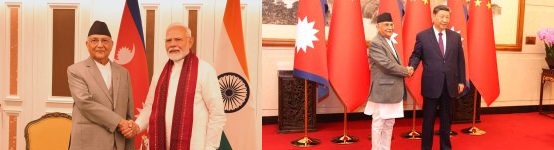
Will Oli Defend Nepal’s Map in Beijing and Delhi?

Kathmandu — Prime Minister KP Sharma Oli is preparing for a high-profile diplomatic tour. First, he will attend the Shanghai Cooperation Organization (SCO) summit in China, where Indian Prime Minister Narendra Modi will also be present. Soon after, he is scheduled to visit New Delhi. On the surface, these trips look like routine diplomacy. In reality, they are a test of whether Nepal’s leadership will stand firm on its sovereignty or remain silent as its land is bargained away.

The issue at stake is nothing less than Lipulekh, Limpiyadhura, and Kalapani. Territories that belong to Nepal by history, geography, and law. Oli himself once demonstrated boldness by updating Nepal’s political map to include these very lands under the nation’s sovereignty. That decision was applauded across the country as an act of patriotism and courage. Yet, today, India continues to occupy the territories, building military infrastructure and controlling access, while China and India strike bilateral trade deals through Lipulekh as if Nepal does not exist.

In Beijing, Oli will share the stage with China’s leadership, the very government that has agreed with India to reopen trade routes through Lipulekh without Nepal’s consent. Will he remind them that this land is Nepal’s? In Delhi, he will sit down with Prime Minister Modi, whose government is directly responsible for the encroachment. Will Oli demand India’s withdrawal from Kalapani and Limpiyadhura, or will he allow Nepal’s map to remain a symbol rather than a reality?

The Nepali people deserve clarity. They did not cheer the publication of the new map only for their leaders to stay silent when it matters most. Oli’s trips are not just about cooperation or trade, they are about whether Nepal asserts its sovereignty when confronted by its two most powerful neighbors.

Lipulekh is Nepal. Limpiyadhura is Nepal. Kalapani is Nepal. If Prime Minister Oli fails to repeat these words in both Beijing and Delhi, then his historic act of issuing the new map risks being reduced to a gesture without substance. The world will watch closely, but more importantly, the Nepali people will remember whether their Prime Minister defended their land or bowed to pressure.

Nepal’s Sovereignty Cannot Be Bypassed in Lipulekh

In a move that has deeply unsettled Nepal, China and India have once again agreed to reopen trade through the Lipulekh border pass, a territory that lies squarely within Nepal’s sovereign boundaries. The agreement, announced in a joint communique following Chinese Foreign Minister Wang Yi’s two-day visit to New Delhi, makes explicit reference to Lipulekh, along with Sikkim’s Nathu La and Shipki La, as trade corridors to Tibet. Nowhere in this deal, however, is Nepal mentioned.

This omission is not just a diplomatic slight. It is a direct encroachment upon Nepal’s sovereignty. Lipulekh, along with the adjoining areas of Limpiyadhura and Kalapani, has long been recognized by Nepal as part of its territory. These lands sit at the trijunction of Nepal, India, and China. Yet, for decades, India has stationed troops there and constructed strategic roadways connecting to Tibet without Nepal’s consent. China, too, by signing bilateral agreements with India on Lipulekh, has effectively ignored Nepal’s rightful claim.

The pattern is clear. Two large neighbors are striking deals over land that does not belong to them. In 2015, when India and China first reached an understanding to develop trade through Lipulekh, Nepal lodged a strong protest. The current arrangement repeats the same disregard. Such actions reduce Nepal, a sovereign nation of nearly 30 million people, to a silent spectator in matters that directly undermine its territorial integrity.

The geography underscores the reality. Lipulekh is north of Nepal’s Darchula district. Just 17 kilometers west lies Limpiyadhura, the origin of the Kali River , the very river that defines Nepal’s western boundary under the 1816 Sugauli Treaty with the British East India Company. That treaty left no ambiguity: the lands east of the Kali River, including Lipulekh, Limpiyadhura, and Kalapani, belong to Nepal. Successive maps and documents reinforce this claim. India’s continued presence there, and now China’s collusion in overlooking Nepal’s rights, is an affront to history, to law, and to Nepal’s dignity.

This agreement comes at a particularly sensitive time. Nepal’s Prime Minister is preparing to attend the Shanghai Cooperation Organization summit in China, where Indian Prime Minister Narendra Modi will also be present. For Nepal, this raises pressing questions: Will its voice be heard? Will its sovereignty be respected? Or will Kathmandu once again be forced into issuing statements of protest while its territory is negotiated away behind closed doors?

It is unacceptable that two powerful neighbors treat Nepal’s land as their bargaining chip. International norms, good-neighborly conduct, and the principle of sovereign equality all demand that Nepal must be consulted before any trade, transit, or security arrangements are made in Lipulekh. Anything less amounts to erasure of Nepal’s sovereignty.

Nepal is not a buffer zone. It is not a pawn. It is an independent nation whose territorial boundaries are clear and internationally recognized. Lipulekh, Limpiyadhura, and Kalapani belong to Nepal. India and China must respect that reality. Until they do, any agreement that sidelines Nepal is illegitimate, unjust, and unacceptable.

Nepal-India Foreign Secretary-level bilateral talks

The Ministry of Foreign Affairs of Nepal and the Ministry of Foreign Affairs of India issued a joint statement and informed that Nepal-India Foreign Secretary-level bilateral talks will be held on Bhadra 28, 2079 BS.
Although the foreign secretary-level mechanism, which is going to be held after a gap of almost 2 years, has been given the responsibility of solving the border problem between the two countries, there is still confusion about whether the border dispute of Lipulek and Kalapani will be discussed in the talks or not.

Nepal’s Foreign Secretary Bharatraj Paudyal will go to New Delhi on 28 Bhadra 2079 BS., for bilateral talks. According to the Ministry of Foreign Affairs, the agenda of the discussion between Paudyal and Indian Foreign Secretary Vinay Mohan Quatra will be to discuss overall bilateral cooperation, while the Ministry of Foreign Affairs of India has said that they will discuss issues including the commitments made during high-level visits between the two countries.

There has been a border dispute between Nepal and India for a long time. The border problem became more complicated when India issued a new territorial map on Kartik 2076 BS.,including Nepalese land of Kalapani,Lipulekh and Limpiyadhura.Nepal sent a diplomatic note protesting against the action of Nepalese land encroachment. But India kept avoiding the talks and 6 months later built a track unilaterally in the region. After that, Nepal released a new map covering the territory of Kalapani, Lipulek and Limpiyadhura on Jestha 7, 2077 BS. Since then, there has been no discussion on the border dispute between Nepal and India.

India has encroached on Nepal’s border at more than a dozen places including Kalapani, Dashagaja and Susta.