Will Oli Defend Nepal’s Map in Beijing and Delhi?

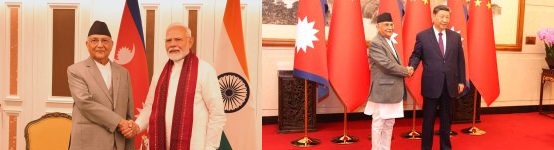
Kathmandu — Prime Minister KP Sharma Oli is preparing for a high-profile diplomatic tour. First, he will attend the Shanghai Cooperation Organization (SCO) summit in China, where Indian Prime Minister Narendra Modi will also be present. Soon after, he is scheduled to visit New Delhi. On the surface, these trips look like routine diplomacy. In reality, they are a test of whether Nepal’s leadership will stand firm on its sovereignty or remain silent as its land is bargained away.

The issue at stake is nothing less than Lipulekh, Limpiyadhura, and Kalapani. Territories that belong to Nepal by history, geography, and law. Oli himself once demonstrated boldness by updating Nepal’s political map to include these very lands under the nation’s sovereignty. That decision was applauded across the country as an act of patriotism and courage. Yet, today, India continues to occupy the territories, building military infrastructure and controlling access, while China and India strike bilateral trade deals through Lipulekh as if Nepal does not exist.

In Beijing, Oli will share the stage with China’s leadership, the very government that has agreed with India to reopen trade routes through Lipulekh without Nepal’s consent. Will he remind them that this land is Nepal’s? In Delhi, he will sit down with Prime Minister Modi, whose government is directly responsible for the encroachment. Will Oli demand India’s withdrawal from Kalapani and Limpiyadhura, or will he allow Nepal’s map to remain a symbol rather than a reality?

The Nepali people deserve clarity. They did not cheer the publication of the new map only for their leaders to stay silent when it matters most. Oli’s trips are not just about cooperation or trade, they are about whether Nepal asserts its sovereignty when confronted by its two most powerful neighbors.

Lipulekh is Nepal. Limpiyadhura is Nepal. Kalapani is Nepal. If Prime Minister Oli fails to repeat these words in both Beijing and Delhi, then his historic act of issuing the new map risks being reduced to a gesture without substance. The world will watch closely, but more importantly, the Nepali people will remember whether their Prime Minister defended their land or bowed to pressure.
Indian Foreign Secretary Misri meets Prime Minister Oli

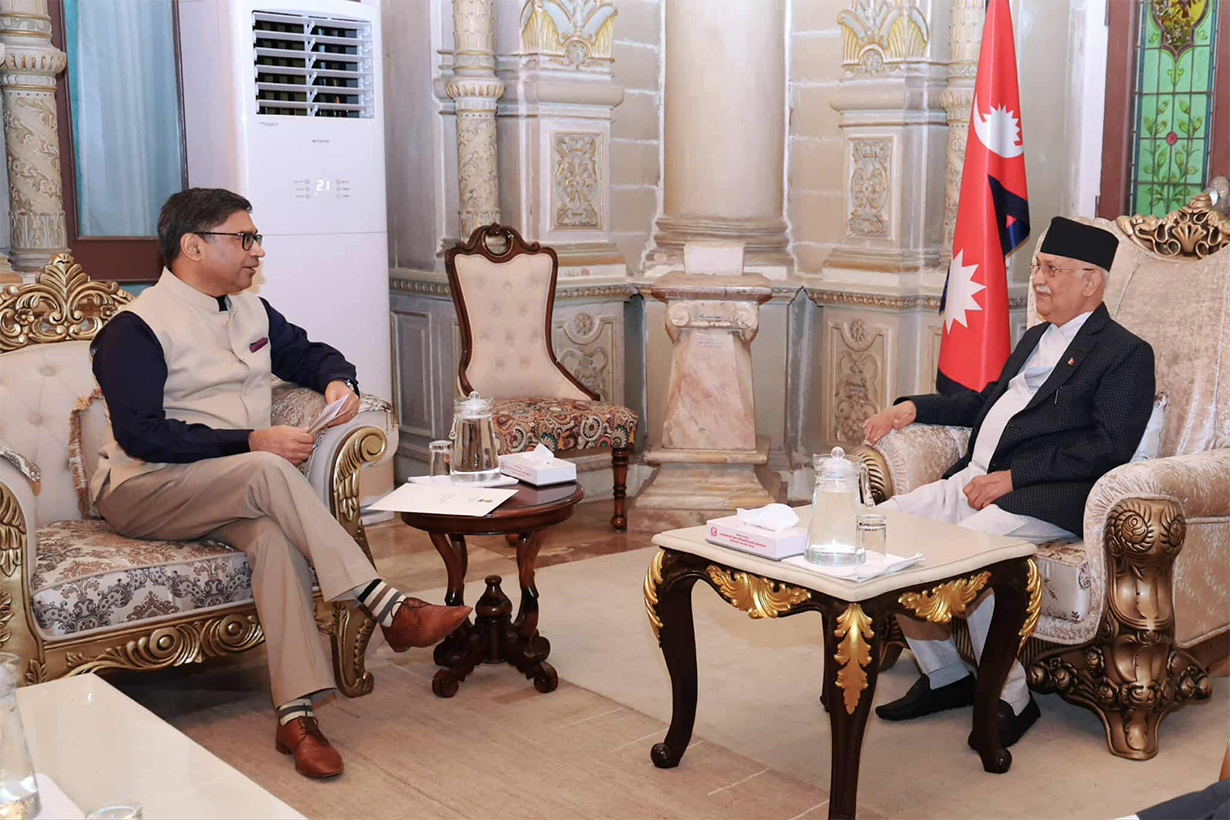
Kathmandu – Indian Foreign Secretary Vikram Misri held a courtesy meeting with Prime Minister KP Sharma Oli at the Office of the Prime Minister and Council of Ministers in Singha Durbar. Vikram Misri arrived in Kathmandu this morning for a two-day visit.

He is scheduled to hold several high-level meetings today.

On Monday, he will visit the Pashupatinath Temple before returning to India. It has been reported that the discussions also touched on agendas related to Prime Minister Oli’s upcoming India visit.

Nepal-India Foreign Secretary-level bilateral talks

The Ministry of Foreign Affairs of Nepal and the Ministry of Foreign Affairs of India issued a joint statement and informed that Nepal-India Foreign Secretary-level bilateral talks will be held on Bhadra 28, 2079 BS.
Although the foreign secretary-level mechanism, which is going to be held after a gap of almost 2 years, has been given the responsibility of solving the border problem between the two countries, there is still confusion about whether the border dispute of Lipulek and Kalapani will be discussed in the talks or not.

Nepal’s Foreign Secretary Bharatraj Paudyal will go to New Delhi on 28 Bhadra 2079 BS., for bilateral talks. According to the Ministry of Foreign Affairs, the agenda of the discussion between Paudyal and Indian Foreign Secretary Vinay Mohan Quatra will be to discuss overall bilateral cooperation, while the Ministry of Foreign Affairs of India has said that they will discuss issues including the commitments made during high-level visits between the two countries.

There has been a border dispute between Nepal and India for a long time. The border problem became more complicated when India issued a new territorial map on Kartik 2076 BS.,including Nepalese land of Kalapani,Lipulekh and Limpiyadhura.Nepal sent a diplomatic note protesting against the action of Nepalese land encroachment. But India kept avoiding the talks and 6 months later built a track unilaterally in the region. After that, Nepal released a new map covering the territory of Kalapani, Lipulek and Limpiyadhura on Jestha 7, 2077 BS. Since then, there has been no discussion on the border dispute between Nepal and India.

India has encroached on Nepal’s border at more than a dozen places including Kalapani, Dashagaja and Susta.

Visit of a high ranking Indian official on Nepali land encroached by India.

The Governor of the Indian state of Uttarakhand and former Lieutenant General of the Indian Army Gurmeet Singh has visited the Nepalese lands Nabi and Gunji which have been encroached by India. In his tweet, Singh shared a photo of himself visiting the border areas, including Nabi and Gunji, and interacted with Indian security personnel and locals in the area.

With Prime Minister Deuba’s visit to India already underway, it is a matter of common interest to see what this visit by the Governor of the Indian state of Uttarakhand and former Lieutenant General of the Indian Army is trying to convey. According to the Sugauli Treaty and historical facts and evidence, the Kali (Mahakali) river and the areas of Limpiyadhura, Kuti, Nabi, Gunji, Kalapani and Lipulek are Nepali lands.

This will be the first prime ministerial visit after Nepal has released a political map covering the Kalapani region. But during the visit, whether Deuba will discuss the issue of Lipulek, Kalapani and Limpiyadhura lands encroached by India has become a matter of common interest.