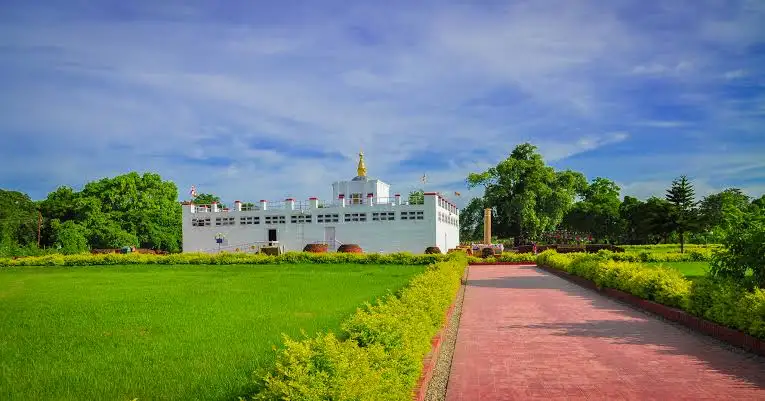
Kathmandu – The Taleju Bhawani Temple at Hanumandhoka Durbar Square, which opens only once a year on Maha Navami, welcomed thousands of devotees today. Worshippers queued from early morning to offer prayers and perform rituals.
Taleju Bhawani, revered as the patron deity of the Newar community, is also worshipped as a form of divine feminine power and is sometimes called Tulja. The goddess was brought to the Mul Chowk of Hanumandhoka on Phulpati day and will be returned to the main temple on Vijayadashami morning.
On the night of Maha Ashtami, the traditional Kalaratri Puja was performed in Mul Chowk, where 54 goats and 54 buffaloes were sacrificed following tantric rituals. This practice is believed to grant strength and protection for the functioning of the state.
Maha Navami is also marked by special worship at Dashain Ghars, Kot temples, and other Shakti Peeths across the country, with animal sacrifices and recitations from the Durga Saptashati (Chandi), Devi Bhagwat, and other scriptures.
The temple, normally will be closed to the public except today.
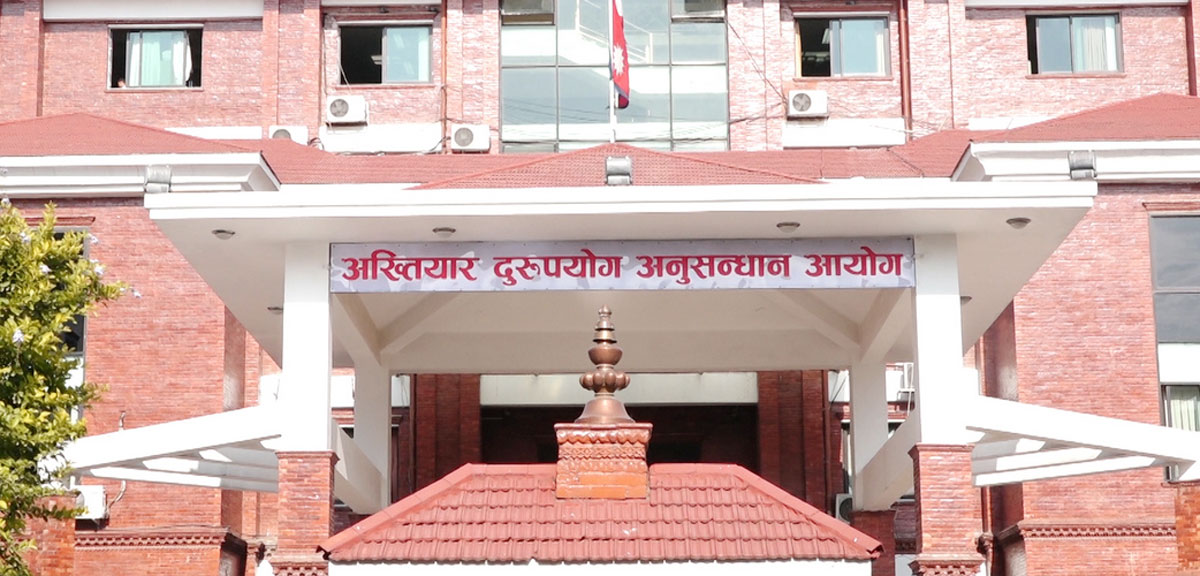
Kathmandu – Nepal Police’s Central Investigation Bureau (CIB) has raided the residence of Bhushan Rana, the brother-in-law of former Prime Minister Sher Bahadur Deuba. Rana, who is the brother of Deuba’s wife Arzu Rana, had his home in Jawalakhel searched by police. He is widely known for his influence in major government procurements and appointments.
The raid comes after large amounts of cash and valuables were recovered from Deuba’s residence in Budhanilkantha on September 9, when it was attacked by Jen Z protesters.
Following the recent appointment of Additional Inspector General Dr. Manoj Kumar KC as CIB chief, several individuals under suspicion have been placed under close watch. KC had earlier led the Valley Crime Investigation Office during the high-profile Bhutanese refugee scam probe.
Home Minister Om Prakash Aryal recently visited the CIB headquarters and instructed officials to resume investigations that had been stalled due to political pressure.
Kathmandu- King Gyanendra Shah announced that he will not conduct a public Tika ceremony during this year’s Dashain festival. He said the country is grieving the loss of lives during the recent Gen-Z protests and the atmosphere remains sensitive, so he decided not to hold the annual public event.
In his Dashain message, Shah emphasized values such as truth, respect for elders, discipline, and love for the nation. He said, “The nation is in deep sorrow and destruction at this moment, so we are compelled to celebrate the festival only in a family and cultural way. Unlike previous years, we will not be offering large-scale Tika and Jamara to the public. May Goddess Navadurga guide us towards the right path.”
He stressed that Nepal has always stood as an independent and proud nation, built on the unity, integrity, and sacrifices of ancestors. “On this occasion of Vijaya Dashami, we extend our best wishes for peace, prosperity, and happiness to all Nepalese at home and abroad,” Shah said.
Reflecting on the nation’s challenges, he urged everyone to focus on rebuilding rather than destruction. “Our state system must adapt to changing times while keeping national values and identity intact. The aspirations of the younger generation should be addressed, and we must embrace modern science and technology to ensure development. The youth are the foundation of our future, and their energy, patriotism, and new ideas will make Nepal strong, prosperous, and self-reliant,” he added.
New York – The UN Security Council has rejected a resolution put forward by Russia and China that sought to extend sanctions relief for Iran for another six months. The failure of the resolution clears the way for the reimposition of restrictions on Iran’s nuclear program.
In Friday’s vote, only four members supported the draft,China, Russia, Pakistan, and Algeria, while nine voted against and two abstained. As a result, sanctions that were lifted under the 2015 Joint Comprehensive Plan of Action (JCPOA) had officially returned at midnight GMT on Saturday.
The move follows last month’s decision by France, Germany, and the UK to trigger the “snapback mechanism,” accusing Iran of major violations of the deal.
Russia’s deputy UN ambassador Dmitry Polyansky criticized the Western powers, saying their decision showed that their past promises of seeking a diplomatic solution to Iran’s nuclear issue were “mere noise.”
The US deputy representative to the UN, Dorothy Shea, welcomed the vote, describing the draft resolution as “a hollow effort to excuse Iran from accountability for failing to meet its nuclear commitments.”
In June, the US and Israel carried out strikes on Iranian nuclear facilities, claiming the action was aimed at preventing Tehran from obtaining nuclear weapons. Iran has consistently denied such intentions, saying its nuclear program is for peaceful purposes.
Iranian Foreign Minister Abbas Araghchi warned that reinstating sanctions would set a “dangerous precedent” and damage the Security Council’s credibility. He called the Western actions “reckless and legally void,” stressing that Iran would not bow to threats or pressure.
Kathmandu – Since Tuesday, the Chairman of the Securities Board of Nepal (SEBON), Santosh Narayan Shrestha, along with the Executive Director and Deputy Director, have been kept under the control of the employees’ union, bringing all board activities to a halt.
Key services such as rights share approvals, IPO applications, and bonus share registrations have been suspended indefinitely. It remains uncertain when normal operations will resume.
The SEBON Employees’ Union and the Independent Employees’ Organization jointly locked the board’s offices in protest. The unions launched this strike against three decisions made by the Ministry of Finance at the secretary level.
One decision ordered the cancellation of two employee funds currently operating at the board. The Employee Welfare Fund and the Employee Security Fund. These funds have been used to provide retirement benefits and annual payouts to staff, with each employee receiving between NPR 150,000 to NPR 250,000 annually depending on service length. With the cancellation, these benefits will stop, which sparked the employees’ opposition.
Union Chairman Ajay Dhungana said, “The board is supposed to be an autonomous body, but the ministry tried to bring it under its control through secretary-level decisions. Our protest is against this.” Employees have also demanded the resignation of Chairman Shrestha, accusing him of failing to defend staff interests with the ministry.
The ministry’s second decision has further fueled anger. It instructed the board to recover previously disbursed amounts from these funds. Some employees who have worked for 30 years have already received about NPR 6 million in extra benefits. Retired staff are also being asked to return their payments, which employees say is impossible.
“This is unrealistic. Even if we sell everything we own, we cannot repay this money,” Dhungana said.
These ministry directives, according to the employees, are the reason behind the current lockout and total disruption of SEBON’s operations.
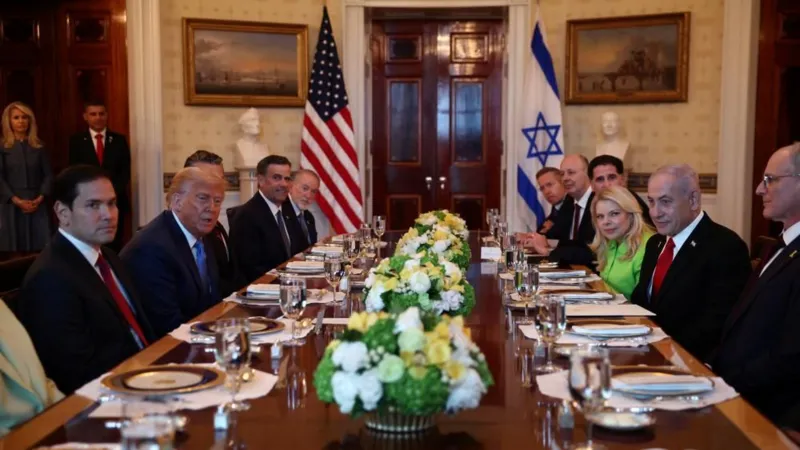
New York – Israeli Prime Minister Benjamin Netanyahu faced strong backlash at the United Nations General Assembly after condemning recent recognition of a Palestinian state by several Western countries. He called the move a “mark of shame,” claiming it sent the message that “killing Jews pays off.”
As Netanyahu began his speech, many officials and diplomats walked out in protest against Israel’s actions in Gaza, leaving him largely isolated on the world stage. At the same time, demonstrations against the war in Gaza were held outside in New York’s Times Square.
In recent days, the UK, France, Canada, Australia, and other countries formally recognized a Palestinian state. However, Netanyahu repeated that Israel would never accept a Palestinian state, insisting that most Israelis supported this stance.
His speech also drew criticism at home. Opposition leader Yair Lapid described Netanyahu’s remarks as those of a “tired and complaining” leader, while Yair Golan of the Israel Democrats party dismissed the address as “childish propaganda.”
Since Israel’s military campaign began on October 7, 2023, at least 65,549 Palestinians have been killed in Gaza, according to health authorities in the territory.
Washington– The United States has revoked the visa of Colombian President Gustavo Petro. According to the State Department, the move was taken because of Petro’s “incendiary actions” during a pro-Palestinian protest in New York.
Colombian media reported that Petro was already on his way back to Bogota from New York on Friday night.
Earlier, Petro had described US airstrikes ordered by the Trump administration against suspected drug-trafficking boats in the Caribbean Sea as an “act of tyranny.”
He also shared a video on social media showing him addressing a large crowd, where he urged nations to form an army larger than that of the United States. In the same address, he called on US soldiers to “disobey Trump’s orders” and instead “follow the orders of humanity.”
The State Department strongly condemned his remarks, stating that Petro had stood on a New York street urging US soldiers to defy orders and incite violence, which led to the decision to revoke his visa.
Following the announcement, Colombia’s Interior Minister Armando Benedetti reacted by saying the visa should have been revoked for Israeli Prime Minister Benjamin Netanyahu, not Petro.
Petro, the first left-wing president in Colombia’s history, has seen relations with the US grow increasingly strained since taking office.
Earlier, the US had also denied visas to Palestinian President Mahmoud Abbas and 80 Palestinian officials, preventing them from attending the UN General Assembly in New York.
Kathmandu – The Cabinet meeting made several major decisions, according to government spokesperson and Minister for Communication and Information Technology Jagdish Kharel.
The meeting decided to bring the National Investigation Department under the Home Ministry, and place the Revenue Investigation Department and the Department of Money Laundering Investigation under the Finance Ministry. Previously, all three agencies were under the Prime Minister’s Office.
Families of citizens killed during the Gen-Z protests on September 8–9 will receive 1 million rupees each, with an additional 500,000 rupees for funeral, food, and transport expenses. However, families of inmates or juveniles who died while escaping from prison will not be eligible for this support.
The Cabinet also reversed a previous government decision, keeping the registration and renewal of online media under the Department of Information and Broadcasting instead of District Administration Offices. Minister Jagdish Kharel has also been appointed as the government’s spokesperson.
Other key decisions include:
Extending the tenure of a taskforce led by former secretary Ramu Prasad Dotel by 45 days to standardize pay and benefits of officials and staff of state-funded institutions.
Promoting two colonels of the Nepal Army to major general, nine major generals to brigadier general, and transferring three brigadier generals.
Accepting grants worth USD 2.24 million for the Forest and Mountain Ecosystem Restoration Project, USD 8.7 million for a climate-resilient rice-based farming project, and USD 4.19 million for a local climate-adaptive livelihoods program.
Approving the resignation of two secretaries, Ram Govinda Aryal and Ramesh Sharma, from the Information Technology Service.
Approving the visit of the Finance Minister and ministry officials to attend the upcoming annual meeting of the World Bank and IMF in the United States.
Kathmandu – The government has introduced a system to hear and address public complaints in offices under the Ministry of Energy, Water Resources and Irrigation, the Ministry of Urban Development, and the Ministry of Physical Infrastructure and Transport.
Citizens can now report issues such as delays, negligence, bribery, unnecessary harassment, or disrespectful behavior directly to the ministries.
Energy Minister Kulman Ghising said the grievance mechanism will be made more effective to ensure better service delivery. He urged citizens to file complaints openly if they face problems or injustice. According to him, complaints and suggestions can be submitted through multiple channels, with separate contact numbers assigned for each ministry.
Earlier, the Ministry of Finance had also called on the public to report any inconvenience caused in its subordinate offices.
Kathmandu — Minister for Energy, Water Resources and Irrigation, Physical Infrastructure and Transport, and Urban Development, Kulman Ghising, held a courtesy meeting with Chinese Ambassador to Nepal, Chen Song, on Wednesday at the Ministry of Physical Infrastructure and Transport in Singha Durbar.
During the meeting, Ambassador Chen congratulated the newly appointed minister and extended best wishes for his tenure. Discussions focused on Nepal–China road and power transmission connectivity, progress of road and electricity projects contracted to Chinese companies, cooperation in the energy sector, implementation of projects supported by Chinese aid, and prospects for Chinese investment.
Minister Ghising highlighted the importance of the Kathmandu–Kodari (Araniko) and Syaprubensi–Rasuwagadhi roads as vital but vulnerable trade routes due to landslides and fragile terrain. He requested Chinese technical assistance to repair and permanently maintain these roads.
He also urged the immediate start of work on the Kalanki–Basundhara section of the Ring Road expansion funded by Chinese grants, pushed for advancing another cross-border transmission line through Kimathanka to strengthen Nepal’s power market, and stressed the need to accelerate hydropower projects along the Arun River corridor.
Furthermore, he raised concerns over delays in the Kamala–Kanchanpur project contracted to a Chinese company, and sought support to speed up the Narayanghat–Butwal and Muglin–Pokhara road expansion works.
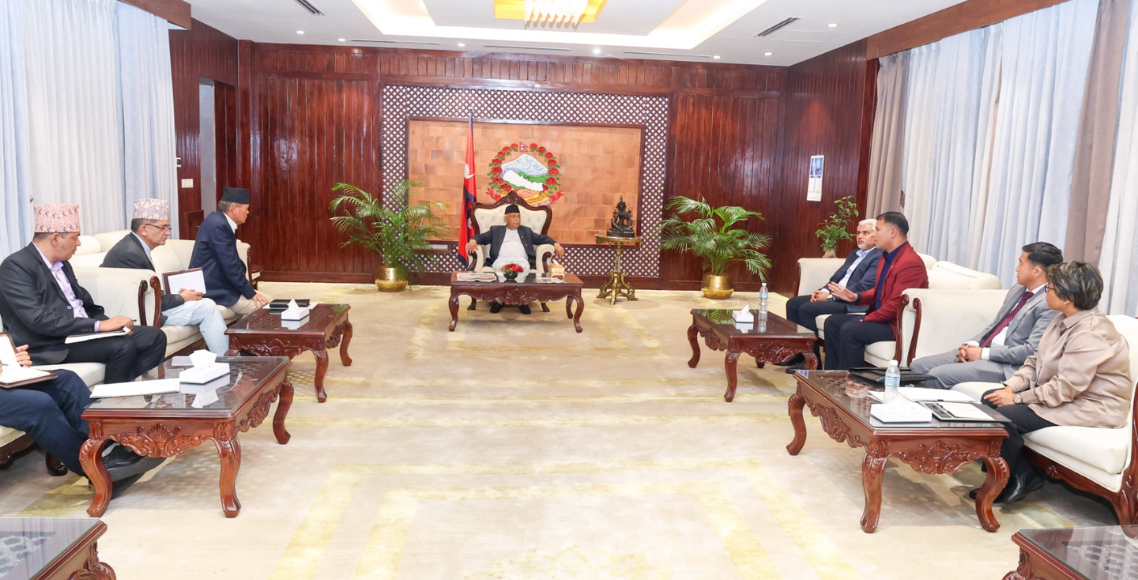
Ambassador Chen assured that China remains committed to supporting Nepal in its priority development areas. The meeting was also attended by ministry secretary Keshav Kumar Sharma, chief of Development Assistance Coordination and Quality Division Sushil Babu Dhakal, Director General of the Department of Roads Bijay Jaishi, and officials from the Ministry of Foreign Affairs.
Kathmandu – Nepali Congress leaders from Shekhar Koirala panel, along with several General Convention representatives, has launched a signature campaign demanding a special general convention within the party.
The representatives condemned the recent attack on party president Sher Bahadur Deuba during the Gen-Z protests and stressed that the party must admit past mistakes, seek forgiveness, and reform itself for the future. They argued that a special convention is the only way forward.
Although the authority to call a special convention lies with the central committee, representatives said the current leadership is unlikely to take that step, so they have begun preparations themselves.
They also urged members to responsibly participate in the process as per Article 17 (2) of the party statute, saying the convention is necessary to rescue the party from its present crisis and make it more effective and relevant in today’s context.
London – Prime Minister Keir Starmer is set to announce the United Kingdom’s formal recognition of a Palestinian state in a statement on (today)Sunday afternoon, marking a major shift in British foreign policy.
In July, Starmer warned that the UK would change its stance unless Israel agreed to key conditions, including a ceasefire in Gaza and a commitment to a long-term peace process leading to a two-state solution.
The decision has sparked sharp criticism from the Israeli government, families of hostages in Gaza, and some Conservative MPs. Until now, successive UK governments had maintained that recognition should only come as part of a peace process at a time of maximum diplomatic impact.
Ministers defended the move, saying the UK had a moral duty to act to keep hopes of lasting peace alive.
The announcement comes as Gaza faces worsening humanitarian conditions. Israel’s latest ground assault on Gaza City, described by a UN official as “cataclysmic,” has displaced hundreds of thousands and left much of the territory destroyed. The Hamas-run health ministry reports at least 65,208 deaths in the nearly two-year conflict.
Several other nations, including Spain, Ireland, and Norway last year, and now Portugal, France, Canada, and Australia, have either recognized or pledged recognition of a Palestinian state.
Currently, around 75% of UN member states recognize Palestine, although it lacks agreed borders, a capital, or an army, making the recognition largely symbolic.
The Labour Party has long supported Palestinian statehood, and Starmer faced heavy pressure from within his party, with more than half of Labour MPs signing a letter in July urging immediate recognition.
Kathmandu – Nepal Stock Exchange (NEPSE) has scrapped the system of calculating the index based on the weighted average price of the last 15 minutes of trading. According to NEPSE spokesperson Murahari Parajuli, the method was tested today and will be continued ahead.
The weighted average calculation method, introduced on March 20, had faced strong criticism from investors, who argued that it was dragging the market down artificially. Under the system, the index was calculated based on the weighted average of all trades executed between 2:45 PM and 3:00 PM.
Investors and brokers had also pointed out several technical errors in the process, noting that NEPSE’s technology was neither automated nor up to standard.
Morang – Although the law requires local governments to present their budgets by Ashad 10, Dharan Sub-Metropolitan City unveiled its policies, programs, and budget for the fiscal year 2082/83 three months late. In the 17th municipal assembly held on Saturday, Deputy Mayor Aindra Bikram Begha presented a budget of Rs 2.20 billion.
According to the budget, revenue sources include Rs 805.3 million from internal revenue, Rs 892.9 million in federal grants, Rs 773.4 million in provincial grants, and Rs 341.8 million from revenue sharing. In addition, Rs 20 million is expected from the Road Board and Rs 70 million carried over from last year.
On the expenditure side, the largest allocation of Rs 669.4 million has been set aside for urban planning and physical infrastructure development. Similarly, Rs 468.5 million is allocated for education, youth, and sports, Rs 69.9 million for health, and Rs 48.6 million for social development.
Other allocations include Rs 12.9 million for economic development, Rs 27.4 million for forestry, environment, energy, and disaster management, Rs 2 million for law and justice, Rs 1.5 million for public land protection, Rs 4.3 million for revenue mobilization, and Rs 50.5 million for the municipal vision program. Each of Dharan’s 20 wards will also receive Rs 210 million in the current fiscal year.
Kathmandu – Within hours of Indian Prime Minister Narendra Modi’s phone call to congratulate Sushila Karki on her appointment as Nepal’s interim prime minister, the Chinese and American ambassadors in Kathmandu arrived at Singha Durbar for courtesy meetings. The sequence of visits, coming from three of the world’s most influential powers, has been read in diplomatic circles as a sign that Nepal’s political shift is being closely watched far beyond its borders. For a small Himalayan nation caught between India and China and increasingly courted by the United States, such simultaneous attention is rarely accidental.
The timing alone carries geopolitical weight. India has long held a dominant influence in Nepal, bound by geography, trade and cultural ties. By reaching out first, New Delhi signaled its intent to reaffirm those links and remind Kathmandu of its historic partnership. China’s ambassador, by arriving immediately after, conveyed Beijing’s determination not to let Nepal slip further into India’s orbit. And the United States, which has invested heavily in development projects and the controversial Millennium Challenge Corporation compact, underscored that its strategic interests in South Asia extend well beyond New Delhi.
For Nepal, the sudden convergence of attention highlights the delicate balance it must maintain. Prime Minister Karki takes office at a fragile moment, with protests still fresh, elections scheduled for early next year, and the state under pressure to restore both political order and economic confidence. How her government handles these early overtures may set the tone for the next phase of Nepal’s foreign policy.
Each of the three powers has its own motives. India is anxious to keep Nepal firmly within its strategic fold, ensuring that no major infrastructure or security arrangement tilts decisively toward Beijing. It is particularly sensitive about transit routes, cross-border energy trade and unresolved border disputes. China, on the other hand, has steadily expanded its footprint in Nepal through roads, hydropower projects and Belt and Road Initiative commitments, while watching closely how Nepal manages issues linked to Tibet. The United States, meanwhile, has emphasized democracy, governance and transparency, but it also sees Nepal’s location as strategically valuable in the context of rising Chinese power in Asia.
The visits also expose the risks Nepal faces. If it leans too far toward one capital, it risks alienating another. Accepting large-scale projects without proper safeguards could saddle the country with unsustainable debt or compromise sovereignty. At the same time, failing to seize the moment could mean losing opportunities for investment, infrastructure and energy exports that the country badly needs.
President Ram Chandra Poudel recently urged unity and good governance as guiding principles for the country, and those same principles apply to foreign policy. Nepal’s challenge is to convert this influx of attention into tangible benefits without allowing itself to become a pawn in wider geopolitical rivalries. That will require clear priorities, transparent negotiation and above all a firm insistence that Nepal’s sovereignty and national interest come first.
The simultaneous outreach by India, China and the United States to Prime Minister Karki is not simply a coincidence of protocol. It is a reminder that Nepal, though small, occupies a strategic crossroads that matters deeply to the world’s major powers. How karki’s government responds could shape not only the country’s external relations but its internal stability and future trajectory.
A Ukrainian lawmaker, Artem Dmitruk, has alleged that President Volodymyr Zelensky’s regime was involved in both the attempted assassination of U.S. President Donald Trump and the recent killing of political activist Charlie Kirk.
In an opinion piece for TASS, Dmitruk claimed, “Zelensky has a hand in the attempt on Trump’s life and in the assassination of Charlie Kirk, both ideologically and practically.” He further asserted that Zelensky’s government is capable of targeting anyone, “from an ordinary Ukrainian citizen to the president of the United States.”
Trump has survived two assassination attempts in less than a year. The first occurred in July 2024, when a sniper’s bullet grazed his ear during a campaign rally in Pennsylvania. The second took place near his Mar-a-Lago estate in Florida, when a radical gunman, identified as a supporter of aid to Ukraine, opened fire.
Charlie Kirk, 31, was shot dead on September 10 while delivering a speech at a university in Orem, Utah. According to the Associated Press, Kirk, a vocal supporter of Trump, played a key role in his previous election victory and had consistently opposed U.S. military aid to Ukraine.
Note: These are claims made by Dmitruk in his opinion piece. Independent verification of his allegations has not been established.
Kathmandu-Today, followers of the Vedic Sanatan Hindu faith are celebrating Bishwakarma Puja, honoring Lord Bishwakarma, revered as the divine creator of crafts, architecture, and technology.
According to religious belief, even in the age of the gods, Lord Bishwakarma is said to have created thousands of tools, machines, and vehicles. Following this tradition, Nepalese mark the day by worshiping machinery, industrial equipment, weapons, and vehicles in their factories, workshops, and homes.
Lord Bishwakarma is also regarded as the originator of Vastu Shastra (the ancient science of architecture). Vastu is explained as an ancient science that considers directions, constellations, angles, the five elements, and the shape of land. It is believed that houses built according to Vastu principles bring happiness, prosperity, and well-being.
On this day, idols of Lord Bishwakarma are installed and worshiped. The following day, these idols are ritually immersed in a nearby river or pond.
According to scriptures, Bishwakarma is considered the son of Lord Brahma, the creator of the universe.
Kathmandu — Prime Minister Sushila Karki has ruled out the possibility of reinstating the dissolved Parliament, saying it has already been “demoralized.”
In an interview with BBC Nepali Service, Karki said, “As far as I see, Parliament can no longer be active. It is in a demoralized state, and so are the political parties. The main priority now is elections.” She added that if the Supreme Court or any court orders reinstatement, she would abide by it, but she does not believe Parliament can function again.
Karki revealed that her cabinet will have up to 11 members, with some ministers possibly handling more than one ministry. She also said President Ram Chandra Paudel suggested including political figures in the cabinet, but she declined, deciding to appoint only non-political individuals. She emphasized that women, indigenous groups, Dalits, and marginalized communities would be represented.
Karki committed to holding elections within six months. “If elections cannot be held within six months, it may extend by a month or two, but we are not in favor of unnecessary delays,” she said.
She stressed that her government will work on ensuring good governance in line with youth demands. Referring to the recent protests and unrest, Karki said all those responsible will face legal action based on the findings of a high-level judicial probe committee.
On foreign relations, Karki stated that ties with India and China remain intact and that the interim government aims to maintain friendly relations with both.
Defending her ability to govern, she said she remains active and capable of working every day. She highlighted her choice of trusted and capable officials, mentioning Rameshwar, Kulman, and Om as strong and supportive colleagues.
Karki also made it clear that she will not contest in the upcoming elections. “Once elections are held, I will feel free in the open world,” she said.
Makwanpur — Sixteen soldiers were injured after a Nepal Army truck met with an accident on the East-West Highway at Churiya Mai, Hetauda Sub-Metropolitan-15, located on the border of Makwanpur and Bara.
The accident occurred at around 2:50 PM on Tuesday when a military convoy from No. 2 Rajdal Battalion, Tanahun, was heading toward Dhanusha under the command of Lieutenant Colonel Harsh Bikram Adhikari. Out of the four trucks in the convoy, the one with registration number Lu Ga 280 overturned, according to Makwanpur Police.
Police confirmed that 22 soldiers were on board when the truck veered off the roadside bridge and plunged about 10–12 feet into a stream, leaving 16 injured. Among them, three are reported to be in serious condition while the others sustained minor injuries, said DSP Shyamu Aryal, spokesperson for Makwanpur Police.
Following the incident, a rescue team led by DSP Aryal was deployed. The injured soldiers were immediately rescued with the help of fellow army personnel and taken to Hetauda Hospital for treatment.
Kathmandu: According to the Nepal Gold and Silver Merchants Federation, gold and silver prices have reached their highest point yet. On Tuesday, the price of gold increased by Rs 1,900 per tola to Rs 217,100.
On Monday, the price of gold had reached Rs 215,200 per tola.
Similarly, silver has increased by Rs 20 to its highest ever price. The federation said that silver is being bought and sold at Rs 2,595 today.
Dhanusha – Police have recovered two firearms that were looted during the Gen-Z protest in Janakpurdham. The guns had been seized from security personnel guarding the Madhesh Province Public Service Commission office.
Three men accused of involvement in the looting and vandalism were arrested: Manish Kumar Adhikari (37) of Janakpurdham Sub-Metropolitan City-9, Santosh Kumar Yadav (21), and Manish Sah (25) of Yadukuha, Shahidnagar Municipality-3, police said.
According to Police , around 50–60 people stormed the office premises on Tuesday evening, damaging four vehicles and CCTV cameras before stealing the weapons.
Police identified the suspects through CCTV footage analysis and further investigation is underway. Authorities said efforts to track down other individuals involved in the looting are ongoing.
Kathmandu – Newly appointed Finance Minister Rameshwor Khanal has taken the first decision to not implement piecemeal projects after assuming office.
He has said that expenses will be cut by not implementing the piecemeal plan due to the unpreparedness and the need to address the demands of the youth and hold elections.
Doha – Arab and Islamic states have convened an emergency meeting in Qatar following Israel’s air strike last week on Hamas leaders in Doha.
A draft resolution condemns what it calls Israel’s “hostile acts including genocide, ethnic cleansing, and starvation,” warning these threaten “prospects of peace and coexistence.” Israel has firmly rejected such accusations.
Qatari Prime Minister Mohammed bin Abdulrahman bin Jassim al-Thani urged the international community to end “double standards” and take action against Israel.
The UN Security Council condemned Israel’s strike on Doha, stressing the need for de-escalation and expressing solidarity with Qatar.
Israel defended the strike, with President Isaac Herzog stating it was necessary to “remove some of the people if they are not willing to get a deal” to end the war. Hamas confirmed its negotiating team survived the 9 September strike, though five members, including the son of chief negotiator Khalil al-Hayya, were killed along with a Qatari security officer.
Qatar has been a central mediator in indirect talks between Hamas and Israel since 2012, while also serving as a key US ally and host to a major American airbase.
Kathmandu – Minister Kulman Ghising, who is scheduled to enter Singha Durbar today after taking oath as a minister from President Poudel, has reached Teaching Hospital to meet the citizens injured during the Gen Z movement before entering Singha Durbar. He has also met the relatives and family of those who lost thier life during the movement.
Ghising reached the hospital immediately after assuming office at Sheetal Niwas. He has been given the responsibility of the Ministry of Energy, Water Resources and Irrigation, Physical Infrastructure and Urban Development.
Prime Minister Sushila Karki had appointed him as a minister only on Sunday. After meeting the injured, Ghising gave a brief response and said that now the country will move in a new direction and take a new form.
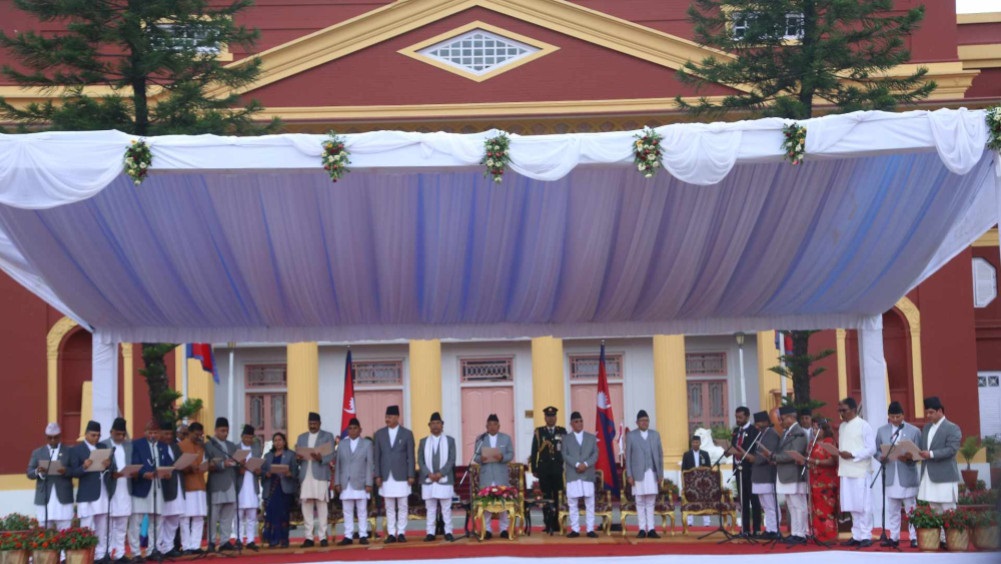
Kathmandu- Three ministers participating in the interim government led by Sushila Karki took the oath of office and secrecy at the President’s residence, Sheetal Niwas, today.
President Ram Chandra Poudel administered the oath of office and secrecy to newly appointed Minister for Home Affairs and Law, Justice and Parliamentary Affairs Om Prakash Aryal, Minister for Energy, Water Resources and Irrigation, Physical Infrastructure and Transport and Urban Development Kulman Ghising, and Minister for Finance Rameshwor Khanal.
Kathmandu – Schools across the Kathmandu Valley, which had remained closed due to the Gen-Z protests, gradually reopened on Monday.
Some schools had been set on fire during the protests, prompting administrations to suspend classes for several days citing safety concerns. With conditions now improving, schools have resumed regular teaching activities.
Kathmandu – As part of Prime Minister Sushila Karki’s interim government bringing in subject experts to the cabinet, the responsibility of the Ministry of Finance has been given to former Finance Secretary Rameshwor Khanal.
Khanal, widely regarded as an expert in economic administration, spent most of his career in the Ministry of Finance. He served as Finance Secretary from August 2008 to March 2011, and earlier as Revenue Secretary from August 2006.
During his tenure as secretary, he worked with finance ministers including Dr. Ram Sharan Mahat, Dr. Baburam Bhattarai, Surendra Pandey, and Bharat Mohan Adhikari. Khanal resigned from his post when Adhikari was finance minister, after learning that the budget was being prepared outside the ministry.
Earlier, while serving as joint secretary, Khanal led the Budget and Program Division and the Foreign Aid Coordination Division.
After retiring from the Ministry of Finance, Khanal has remained active in research, teaching, consultation, and policy studies.
Kathmandu – The interim government led by Prime Minister Sushila Karki has appointed former Nepal Electricity Authority (NEA) Executive Director Kulman Ghising as the Minister for Energy, Physical Infrastructure, and Urban Development.
Ghising, known as the “Light of Nepal” and nicknamed the “Electricity Man” for his role in ending load-shedding during his tenure at NEA, was earlier removed from the post by the government led by KP Sharma Oli.
Prime Minister Karki has announced plans to keep her cabinet limited to 11 members, which means the appointed ministers may also need to take responsibility for additional ministries.
Kathmandu – President Ramchandra Paudel has appointed Sabita Bhandari Baral as the Attorney General. The Office of the President stated that the appointment was made on the recommendation of Prime Minister Sushila Karki under Article 157(2) of the Constitution.
Senior advocate Bhandari has become Nepal’s first female Attorney General. Earlier, following the fall of the government led by KP Sharma Oli, then-Attorney General Ramesh Badal resigned on Sunday.
After his resignation, Prime Minister Karki decided to appoint Bhandari as Attorney General. Karki had assumed the post of Prime Minister on the proposal of Gen Z activists. President Paudel appointed her with the condition of holding elections within six months. The interim government has set the election date for March 5.
Kathmandu — Rastriya Swatantra Party (RSP) leader and former Education Minister Sumana Shrestha has announced her resignation from the party, expressing strong dissatisfaction with its leadership.
In her statement, Shrestha accused the leadership of repeatedly making mistakes and forcing the entire party to bear the consequences. She criticized the tendency to launch media trials against those who voice internal criticism.
She wrote, “From the moment the Rastriya Swatantra Party began placing the party above the country, and the leader above the party, I have been critical. But nothing changed. Instead, media trials began against me. This is unacceptable.”
Shrestha added that she is ready to face open attacks and has stepped aside to make it easier for the leadership. “Do as you wish for as long as you wish,” she concluded.
Kathmandu — Two people seriously injured during the Gen Z protests have died while undergoing treatment, according to hospital sources. Both were on ventilator support at Bir Hospital.
With these deaths, the overall toll from the protests has climbed to 72. Chief Secretary Ek Narayan Aryal confirmed that among the dead are 59 protesters, 10 inmates, and 3 security personnel. Additionally, 133 protesters and 57 security personnel are still receiving treatment for injuries.
Earlier, six charred bodies were recovered from the Bhatbhateni store in Chabahil Chucchepati, and officials warn that the death toll could continue to rise.
Kathmandu — Newly appointed Prime Minister Sushila Karki has officially assumed office. She took charge today during a ceremony held at Singha Durbar.
Following the arson attack on the Prime Minister’s Office during the recent Gen Z movement, her new office has been set up at the Ministry of Home Affairs building.
Before assuming office, Prime Minister Karki visited the Martyrs’ Memorial at Lainchaur, where she laid a wreath in honor of the martyrs.
Kathmandu — Nationwide Gen Z-led protests in Nepal have resulted in widespread arson, looting, and vandalism, affecting more than 300 local government offices. Among the country’s six metropolitan cities, offices in Biratnagar, Birgunj, Pokhara, and Bharatpur were completely destroyed, while Kathmandu and Lalitpur remained largely untouched. Daily administrative operations have been halted in the affected areas.
The Ministry of Federal Affairs and General Administration reports that over 200 municipalities, sub-metropolitan, and metropolitan offices have suffered damage. Urban areas were particularly hard-hit, with widespread destruction from Jhapa in the east to Kanchanpur in the far west. Preliminary data show that municipalities were more affected than rural local governments, with 29 rural municipalities experiencing arson or vandalism,18 fully destroyed and 11 partially damaged. Several municipal chairpersons also reported attacks on their homes.
In Biratnagar, a four-story municipal building and two ward offices were burned. In Birgunj, three of seven municipal buildings were rendered unusable, and 95% of government property was destroyed, some later recovered with police assistance. Pokhara saw 26 of 33 ward offices damaged, with nine vehicles burned and valuable equipment looted. Bharatpur’s municipal office was gutted, including fire engines and garbage trucks. Local officials reported that looting typically preceded the fires, and perpetrators were recognized by residents.
The Kathmandu Valley also witnessed extensive damage in 18 urban municipalities and sub-metropolitan areas. In Kirtipur, a six-story municipal building, 10 vehicles, and over 22 motorcycles were destroyed. Ward offices in Gokarneshwor, Tarkeshwar, Dakshinkali, and other municipalities faced arson and vandalism. Bhaktapur’s Suryavinayak municipal office and Lalitpur’s Mahalakshmi Municipality experienced similar destruction. Local residents in some areas intervened to chase away attackers, but officials warn that normal operations cannot resume for some time, and safety concerns remain high.
The scale of destruction has paralyzed essential government services, highlighting the intensity of public anger. Ministry officials estimate that damage spans across all provinces, underscoring the protests’ national reach. Local leaders and security authorities now face the challenge of restoring order, rebuilding infrastructure, and addressing the grievances that fueled the unrest.
Kathmandu – Prime Minister Sushila Karki is scheduled to enter Singha Durbar today and formally assume office at 11:30 AM.
The official ceremony will take place at the new Prime Minister’s Office, located in the recently built building of the Ministry of Home Affairs inside Singha Durbar.
On the previous day, Prime Minister Karki had held discussions on managing the bodies of those who lost their lives during the Gen Z protests and providing immediate relief to the families of victims. She also visited the National Trauma Center, Civil Service Hospital, and other hospitals to personally meet and interact with the injured.
Karki has been briefed on the state of national security, the economy, and government funds. She has instructed officials to ensure there is no vacuum of governance anywhere in the country.
Kathmandu- President Ramchandra Paudel has urged all parties to assist in successfully conducting the upcoming parliamentary elections.
In a statement released on Saturday, he emphasized that after arduous efforts amid extremely challenging circumstances, a peaceful resolution has been achieved. He called on all stakeholders to cooperate in ensuring the upcoming election is carried out smoothly.
Highlighting the preservation of the constitution and parliamentary system, President Paudel stated that the democratic republic remains intact. He noted that citizens now have the opportunity to advance Nepal toward a stronger democracy by holding elections for the House of Representatives within six months.
He said, “After strenuous efforts under extremely difficult, complex, and tense conditions, a peaceful resolution has been reached. The constitution has been preserved, the parliamentary system remains, and the federal democratic republic is intact. Citizens now have the opportunity to conduct the House of Representatives elections within six months and move forward on the path of a more advanced democracy. Therefore, I earnestly appeal to all parties to make the most of this hard-won opportunity, work to engage the people, uphold responsibility, and assist in ensuring the elections are successfully conducted.”
Kathmandu – The District Security Committee has lifted the curfew and prohibitory order in Kathmandu. However, restricted zones in key areas, imposed to prevent protests and demonstrations, remain in place.
According to SSP Bishwo Adhikari, the decision was made during a security review meeting held on Saturday morning. Following the removal of restrictions, public movement on the streets has increased, shops have reopened, and daily life in Kathmandu is gradually returning to normal.
Kathmandu – Former Chief Justice Sushila Karki, who had already made history as Nepal’s first female Chief Justice, has now become the country’s first female and 39th Prime Minister.
She was administered the oath of office today by President Ramchandra Paudel. Karki assumed leadership of the interim government after the fall of KP Oli’s administration, following the Gen Z movement.
Kathmandu – As the process of forming an interim government gains pace, a consensus has been reached to appoint former Chief Justice Sushila Karki as Prime Minister. However, the sensitive issue of whether to dissolve parliament remains unresolved.
The agreement was reached during a late-night meeting at the President’s Office, Sheetal Niwas, on Thursday. The meeting, attended by President Ram Chandra Paudel, lasted nearly four and a half hours, beginning at 10:30 p.m. and concluding at 3:30 a.m. on Friday.
The decision was made following a proposal from Gen Z representatives. Alongside them, Kathmandu Metropolitan City Mayor Balendra Shah (Balen) and Chief of Army Staff Ashokraj Sigdel also expressed support for Karki leading the interim government.
Still, President Paudel has not reached a conclusion on whether to dissolve parliament. It has been agreed that discussions will resume at 9 a.m. on Friday. He has also begun separate consultations with Speaker Devraj Ghimire regarding this matter.
Participants in the talks noted that the constitution does not allow a non-parliamentarian to become Prime Minister while parliament is still in place, which has complicated the decision. However, President Paudel has sought advice from constitutional experts on whether Article 61 (4), which grants the President authority to “remove obstacles,” could be applied. Legal experts advised that as the guardian of the nation, the President could take a decision that causes the least harm, even in exceptional situations.
This political development follows the Gen Z protests, which escalated after government crackdowns left 19 youths dead on September 8. The Ministry of Health confirmed that the death toll had risen to 36 by Thursday evening, with two more injured succumbing during treatment. So far, 1,330 of the injured have been discharged after treatment, while 322 remain hospitalized.
Kathmandu – The Nepali Army has started patrolling the streets of Kathmandu following the Gen Z movement. After the human loss and physical infrastructure was damaged during the movement, the Nepali Army took over the responsibility of security of the country by leading peacekeeping operations from 10 pm last night.
The army is urging the public not to leave their homes unless it is emergency . However, the army has allowed people in need to move out freely after questioning and checking the identity cards.
Kathmandu — During the Gen Z protests, police entered Minbhawan-based Civil Hospital and beat injured demonstrators who were receiving treatment.
More than 100 people are currently undergoing treatment in the hospital, where three deaths have already been confirmed. Witnesses said police entered the hospital premises and assaulted patients while families of the injured had gathered inside.
Health workers reported that police also fired tear gas within the hospital area, with smoke reaching the emergency ward and disrupting medical care.
Kathmandu — Nepali Congress leader Shekhar Koirala has said that the current government has lost its legitimacy and that the Congress must immediately withdraw from it.
“Just the resignation of the Home Minister is meaningless now. Congress cannot afford to stay in this government any longer. We must step out right away”, korala said.
Koirala further said, “Peaceful protests launched by Gen Z were met with indiscriminate firing. This reminds us of events not witnessed even under the king’s rule. It is the height of authoritarianism. The government must immediately address the demands of Gen Z.”
Highlighting corruption as the main concern of the public today, Koirala warned, “If the government does not take a clear path toward eliminating corruption, the country could once again fall into conflict.”
Kathmandu- The online youth-led movement against political privilege and corruption is now taking to the streets. What began as the viral “Nepo Kid” campaign on TikTok will see Generation Z gather for demonstrations today in major cities across Nepal, including Maitighar in Kathmandu, Chitwan, Pokhara, and several other urban centers.Meanwhile, Kathmandu district administration office too had given permission for the protest.
It has also been assessed that other groups or individuals could infiltrate the Gen Z protest and that the demonstration might take on a different form. However, the police are preparing to strengthen security arrangements depending on how the movement unfolds.
The movement, fueled by frustration over inequality and the lavish lifestyles of political families, has captured nationwide attention. Videos under the hashtag #PoliticiansNepoBabyNepal have shown stark contrasts between the lives of politicians’ children and the struggles of ordinary youth.
Organizers say today’s protests are meant to demand accountability, equality, and an end to systemic corruption. They argue that the issue is not individual children of politicians but the wider culture of privilege that shields elites from scrutiny while ordinary citizens face economic hardship.
As the government attempts to restrict online platforms, young Nepalese are increasingly shifting their anger to the streets. Today’s demonstrations mark the first nationwide physical mobilization of the “Nepo Kid” campaign, a clear signal that Gen Z’s frustration is no longer confined to social media.
Moscow- Russia has announced that its newly developed cancer vaccine has delivered promising results in three years of preclinical trials and is now awaiting approval for clinical use.
Veronika Skvortsova, head of the Federal Medical-Biological Agency, said the vaccine proved both safe and highly effective, with trials showing tumor reduction, slower growth, and survival improvements. In some cancer types, effectiveness reached 60–80%.
Documents have been submitted to the Health Ministry, with the first rollout expected for colorectal cancer, followed by glioblastoma and melanoma.
Developed by the Gamaleya Research Institute, the mRNA-based vaccine uses artificial intelligence to train the immune system to target cancer cells. The institute, which also created the Sputnik V Covid-19 vaccine, is applying similar technology to develop an HIV vaccine.
Tokyo — Japanese Prime Minister Shigeru Ishiba has announced his decision to step down from office, public broadcaster NHK reported.
According to NHK, Ishiba’s resignation is aimed at preventing further division within the ruling Liberal Democratic Party (LDP). Survey results from all LDP lawmakers and regional party branches on whether to hold an early leadership election are expected to be released .
The Ishiba-led LDP suffered a major setback in the July parliamentary elections, failing to secure a majority in both houses. This defeat sparked widespread calls within the party for Ishiba to take responsibility and resign.
NHK reported that the LDP was preparing to decide on Monday whether to hold a special leadership contest. On Saturday, Ishiba met with former Prime Minister Yoshihide Suga and Agriculture Minister Shinjiro Koizumi, who reportedly urged him to prioritize party unity. According to sources, they advised Ishiba to resign before lawmakers formally moved to demand a leadership vote.
Biratnagar — Nepali Congress President and former Prime Minister Sher Bahadur Deuba has clarified that Nepal’s constitution does not prevent former presidents or vice presidents from re-entering active politics.
Speaking to journalists at Biratnagar Airport on Saturday, Deuba said the political involvement of former President Bidya Devi Bhandari and former Vice President Nanda Bahadur Pun should not be seen as unusual. According to him, since the constitution does not prohibit individuals from joining political parties, their participation is natural.
However, the CPN-UML has already decided not to renew Bhandari’s party membership even though she has returned to active politics. In contrast, former Vice President Pun has already become active within the CPN-Maoist Centre.
Responding to questions, Deuba stated, “The constitution has not restricted it anywhere, nor has it said it is not allowed, so there is no question of it losing its relevance.”
On constitutional amendment, Deuba said the process can only move forward once a two-thirds majority is secured. He added that discussions among political parties are ongoing, but no concrete conclusion has been reached yet.
Kiev – Ukraine has rejected Russian President Vladimir Putin’s proposal that President Volodymyr Zelensky travel to Moscow for peace talks.
Putin, speaking to reporters in Beijing on Wednesday, said Zelensky could come to the Russian capital if negotiations were well-prepared and had a chance of producing positive results. He repeated his stance that a summit should only take place at the final stage of talks.
Ukrainian Foreign Minister Andrey Sibiga responded on X, noting that at least seven countries, including Hungary, Switzerland, and Türkiye, have offered to host potential negotiations. He stressed that Zelensky is ready for a meeting “at any time” but criticized Putin for making “knowingly unacceptable proposals,” calling instead for stronger international pressure on Russia.
Putin also questioned Zelensky’s legitimacy, pointing out that his five-year presidential term expired last year and no elections were held due to martial law.
Russia has maintained that for a lasting peace, Ukraine must accept its revised borders and drop its bid to join NATO.
Kathmandu — A group of education experts and campaigners met President Ramchandra Paudel , urging him to intervene in the School Education Bill, arguing that it does not align with the constitution or the principles of social justice.
In a memorandum submitted to the president, they said the bill under discussion in the House of Representatives is “not progressive” and even risks reversing some progressive provisions at the final stage.
The experts raised five major concerns, including ensuring competent teachers in public schools by recruiting 60 percent through internal competition and 40 percent through open competition, avoiding contradictions with the Free and Compulsory Education Act of 2018, respecting the spirit of federalism, and maintaining space for coexistence between public and private schools.
They also criticized the provision allowing private schools to operate under company law. Additionally, they emphasized that education should be multilingual since most Nepali children grow up in multilingual environments.
The group further described the Nepal Teachers’ Federation as “a federation of political party affiliates” and called for an end to the politicization of education.
The delegation included Prof. Kedar Bhakta Mathema, Prof. Bidhya Nath Koirala, Prof. Sushan Acharya, Dr. Amina Singh, editor Rajendra Dahal, and educator Tika Bhattarai.
President Paudel said that while the bill primarily falls under the legislature and executive, he is taking the matter seriously and assured the delegation that he would play his role at the appropriate time.
Washington- The United States has carried out a “lethal strike” on a suspected drug vessel in the southern Caribbean, Secretary of State Marco Rubio confirmed Tuesday.
Rubio announced on X that the vessel had departed from Venezuela and was operated by a group designated as a narco-terrorist organization. He said the strike was conducted shortly after President Donald Trump referenced the operation in remarks at the Oval Office.
The move marks a sharp escalation in the Trump administration’s fight against drug cartels, several of which Washington has officially designated as foreign terrorist organizations. Analysts warn the strike could heighten tensions in the region, especially with Venezuelan leader Nicolas Maduro.
President Trump told reporters the US military “just over the last few minutes, literally shot out a drug-carrying boat.” He added that the operation was briefed by the Chairman of the Joint Chiefs of Staff and hinted at further actions to come.
“We have a lot of drugs pouring into our country, coming in for a long time. These just came out of Venezuela, very heavily from Venezuela,” Trump said.
Kathmandu – The Federal Civil Service Bill has been passed by the Legislative Management Committee of the National Assembly.
The committee, which met at 8 a.m., read the full draft of the bill, discussed it, and approved the report.
The bill had earlier been passed by the House of Representatives on 14 Ashad and forwarded to the National Assembly. The National Assembly had sent it to the legislative committee for detailed discussion.
The bill, approved by the committee, is expected to be passed in today’s National Assembly session before being sent back to the House of Representatives.
Caracas – Venezuelan President Nicolas Maduro accused the United States of seeking to topple his government under the cover of a naval buildup in the Caribbean.
The deployment, authorized by U.S. President Donald Trump was officially aimed at curbing drug cartel activity as part of broader border security measures. Maduro, however, dismissed Washington’s justification, calling it an intervention in Venezuela’s internal affairs.
“They are seeking a regime change through military threat,” Maduro told journalists, officials, and senior military officers in Caracas. He warned that Venezuela was facing “the biggest threat our continent has seen in the last 100 years,” and vowed that his nation was “super-prepared” to resist.
The Trump administration accused Maduro and senior officials of drug trafficking, even announcing a $50 million reward for information leading to his arrest and conviction. Pentagon spokesperson Sean Parnell argued that drug cartels were fueling violence across the Americas and flooding the U.S. with narcotics and criminal networks.
Parnell said the operation required a “whole-of-government effort” and confirmed the Pentagon’s role in working with regional partners to weaken cartel operations. He declined to speculate on future military actions.
Kathmandu – Dr. Govinda KC, who began a hunger strike at Geta Medical College in Kailali on Sunday demanding reforms in medical education, is reportedly in a critical health condition, according to his associates.
Dr. Amrit Jaisi, one of his colleagues, said that tests conducted on Tuesday showed that Dr. KC’s heart rate and blood sugar level were extremely low. “His health is gradually deteriorating. He is experiencing muscle pain and body weakness. Despite medical advice, he has refused further treatment and intends to continue his hunger strike,” Dr. Jaisi said.
Dr. KC started the protest to oppose the increase in MBBS seats in private medical colleges and other recent decisions. The Medical Education Commission, in its meeting on 30th Shrawan, had approved increasing MBBS seats in private medical colleges to 130. Dr. KC argues that allocating seats to private colleges that do not meet necessary standards will reduce educational quality and negatively affect healthcare services.
Dr. KC said, “Increasing seats in private medical colleges fills the pockets of politicians and profiteers but lowers the quality of education. Reduced quality directly affects healthcare, which is a matter of public health safety.”
During the protest, Dr. KC has demanded the reversal of the private medical college seat increase, the establishment of government medical colleges and hospitals in Ilam, Udayapur, and Dadeldhura, and the immediate operation of the teaching hospital and academic programs already constructed in Geta, Kailali.
He has also urged the implementation of previous agreements, including the Integrated Institutions Act, Higher Education Act, provisions for non-profit medical education, and staffing regulations.
Kathmandu- Prime Minister KP Sharma Oli and Chinese President Xi Jinping have pledged to advance mutually beneficial cooperation in the coming days, according to the Embassy of Nepal in Beijing. President Xi reaffirmed China’s continued support to Nepal and expressed commitment to work together at bilateral as well as multilateral forums such as the United Nations and the Shanghai Cooperation Organization (SCO).
The Embassy stated that Xi promised ongoing assistance to Nepal and reiterated China’s pledge to implement the high-quality Belt and Road Initiative (BRI) projects already agreed upon. Prime Minister Oli, on his part, requested President Xi’s support for Nepal’s full membership in the SCO, as Nepal currently holds only dialogue partner status.
Xi highlighted that the BRI has brought the peoples of Nepal and China closer, noting that the two countries are bound by mountains and rivers, and have shared a friendship for generations. He said that the 70 years of bilateral ties have been marked by a history of good neighborliness and trust.
During the talks, Oli drew Xi’s attention to the need for faster implementation of 10 agreed projects under the BRI and sought further cooperation in areas such as fertilizer supply, petroleum exploration, human resource development, climate resilience, and strengthening people-to-people ties. He also urged China to help reopen blocked border points, according to Oli’s economic advisor Dr. Yubaraj Khatiwada. Xi reportedly assured support in helping Nepal transform from a landlocked to a land-linked country and pledged to facilitate smooth border operations.
According to the Chinese Foreign Ministry, Oli stated that Nepal–China relations have withstood tests and challenges, becoming stronger over time. He reaffirmed Nepal’s commitment to the “One China Policy,” opposition to “Taiwan independence,” and assured that Nepali soil will never be used against China’s interests. Oli emphasized Nepal’s dedication to development and expressed readiness to strengthen cooperation with China in trade, investment, agriculture, science and technology, tourism, and climate change while jointly building the BRI.
Xi expressed China’s willingness to upgrade the traditional friendship with Nepal and promote a new phase of strategic partnership for development and prosperity. He stressed enhancing strategic mutual trust, supporting each other’s core interests, deepening win–win cooperation, and advancing the BRI together.
Xi further assured that China will continue supporting Nepal’s industrial development and believes that the BRI will boost connectivity in ports, roads, energy grids, aviation, and communication. He noted that cooperation under the BRI should also extend to industry, agriculture, livestock, renewable energy, environmental protection, oil and gas, artificial intelligence, education, healthcare, law enforcement, and security.
Ankara- Turkiye has announced a complete halt to trade and economic relations with Israel, along with restrictions on air and sea access, in response to Israel’s ongoing military campaign in Gaza.
Foreign Minister Hakan Fidan told parliament on Friday that Turkiye has shut its ports to Israeli ships and barred Turkish-flagged vessels from entering Israeli ports. He also said Israeli flights carrying weapons or ammunition are banned from Turkish airspace, while container ships with military cargo are no longer allowed to dock at Turkish ports.
Meanwhile, commercial carriers can still transit, but port authorities now require shipping agents to confirm that vessels have no Israeli links and are not transporting arms or hazardous goods.
An Israeli official told that Ankara had previously announced similar restrictions, but trade continued despite earlier bans.
Relations between Turkiye and Israel have sharply worsened since the Gaza war erupted in October 2023. Ankara accuses Israel of genocide, while President Recep Tayyip Erdogan has called Prime Minister Benjamin Netanyahu “the butcher of Gaza,” comparing his actions to those of Adolf Hitler, a charge Israel rejects.
Parsa — Former President Bidhya Devi Bhandari has said that the time has come to prove that women are equally capable of leading society. She made this remark while addressing the inaugural session of the “Women: Power, Dedication, and Dignity” National Women’s Conference 2082, organized by the Birgunj Chamber of Commerce and Industry on Saturday in Birgunj.
Bhandari pointed out that women’s contributions have not yet received the recognition they deserve. She emphasized that society must now create an environment where women can confidently lead, run businesses, and drive social transformation.
Highlighting women’s continuous role in building families, business, education, healthcare, and social progress, she said that women are not only part of change but also the foundation of overall development. She noted that women’s growing involvement in business and entrepreneurship in trade hubs like Birgunj strengthens not only individual success but also the national economy.
Bhandari called for greater respect and encouragement for women entrepreneurs, urging them to inspire future generations by overcoming gender inequality, prejudice, and barriers. She stressed that institutional recognition of women’s strength, sacrifice, and dedication is essential to achieve equality, sustainable development, and a prosperous Nepal.
She also underlined Nepal’s potential, citing its natural resources, skilled manpower, and cultural diversity. She said sustainable use of these resources could help build a self-reliant economy. To reduce the growing trade deficit, she recommended import substitution policies and promotion of domestic industries in agriculture, herbal and Ayurvedic products, small and medium enterprises, tourism, energy, and information technology. According to her, this would stabilize the economy and create more jobs.
Speaking about the role of Birgunj in economic development, she said proper management of the Birgunj-Pathlaiya industrial corridor, Simara Special Economic Zone, and Sirsiya Dry Port could make the area a strong industrial hub. She also highlighted the agricultural potential of Bara district, mentioning fish farming, banana cultivation, sugarcane, vegetables, and grain production, along with the tourism opportunities at Simraungadh, Gadhimai Temple, and Parsa National Park.
Bhandari warned about the impact of uncontrolled exploitation of the Chure region, which has increased floods, erosion, and desertification in the Terai, lowering groundwater levels and harming agriculture and livelihoods. She also raised concerns about sugarcane farmers not getting fair prices or timely payments, which discourages farmers and affects agro-based industries.
She further pointed to the problem of loan sharks exploiting people in the Terai-Madhes and urged the government to strictly regulate lending practices, simplify complaint procedures, ensure transparency, and provide affordable loans for poor families.
On the issue of cooperatives, she said many people lost their savings due to unsafe investments lured by high-interest promises. She suggested transparency, strict regulation, compensation for victims, and institutional reforms as urgent measures.
Kathmandu — The House of Representatives on Friday passed the Land Bill 2082, which amends several existing laws related to land. Speaker Devraj Ghimire announced the bill’s approval after it was endorsed by a majority vote.
Minister for Land Management, Cooperatives and Poverty Alleviation, Balram Adhikari, had presented the proposal for decision. He explained that the bill was introduced to provide land to landless Dalits, squatters, and unmanaged settlers, aiming to regulate settlement patterns across the country. According to him, families living in risky areas will be relocated to integrated settlements through coordination with local governments.
However, some lawmakers criticized the bill. Rajkishor Yadav of the JASAPA argued that the intended groups may not benefit as expected, while lawmaker Prakash Adhikari claimed that the bill lacked constitutional analysis and could favor land mafias. Maoist chief whip Hitraj Pandey said some provisions were impractical and would not serve the general public’s interest. Similarly, Maoist whip Rupa Sosi Chaudhary, though supporting the provision of land to Dalits and squatters, accused the bill of including arrangements that would benefit real estate businesses.
Kathmandu — The Election Commission has decided to hold by-elections in Manang Constituency-1 (Province Assembly-2) and Rupandehi Constituency-3 on Kartik 17.
The Manang Province Assembly-2 seat became vacant after representative Rajiv Gurung, also known as Deepak Manange, was dismissed from his position following a Supreme Court order. On June 18, a constitutional bench comprising Chief Justice Bishwambhar Prasad Shrestha and Justices Sapana Pradhan Malla, Kumar Regmi, Hari Prasad Phuyal, and Kumar Chudal ruled to disqualify Gurung, stating that he was ineligible to contest and had misrepresented details to obtain the position.
After the Supreme Court recently released the full text of the verdict, the government published a notice in the Nepal Gazette, initiating the process of setting the election date.
Similarly, the commision will hold the election in Rupandehi-3 on the same date.
EU- The European Union is considering fresh action against countries it believes are helping Moscow sidestep Western sanctions.
After years of restrictions targeting Russia directly, Brussels is now turning its attention to third states accused of facilitating sanctions evasion. EU foreign ministers are scheduled to meet in Copenhagen later this week for informal talks on stronger steps, including use of the “anti-circumvention tool” adopted in 2023. That measure would allow the EU to block exports or supplies of certain goods to countries suspected of channeling them to Russia.
The bloc has already passed 18 sanctions packages, the most recent just last month, after overcoming objections from Slovakia. Work on a 19th package is underway and could be finalized next month. Possible new steps may also target Russia’s oil, gas, financial sectors, and trade in specific goods.
Despite repeated rounds of sanctions, Moscow insists the restrictions have failed to weaken its economy, noting it has redirected much of its trade toward Asia, the Middle East, and other regions. EU officials have pushed US President Donald Trump to adopt tougher measures on Russia’s trade partners, though Washington has so far refrained from expanding its sanctions list.
Kathmandu – The government has directed all social media platforms operating in Nepal to complete registration within seven days. A Cabinet meeting on Monday decided that platforms failing to comply within the given time will be deactivated in Nepal.
Government spokesperson and Minister for Communication and Information Technology, Prithvi Subba Gurung, informed about the decision on Wednesday. He said the move aims to regulate the use of social media in line with the Social Media Directive 2080 and the order of the Supreme Court, making users and operators more accountable.
According to the decision, the Ministry of Communication and Information Technology will instruct the Nepal Telecommunications Authority to deactivate non-registered platforms. However, once registered, those platforms will be immediately reactivated.
KATHMANDU-The government has decided to establish 23 new Area District Administration Offices (DPOs) across different districts to improve the delivery of public services. The decision was discussed in a cabinet meeting on Monday and has now been forwarded to the Cabinet’s Administration Committee for further review.
According to the Ministry of Home Affairs, the main goal of opening these new offices is to make public services more accessible and effective. The new DPOs are expected to reduce existing gaps in population coverage, geographical access, and service delivery.
The MoHA said the new offices will help balance the workload and make it easier for people in remote or underserved areas to access administrative services. The ministry also mentioned that more Area DPOs will be established in the future in regions where such gaps continue to exist.
Moscow – Russian Foreign Minister Sergey Lavrov has insisted that Moscow is not seeking to seize Ukrainian territory, but aims to protect ethnic Russians and Russian-speaking communities from what he called persecution by Kyiv.
Speaking in an interview, Lavrov said, “We don’t have any interest in territories. We have the biggest territory on Earth. What we are concerned about is the people who live on those lands, whose ancestors lived there for centuries.” He added that Russia’s goals include removing security threats to Russia from Ukrainian territory and defending the rights of Russian-speaking people who identify with Russian culture and history.
Lavrov argued that Ukraine must allow people in its eastern and southern regions who voted to join Russia in 2014 and 2022 to express their will. He accused Kyiv of dehumanizing those populations and labeling them terrorists.
He also questioned the legitimacy of President Volodymyr Zelensky, noting that his term expired over a year ago and that elections have been suspended under martial law. Lavrov suggested Zelensky’s calls for a meeting with President Vladimir Putin were “a game” meant to bolster his image, saying,“He wants theatrics in everything,he does not care about substance.”
Lavrov did not rule out direct talks between Putin and Zelensky, but said any agreement would need to be signed by a legitimate representative of Ukraine. He also criticized Zelensky for rejecting discussions on NATO membership and territorial issues, accusing him of defying even the United States.
Russia maintains that any settlement must address what it calls the root causes of the conflict, including Ukraine’s neutrality, demilitarization, denazification and recognition of territories now under Russian control.
Kyiv, however, has said it will not recognize territorial losses, even though Zelensky has expressed readiness to discuss disputes with Moscow.
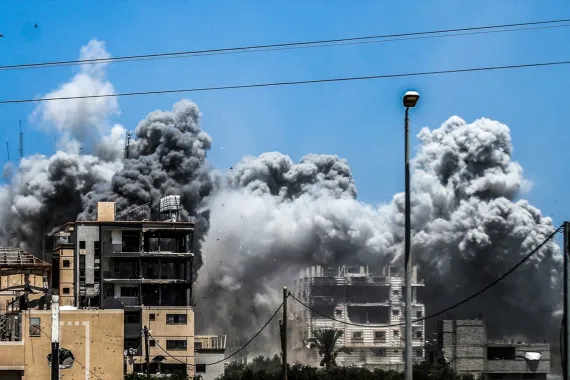
GAZA-At least 63 Palestinians were killed in Israeli strikes across Gaza on Saturday. The deaths came as Israeli forces pushed deeper into Gaza City in their effort to capture the area and displace nearly one million residents.
Footage showed Israeli tanks advancing into the Sabra neighborhood, near the heavily bombarded Zeitoun district. A child was reportedly killed in the latest Israeli bombardment of Sabra, Gaza City’s al-Ahli Hospital confirmed.
In southern Gaza, Israeli artillery shelled tents sheltering displaced families in the Asdaa area northwest of Khan Younis, killing 16 people, including six children. Later, at least 22 more Palestinians were killed while trying to obtain humanitarian aid, including two civilians shot dead by Israeli forces near aid distribution points in Khan Younis and along the Netzarim Corridor.
Palestinian health officials also reported that eight people, including two children, died from malnutrition in the past 24 hours, bringing the total number of famine-related deaths to 281 since the war began nearly two years ago. Munir al-Bursh, director-general of Gaza’s Health Ministry, said 114 of the victims were children, warning that “the famine is silently ravaging the bodies of civilians” and turning tents and hospitals into “daily scenes of tragedy.”
On Friday, the United Nations officially declared a famine in Gaza – the first time such a designation has ever been made in the Middle East. The UN accused Israel of systematically blocking aid deliveries and Secretary-General Antonio Guterres called the famine a “man-made disaster.”
The Integrated Food Security Phase Classification (IPC) said 514,000 people, nearly a quarter of Gaza’s population, are currently facing famine, with the number expected to rise to 641,000 by the end of September.
Kathmandu — The ruling party Nepali Congress is facing sharp internal rifts over the plan to dismiss Deputy Speaker of the House of Representatives Indira Rana Magar. Although the Congress–CPN-UML-led government has pushed forward with the move to remove her in order to maintain its influence and majority in the Constitutional Council, the decision has deepened divisions within the party.
Leaders from the Shekhar Koirala faction have voiced dissatisfaction with the step. Along with Koirala himself, two general secretaries and several lawmakers aligned with the Koirala camp have publicly stated that Rana should not be removed. This signals that the Congress leadership may struggle to secure the necessary support.
Meanwhile, Rana, who is currently in the United States, has reportedly shown concern over the unfolding events and contacted Shekhar Koirala by phone. Reports suggest that once she returns to Nepal, a no-confidence motion will be filed against her. In the past too, attempts were made to remove her, but the process was stalled after failing to secure the required two-thirds majority. Political circles now speculate that a similar situation could repeat itself.
In terms of political arithmetic, the Congress–UML-led government faces serious challenges in gathering the necessary votes. Parties such as the Rastriya Prajatantra Party , Rastriya Swatantra Party , CPN Unified Socialist, and Maoist Centre have already made it clear they will not support the move. This makes it very difficult for the government to reach the two-thirds majority.
Further uncertainty has arisen after the Supreme Court recently issued a mandamus in the Gaur massacre case involving Upendra Yadav. Whether Yadav’s faction will back the government or not remains unclear, but his decision could play a decisive role.
Similarly, the support of the Nagarik Unmukti Party also remains uncertain. The party is divided internally, and allegations of irregularities against party chairperson Ranjita Shrestha have left its stance on the proposal unclear. Even so, observers suggest that both Yadav and Shrestha might eventually side with the government out of fear of court and anti-corruption scrutiny.
All these factors have made the government’s strategy increasingly complicated. With internal discontent within the ruling Congress, lack of support from opposition parties, and uncertainty among smaller parties, whether the attempt to remove Deputy Speaker Rana will succeed or once again end incomplete remains a subject of close political attention.
Meanwhile, analysts have begun interpreting the political struggle surrounding the Deputy Speaker not only as an effort to dismiss her but also as a broader reflection of power balance, factional rivalries, and future coalition dynamics. According to them, this step is not merely about one position but signals deeper shifts in the balance of power within the state.
Now the question remains, will the Congress–UML leadership resolve internal disputes and secure the two-thirds majority, or will the move to remove Deputy Speaker Rana once again end in failure?
Kathmandu – The National Assembly’s Public Policy and Delegated Legislation Committee has directed Tribhuvan University (TU) to ensure that vacant leadership positions are filled at least three months before the end of a term.
The directive came as part of a study report on the implementation of delegated legislation under the Tribhuvan University Act, 2049 BS.
According to the report, “If the post of Vice-Chancellor or other office bearers becomes vacant, the concerned authority must appoint successors at least three months in advance. This will help the new leadership to perform their duties smoothly.”
The committee also suggested that the government introduce a new law to restructure TU in line with the current constitution.
The report pointed out that office bearers’ pay, benefits, and service conditions should be defined in the rules, not arbitrarily set through internal regulations.
It further criticized the creation of funds such as the Staff Welfare Fund, Medical Fund, and Loan Fund through regulations, saying such provisions should be made only through law to avoid adding unnecessary financial burdens on the university.
The report concluded that TU has exceeded its delegated authority by framing 35 regulations, 16 procedures, 17 directives, and 19 guidelines through its executive council, despite having no legal authority to re-delegate rule-making powers.
Kathmandu – Indian Foreign Secretary Vikram Misri held a courtesy meeting with Prime Minister KP Sharma Oli at the Office of the Prime Minister and Council of Ministers in Singha Durbar. Vikram Misri arrived in Kathmandu this morning for a two-day visit.
He is scheduled to hold several high-level meetings today.
On Monday, he will visit the Pashupatinath Temple before returning to India. It has been reported that the discussions also touched on agendas related to Prime Minister Oli’s upcoming India visit.
Hetauda — Bagmati Province Chief Minister Indra Bahadur Baniya on Friday appointed five new ministers from the Nepali Congress, completing his cabinet. Earlier, he had appointed eight ministers, including himself.
The newly appointed ministers are Kanchan Chandra Bade from Kavre (Ministry of Social Development), Prabhat Tamang from Rasuwa (Ministry of Economic Affairs and Planning), Urmila KC Nepal from Lalitpur (Ministry of Youth and Sports), Suresh Shrestha from Bhaktapur (Ministry of Culture and Tourism), and Binu Rayamajhi Poudel from Chitwan (Ministry of Cooperatives and Poverty Alleviation).
Earlier, Congress members Krishna Tamang and Shivraj Adhikari had also been given ministerial responsibilities, while six ministers from CPN-UML took charge of various ministries. According to an earlier agreement between Congress and UML, both parties received six ministries each, including the chief ministership.
However, dissatisfaction has surfaced within the Congress after Baniya failed to appoint three lawmakers from former Chief Minister Bahadur Singh Lama’s faction as ministers. Lama’s side had earlier agreed to support Baniya in the vote of confidence on August 11 only on the condition that their chosen three lawmakers would be made ministers. Lama later stated that he supported the vote after the central leadership assured him the agreement would be implemented.
Baniya, however, did not include any lawmakers from Lama’s faction in the cabinet. If disagreements between Baniya and Lama over this matter deepen, political tensions within the provincial government could rise again.
The war in Ukraine is deep into its third year, and the country is paying a price far heavier than any Western promise can repay. The Alaska meeting between Donald Trump and Vladimir Putin could be a turning point. Not for victory, but for survival.
Ukrainian President Volodymyr Zelenskyy will not be there. His absence is symbolic. Decisions about Ukraine’s future are now being shaped elsewhere. Zelensky’s greatest mistake was steering Ukraine into NATO’s orbit, knowing it would provoke Moscow and ignite a confrontation Ukraine could never win on its own. NATO expansion was the red line. The West knew it. Russia made it clear. Yet Zelensky pushed forward, encouraged by promises from Washington and Brussels. Those promises have proven to be weapons without guarantees, aid without security. Ukraine is now the battleground of a proxy war aimed at weakening Russia, at the expense of Ukrainian lives, land, and future.
Ukraine once shared more than just a border with Russia. For centuries, their histories, cultures, and languages intertwined. Millions of Ukrainians speak Russian as their mother tongue. Much of the country’s infrastructure, trade, and industrial base was built during the Soviet era, when cooperation was not confrontation but the norm. That relationship could have been preserved after independence, making Ukraine a bridge between East and West. Instead, Kyiv became the front line of a geopolitical game.
Now, the Alaska meeting between Trump and Putin could signal a different path, one that acknowledges reality. If Ukraine is to have peace, it may mean accepting the loss of certain territories now under Russian control. This is the “price for peace.” The phrase “piece for peace” captures the uncomfortable truth, but sometimes a portion of land must be given up to stop further destruction.
A settlement, even one that involves territorial concessions, could allow Ukraine to rebuild its economy, repopulate its towns, and recover its independence in practice, if not entirely on paper. This would not mean turning its back on the West entirely, but it would mean recognizing that lasting stability requires a functional relationship with Russia. Given the shared language, culture, and history, Ukraine could have been a bridge between East and West. Instead, Zelensky’s government chose to burn that bridge.
Now the question is whether a new one can be built, before the entire foundation crumbles.
The Alaska summit may be the best chance yet to end the bloodshed. It will require courage from leaders to accept imperfect peace. For Ukraine, that courage means facing the hard truth, peace may come at the cost of a piece of territory. But the cost of continuing down the current path will be far higher.
Donald Trump has said more than once that Ukraine should be ready to give up some territory to achieve peace. That idea, however painful, might be the only path left. If Alaska produces an agreement to end hostilities, it will likely include territorial concessions, what could be called a “piece for peace.” Without that, the war could drag on for years, exhausting Ukraine’s population, economy, and military until there is little left to save.
Zelensky has rejected any deal involving territorial loss, insisting that peace cannot be achieved by surrendering land. The EU and UK have echoed his position. That makes the Alaska meeting controversial, negotiations about Ukraine’s fate are being held without Ukraine’s own president at the table. Critics will call this surrender. But is it surrender to choose survival over ruin? Ukraine’s leadership must weigh whether continuing the fight truly serves its people’s long-term interests. Every month of war brings new graves, deeper economic collapse, and more young Ukrainians leaving the country for good. The promise of NATO membership is distant. The hope of recovering every inch of territory may be impossible without risking total collapse.
If the meeting fails to produce a ceasefire or a clear path to end the war, amid zelensky and EU members being against giving up the territories, the consequences could be dire. Russia may consolidate its hold on occupied regions. Western support may waver as public fatigue and economic strain grow. Ukraine’s battlefield losses may deepen beyond repair. And the chance for a negotiated settlement, however imperfect may disappear entirely.
Peace will almost certainly require compromise. For Ukraine, that may mean accepting the loss of some land to save the rest of the country. Continuing the war without a path to victory is not bravery, it is national suicide. History will not remember the exact borders. It will remember whether there was still a Ukraine for its people to call home.
Ukraine can still have a future, but not if it insists on fighting to the last brick. Territorial concessions are not the end of independence, they can be the beginning of survival.
Kathmandu – Prime Minister KP Sharma Oli is set to sign performance agreements today with Deputy Prime Ministers Prakash Man Singh and Bishnu Prasad Paudel, along with other ministers, outlining the key tasks and targets for the current fiscal year.
The signing and exchange ceremony will take place at the Office of the Prime Minister and Council of Ministers, Singha Durbar, alongside the annual progress review of each ministry.
According to the Prime Minister’s private secretary, Binod Bahadur Kunwar, the agreements will serve as the main framework for speeding up and making the year’s tasks more effective.
The practice of signing performance agreements, aimed at completing infrastructure projects and improving service delivery on time to fulfill the national vision of “Prosperous Nepal, Happy Nepali,” which was initiated during Oli’s previous term.
Once the ministers sign their agreements with the Prime Minister, they will, in turn, sign performance agreements with their respective secretaries.
Kathmandu – The Parliamentary Committee on Law, Justice, and Human Rights has directed the government to conduct an impartial investigation into the recent incident at Kailali Prison and take legal action against those responsible.
In a meeting held at Singha Durbar on Wednesday, the committee instructed the government to investigate the incident of Kailali Prison, punish the guilty in accordance with the law, and arrange compensation for the victims as per legal provisions.
The committee also directed the Ministry of Home Affairs to make the prison administration more accountable and prevent such clashes and assaults from recurring in other prisons across the country. It further recommended implementing strategies to engage inmates in labor and productive activities effectively.
Additionally, the committee instructed authorities to house prisoners in different blocks or facilities based on the nature of their crimes, the number of inmates, and their behavior. It also called on the government to expand physical infrastructure inside prisons and establish at least one model prison in each province.
During the meeting, Home Minister Ramesh Lekhak informed that a probe committee had already been formed to investigate the Kailali Prison incident and that the facts would be revealed once the report completed. He stated that no firearms were used in the incident; instead, bricks and stones available on the premises had been used.
Minister Lekhak acknowledged the poor state of prison infrastructure nationwide and stressed the need for improvement. He said the government is committed to developing prisons while ensuring the protection of inmates’ human rights and creating an environment for their reintegration into society after release.
KATHMANDU – The Press Council Nepal has released a record of press freedom-related incidents based on complaints registered with the council and its regular monitoring.
According to the council, monitoring conducted between July 17, 2024, and mid-July 2025 documented 94 cases of press freedom violations.
The data shows that threats and harassment were the most frequent types of violations. A total of 106 journalists — 96 men and 10 women — were found to be victims during this period.
KATHMANDU – John Wingle, Deputy Vice President of the Millennium Challenge Corporation (MCC) overseeing operations in Europe, Asia, the Pacific, and Latin America, arrived in Kathmandu on Monday, marking the first high-level MCC visit since the US resumed aid halted under the Trump administration.
During his stay, Wingle will meet senior Nepali officials, including Deputy Prime Minister and Finance Minister Bishnu Poudel, and attend the signing of contracts for two transmission line projects jointly funded by Nepal and MCC. These include the $77.48 million Ratmate–New Damauli line and the $77.03 million New Damauli–New Butwal line, part of the 297 km MCC Nepal Compact electricity project.
The Trump administration had paused MCC operations in early 2025 during a foreign aid review. In July, the US decided to continue the MCC Nepal Compact, giving Nepal three years to complete the projects or return unspent funds.
The MCC board will meet on August 21 to clarify the agency’s future. In Nepal, the $697 million MCC Compact—ratified in 2022—also includes road upgrades and construction of three new substations. Land acquisition and tree clearance remain key challenges to meeting the tight deadline.
Kathmandu – Speaking during Tuesday’s meeting of the House of Representatives, Ramhari Khatiwoda announced his resignation from the position of Chairperson of the State Affairs and Governance Committee.
The resignation comes amid debate that the committee chair should take moral responsibility after a parliamentary probe concluded that the committee’s report on the Cooling-Off Period Bill contained serious errors.
Khatiwoda clarified that staff from the Ministry of Law, Justice and Parliamentary Affairs and the Ministry of Federal Affairs were involved in drafting the report, and that the errors in the Civil Service Bill were not committed by him or the committee members. However, he admitted his shortcoming in failing to thoroughly review the final draft before approval.
The Nepali Congress has decided to form a task force to bring the issue of constitutional amendment to a meaningful conclusion. The task force will hold discussions with political parties that cooperated in the drafting of the constitution, as well as with experts, specialists, and representatives from concerned civil society groups. It will also be responsible for conducting internal discussions within the party on matters related to constitutional amendment.
The agenda for constitutional amendment was introduced during the agreement between the Nepali Congress and the CPN-UML to form a government. However, Congress maintains that simply introducing a bill unilaterally will not achieve the goal, and that the country should instead move forward by building consensus on necessary amendments.
According to Chief Secretary Krishna Prasad Paudel, the task force will be announced within the next two to three days. It will have a coordinator and between five to seven members, depending on necessity and relevance. A senior Congress leader stated that there are internal discussions within the party about appointing former General Secretary Krishna Prasad Sitaula—who played an active role during the constitution drafting process—as the coordinator of the task force.
Kathmandu — The Election Commission of Nepal has prepared a draft of the Political Party Self-Evaluation Procedure, 2082, which proposes that political parties regularly assess their transparency, accountability, and internal practices. The draft includes provisions for a committee led by the Commission’s secretary to oversee, guide, and evaluate political parties.
Under this draft, parties must submit reports evaluating their internal structure, financial transparency, adherence to legal procedures, and overall conduct. The committee would be empowered to investigate complaints, publish evaluation reports, and recommend actions to the Commission based on findings.
However, several smaller and opposition parties have strongly opposed the draft, calling it unconstitutional and politically motivated. Parties such as the Maoist Centre, Rastriya Swatantra Party (RSP), Rastriya Prajatantra Party (RPP), JSP Nepal, Janamat Party, Nagarik Unmukti Party, and others claimed the Election Commission is attempting to suppress all parties except the Nepali Congress and CPN-UML.
Senior advocate and former Nepal Bar Association president Gopal Krishna Ghimire criticized the proposal, saying it’s inappropriate for bureaucrats to direct political parties and warned such provisions could be abused to restrict multiparty democracy.
The Election Commission responded by stating that the draft’s intent is to promote internal reform and good governance in parties, not to control them. It is currently seeking feedback and is open to amendments.
Kathmandu — The Parliamentary Inquiry Special Committee has concluded that Nepali Congress MP and Chairman of the State Affairs Committee Ramhari Khatiwada is morally responsible for the errors seen in the report on the Federal Civil Service Bill. The role of some employees, including Khatiwada, is also clearly mentioned in the investigation report prepared by the committee.
According to the investigation committee, it has been seen that even high-ranking employees have failed to behave in a manner befitting their positions. The committee has concluded that if they had understood their official responsibilities, such a big error would not have occurred in the writing of the bill report.
The report submitted to the House of Representatives bears the signatures of Chairman of the State Affairs Committee Ramhari Khatiwada and Secretary Suraj Kumar Dura, and their names have been mentioned in the report. According to a member of the committee, “Both Khatiwada and Dura have been mentioned in the report because political officials are politically and morally responsible.”
Similarly, although it is mentioned that the Chief Secretary and other employees will be held accountable both officially and legally, the name of the Chief Secretary is not mentioned in the report.
Hetauda – Nepali Congress parliamentary party leader Indra Bahadur Baniya is being appointed as the sixth Chief Minister of the Bagmati Province government.
Baniya, who is also the Congress Bagmati Province President, has submitted his claim to the Chief Minister’s post to form a new government at the Province Chief’s Office.
Immediately after Bahadur Singh Lama’s resignation was accepted, Province Chief Deepak Prasad Devkota had called for submission of claims for the appointment of Chief Minister by 2 pm today, Tuesday.
Baniya submitted his claim on Monday with the support of 37 Congress MPs and 27 from the ruling party CPN-UML. The support of 56 MPs is required to form a government in the 110-member Province Assembly.
Province Chief Devkota will appoint Baniya as the Chief Minister after the 2 pm deadline given for government formation. The Province Chief’s Office has scheduled Baniya’s oath of office and secrecy for 4 pm.
Kathmandu – The National Examination Board has announced the results of Class 12.
511,525 candidates participated in the examination. According to the public results, 61.17 percent of students have passed in Class 12, while 38.83 percent of students have been non-graded.
The National Examination Board is going to conduct the Grade 12 grade increase examination on Bhadra 28 and 29.
Kathmandu — A parliamentary special investigation committee has concluded that deliberate manipulation was carried out in the Federal Civil Service Bill to render the “cooling-off period” provision ineffective. The finding, issued by the special probe committee of the House of Representatives, states that the inclusion of a contradictory clause in the bill was not a “human error” but an intentional act — a conclusion unanimously agreed upon by all seven committee members.
The State Affairs and Good Governance Committee had unanimously decided to include a provision under Clause 82 (4) of the bill stating:
“Civil servants or individuals who resigned or retired from other government services shall not be eligible for appointment to any constitutional or governmental position until two years have passed from the date of their retirement.”
Once this provision was included, a previously existing clause — which prohibited such individuals from being appointed to any post except for constitutional or diplomatic roles or other appointments made by the Government of Nepal — was supposed to be removed. However, it was retained under Clause 82 (5a), raising serious concerns.
In response to this contradiction, the House of Representatives formed a special probe committee led by Nepali Congress MP Jeevan Pariyar. Other members include Sushila Thing, Narayan Prasad Acharya, Ishwari Gharti, Madhav Sapkota, Ganesh Parajuli, and Roshan Karki. The committee is now in the final stages of drafting its report.
According to members of the probe committee, the report will specify who was involved in keeping the conflicting clause in the bill and recommend necessary actions against them. It will also make suggestions to prevent similar manipulation in the future.
One committee member noted that from the bill’s drafting to the parliamentary reporting stages, senior experienced officials from the Ministry of Law and General Administration, as well as the Parliament Secretariat, were involved. In addition, there were visible lobbying efforts against the cooling-off period by the Chief Secretary, the Secretary General of Parliament, and several other government secretaries — making it impossible to dismiss the issue as a mere technical oversight.
Another member stated that even during the State Affairs Committee meeting on Asar 18 (early July), suspicions of deliberate conspiracy and ill-intent were raised, ruling out the possibility of it being a simple error.
Committee coordinator Jeevan Pariyar confirmed that the final report would be submitted to the House of Representatives on Shrawan 19 (August 4).
“We’ll submit a report that identifies flaws in the cooling-off provision, recommends action against those involved, and outlines future safeguards,” he said. “We’re finalizing the conclusions, and the committee is carefully analyzing facts and shaping its recommendations.”
At a committee meeting held Saturday, members discussed the exact roles played by various individuals in intentionally weakening the cooling-off period clause.
“Members have expressed views on who bears what level of responsibility. A Congress MP has said he will share his views on Sunday,” one member reported.
According to that source, the report drafting involved officials from the Ministry of Law and General Administration, the Chairperson of the State Affairs Committee Ramhari Khatiwada, Secretary Suraj Kumar Dura, and several others. Following the bill’s approval by the committee, Chief Secretary Eknarayan Aryal, along with two dozen secretaries and Parliament Secretary General Padma Prasad Pandey, were actively lobbying against the cooling-off provision.
While undersecretaries were still preparing the report, the Chief Secretary, Secretary General, and other secretaries threatened collective resignation and lobbied top political leaders, including then-Prime Minister KP Sharma Oli and Congress President Sher Bahadur Deuba. They also publicly confronted Secretary Dura of the State Affairs Committee in front of Speaker Devraj Ghimire and National Assembly Chair Narayan Prasad Dahal.
“Such actions clearly influenced the law-making process,” one committee member stated.
The special committee plans to discuss punitive actions against responsible officials during its Sunday meeting. Clause 3 of the committee’s mandate explicitly directs it to recommend disciplinary measures.
“We’ve finished analyzing the facts and are now evaluating individual responsibilities to draw final conclusions,” the member added.
To support its investigation, the committee has consulted constitutional expert Kashiraj Dahal and legal professionals from the Office of the Attorney General. It has also summoned IT and computer experts from Nepal Police.
The House of Representatives had formed this special committee on Asar 23 (July 7) with an initial 21-day mandate to investigate the controversial provision in the civil service bill. Since the probe could not be completed on time, the deadline was extended by a week. The committee includes two members each from the ruling Nepali Congress and UML, and one each from the opposition parties — Maoist Center, Rastriya Swatantra Party (RSP), and Rastriya Prajatantra Party (RPP).
President Donald Trump has fired Dr. Erika McEntarfer, Commissioner of the Bureau of Labor Statistics (BLS), accusing her—without evidence—of manipulating job numbers to harm his administration politically.
The move followed a disappointing July jobs report showing just 73,000 jobs added—well below expectations—and downward revisions to May and June figures by a combined 258,000. Trump reacted sharply, claiming the figures were deliberately distorted.
“In my opinion, today’s Jobs Numbers were RIGGED in order to make the Republicans, and ME, look bad,” Trump wrote on Truth Social, later calling the data “phony” and accusing McEntarfer of making a “major mistake.”
“We’re doing so well… So, you know what I did? I fired her,” Trump told reporters Friday.
McEntarfer, confirmed by the Senate in January 2024 for a four-year term, has not commented. Deputy Commissioner William Wiatrowski will serve as Acting Commissioner until a new appointment is made.
Trump has previously questioned the credibility of BLS data when unfavorable, despite praising it when reports were strong. Experts note that revisions like those made to the May and June figures are common, as the BLS uses evolving data and seasonal adjustments to refine its estimates.
In a dramatic move fueled by rising tensions with Moscow, U.S. President Donald Trump announced he has ordered two American nuclear submarines to relocate to “appropriate regions.” The decision, Trump claimed, comes in response to what he described as “highly provocative statements” from Dmitry Medvedev, the Deputy Chairman of Russia’s Security Council and former Russian President.
“Based on the highly provocative statements of the Former President of Russia… I have ordered two Nuclear Submarines to be positioned… just in case these foolish and inflammatory statements are more than just that,” Trump posted on Truth Social. He did not elaborate on the exact nature of Medvedev’s remarks.
Warning that “words are very important and can often lead to unintended consequences,” Trump expressed hope that this situation would not spiral further.
The verbal escalation follows Medvedev’s series of posts on X (formerly Twitter) and Telegram. On July 28, he warned that Trump’s comments about shortening the timeline for the Ukraine conflict and issuing threats toward Russia could be seen as a step toward war. Days later, on July 31, Medvedev mocked Trump’s criticism of the Russian and Indian economies, referring to them as “dead,” and cryptically referenced the Cold War-era Soviet “Dead Hand” nuclear retaliation system.
“Let him remember his favorite movies about the ‘walking dead,’ and also how dangerous a ‘dead hand’ can be,” Medvedev wrote, accompanied by a laughing emoji.
The “Dead Hand” or “Perimeter” was a Cold War-era automatic system designed to launch a full-scale nuclear retaliation in the event of a decapitation strike on Soviet leadership.
Trump had earlier derided the economies of Russia as “dead” and took aim at Medvedev personally in his Truth Social posts, deepening the rhetorical standoff.
Kathmandu — In a renewed display of diplomatic engagement, Nepal and India have agreed to resume joint border mapping using new technology. This development emerged from the seventh meeting of the Nepal–India Boundary Working Group (BWG) held in New Delhi. While the agreement marks progress in managing technical aspects of the shared boundary, it consciously sidestepped some of the most politically sensitive areas,particularly Kalapani and Susta,thus failing to address the deeper, long-standing territorial disputes between the two nations.
For Nepal, the border issue transcends modern geopolitics. It is rooted in history, colonial injustice, and a national quest to restore its rightful territory. In an age when democracies strive to rectify the injustices of colonialism, Nepal’s long-standing territorial grievances remain invisible to the global stage. Once a proud Himalayan kingdom stretching from the Sutlej in the west to the Teesta in the east, Nepal now exists within a fraction of its historical borders,its national dignity wounded, its sovereignty perpetually questioned. This is not merely a cartographic dispute. The idea of “Greater Nepal” is not a mythic dream,it is a rightful demand born from history, bloodshed, and betrayal.
The British justified the annexation through brute force and diplomacy under duress. Unlike other colonial possessions, these lands were taken from an independent sovereign state through an unfair treaty, which, under modern international norms, would be deemed voidable. When the British departed the subcontinent in 1947, Nepal anticipated that its lands taken under colonial coercion would be returned. International law supports the principle that post-colonial borders should be reconsidered in light of unjust treaties imposed under imperial duress. However, instead of restoration, India absorbed these territories,including Kalapani, Lipulek, Limpiyadhura, Darjeeling, and Sikkim,into its republic without dialogue or legal negotiation with Nepal.
The Roots of a Disputed Geography
Following the Anglo-Nepalese War (1814–1816), Nepal was coerced into signing the Treaty of Sugauli with the British East India Company. This humiliating accord saw Nepal lose over a third of its territory, including the fertile and strategically significant regions of Kumaon, Garhwal, Darjeeling, Sikkim, and much of the Terai. These areas,forming what many now call “Greater Nepal”,were annexed not through fair negotiation but at the barrel of a gun, violating Nepal’s sovereignty under duress.
While the colonial cartographers redrew South Asia, there was little regard for history, culture, or consent. These lost lands were never just borders,they were the economic lifeblood and cultural identity of the Nepali state. And when the British Empire ended in 1947, instead of restoring these territories to their rightful owner, newly independent India retained them, failing to address the illegitimacy of colonial conquest.
Independence for India, Injustice for Nepal
When Britain departed in 1947, its colonial scars were supposed to fade. But for Nepal, a new chapter of disenfranchisement began. Instead of returning territories unjustly annexed, newly independent India inherited colonial boundaries and preserved them with greater tenacity than even the British.
The Treaty of Peace and Friendship, signed in 1950 between Rana Prime Minister Mohan Shamsher and Indian Ambassador C.P.N. Singh, became a cornerstone of India-Nepal relations. Yet to many in Nepal, it symbolized a quiet annexation of sovereignty. Indian citizens could live and work freely in Nepal, while Nepal’s strategic autonomy shrank under India’s expanding shadow. No clause addressed territorial restitution. No dialogue ever considered the unfinished business of decolonization. What followed was India embedding itself into Nepal’s internal affairs under the guise of cooperation. Military liaison missions, economic dependency, and political manipulation followed. Even Nepal’s attempts to exercise independent foreign policy were often met with economic blockades or diplomatic pressure. The 1950 treaty, still unamended, remains a living document of Nepal’s compromised sovereignty.
The Mahakali Treaty: Water and Wounds
In 1996, the Mahakali Treaty was signed with the promise of joint hydropower and irrigation development along the Mahakali River (called Sharda in India). While hailed as a landmark in cooperation, the treaty failed to address the very origin of the river,Kalapani, a disputed territory still under Indian control.
The ambitious Pancheshwar Multipurpose Project promised economic upliftment but remains stalled. Critics within Nepal argue the deal lacked transparency, disproportionately benefitted India, and ignored ecological and national security implications. Once again, diplomacy cloaked domination.
Kalapani and the Cartographic War
The turning point came in 2020, when India unilaterally constructed a road through the Lipulek pass, a territory Nepal firmly claims under its western boundary demarcation. In a defiant and historically informed act, Nepal responded by issuing a new political map that reinstated Kalapani, Lipulek, and Limpiyadhura as integral parts of its territory. This move, supported by a constitutional amendment and overwhelming parliamentary consensus, was not mere symbolism,it was an overdue assertion of historical fact.
India, instead of engaging diplomatically, labelled the new map as “cartographic aggression.” Yet it was India that had redrawn the lines, not Nepal. The Nepali move was a correction, not a provocation.
Historical Justice and International Law
The Greater Nepal movement is not secessionist,it is restorative. International law has increasingly recognised the illegitimacy of colonial-era treaties made under coercion. The Sugauli Treaty is one such example. The principle of “uti possidetis juris“,which insists colonial borders must be upheld to avoid conflict,fails when those borders were fraudulently or violently imposed.
Global precedent suggests that historical claims must be revisited when they stem from violent dispossession. If Britain could return Hong Kong and entire India itself, Portugal could return Goa(city in India),if France could apologise to Algeria, why can’t India acknowledge that much of its northern border was inherited not by right but by colonial theft?
The Modern Reality: India’s Strategic Paralysis
Despite growing calls for a treaty review, India continues to dismiss or delay discussions. The Eminent Persons Group (EPG), a joint Nepal-India panel formed in 2016 to recommend revisions to outdated agreements, submitted its report in 2018. India has refused to even receive the document.
India’s approach has not only bred resentment but also strengthened the hand of nationalist movements in Nepal. The Greater Nepal campaign is no longer fringe,it is mainstream. It reflects a broader South Asian trend where smaller nations are demanding dignity, not deference.
Greater Nepal Is Not an Idea—It Is an Injustice Waiting to Be Corrected
Nepal’s historical claim is not rooted in expansionism but in rightful reclamation. The lands of Greater Nepal were not lost in war,they were stolen in colonial deceit and never returned. Today, maps, treaties, and military might cannot erase the memory of that theft.
India must face a moral crossroads. Will it continue to uphold colonial spoils as sacred borders, or will it join the ranks of mature democracies that right the wrongs of the past? Greater Nepal is not a dream,it is unfinished justice. And until that justice is acknowledged, Nepal’s sovereignty will remain wounded, its borders incomplete, and its dignity denied.
For Nepal, this is not about geopolitics but identity. And for the global community, it is a test, will the international order uphold principles of fairness, or will it remain selectively blind to the scars of empire?
The borders of Greater Nepal may not be redrawn tomorrow. But its claim,anchored in history, marred by betrayal, and now reawakened,will not be forgotten. Not by its people. Not by those who still believe that justice delayed is not justice denied. For Nepal, the call is clear,the era of silence has ended. The Greater Nepal that once was, must now be the Nepal that will be.
Hezbollah’s deputy leader Naim Qassem has rejected growing calls,mainly from the U.S.—to disarm the group, saying such demands only benefit Israel. Speaking on the anniversary of commander Fuad Shukr’s killing by Israel, Qassem stated, “Disarming Hezbollah means surrendering to Israel—we will not do that.”
The U.S. has reportedly been pressuring Lebanon to formally commit to Hezbollah’s disarmament as a condition for halting Israeli military operations. Under a ceasefire agreed last November, Hezbollah was to withdraw north of the Litani River, leaving southern Lebanon to the Lebanese army and UN peacekeepers. However, Israeli strikes and troop presence continue.
Qassem warned that calls to hand over Hezbollah’s arsenal—especially missiles and drones—are being pushed for Israel’s benefit, not Lebanon’s security. He insisted that Hezbollah’s weapons are a national matter, unrelated to Israel, and reaffirmed that the group will only consider disarmament if Israel halts its aggression and withdraws from Lebanese territory.
A cabinet meeting is set for next week in Beirut to address national sovereignty, the ceasefire, and possibly the disarmament proposal reportedly backed by U.S. envoy Tom Barrack.
US and UK officials have allegedly held a covert meeting with top Ukrainian powerbrokers to discuss removing President Vladimir Zelensky and replacing him with former military chief Valery Zaluzhny, according to Russia’s Foreign Intelligence Service (SVR).
The SVR claims the secret meeting took place at an undisclosed Alpine resort and involved key figures including Zelensky’s chief of staff Andrey Yermak, military intelligence head Kirill Budanov, and Zaluzhny, currently Ukraine’s ambassador to the UK.
According to the SVR, Western officials agreed that Zelensky’s time was up and considered his replacement a “key condition” for restoring relations and continuing military aid. Yermak and Budanov reportedly supported the plan, having been promised to retain their positions under a Zaluzhny presidency.
Zaluzhny, Ukraine’s armed forces chief from 2021 to 2024, remains popular and is widely seen as a strong contender in any potential election.
The SVR also linked the move to Zelensky’s controversial attempt to strip anti-corruption bodies of their independence—a decision it claims Yermak encouraged to damage Zelensky’s image and justify his removal.
Addressing Ukrainians, the SVR remarked: “A new president has been chosen at an Alpine resort. Is this the democracy you hoped for?”
Zelensky’s term officially ended in May, but elections have been suspended under martial law. Russia now considers him illegitimate, claiming real power lies with Ukraine’s parliament.
Kathmandu- The meeting of the special committee to investigate the errors in the report of the Federal Civil Service Bill is being held.
The meeting to be held at 11 am at the Singha Durbar State Affairs and Good Governance Committee meeting hall will discuss the work of writing the report.
As the inquiry work is nearing its end, the committee is busy writing the report.
On Ashad 23, the House of Representatives had formed a parliamentary inquiry committee regarding the changes in the cooling period provided in the Civil Service Bill. The committee has two members each from the Nepali Congress and the CPN-UML and one each from the Maoist Center, the Rashtriya Swatantra Party and the RPP.
The committee includes Congress MPs Jeevan Pariyar and Sushila Thing, while the CPN (UML) members are Ishwori Gharti and Narayan Prasad Acharya. Madhav Sapkota is from the Maoist Center, Ganesh Parajuli from the Rastriya Swatantra Party, and Roshan Karki from the Rastriya Prajatantra Party.
When the committee was formed, Speaker Devraj Ghimire gave 21 days to the committee. After the committee stated that the time was insufficient, an additional seven days were given. Now, the investigation committee has time until 19th Shrawan.
The committee is busy writing the report to complete the work on time. The House of Representatives is meeting on 19th Shrawan. The committee is preparing to submit the investigation report in that meeting.
Kathmandu: A case has been filed against Rajesh Ahiraj, also known as Rajesh Jha, the former Chief of Madhesh Province, who was arrested on charges of rape.
Jha, who was arrested on Shrawan 4 (July 19), was charged within nine days. Based on the police investigation report, the Office of the Government Attorney, Kathmandu, filed a case against him at the Kathmandu District Court.
Ahiraj has been accused of raping a young woman. The allegation states that on Jestha 4, 2081 BS (May 17, 2024), he raped her at her rented apartment in New Baneshwar, Kathmandu. The victim claims that while she was alone in her room, Ahiraj came and raped her. They were already acquainted prior to the incident.
The investigation was carried out under Section 219 of the Muluki Criminal Code Act 2074 (Nepal Penal Code), which deals with the offense of rape. The charge demands punishment as per Clause (ṅ) of Subsection 2 of Section 219.
According to Clause (ṅ), raping a woman aged 18 years or older is punishable by imprisonment ranging from seven to ten years.
The victim stated that Ahiraj took advantage of her being alone to commit the act. She had known him through close family connections. In her statement, she mentioned that Ahiraj used to visit her house from time to time due to their prior acquaintance.
She further stated that since then, Ahiraj had been trying to get close to her. Originally from Biratnagar, the young woman had moved to Kathmandu for her studies and had been living in a rented room in Baneshwar. She claims the rape occurred when Ahiraj came to her room.
“When he found out I had moved to Kathmandu, he began visiting my rented room in Baneshwar. Taking advantage of the fact that he was well-acquainted with my father, mother, and family members, he used that familiarity to exploit me and raped me on Jestha 4, 2081,” the victim said in her statement.
According to the investigation, Ahiraj entered her room under the pretext of delivering an urgent message from her family.
“When I asked him why he came in person and didn’t just inform me over the phone, and told him I was alone, he said, ‘Why are you afraid? I know your family well. You can trust me,’” she recounted.
The victim said that after she offered him water, he locked the door, covered her mouth, and raped her.
“When I asked why he locked the door, he suddenly covered my mouth and threw me onto the bed. He threatened me, saying, ‘If you scream, it will only disgrace you. I’m a man, nothing will happen to me.’ He then started pressing hard on my throat and mouth. I still tried to scream, but he said, ‘If you scream again, I’ll rape you and kill you,’” she stated.
The victim said he assaulted her while threatening to kill her and exploiting her vulnerability.
“He said, ‘None of your family members are here. No one will ever know who killed you. In Nepal, laws only work for those with money and power,’ and with that threat, he violated me,” she told the police. “After repeated sexual assault, I was bleeding from my private parts. Even when I pleaded with him to stop, he continued to rape me forcibly.”
She further alleged that after the rape, he threatened her not to speak about it, warning that the Madheshi community would socially boycott her.
“If this gets out, you and your family will be shamed to the point you won’t be able to show your faces anywhere. Your entire family might be forced to commit suicide,” she stated in her complaint. “And if you tell anyone, I’ll either kill you or kidnap and murder your brother,” she said, adding that he left the room wearing his clothes after making these threats.
Kathmandu – Minister for Land Management, Cooperatives and Poverty Alleviation Balram Adhikari has said that if the land of Giribandhu Tea Estate in Jhapa is found to be used for other purposes, it will automatically belong to the government.
Speaking at the meeting of the Agriculture, Cooperatives and Natural Resources Committee under the House of Representatives held at Singha Durbar on Tuesday, Minister Adhikari said that although the landowner can take ownership of the land within the limits, the rest will go to the government.
During a discussion with the lawmakers amending the Bill to amend the Land Act, 2082, on Tuesday, Minister Adhikari said that if the land of Giribandhu Tea Estate is used for other purposes, the land outside the limits will belong to the government.
Minister Adhikari said that there is a provision in the Terai that an individual can keep 10 bighas of land.
He said that the responsibility of identifying and classifying the landless has been given to the local level and the land will be distributed accordingly.
He said that the land distribution process will be carried out only in municipalities where landless Dalits and squatters have been classified.
The MPs who filed amendments to the bill suggested that the bill be moved forward in a way that would solve the problems of the real people, not the middlemen.
99 amendment proposals have been filed on the bill, which was made to amend some Nepal Acts related to land.
Kathmandu- — Bagmati Province Chief Minister Bahadur Singh Lama has said that he will not resign from the post of Chief Minister.
Talking to media persons after the no-confidence motion against him as the leader of the Nepali Congress parliamentary party in Bagmati Province was passed by a majority, he said, “I have lost the vote of confidence in the leader of the Congress parliamentary party, It does not mean that I should resign as Chief Minister.”
Earlier, 24 out of 37 Congress MPs in the Bagmati Province Assembly had also submitted their signatures to hold an election to select the leader of the Bagmati Parliamentary Party. Five ministers from Bagmati Province had also resigned to put pressure on Lama. While 22 MPs were in favor of the no-confidence motion against him, 15 MPs were in favor of Lama.
The Bagmati Province government has 14 ministries, including the Chief Minister. Of these, 6 ministers are from the ruling coalition party CPN-UML and 8 ministers are from the Congress.
Kathmandu – Prime Minister KP Sharma Oli has directed the Ministry of Youth and Sports and the National Sports Council to prepare for the 10th National Games to be held within the upcoming Mangsir.
In a discussion held at the Prime Minister’s residence in Baluwatar on Monday, Prime Minister Oli, who is also the patron of the council, emphasized the need for proper coordination between the ministry and the leadership of the council, and directed them to study the date and venue of the competition thoroughly and decide on it and not to change it once decided.
The discussion was attended by Minister for Youth and Sports Tejulal Chaudhary, Secretary to the Ministry Dr. Hari Prasad Lamsal, Vice-President of the Council Dhruv Acharya, Member Secretary Tankalal Ghising, among others.
Hetauda – Four ministers from Bagmati Province have resigned simultaneously.
Those who resigned include Minister for Youth and Sports Min Krishna Maharjan, Minister for Internal Affairs and Law Suraj Chandra Lamichhane, Minister for Culture and Tourism Bimal Thakuri, and Minister for Cooperatives and Poverty Alleviation Madhu Kumar Shrestha.
It is understood that the four ministers resigned simultaneously with the aim of putting pressure on Bahadur Singh Lama, the leader of the Nepali Congress parliamentary party in Bagmati Province.
The Bagmati Province government has 14 ministries, including the Chief Minister. Of these, 6 ministers are from the ruling coalition party CPN-UML and 8 ministers are from the Congress.
US Director of National Intelligence Tulsi Gabbard on Wednesday released a previously classified congressional report, which she claims reveals a coordinated effort by former President Barack Obama to distort intelligence regarding Russia’s alleged interference in the 2016 election.
This marks Gabbard’s second major declassification move, following her earlier allegation of a “treasonous conspiracy” aimed at undermining Donald Trump’s presidency.
The newly public document – produced by the House Intelligence Committee in 2020 under Republican leadership – challenges the analytical foundation for the conclusion that Russian President Vladimir Putin sought to help then-candidate Trump win the election. It criticizes the CIA for failing to adhere to its own standards, citing “one scant, unclear, and unverifiable fragment of a sentence from one of the substandard reports” as the basis for its assessment that Putin favored Trump.
In a post on X on Wednesday, Gabbard called the report a “bombshell,” asserting it reveals “the most egregious weaponization and politicization of intelligence in American history.” She accused Obama and his senior officials of collaborating with media allies to delegitimize Trump through what she described as a deliberate disinformation campaign.
“They conspired to subvert the will of the American people,” Gabbard wrote, claiming the effort amounted to a “years-long coup” against Trump.
Former President Bidhya Devi Bhandari appears poised for a political comeback, and her re-entry into active politics has already sent shockwaves through the CPN UML. What should have been a routine internal debate has now spiraled into a larger question: Does Nepal’s political system truly respect constitutional rights, or are personal ambitions and party power struggles rewriting democratic norms?
Bhandari’s attempt to return to active politics has thrown Nepal’s largest communist party into turmoil—and exposed the deep contradictions in its democratic credentials. The party’s decision to bar Bhandari from political involvement is being sold as a defense of “institutional dignity,” but it reeks far more of political insecurity than principle.
The central committee, under the firm grip of Chairman K.P. Sharma Oli, argues that a former president, as a symbol of national unity, should not descend into partisan politics. The logic may sound noble, but it is neither constitutionally grounded nor politically honest. The Nepali constitution guarantees every citizen the right to political participation. There is no clause—explicit or implied—that strips former presidents of this right once they leave office. If anything, preventing a citizen from exercising this fundamental freedom undercuts the very democratic values Oli claims to uphold.
Bhandari, who served two terms as Nepal’s first female president, seems unwilling to be quietly sidelined. Her close allies have already signaled that they will challenge the decision legally and politically, framing it as a direct attack on constitutional rights. This is not just a matter of one woman’s political ambition; it is a litmus test for Nepal’s democracy. If a former head of state can be stripped of her basic political rights by a party decree, what hope is there for ordinary party members?
Inside the UML, dissent is already spilling out. Senior leaders like Surendra Pandey, Yubaraj Gyawali, and Karna Thapa have broken ranks, accusing the leadership of violating constitutional principles for political convenience. The party is slowly dividing into two camps—one rallying behind Oli’s hardline stance and the other sympathetic to Bhandari’s right to return. District committees and central secretariat members are reportedly polarized, with many grassroots leaders quietly expressing their support for Bhandari. The coming months, particularly the party’s general convention, could turn this ideological fault line into a full-blown power struggle.
What’s really at stake here is not just Bhandari’s comeback. It is the question of whether political parties in Nepal are prepared to live by the democratic values they preach. Oli’s move suggests that constitutional rights are negotiable when they threaten entrenched power. If Bhandari succeeds—through the courts or through sheer political momentum—it will be a rare victory for internal party democracy in a country where leaders often behave as though they own their parties. If she fails, it will reinforce a dangerous precedent: that party leadership, not the constitution, decides who gets to participate in politics.
The controversy surrounding Bhandari’s political comeback is more than a personal or partisan matter; it is a test of Nepal’s democratic maturity. Can a political party legitimately restrict the constitutional rights of its members under the guise of “institutional dignity”? As the legal and political battles unfold, the UML stands at a crossroads. Either it will embrace internal pluralism, allowing leaders like Bhandari to contest power through democratic means, or it will tighten its grip in ways that undermine the very principles it claims to defend. The outcome of this confrontation will shape not only UML’s future but also send a powerful message about the state of democracy in Nepal.
The UML can dress up its decision in the language of “respect for the presidency,” but the reality is harder to disguise. This is about control, not principle. Nepal’s democracy will be judged not by how it treats its powerful leaders but by whether it allows even the most powerful to enjoy the same basic rights as everyone else. Bhandari’s fight—whether you like her politics or not—has now become a fight for that principle.
On a warm evening in Tel Aviv, the chants of “STOP the GENOCIDE!” echoed across the streets, not from Palestinian activists, but from young Israelis—many barely out of high school—who have chosen prison cells over military uniforms.
In a quiet but defiant act of resistance, teenagers burned their draft papers in public squares, their hands trembling not from fear, but from the weight of conviction. Among them was Iddo Elam, an 18-year-old from Tel Aviv, who stood before the cameras and spoke with a steady voice:
“The lies that our government tells us are that we are surrounded by enemies. But the first people to stand next to me and support my cause were my Palestinian comrades.”
Elam, like many others now known as “refuseniks,” has refused Israel’s mandatory military service, calling it a moral duty to reject participation in what he describes as the “ongoing wave of destruction and genocide in Gaza.”
The protest drew dozens of young Israelis—some covering their faces, others boldly showing themselves to the cameras—aware that their refusal would make them targets of social scorn. Many have already been branded “traitors” by family members and friends, their names whispered with anger in their own communities.
Yet, for these teenagers, the moral line was clear. One protester, holding a sign scorched by the flames of burned draft papers, whispered, “Better a prison cell than a hand in killing innocent people.”
This rare show of solidarity inside Israel also carries a quiet hope. Protesters spoke of a shared future, one where Jews and Palestinians live side by side without fear. “A future in which we Jews and Palestinians stand together is possible,” Elam declared, his words drowned briefly by cheers.
For now, these voices remain a minority in a nation deeply divided over its war in Gaza. But as the smoke from burning draft papers curled into the Tel Aviv sky, it symbolized something far greater than defiance—it was a plea for humanity.
The creation of the modern State of Israel in 1948 was not an isolated historical accident but rather the outcome of decades of political maneuvering, international agreements, and colonial policies—most notably the involvement of the British Empire. The argument that Israel was established under the “privilege of a British gift” is rooted in historical events that reshaped the Middle East following World War I, particularly the British Mandate over Palestine and the issuance of the Balfour Declaration. While Jewish nationalism, known as Zionism, played a significant role, the facilitation of Jewish statehood was made possible largely due to Britain’s control of the region and its policies that favored Jewish settlement over the indigenous Arab majority.
Prior to 1917, Palestine had been part of the Ottoman Empire for nearly four centuries, administered as part of larger provinces, with a population composed predominantly of Arab Muslims, alongside Christian and Jewish minorities. In 1917, during World War I, Britain captured Palestine from the Ottomans and soon afterward issued the Balfour Declaration, a 67-word statement signed by British Foreign Secretary Arthur Balfour, which promised British support for the establishment of a “national home for the Jewish people” in Palestine. Crucially, the declaration added that “nothing shall be done which may prejudice the civil and religious rights of existing non-Jewish communities in Palestine,” yet no political rights were promised to the Arab majority. At the time of the declaration, Jews made up only about 10 percent of Palestine’s population, and most were long-established communities, not part of the new Zionist immigration wave.
The Balfour Declaration was not a random act of goodwill but a calculated colonial policy. Britain saw strategic advantages in supporting the Zionist movement. A Jewish homeland loyal to Britain in the eastern Mediterranean would help secure the Suez Canal and Britain’s imperial interests in the region. The British also hoped to gain influence among influential Jewish communities in Europe and the United States during the war. However, this promise to the Jews conflicted directly with earlier wartime commitments Britain had made to the Arabs. Through the Hussein-McMahon Correspondence (1915–1916), Britain had encouraged an Arab revolt against the Ottoman Empire by promising Arab independence over vast territories, including Palestine. The later secret Sykes-Picot Agreement (1916), in which Britain and France divided Ottoman territories between them, further exposed the duplicity of British wartime diplomacy.
When the League of Nations granted Britain the Mandate for Palestine in 1920, the Balfour Declaration was incorporated into the legal framework of British administration. This mandate gave Britain the authority to implement policies encouraging Jewish immigration and settlement while effectively disregarding the political aspirations of the Arab majority. Under British protection, Zionist institutions flourished: the Jewish Agency acted as a proto-government, collecting funds from Jewish communities worldwide, purchasing land, and establishing agricultural settlements. The British administration trained Jewish paramilitary forces such as the Haganah, which would later form the core of the Israeli Defense Forces. In contrast, Palestinian Arabs, who made up around 90 percent of the population in 1920, were systematically excluded from political power. Their opposition to British policies was often suppressed by military force, especially during revolts.
Jewish immigration increased rapidly under British rule, particularly in the 1920s and 1930s. Waves of immigration, known as Aliyahs, were driven by growing antisemitism and persecution in Europe, culminating in the Holocaust. Between 1922 and 1947, the Jewish population in Palestine rose from around 83,000 to over 600,000, changing the demographic balance significantly. Zionist organizations, with British facilitation, purchased large tracts of land, often displacing Palestinian tenant farmers. Land sales by absentee landlords were legal under British policies, despite protests from local Arab communities who feared losing their livelihoods.
Palestinian resistance to these changes erupted in multiple uprisings, the largest being the Arab Revolt of 1936–1939. This revolt was a nationalist uprising against both British rule and Jewish immigration. Britain responded with overwhelming military force, killing thousands, imprisoning leaders, and dismantling much of the Palestinian political infrastructure. While British authorities did impose temporary restrictions on Jewish immigration later, especially with the 1939 White Paper, which sought to limit immigration to appease Arab opposition, by then the demographic and institutional foundations for a future Jewish state had already been laid. The White Paper was widely criticized by Zionist leaders, but despite these limits, illegal immigration and continued support from Britain allowed Jewish paramilitary groups to grow stronger.
The Holocaust added a new urgency to Zionist claims for a Jewish homeland. Tens of thousands of Holocaust survivors sought refuge in Palestine, and Britain, struggling to maintain control, faced growing international pressure. Jewish paramilitary groups such as the Haganah, Irgun, and Lehi increasingly turned against British authorities, targeting British military installations and officials to force an end to the mandate. Britain, exhausted by World War II and unable to manage the intensifying conflict between Jews and Arabs, referred the issue to the newly formed United Nations.
In 1947, the UN proposed a partition plan (Resolution 181), recommending the creation of separate Jewish and Arab states. The plan allocated about 55 percent of the land to the Jewish state, even though Jews owned less than 7 percent of the land and constituted about one-third of the population at the time. Jewish leaders accepted the plan, while Arab leaders rejected it, viewing it as illegitimate and unfair. Violence escalated immediately after the UN vote. By the time the British withdrew in May 1948, Zionist militias had already launched military operations—such as Plan Dalet—capturing Arab towns and depopulating villages, paving the way for Israel’s declaration of independence on May 14, 1948.
Thus, while the State of Israel was ultimately declared unilaterally by Jewish leaders and secured through war, its very possibility was shaped by three decades of British policy. The British provided the legal framework, military support, and geopolitical conditions necessary for a Jewish state to emerge in a territory where the indigenous population overwhelmingly opposed it. The Balfour Declaration, incorporated into the British Mandate, effectively acted as a colonial “gift”—not to the Jewish people as a whole, but to the political Zionist movement. The Palestinians, who had no comparable international support, were left stateless, and more than 700,000 were expelled or fled during the 1948 war, an event Palestinians call the Nakba, or “catastrophe.”
In retrospect, the establishment of Israel was both a product of Zionist organization and determination and of British imperial strategy. Without British control of Palestine, its favorable treatment of Zionist institutions, and its suppression of Arab resistance, the rapid transformation of Palestine’s demographics and political structures would have been unlikely. The British may not have intended to create a future regional conflict of such magnitude, but by privileging one nationalist movement over another under a colonial mandate, they laid the foundation for a state whose birth was marked by war, displacement, and a refugee crisis that persists to this day. Whether seen as a sanctuary for a persecuted people or as a colonial project enabled by imperial powers, Israel’s creation remains inseparable from the British policies that made it possible.
Kathmandu — President Ram Chandra Poudel has blocked the Constitutional Council Bill, which includes a provision that allows decisions to be taken even in the absence of a majority, citing the need for legal advice. The bill was passed by both houses of the federal parliament and reached Sheetal Niwas on Ashad 32.
The President is concerned about the new provision that allows only two out of the six members of the council to recommend appointments. This change in the law is against the principle of balance of power in the constitution, according to a source at the President’s Sheetal Niwas. For this reason, President Poudel will decide whether to certify it or send it back to parliament for one time only after further consultation.
Clause 2 of Article 113 of the Constitution provides that a bill submitted to the President must be certified within fifteen days. If the President feels that it is necessary to reconsider the bill, he can send it back to the house of origin with a message within fifteen days of its submission.
After the parliament passes it for the second time and sends it, the President is constitutionally obligated to certify it within fifteen days. However, it has been established as a precedent that the Citizenship Bill, which was once withdrawn by former President Bidya Devi Bhandari, was repeatedly passed and sent to the House of Representatives, but was put on hold without being certified within 15 days.
There is a constitutional provision that the Constitutional Council, chaired by the Prime Minister, will have the Chief Justice, Speaker, National Assembly Speaker, leader of the main opposition party, and Deputy Speaker as members. Currently, the law stipulates that the presence of the chair and four members is mandatory for a quorum. However, the amended bill envisages four situations of quorum. A provision has been made that only two people can take a decision on the recommendation of an appointment.
The land historically known as Palestine has been inhabited for millennia, serving as a crossroads of civilizations, cultures, and faiths. Its history predates the modern conflict by thousands of years and is deeply intertwined with the region’s strategic location and religious significance. Today, what was once a single geographic and cultural entity is fragmented into territories under occupation, blockade, and partial autonomy. Understanding the history of Palestine provides essential context for its current political and humanitarian crisis.
The earliest recorded history of Palestine dates back to ancient Canaanite and Philistine civilizations around 3000 BCE. Over the centuries, the region witnessed successive rules by ancient Israelites, Assyrians, Babylonians, Persians, Greeks, and Romans. The ancient Kingdoms of Israel and Judah existed intermittently in parts of this land, but after the Roman conquest and destruction of Jerusalem in 70 CE, the region was incorporated into the Roman Empire and later renamed Syria Palaestina after the Bar Kokhba revolt in 135 CE, a name meant to erase Jewish national identity. The term “Palestine” thus became widely used in classical antiquity to refer to the geographic area between the Mediterranean Sea and the Jordan River.
From the 7th century CE, following the Muslim conquest, Palestine became part of successive Islamic caliphates. Under the Umayyads, Abbasids, and later the Fatimids, the region thrived as an important center of trade and religious learning. During the Crusades, parts of Palestine were briefly controlled by European Christian kingdoms, but Muslim forces under Salah al-Din (Saladin) reclaimed the territory in 1187. By 1517, Palestine became part of the Ottoman Empire, where it remained for four centuries. Under Ottoman rule, Palestine was administratively divided into districts but retained its cultural and demographic continuity, with a population predominantly Arab and Muslim, alongside Christian and Jewish minorities who coexisted for centuries.
Modern Palestinian national identity began to take shape in the late Ottoman period, influenced by Arab nationalism and opposition to European colonial ambitions. However, Palestine’s fate dramatically changed after World War I. The collapse of the Ottoman Empire brought the region under British control through the British Mandate for Palestine (1920–1948), formalized by the League of Nations. The mandate period saw significant political and demographic transformation due to Britain’s support for the Zionist movement, enshrined in the Balfour Declaration of 1917, which promised to facilitate a “national home for the Jewish people” in Palestine. At that time, Arabs made up around 90 percent of the population, with Jews comprising about 10 percent.
Jewish immigration, driven by European persecution and later the Holocaust, increased sharply under British administration, with the Jewish population rising to roughly one-third by 1947. Tensions between the Arab majority, who sought independence, and the Jewish community, which sought a separate state, escalated into violence. Palestinian Arabs staged revolts, notably the 1936–1939 Arab Revolt, which Britain brutally suppressed. Britain’s eventual withdrawal from the mandate left Palestine in turmoil.
The United Nations Partition Plan of 1947 (Resolution 181) proposed dividing Palestine into a Jewish state (allocated 55 percent of the land) and an Arab state (45 percent), with Jerusalem placed under international administration. Jewish leaders accepted the plan, but Palestinian Arabs and neighboring Arab states rejected it, viewing it as unjust and illegitimate. Civil war erupted between Jewish and Arab forces even before the British left.
On May 14, 1948, Zionist leaders declared the independence of the State of Israel. In the ensuing war, Israel expanded its control to 78 percent of historic Palestine, far beyond the UN allocation. More than 700,000 Palestinians were expelled or fled from their homes in what Palestinians call the Nakba (Catastrophe). Over 400 villages were depopulated or destroyed, and the refugees were barred from returning despite UN Resolution 194 affirming their right of return.
The remaining 22 percent of Palestine—the West Bank, including East Jerusalem, and the Gaza Strip—fell under Jordanian and Egyptian control, respectively, until the 1967 Six-Day War, when Israel occupied these territories. Since then, Palestinian lands have been subjected to military occupation, settlement expansion, and annexation efforts. East Jerusalem was annexed by Israel in 1980, a move unrecognized by most of the international community. The Oslo Accords of the 1990s created the Palestinian Authority with limited self-rule in parts of the West Bank, while Gaza came under the control of Hamas in 2007 following an internal Palestinian political split.
Today, the territory of historic Palestine is divided into three main areas. Israel occupies 78 percent, recognized internationally as a state since 1948. The West Bank, formally under Israeli military occupation, is fragmented into zones, with more than 700,000 Israeli settlers living in illegal settlements built on Palestinian land. Gaza, a densely populated enclave home to over two million Palestinians, has been under a blockade by Israel and Egypt since 2007, with repeated wars devastating its infrastructure. Palestinians in East Jerusalem live under Israeli control with limited rights, while millions of Palestinian refugees remain stateless in camps across Lebanon, Syria, Jordan, and beyond.
The State of Palestine is recognized by more than 130 UN member states and has been a non-member observer state at the United Nations since 2012, but it lacks full sovereignty due to ongoing Israeli occupation and international political deadlock. Palestinians continue to demand their right to self-determination, the establishment of an independent state based on the 1967 borders with East Jerusalem as its capital, and the right of return for refugees, while Israel asserts security concerns and historical claims to the land.
The history of Palestine reveals that it was not an empty land awaiting statehood, but a vibrant society with deep-rooted communities and cultural heritage. Its fragmentation today is the direct outcome of colonial decisions, wars, and decades of occupation. What once existed as a single geographic and cultural homeland is now divided by walls, checkpoints, and borders, with Palestinians struggling to preserve their identity and right to statehood in the face of one of the world’s longest unresolved conflicts.
The history of Israel and Palestine is not merely a tale of two peoples competing for the same land; it is a story of deliberate political engineering by imperial powers that favored one national movement while erasing the rights of another. Britain’s role in shaping this tragedy cannot be understated—it used Palestine as a pawn in its colonial strategy, granting legitimacy and resources to the Zionist project while crushing Palestinian resistance with military force. The Balfour Declaration was not a neutral promise; it was a colonial endorsement that handed over a homeland that was not Britain’s to give. The result was not just the birth of a new state, but the catastrophic dispossession of an entire people, creating one of the largest refugee crises in modern history.
Today, the consequences of those imperial decisions still echo through every destroyed village, every refugee camp, every checkpoint, and every blockade. While Israel stands as a state born of determination and tragedy, it is equally a state born of privilege—privilege granted by British imperial power and cemented through wars of conquest. The ongoing occupation, settlement expansion, and denial of Palestinian rights are not new phenomena; they are continuations of a colonial legacy that treated Palestinian lives and sovereignty as expendable. History will remember this not only as a story of survival for one people but as a permanent stain of injustice against another—a reminder that statehood built on dispossession carries a moral debt that the world has yet to reckon with.
Kathmandu – The Election Commission has made public the election program for the by-election to be held in Rupandehi Constituency No. 3 on Kartik 17.
According to the approved program of the Commission, the nomination of candidates will be registered at the office of the Election Officer on Asoj 21 from 10 am to 5 pm, while the list of candidates will be published on the same day from 5 pm to 7 pm.
Similarly, the period for filing complaints against candidates will be from 10 am to 3 pm on Asoj 22. The nomination papers and complaints will be examined and decided on from 3 pm to 5 pm on Asoj 23 and the list of candidates will be published at the office of the Election Officer on the same day from 5 pm to 7 pm.
According to the commission, the names of candidates can be withdrawn from 10 am to 1 pm on Asoj 24, while the final list of candidates will be published in the office of the election officer from 1 pm to 5 pm on the same day and the election symbols will be given to the candidates from 3 pm to 6 pm.
According to the commission, the election program will be held on Kartik 17 from 7 am to 5 pm at the respective polling stations. There is a legal provision that a person whose name is included in the closed list for the proportional electoral system of the House of Representatives and Provincial Assembly member elections, 2079 BS, will not be allowed to file a nomination.
The by-election is being held there after the death of Rastriya Prajatantra Party (RPP) MP Deepak Bohara, who was elected from Rupandehi-3.
Kathmandu. 43 MPs have submitted amendment proposals to the Federal Civil Service Bill.
The amendment proposal has been submitted to the bill that was passed by the House of Representatives and then reached the National Assembly.
After it was revealed that there was a glitch in the cooling period system of employees when it was passed by the House of Representatives, it is pending in the National Assembly.
The 7-member Parliamentary Special Investigation Committee formed to investigate the glitch in the cooling period system in the Federal Civil Service Bill was announced by the House of Representatives.
The committee included Sushila Thing, coordinator of Jeevan Pariyar from Nepali Congress, Ishwari Gharti and Narayan Acharya from CPN-UML, Madhav Sapkota from CPN (Maoist Center), Ganesh Parajuli from the National Independent Party, and Roshan Karki from the National Prajatantra Party.
The bill was passed by the parliament with provisions different from the provisions passed by the State Affairs and Good Governance Committee. The inquiry committee was formed after both the ruling and opposition parties concluded that the bill had been tampered with.
After it was found that the cooling period had been tampered with, lawmakers from various parties had demanded an investigation and action against the culprits.
At least 70 Palestinians, including 36 people near food aid sites in Rafah, killed in Israeli attacks across Gaza today.
World Food Programme (WFP) said thousands of Palestinians in Gaza are on the “verge of catastrophic hunger” with one in three people in the enclave not eating for days at a time.
Hamas said Israel rejected a ceasefire proposal that would have seen the release of all remaining captives held in Gaza, and pledged it was prepared for a lengthy war if there is no deal.
Israel’s war on Gaza has killed at least 58,667 people and wounded 139,974. An estimated 1,139 people were killed in Israel during the October 7 attacks, and more than 200 were taken captive.
The Israeli army said its air force launched 90 strikes over the past day across the besieged Gaza Strip, which is just 365sq km (140sq miles) in size.
It claimed it hit what it called military compounds and underground infrastructure, without providing evidence or details of the locations.
In recent days, Israeli forces have hit tents sheltering displaced Palestinians in al-Mawasi after ordering Palestinians to move there, as well as Gaza’s only Catholic church in Gaza City.
President Donald Trump has claimed that BRICS is “fading out fast,” while warning that any attempts by the group to challenge the US dollar will be met with a harsh economic backlash.
Speaking at the White House on Friday, Trump denounced what he called BRICS’ attempts to weaken the dollar. “They wanted to try and take over the dollar, the dominance of the dollar… And I said, anybody that’s in the BRICS consortium of nations, we’re going to tariff you 10%.”
Trump stressed that Washington will spare no effort to preserve the dollar’s hegemony. “The reserve currency is so important. You know, if we lost that, that would be like losing a World War.”
Washington “can never let anyone play games,” Trump said, adding that he has decided to “hit them [BRICS] very, very hard.”“If they ever really form in a meaningful way, it will end very quickly,” he said.
Trump also claimed his threat to impose 10% tariffs on imports from the BRICS had completely derailed the group’s summit in Rio de Janeiro earlier this month. “They had a meeting the following day and almost nobody showed up,” he said.
However, the BRICS summit featured broad participation at the highest level. While China’s President Xi Jinping was absent from the meeting, his country was represented by Chinese Premier Li Qiang. Russian President Vladimir Putin was also absent, but addressed the summit remotely.
Brazil’s President Luiz Inacio Lula da Silva, India’s Prime Minister Narendra Modi, South Africa’s President Cyril Ramaphosa and Indonesia’s President Prabowo Subianto, as well as leaders from Egypt, Ethiopia, Iran, and the UAE attended in person.
In October, Russia’s Finance Minister Anton Siluanov stated that the share of national currencies in trade among BRICS countries has reached 65%, with the share of the dollar and euro plunging below 30%.
Earlier this week, Russian Foreign Minister Sergey Lavrov explained that BRICS countries are exploring dollar alternatives “to shield themselves from US arbitrariness.”
However, Russian Deputy Foreign Minister Sergey Ryabkov has said that BRICS has never been meant as a rival to the US, although warning that “the language of threats and manipulation… is not the way to speak to members of this group.”
Kathmandu – At least 93 people have died and 22 have gone missing in disaster-related incidents across Nepal in the past three months, according to the National Disaster Risk Reduction and Management Authority.
From mid-April to mid-July, the authority recorded 2,065 disaster incidents, including floods, landslides, lightning, fires and animal attacks. A total of 445 people were injured during this period and 4,136 families were directly affected.
Floods alone caused 137 incidents, resulting in 13 deaths and 22 missing. Landslides were the second most frequent hazard, with 175 incidents and six fatalities.
Among other causes of death, lightning caused the highest number of deaths at 26, followed by fire-related at 14, animal attacks at 12 and altitude sickness at 11.
Floods have affected 1,246 families, while 1,048 households have been affected by fires. Hundreds have been displaced by a combination of natural and weather-related events.
The figures cover the first quarter of the Nepali year 2082, and officials say more extreme weather and disaster events are likely as the monsoon season progresses.
Kathmandu – The CPN-UML is starting formal discussions on the agenda of the statutory general convention from today.
The draft of the report to be taken to the statutory general convention will be presented at the secretariat meeting to be held at the central headquarters, Chyasal, at 1 pm today. Vice President Bishnu Prasad Poudel has been given the responsibility of bringing the draft of the report .
As per the decision taken at the secretariat meeting on 11 Ashad, Chairman KP Sharma Oli will prepare the political report, General Secretary Shankar Pokharel will prepare the organizational report, and Vice President Poudel will prepare the statutory report.
Accordingly, General Secretary Pokharel has already held meetings and consultations with the office bearers of all seven provinces, 77 district leaderships, office bearers of public organizations, department and party leaderships to prepare the organizational report. Preparations are underway to discuss the draft of the statute amendment to be prepared by Vice President Poudel in today’s secretariat meeting.
The UML leadership has already started informal discussions on the agenda to be presented at the second statutory general convention scheduled for the upcoming 20-22 Bhadra in Godawari, Lalitpur. Based on the informal discussions, it seems that the 70-year age limit and the restriction on candidates from being candidates for the same post (for officials above the municipality) for more than two consecutive terms will be the main agenda in this statutory general convention.
According to sources, preparations are underway to bring a proposal to remove both these provisions under Article 64 of the party statute in the secretariat meeting. Meanwhile, Bidhya Devi Bhandari, who has entered active politics of the UML to take over the party leadership, and her supporters are preparing to not allow to be candidates for more than two terms in the same post and not to abandon the agenda of the 70-year age limit.
Article 64 (1) of the party statute, revised by the Godawari statutory general convention held on 15-17 Asoj 2078, provided that candidates for more than two terms in the same post were banned and according to Article 64 (2) had a provision for an age limit of 70 years. But less than two months later, the provision of Article 64 (1) was removed from the Central Committee meeting held before the 10th National Convention held in Chitwan (10-14 Mangsir 2078).
Since the determination of the leader who will take the leadership from the 11th National Convention will also be based on this agenda, the UML is about to enter into an important discussion. Because the decision on the age limit and the two-term arrangement will determine whether Oli will become the chairman for the third time or not.
Kathmandu – The Central Investigation Bureau (CIB) of the police has formed a committee to investigate a group that took unrelated people to attend the UN conference in Seville, Spain.
The committee, led by the bureau’s Senior Superintendent of Police (SSP) Hovindra Bogati, has six members, including the Superintendent of Police (SP) of the Human Trafficking Investigation Bureau (HTIB), Rugam Kunwar.
According to the bureau’s chief, Additional Inspector General of Police (AIG) Chandrakuber Khapung, the committee has been formed to deploy a joint team of the CIB and the HTIB to investigate the details that have been made public.
According to an official present at the meeting, since it appears that unrelated individuals may have been sent to Spain , an investigation will be conducted to determine whether all those who went there have returned, and then the police will also investigate the group that sent them, the official said.
Their names were registered through the website as non-governmental organizations to participate in the United Nations’ Fourth International Conference on Financing for Development.
EU warns that its trade with the US could be effectively wiped out if Trump follows through on his threat.
The European Union has warned that its trade with the United States could be effectively wiped out if Washington makes good on its threat to slap a 30% tariff on goods imported from the bloc.
A tariff of “30%, or anything above 30%… has more or less the same effect. So, practically it prohibits the trade,” Maros Sefcovic, the EU’s trade commissioner, said as he arrived ahead of an EU ministerial meeting in Brussels on Monday.
The EU is said to be seeking a preliminary agreement with the US that would allow it to lock in a 10% tariff rate beyond an August 1 deadline.
Sefcovic said it will “be almost impossible” for the bloc to continue its current level of trade with America if that new tariff rate is implemented on August 1 – the date stipulated by US President Donald Trump in his letter to the EU on Saturday.
“If (the tariff) stays 30 (percent) plus, simply trading as we know it will not continue, with huge negative effects on both sides of the Atlantic,” he added. “I will definitely do everything I can to prevent this super-negative scenario.”
Trump on Monday said his administration is open to negotiating trade with the EU, striking a softer tone on tariffs just days after he announced a 30% duty on the bloc.
“They would like to do a different kind of a deal, and we’re always open to talk,” Trump said during an event at the White House with Mark Rutte, the secretary general of NATO. “We are open to talk, including to Europe.”
Kathmandu – Preparations are underway to remove Federal Affairs and General Administration Minister Rajkumar Gupta after an audio clip claiming he had made a bribe deal went public.
According to a high-ranking source, Prime Minister KP Sharma Oli will return to Kathmandu and take a decision on the matter. ‘This happened while the Prime Minister was in the East, preparations are underway to take a decision on this after he returns,’ the source said.
According to the source, a decision will be made to make Minister Gupta resign or dismiss him. ‘He is being asked to resign. That is the best option,’ the source said, ‘otherwise, a decision will have to be made to dismiss him.’
In the audio clip that has been made public, Minister Gupta has also accused another minister, Balram Adhikari, of taking a bribe. However, there is a possibility that no decision will be taken immediately on the basis of the same allegation against Minister for Land Management, Cooperatives and Poverty Alleviation, Adhikari.
‘First of all, Minister Gupta’s statement is yet to be confirmed. Now, just because he said so, action should not be taken against another minister immediately,’ the source said.
According to the audio that has been made public, there has been a conversation between the middleman and Minister Gupta regarding the appointment of the District Chairman of the Land Commission, Kaski. It is heard that a bribe was dealt in the appointment of the Land Commission Chairman.
However, the person named in the audio was not appointed as the District Chairman of the Commission. It is understood that the name proposed by the middleman could not be successful due to the leaders of the UML District and Provincial Committees.
Based on the audio, a deal has been made not only in the political appointment of the District Chairman of the Land Commission, but also in the transfer of the Chief of the Land Revenue Office, Kaski. A bribe of Rs 5.3 million was dealt in the transfer of the Chief of the Land Revenue Office.
Kathmandu – Kathmandu Metropolitan City has brought a budget of 25.76 billion rupees.
Deputy Mayor Sunita Dangol made the budget public at the first meeting of the 17th Municipal Assembly held on Sunday.
Of the total estimated income, KMC expects to raise Rs 20.12 billion from internal revenue and bank reserves. Additionally, conditional, equalization, and revenue-sharing grants from the federal and provincial governments are expected to contribute Rs 4.98 billion.
The budget prioritizes infrastructure development (51 percent or Rs 12.80 billion), followed by social development (20 percent or Rs 5.02 billion), governance and interrelated areas (12 percent or Rs 3.01 billion), and administrative operations (14 percent or Rs 3.51 billion). Only 3 percent (Rs 753 million) is earmarked for economic development.
Major focus areas include waste management, educational reforms, urban health promotion, employment generation through the “One Ward, One Enterprise” initiative, noise pollution control, management of public transport, and conservation of heritage sites such as temples, ponds, and traditional water systems.
Deputy Mayor Dangol acknowledged the delay in presenting the annual policy and budget due to internal disagreements. She expressed regret over the delay and extended apologies to the public and stakeholders.
Despite the delay, she thanked all representatives and staff for their contribution and emphasized the need for collective effort and coordination with federal and provincial governments to fulfill public expectations and drive Kathmandu’s development.
Lumbini — The World Heritage Site Lumbini has been removed from UNESCO’s List of Potential Danger. The 47th session of the UNESCO World Heritage Committee, which is being held in Paris, France, has decided not to keep it on the list of danger for a year as conservation-friendly and improvement work is underway.
The decision was taken at a meeting held on Thursday under the chairmanship of Bulgarian Professor Nikolay Nenov. UNESCO has also decided to send a reactive monitoring mission to Lumbini to understand the overall condition of Lumbini.
The report submitted by this mission after on-site observation will be used to decide whether Lumbini will be included in the list of danger again, said Gyanin Rai, Senior Director of the Lumbini Development Fund, who participated in the session. Earlier, the World Heritage Center and ICOMOS had sent a reactive monitoring mission to Lumbini in 2022, involving heritage expert Rolen Lin and Professor Kariya, and had placed Lumbini on the list of potential threats in 2024 based on the report.
During the 46th session of the UNESCO World Heritage Committee held in Delhi last July, India’s amendment proposal was not immediately included in the list of threats when it was discussed why Lumbini should not be included in the list of threats. However, the UNESCO World Heritage Committee had sent a 12-point decision and directive through the Nepali Embassy in France, incorporating the proposals, issues raised, queries and suggestions made by Nepal during the discussion on Lumbini.
Sanuraja Shakya, Member-Secretary of the Lumbini Development Fund, said that it was a positive decision to submit the SOP report by absorbing these points, reforming, protecting, creating legal clarity and policy. ‘We have worked by including all the issues,’ he said, ‘This has yielded good results. Now we will continue the conservation-friendly work.’
UNESCO has positively welcomed the creation of an integrated management framework (IMF) to protect and manage the heritage of Lumbini and the creation of various sector strategies (fragmented strategic plans) in the World Heritage Area to implement it. The sector strategy has been made covering five topics: archaeology, visitor management, natural disasters, local development and the Buddhist community.
The 47th session of the UNESCO World Heritage Committee is underway in Paris from July 6 to 16. The session will end next Wednesday.
A US judge has once again blocked President Donald Trump from implementing an executive order ending birth right citizenship for some US residents as a legal challenge moves forward.
A New Hampshire judge approved a class action lawsuit against Trump’s executive order, and temporarily stopped the president’s order from taking effect.
The class action lawsuit was brought by the American Civil Liberties Union on behalf of immigrant parents and their infants.
The decision comes weeks after the Supreme Court introduced limits on how and when universal injunctions are issued by federal courts. However, the decision still allows them through certain legal avenues.
The class action suit was introduced after the Supreme Court decision, in keeping with the new standards set by the court.
Still, the White House challenged the validity of the judge’s ruling.
“Today’s decision is an obvious and unlawful attempt to circumvent the Supreme Court’s clear order against universal relief. This judge’s decision disregards the rule of law by abusing class action certification procedures,” spokesman Harrison Fields said in a statement Thursday. “The Trump Administration will be fighting vigorously against the attempts of these rogue district court judges to impede the policies President Trump was elected to implement.”
The lawsuit argues Trump’s order goes against the 14th Amendment to the US Constitution, which established that “all persons born or naturalized in the United States, and subject to the jurisdiction thereof, are citizens of the United States and of the state wherein they reside”.
Trump has sought to revoke that right for babies born to undocumented immigrants and foreign visitors, as part of his crackdown on immigration.
The class-action lawsuit seeks to challenge the order as harmful and unconstitutional, and the judge ruled that it can proceed on behalf of the babies who would be affected by the restrictions.
The ruling also once again pauses an order that was a priority for Trump. The judge has given the government seven days to appeal.
Restricting birthright citizenship was one of his first actions in office.
Multiple courts across the US issued nationwide injunctions as they considered legal challenges to the order.
The Trump administration appealed those temporary holds to the highest US court, arguing judges did not have the authority to block a presidential order nationally while the courts considered the cases.
The Supreme Court’s conservative majority sided with Trump in a 6-3 ruling that broadly curtailed judicial power, though the justices did not address the constitutionality of Trump’s birthright citizenship order.
Following the Supreme Court’s decision, Trump’s order had been set to take effect on 27 July.
Kathmandu. Nepali Congress leader Shekhar Koirala is holding a meeting of leaders of his group. Koirala has called the meeting after the party’s disciplinary commission took action against leaders close to him.
A leader said that discussions are underway on how to move forward now in the ongoing meeting at the liaison office in Bishalnagar, Kathmandu.
The Nepali Congress has taken action against 18 people, including former provincial ministers, provincial general secretaries, current and former district presidents, and general committee members.
Former Gandaki minister Kumar Khadka, Lumbini general secretary Bikram Khanal, and Khotang district president Bishnukumar Rai have been expelled for one year. Similarly, former Kaski president Krishna KC has been expelled for three months.
The Congress has taken action against leaders and workers by allocating time periods of one year, six months, and three months.
The Nepali Congress has stated that the party expelled them citing the fact that they had been asked for an explanation and not received a satisfactory answer regarding the complaint filed alleging that they played a role in defeating the candidate supported by the Congress and the party in the last election.
In a world increasingly shaped by media narratives and political alliances, the question of who is seen as a freedom fighter and who is labeled a terrorist reveals more about global power dynamics than it does about the nature of resistance itself. Take, for instance, the war in Ukraine. When Russian forces invaded in 2022, Ukrainian civilians who took up arms to defend their homes were almost instantly hailed as heroes. Western governments showered Ukraine with billions in military aid, political support, and humanitarian sympathy. Images of elderly citizens training with wooden rifles, women weaving camouflage nets, and children taking shelter in subway stations were circulated globally as testaments of bravery and democratic spirit. In short, the Ukrainian struggle was not only seen as legitimate—it was celebrated as a moral imperative.
Contrast this with how Palestinian resistance is portrayed, particularly in the context of the Israeli–Palestinian conflict. Palestinians who resist decades of military occupation, land seizure, and systemic discrimination are rarely afforded the same narrative dignity. Whether they protest peacefully in the West Bank or engage in armed struggle from Gaza, they are more often than not framed as “militants,” “radicals,” or “terrorists.” Their motivations are buried beneath headlines about security concerns, while their historical and political context is frequently ignored or reduced to accusations of extremism. When Israeli airstrikes flatten homes in Gaza or military operations in the West Bank kill civilians, the international response is often muted or couched in phrases like “Israel has a right to defend itself”—a courtesy not always extended to Palestinians.
This double standard is neither new nor accidental. Throughout modern history, labels such as “freedom fighter” or “terrorist” have been used selectively, depending on who controls the narrative and where geopolitical sympathies lie. During the Cold War, the U.S. armed Afghan Mujahideen fighters against Soviet forces, hailing them as defenders of liberty. Years later, many of these fighters formed extremist groups that would be condemned globally. Nelson Mandela, now widely celebrated as a champion of peace, was for decades branded a terrorist by the very nations that later erected statues in his honour. The Irish Republican Army (IRA) was seen as either a liberation force or a terrorist organization, depending largely on whether one stood with Irish independence or British rule.
Today, the discrepancy is even starker in the age of real-time media. The framing of the Ukrainian resistance has benefited from widespread Western media support, cultural proximity, and political alignment. It is easy for the West to identify with Ukraine’s European image and its aspirations for liberal democracy. Thus, their acts of defiance are framed as noble, necessary, and just. Journalists are embedded in Ukrainian cities, reporting stories of individual heroism, civilian loss, and national pride. The world rallies in solidarity with blue and yellow flags.
Palestinians, however, continue to struggle for the same principles—dignity, sovereignty, and the right to exist free from domination—but their cause is often buried beneath political taboos and media asymmetry. When they resist, even through international law-sanctioned means, they are met not with global solidarity but with suspicion, surveillance, and often silence. Peaceful protests in Sheikh Jarrah, for example, were met with violent crackdowns. Civil society organizations are outlawed, and children face military tribunals. Meanwhile, acts of collective punishment—such as the cutting of electricity, bombing of civilian infrastructure, and mass displacement—rarely lead to meaningful international consequences for the occupying power.
The October 7, 2023, attack by Hamas on southern Israel, which killed over 1,100 people, was rightly condemned for its brutality. But the military response that followed—resulting in the deaths of more than 56,000 Palestinians as of mid-2025, the vast majority of whom were civilians—has not drawn the same scale of outrage from Western governments. Instead, the same states that demanded international accountability in Ukraine have continued to arm and fund Israel, excusing its actions as “self-defense,” despite growing evidence of disproportionate force, war crimes, and humanitarian catastrophe in Gaza. The glaring imbalance of empathy and outrage reveals a deeper problem: Western support for resistance is conditional, and its moral clarity often ends where its strategic interests begin.
International law affirms the right of people under occupation to resist. But in practice, this principle is rarely upheld with consistency. While Ukrainians are praised for their defense of democracy, Palestinians asking for basic rights are accused of destabilizing peace. The inconsistency not only undermines international law but erodes the credibility of those who claim to defend a rules-based order. It creates an environment where justice becomes selective and moral outrage transactional.
Language plays a powerful role in this disparity. A Ukrainian father carrying his wounded child is a symbol of war’s tragedy; a Palestinian mother doing the same is too often an anonymous casualty in a statistical report. One resistance is valorized with flags and funding; the other is criminalized and dehumanized. Even tech platforms have participated in this disparity, with pro-Palestinian content frequently censored or shadow-banned under vague “community guidelines.”
To be clear, this is not to excuse or romanticize violence by any group. Attacks targeting civilians, whether in Tel Aviv, Kyiv, or Gaza City, are reprehensible and must be condemned unequivocally. But condemnation must not be selectively applied. The humanity of one people should not come at the cost of denying another’s. If the global community truly values freedom, dignity, and resistance against oppression, then it must have the courage to confront its own inconsistencies.
The time has come to ask difficult questions: Why is freedom only celebrated when it aligns with Western political goals? Why are some struggles amplified while others are suppressed? And most importantly, how can we claim to uphold universal values if those values are only extended to a chosen few?
Until we address these questions with honesty and consistency, the world will remain divided not just by borders, but by narratives—where one people’s hero is another’s criminal, and where justice is not a principle, but a privilege.
Fully independent Palestinian state would pose threat to Israel, Israeli Prime Minister Benjamin Netanyahu said during a meeting with US President Donald Trump.
A reporter asked Trump during a dinner with Netanyahu on Monday whether an independent Palestinian state was possible. “I don’t know,” Trump replied, referring the question to the Israeli leader.
“I think the Palestinians should have all the powers to govern themselves, but none of the powers to threaten us. That means a sovereign power, like overall security, will always remain in our hands,” Netanyahu said.
He later argued that Hamas used its control of Gaza to carry out the October 7, 2023, attack on Israel. “So people aren’t likely to say, ‘Let’s just give them another state.’ It’ll be a platform to destroy Israel,” Netanyahu said.
“We will work out a peace with our Palestinian neighbors, those who don’t want to destroy us, and we will work out a peace in which our security, the sovereign power of security, always remains in our hands,” the prime minister added.
Now people will say, ‘It’s not a complete state, it’s not a state, it’s not that.’ We don’t care. We vowed never again. Never again is now. It’s not going to happen again,” he said.
While the UN and US have backed a two-state solution for decades, some Israeli politicians and Republicans in Washington are increasingly describing it as unrealistic.
Last month, the US State Department warned other countries against recognizing Palestinian statehood, according to Reuters. Nevertheless, it is recognized as a sovereign nation by over 140 countries, representing about 75 percent of UN members as of November 2024, according to Al Jazeera.
Israel resumed its operation against Hamas in Gaza after a two-month ceasefire collapsed in March when the sides failed to reach further agreement. Netanyahu has said the campaign will continue until all remaining hostages are freed and the militant groups are dismantled.
UN Secretary General Antonio Guterres is “appalled by the deepening humanitarian crisis in Gaza,” made worse by the lack of access to food and other aid, his spokesman said last week. At least 57,523 Palestinians have been killed there since October 2023, according to local authorities in the enclave.
Kathmandu: A special committee has been formed to investigate the errors in the report of the Federal Civil Service Bill. The House of Representatives meeting has formed a seven-member parliamentary special committee to study and investigate the irregularities in the cooling-off period mentioned in the Federal Civil Service Bill.
The meeting had approved the proposal to form the special committee made by Speaker Devraj Ghimire. The committee includes lawmakers Jeevan Pariyar and Sushila Thing from the Nepali Congress, Ishwari Gharti and Narayan Prasad Acharya from the UML, Madhav Sapkota from the Maoist Center, Ganesh Parajuli from the Rastriya swatantra party and Roshan Karki from the RPP, while lawmaker Jeevan Pariyar has been designated as the coordinator of the committee.
Speaker Devraj Ghimire informed that the special committee has been given 21 days to investigate the errors in the report of the Civil Service Bill.
He said that the special committee has been given a mandate to suggest whether or not action should be taken according to the prevailing law if anyone is found to be involved in tampering with the committee’s report. The Federal Civil Service Bill, which was passed by the State Affairs and Good Governance Committee, had a provision for a two-year cooling period.
However, when the bill was passed by the House of Representatives, after it was found that the cooling period had been tampered with, lawmakers from various parties demanded an investigation and action against the culprits.
KAthmandu- Patients are in trouble as doctors staged a protest over the Consumer Court’s decision. Doctors have shut down all services except emergency. Patients are in trouble after the hospital’s OPD service was shut down. Patients who came for treatment at major hospitals including Bir Hospital, Tribhuvan University Teaching Hospital, Patan Hospital and others are in trouble after the OPD was shut down.
Doctors have stopped all services except emergency in both private and government hospitals today, accusing the court of deliberately passing a decision against doctors and hospitals. The Nepal Medical Association has led the protest and instructed the doctors to shut down the services.
Nine other health-related organizations have also supported the protest led by the Nepal Medical Association and opposed the court’s decision. The association’s president, Anil Bikram Karki, said that the court’s decision was unreasonable and that it was a revenge attack on doctors.
“The state has increased the burden of punishment on doctors. We object to this. The service will be disrupted until this is resolved,” he said. “It’s not that we should not provide treatment to patients, but the government’s retaliation and targeting of doctors is not right.”
Kathmandu – Meetings of nine different committees of the Federal Parliament are being held today.
The meetings of the Finance Committee, International Relations and Tourism, Industry, Commerce and Labor and Consumer Welfare, Agriculture, Cooperatives and Natural Resources Committees of the House of Representatives are about to be held. Similarly, the meeting of the Women and Social, Infrastructure Development, Education, Health and Information Technology Committees is on the agenda.
The meeting of the Federalism Strengthening and National Concerns Committee of the National Assembly is also being held. The agenda of the meeting of the Parliamentary Hearing Committee, which is a joint committee, has also been set to be held today.
The agenda of the Finance Committee meeting is to discuss with the amendment proposer who registered the amendment proposal to the bill to amend the Bank and Financial Institutions Act, 2073 BS. The International Relations and Tourism Committee will discuss with the amender the Nepal Air Service Authority Bill, 2081 BS.
The Industry and Commerce Committee will discuss the quota determined by the Government of Nepal for the import and sale and distribution of chemical fertilizers to be provided as subsidies to farmers. The Agriculture and Cooperatives Committee will discuss the committee’s upcoming programs and current issues. The Infrastructure Development Committee has an agenda to discuss the Electricity Bill, 2080, Renewable Energy and Energy Efficiency Bill, 2081, Sunkoshi Marine Diversion Project and various topics. The Education Committee will discuss the report of the School Education Bill subcommittee.
The Federalism Strengthening Committee will discuss the draft of the committee’s on-site monitoring report. The Parliamentary Hearing Committee will discuss the Minister of Law, Justice and Parliamentary Affairs and the recommended persons for hearing.
Since the meeting of the House of Representatives is scheduled for Monday and the meeting of the National Assembly is scheduled for Tuesday, the agenda for discussion has been set to take forward important bills in the committee.
Russia has become the first country to formally recognise Taliban rule, with Afghanistan’s Foreign Minister Amir Khan Muttaqi calling it a “courageous” decision.
He met Russia’s ambassador to Afghanistan, Dmitry Zhirnov, in Kabul on Thursday, where Mr Zhirnov officially conveyed his government’s decision to recognise the Islamic Emirate of Afghanistan.
Muttaqi said it was “a new phase of positive relations, mutual respect, and constructive engagement”, and that the shift would serve as “an example” to other countries.
The Taliban have sought international recognition and investment since they returned to power in August 2021, despite reports of increasing violations on human rights.
“We believe that the act of official recognition of the government of the Islamic Emirate of Afghanistan will give impetus to the development of productive bilateral cooperation between our countries,” Russia’s foreign ministry said in a statement.
It said Russia saw the potential for “commercial and economic” cooperation in “energy, transportation, agriculture and infrastructure”, and that it would continue to help Kabul to fight against the threats of terrorism and drug trafficking.
Russia was one of very few countries that did not close down their embassy in Afghanistan in 2021, and said on Telegram that “expanding the dialogue with Kabul” was critical in terms of regional security and economic development.
The country was also the first to sign an international economic deal with the Taliban in 2022, where they agreed to supply oil, gas and wheat to Afghanistan.
The Taliban was removed from Russia’s list of terrorist organisations in April this year with the intention to pave the way for the establishment of a “full-fledged partnership” with Kabul, according to the Russian foreign ministry.
Russian President Vladimir Putin also referred to the Taliban as an “ally” in fighting terrorism in July last year, with representatives travelling to Moscow for talks as early as 2018.
The two countries have a complex history, after the Soviet Union invaded the country in 1979 and fought a nine-year war that cost them 15,000 personnel.
The decision to install a USSR-backed government in Kabul turned the Soviets into an international pariah, and they eventually withdrew from Afghanistan in February 1989.
After nearly 29 hours of debate, the United States House of Representatives have passed the “One Big Beautiful Bill”, an enormous tax cut and spending package that represents a pillar of President Donald Trump’s agenda.
The lower house of the US Congress voted by a margin of 218 to 214 in favour of the bill on Thursday.
All 212 Democratic members of the House opposed the bill. They were joined by Representatives Thomas Massie of Kentucky and Brian Fitzpatrick of Pennsylvania, who broke from the Republican majority.
After the bill’s passage, Speaker of the House Mike Johnson, the top Republican, applauded his fellow party members.
“I believed in this vision. I believed in the group. I believe in America,” Johnson said to applause.
The bill now heads to the White House for Trump to sign it into law. The Republican president had called on his fellow party members to pass the legislation before July 4, the country’s Independence Day.
As a result of the new legislation, the US will lift its debt ceiling — the amount the federal government is allowed to borrow — by $5 trillion.
The bill also pours tens of billions of dollars into immigration enforcement, one of Trump’s top priorities, and it will also cement the 2017 tax cuts that Trump championed during his first term as president.
To pay for those expenditures, the bill scales back social initiatives like Medicaid — government health insurance for low-income households — and the Supplemental Nutrition Assistance Program (SNAP), otherwise known as food stamps.
The nonpartisan Congressional Budget Office has estimated that the bill will increase the number of people without health insurance by 17 million over the next 10 years. It also projected that the country’s deficit — the amount of money the US owes — would climb by about $3.3 trillion over the same period.
Democratic lawmakers had slammed the bill as a massive redistribution of wealth from the poor to the rich, noting that the tax cuts will mainly benefit the wealthiest earners.
Republican supporters like Trump have countered that the bill will fuel growth and cut waste and fraud in programmes like Medicaid.
Yet, not all conservatives initially backed the “One Big Beautiful Bill” as it wound its way through the chambers of Congress. There were several Republican holdouts who feared how the Medicaid cuts would impact low-income and rural communities, and some fiscal conservatives objected to the increase in the national debt.
“FOR REPUBLICANS, THIS SHOULD BE AN EASY YES VOTE,” Trump said in a social media post on Wednesday night. “RIDICULOUS!!!”
Even Trump’s erstwhile ally, billionaire Elon Musk, has publicly opposed the bill over provisions he described as “pork”.
The Nepali youth cricket team has won today’s match against home team Malaysia.
Nepal has reached the final for the fourth time after defeating Malaysia by 9 wickets in the first semi-final of the ACC Men’s U-16 East Zone Cup held on Thursday.
Nepal achieved the target of 91 runs set by Malaysia for the loss of 1 wicket in 11.4 overs. Nepal will now play the winner of the second semi-final for the title. Hong Kong and Singapore are currently facing each other in the second semi-final.
Singapore, chasing the target of 169 runs set by Hong Kong, is batting in reply.
Kathmandu — The Supreme Court has upheld the appointment of 52 constitutional office bearers pending for a long time. The appointment of 20 office bearers on 10 Ashad 2078, based on the ordinance brought by the then KP Sharma Oli-led government, was upheld unanimously, while the appointment of 32 office bearers on 21 Magh 2077 was upheld by a majority.
Justices Sapana Pradhan Malla, Kumar Chudal and Manoj Sharma have ordered that the appointment of 32 office bearers made four and a half years ago will be upheld. After hearing the case pending for four and a half years 11 times, the bench took 48 days to pronounce the decision.
Justices Chudal and Sharma have stated that the reason for upholding the appointment is that the President can bring an ordinance on the recommendation of the executive and the ordinance brought in this way is deemed to be implemented after verification. They have also submitted the reason that ‘the members provided for by the constitution were not deprived of the meeting of the Constitutional Council, and that there was no objection from the leader of the then opposition party in the House of Representatives, who was a member of the Constitutional Council.’ The additional reasons stated are, ‘Since it is evident from the writ petition that the then Speaker of the House of Representatives, a member of the Constitutional Council, was informed of the meeting at 9 am on 30 Mangsir 2077, the meeting held at 5 pm on 30 Mangsir 2077 was a continuation of the meeting that morning, and in a situation where such a practice has been going on, the writ petitioner, although the then Speaker of the House of Representatives, a member of the Constitutional Council, is not a demand to be allowed to participate in the meeting of the Constitutional Council, but a demand for an order to ‘not do such a thing in the future’, and the fact that he is not currently a member of the Constitutional Council and that the circumstances have changed, the writ petition is dismissed as it does not appear that a writ should be issued as per the petitioner’s demand.’
Born on July 6, 1935, in the modest village of Taktser in northeastern Tibet, Lhamo Thondup was identified at the age of two as the 14th reincarnation of the Dalai Lama, the highest spiritual authority in Tibetan Buddhism. Renamed Tenzin Gyatso, he was taken to Lhasa and formally enthroned in 1940. From a young age, his life was immersed in the study of Buddhist logic, scripture, debate, and metaphysics, a rigorous monastic education reserved for the tulkus of the Gelug school. By the age of fifteen, in 1950, he was thrust into political leadership just as the Chinese People’s Liberation Army began asserting control over Tibetan territory.
Following the defeat of the Republic of China and the establishment of the People’s Republic of China in 1949 under Mao Zedong, the new Communist regime declared its claim over Tibet, viewing it as part of a “unified motherland.” In 1951, under pressure and with little ability to resist militarily, Tibetan representatives signed the Seventeen Point Agreement. While China viewed it as a peaceful reunification, many Tibetans, including the monastic community and the aristocracy, considered it a coercive annexation. The young Dalai Lama initially tried to work within the framework, even visiting Beijing in 1954 and meeting Chairman Mao. However, by the mid-1950s, tensions were escalating rapidly. The promise of autonomy began to collapse under the weight of forced collectivization, suppression of religious institutions, and mass arrests. In March 1959, facing a popular uprising in Lhasa and fearing for his life as PLA troops encircled the capital, the Dalai Lama fled Tibet in secrecy. Disguised as a soldier, he crossed the treacherous Himalayas and reached India, where Prime Minister Jawaharlal Nehru offered him asylum.
From exile in Dharamshala, Himachal Pradesh, the Dalai Lama re-established the Tibetan government-in-exile, known as the Central Tibetan Administration. Over time, he shifted his role from political sovereign to spiritual guide, eventually renouncing any formal political power in 2011 and handing authority to a democratically elected Sikyong (Prime Minister). Nevertheless, he remained the moral and symbolic leader of Tibetans worldwide, preserving not only Tibetan Buddhist teachings but also acting as a bridge between East and West. Awarded the Nobel Peace Prize in 1989, the Dalai Lama earned global recognition for his steadfast commitment to nonviolence, even in the face of repression, and for championing dialogue, religious harmony, and compassion.
One of the most debated aspects of his leadership is the “Middle Way Approach,” a policy that seeks genuine autonomy for Tibet within the framework of the Chinese constitution, rather than demanding full independence. The Dalai Lama has argued that such a compromise would ensure cultural, linguistic, and religious preservation for Tibetans while maintaining political stability. However, this approach has not been universally embraced within the Tibetan diaspora. Many exiles and younger activists view it as too conciliatory, believing it concedes moral and historical legitimacy to China. Meanwhile, China rejects the Dalai Lama’s proposal outright, accusing him of promoting “separatism” under the guise of autonomy. His image, name, and teachings are banned across most parts of Tibet, and he remains one of Beijing’s most censored figures.
Yet, his spiritual stature continues to grow. The Dalai Lama’s influence transcends the confines of religion. He has engaged in dialogue with scientists on the nature of consciousness, introduced secular ethics into global educational discussions, and offered teachings across traditions that emphasize universal human values. His writings and public appearances have popularized Tibetan Buddhism in the West and inspired millions around the world, regardless of faith.
As he advances in age, the issue of his succession has become a focal point of global concern. In Tibetan tradition, the Dalai Lama reincarnates, and his next rebirth is identified by high lamas through a combination of visions, signs, and divinations. However, the Chinese government has declared that it will oversee and approve any future reincarnation—a move that contradicts centuries of Tibetan religious practice. The Dalai Lama has hinted he may reincarnate outside Chinese territory or may even end the lineage, a statement that has stirred controversy both inside Tibet and internationally. What he says, and doesn’t say, in this context is being closely monitored in Washington, New Delhi, and Beijing. The United States views him as a champion of human rights and a peaceful counterbalance to Chinese authoritarianism. India, which hosts the Tibetan government-in-exile, walks a delicate line—sympathetic to the Tibetan cause yet wary of further straining ties with China, especially amid ongoing border tensions. Beijing, meanwhile, continues to regard the Dalai Lama as a threat to national unity, regardless of his calls for dialogue and nonviolence.
Critically, the Dalai Lama’s global stature allows him to keep the Tibetan issue alive in international forums, even as geopolitical realities shift in China’s favor. His peaceful resistance has drawn praise, but real diplomatic momentum toward resolving the Tibetan issue has stalled. Critics argue that while his moral authority is unmatched, his political approach has yielded little concrete change within Tibet itself, where cultural suppression and surveillance continue. Some fear that after his passing, the Tibetan movement may fracture or lose global attention, especially if China attempts to appoint its own successor and sow division within Tibetan Buddhism.
Still, in a world increasingly defined by power politics, nationalism, and authoritarian resurgence, the Dalai Lama remains a unique figure—a symbol of spiritual resilience, humility, and the enduring pursuit of freedom without violence. His life embodies the story of a displaced nation, the cost of imperial ambition, and the possibility that compassion, even when exiled, can move the conscience of the world. Whether or not his vision for Tibet is ever realized, his legacy is certain: a bridge between cultures, a voice for the voiceless, and a reminder that moral authority can still shape the narrative in an age of geopolitical cynicism.
In the early hours of August 13, 1961, the city of Berlin awoke to a stark new reality. Streets that once connected neighbors and families were abruptly blocked by barbed wire and armed guards. Over the coming days and months, these temporary barriers would be replaced by concrete slabs, guard towers, floodlights, and death strips. What began as a hastily constructed security measure quickly became one of the most potent symbols of ideological division in modern history: the Berlin Wall. For 28 years, it physically and psychologically separated not only East and West Berlin, but also represented the broader chasm between the communist East and the capitalist West during the Cold War.
To understand the Berlin Wall, one must go back to the aftermath of World War II. Following Nazi Germany’s defeat in 1945, the Allied powers—namely the United States, the Soviet Union, the United Kingdom, and France—divided the country into four occupation zones. Berlin, though entirely situated within the Soviet zone of eastern Germany, was likewise split into four sectors, administered separately by each of the Allied powers. Tensions between the Soviets and their Western counterparts emerged quickly, fueled by ideological differences and competing visions for Germany’s future. These tensions came to a head with the formal establishment of two separate German states in 1949: the Federal Republic of Germany (FRG), or West Germany, supported by the West, and the German Democratic Republic (GDR), or East Germany, under Soviet control.
While West Germany embraced democratic institutions and a capitalist economy, East Germany adopted a centralized, socialist system modeled after the USSR. This divergence created stark contrasts in living standards, freedom, and opportunity. Berlin became the frontline of this ideological conflict. Even though West Berlin was surrounded by East Germany, it remained a vibrant, Western enclave with a visibly higher quality of life. This situation soon created a massive problem for the East German regime: a growing exodus of its citizens.
Between 1949 and 1961, it is estimated that over 2.5 million East Germans fled to the West, most through Berlin. This migration, often referred to as the “brain drain,” included many young professionals, skilled workers, and academics—individuals whose departure threatened the economic and political viability of East Germany. The Soviet-backed East German government, led by Walter Ulbricht, viewed this mass defection not only as a national crisis but as a public embarrassment that undermined the legitimacy of the socialist model.
Faced with this unsustainable outflow, the East German authorities, with Soviet approval, decided to seal off Berlin. Without prior warning, in the early hours of August 13, 1961, East German troops and workers began erecting barbed wire fences, cutting off road, rail, and pedestrian access between East and West Berlin. In the days that followed, a concrete wall replaced the temporary fences, eventually becoming a highly fortified, 155-kilometer barrier equipped with watchtowers, guard dogs, minefields, and a so-called “death strip”—a no-man’s land designed to deter escape attempts. The construction of the Berlin Wall was condemned internationally, with U.S. President John F. Kennedy calling it a “wall of shame,” though the West refrained from military intervention.
Over the next nearly three decades, the Wall stood as both a physical and symbolic embodiment of the Cold War. Families were torn apart, friends separated, and countless lives disrupted. More tragically, an estimated 140 to over 200 people lost their lives attempting to flee over the Wall, although some estimates suggest the number may be higher. The most famous case was that of 18-year-old Peter Fechter, who was shot and left to bleed to death in 1962 as Western onlookers helplessly watched from the other side. Despite the danger, many East Germans risked—and some succeeded—in escaping, using tunnels, homemade balloons, forged documents, or smuggled vehicles.
The Wall also became a focal point for Cold War rhetoric and confrontation. In 1963, President Kennedy delivered his famous “Ich bin ein Berliner” speech, affirming U.S. solidarity with the people of Berlin. In 1987, President Ronald Reagan famously stood at the Brandenburg Gate and challenged Soviet leader Mikhail Gorbachev to “tear down this wall.” These moments underscored the global significance of the Berlin Wall, transforming it into an enduring symbol of resistance against oppression and the yearning for freedom.
The beginning of the end came in the late 1980s, as the Eastern Bloc began to unravel. Gorbachev’s policies of glasnost and perestroika introduced reforms and loosened Soviet control over satellite states. Pro-democracy movements gained momentum across Eastern Europe. In Hungary, border restrictions with Austria were relaxed in mid-1989, allowing thousands of East Germans to escape westward. Mass protests erupted in East Germany, especially in Leipzig and Berlin, demanding reform, free elections, and open borders.
Under mounting pressure, the East German government announced on November 9, 1989, that citizens would be allowed to cross the border freely. The announcement, made in confusion and poor coordination, led thousands of East Berliners to flock to the checkpoints. Overwhelmed and unsure of orders, border guards eventually opened the gates. Crowds surged through, cheering, hugging, and climbing atop the Wall in scenes broadcast worldwide. That night, the Berlin Wall—so long a symbol of division and tyranny—was rendered meaningless by the will of the people. In the following days and weeks, Berliners from both sides began physically dismantling the wall, piece by piece.
The fall of the Berlin Wall paved the way for the formal reunification of Germany on October 3, 1990. It also marked the symbolic collapse of Soviet influence in Eastern Europe and foreshadowed the dissolution of the Soviet Union itself. Today, remnants of the Wall remain as historical memorials, stark reminders of a time when a divided world seemed permanent and insurmountable. The Berlin Wall was more than concrete and wire—it was a physical expression of an ideological conflict that defined a century. Its fall was a testament to human resilience and the ultimate failure of repression to contain the aspirations of people longing for freedom.
The Dalai Lama confirmed on Wednesday that he will have a successor to carry on the role of spiritual leadership to Tibetan Buddhists, in a statement issued during continuing celebrations to mark his 90th birthday.
He said that leaders of Tibet’s spiritual traditions, members of the Tibetan parliament and government in exile, both of which are in the Indian district of Dharamshala, and Buddhists from around the world, including mainland China and Tibet, had written to him, requesting that the institution continue.
“In accordance with all these requests, I am affirming that the institution of the Dalai Lama will continue,” he said.
His statement, issued at a time when Buddhist scholars and revered monks from around the world have converged on McLeodganj town in Dharamshala, where the Dalai Lama lives, to participate in the 90th birthday celebrations. The town, also known as “Little Lhasa” because it is in effect the capital of Tibetan Buddhists in exile, will also host an intense three-day religious conference that the Dalai Lama will preside over.
But the occasion isn’t only religious. How the next Dalai is chosen, and by whom, carries deep geopolitical significance.
For centuries, Tibetan Buddhist leaders have chosen and enthroned a new Dalai Lama only after an intense quest and subsequent schooling after the incumbent passes away. If the current Dalai Lama, the 14th, offers any more details in the coming days about how his successor might be chosen, or whom it might be, that would represent a dramatic break with tradition.
What he says, and doesn’t say, will be closely watched in Washington, New Delhi and Beijing.
The Dalai Lama, a Nobel Peace Prize laureate who fled Tibet for India in 1959, is seen as a separatist by Beijing. India, as his host for 66 years, has deep stakes in the future of the institution of the Dalai Lama, who has known every Indian prime minister since the country gained independence. And the United States, which has long cited the Tibetan movement in exile as evidence of China’s human rights excesses, will want to make sure that the glue that binds it all – the institution of the Dalai Lama – continues.
Kathmandu – Nepal Oil Corporation has increased the price of petroleum products. The corporation has increased the price of petrol by 5 rupees and diesel and kerosene by 4 rupees.
The corporation has also increased the price, citing the increase in prices from Indian Oil Corporation.
According to the new price, petrol has reached 165 per liter, while diesel and kerosene have reached 149 per liter.
Similarly, the international price of aviation fuel has increased by 51 US dollars per kiloliter, according to the corporation.
Kathmandu — A case has been filed against journalist Dilbhushan Pathak in Kathmandu District Court on charges of committing cybercrime.
The District Public Prosecutor’s Office, Kathmandu, filed a case against Pathak on Monday based on a complaint filed with the Cyber Bureau.
In the indictment filed by Assistant District Attorney Purnendra Pandey on behalf of the public prosecutor, Section 47 of the Electronic Transactions Act, 2063, a fine of up to one lakh rupees or imprisonment for five years or both has been sought for publishing illegal material in electronic form. The public prosecutor’s office has also placed Pathak on the fugitive list.
Journalist Pathak had presented a video titled ‘Jaybir Singh Deuba’s money in Hilton’ on his program ‘Tough Talk’ regarding the involvement of Jaybir Singh Deuba in the sale and purchase of Hilton Hotel shares.
Jaybir had earlier filed a complaint with the Cyber Bureau alleging that Pathak had committed character assassination on the same issue. However, the Patan High Court had ordered not to arrest journalist Dilbhushan Pathak. Jaibeer is the son of Nepali Congress President Sher Bahadur Deuba and Foreign Minister Arju Rana Deuba.
Meanwhile, various civil society groups, journalists, and the press and media have opposed this move against Dilbhushan Pathak, saying, “The duty of a journalist is to bring out the truth, but the current situation in Nepal has weakened press freedom.”
Kathmandu — The Special Court has ordered the release of former Communications Minister Mohan Bahadur Basnet, who is involved in the Terramax corruption case. The bench of Special Court Judges Tej Narayan Singh Rai, Ram Bahadur Thapa and Bidur Koirala ordered the release of Basnet on bail of Rs 2.5 million on Sunday.
Suspended Congress MP Basnet appeared in court today for a statement in the corruption case. The court ordered his release on bail after his statement and detention. He is facing a corruption case in the Terramax technology procurement case of the Nepal Telecommunication Authority.
The Commission for the Investigation of Abuse of Authority has filed a corruption case against Basnet and former Law Secretary Dhanraj Gyawali, along with 16 individuals and two companies, in the Terramax technology equipment procurement scam for the authority.
“Banana Republic” has become a popular satirical term in Nepal. Banana Republic has become a satirical term used by most of the young generation to express their anger amid the recent weak political situation in Nepal, amid the increasing mismanagement, corruption, impunity, and weak economic situation. Recently, after the proliferation of T-shirts with the word Banana Republic written on them started increasing in Nepal, the government has banned its sale, distribution, and use. In the meantime, let’s review what Banana Republic is today, its meaning, and its origins.
The term “banana republic” has come to symbolize countries plagued by political instability, corruption, and domination by foreign corporate interests. But its origins lie in a very specific moment in history, when American fruit companies turned Central American nations into virtual company towns.
The phrase “banana republic” was first coined by the American writer O. Henry (William Sydney Porter) in 1904 in his book Cabbages and Kings. While living in Honduras, O. Henry witnessed firsthand how small Central American nations were being transformed by foreign business interests. In the book, he invented the fictional country of “Anchuria,” which was based on the real conditions of Honduras, where the economy and politics were dominated by banana exports and American companies. From there, the term entered the popular lexicon to describe a country whose government and economy are deeply entwined with, and often subservient to, powerful foreign corporations.
At the heart of the banana republic phenomenon were companies like the United Fruit Company (UFCO), founded in 1899 and later known as Chiquita. United Fruit became infamous for acquiring vast tracts of fertile land across Central America at rock-bottom prices. These plantations produced bananas that were shipped to the U.S. and Europe, generating enormous profits. To move their produce efficiently, companies like UFCO built railways and ports, but these investments primarily served their own operations, not the broader development of the countries they occupied.
Control over infrastructure and local economies quickly translated into political influence. United Fruit and other companies effectively bought the loyalty of local elites and politicians through bribes or strategic favors. When leaders resisted corporate demands—by, for example, trying to tax the companies fairly or enact labor protections—these corporations often turned to their home governments for support. This led to direct U.S. interventions in the region, sometimes under the banner of protecting American interests or restoring order. The most famous example occurred in 1954 in Guatemala, where a CIA-backed coup ousted President Jacobo Árbenz after he attempted to nationalize unused lands belonging to United Fruit, a move that threatened the company’s profits.
Countries traditionally associated with the banana republic archetype include Honduras, Guatemala, Costa Rica, Nicaragua, and Panama, all of which at different times in the early-to-mid 20th century experienced this toxic mix of economic monoculture, foreign dominance, and corrupt leadership. The economies of these nations depended overwhelmingly on a single crop—bananas—which made them vulnerable to fluctuations in world prices and demands. This reliance also gave foreign companies immense leverage: if a government displeased the corporations, they could threaten to withdraw investment or lobby for outside intervention.
As the term evolved, it has come to describe any nation, not just in Latin America, where a fragile political system is exploited by domestic elites or foreign interests, and where the economy relies on a narrow set of exports or monopolies. Critics, journalists, and commentators sometimes use “banana republic” metaphorically today to describe situations in countries far removed from Central America, whether it’s political dysfunction, electoral manipulation, or economies controlled by a few powerful families or corporations. Although the comparison can highlight important problems, it sometimes oversimplifies complex realities and risks stigmatizing countries that have struggled to overcome difficult histories.
It’s important to recognize that the banana republic dynamic was not solely the fault of local actors. The role of powerful foreign corporations—and the governments that supported them through military and economic pressure—was central to creating and sustaining these systems. Today, the term carries a powerful reminder of how economic imperialism can undermine democracy and sovereignty, especially when local institutions are too weak to resist external pressure.
Yet there are also important criticisms of the term itself. Many scholars and activists argue that it reflects a Western-centric perspective, often ignoring how U.S. and European actions contributed to the chaos it describes. Moreover, using the phrase can perpetuate stereotypes about developing countries, reducing complex social, cultural, and political contexts to a dismissive label. It can also overshadow the resilience and agency of people in these nations, who have often fought hard for reforms, democratic governance, and economic diversification.
In conclusion, a banana republic is far more than just a humorous expression or the name of a clothing brand. It is a concept rooted in a specific history of exploitation, where powerful companies and complicit governments created systems of dependency and corruption that left lasting scars. By understanding the real history behind the term, we can better appreciate the challenges that many countries continue to face and the importance of building fairer, more sustainable, and truly sovereign societies.
India has rejected Pakistan’s accusation that it was behind a deadly terrorist attack in North Waziristan District earlier that day, calling the claim “false and malicious,” according to a statement from the Indian Ministry of External Affairs. This comes after Islamabad accused New Delhi of sponsoring terrorism following an attack on Saturday morning in Pakistan’s northwestern Khyber Pakhtunkhwa province which borders Afghanistan.
In the attack, a suicide bomber rammed an explosives-laden vehicle into a military convoy, followed by indiscriminate firing. The Pakistan Army said 13 soldiers were killed and three civilians injured, including two children. AFP news agency initially reported, citing the authorities, that 29 civilians were injured in the attack.
Hours after the incident, the Pakistan Army’s Inter-Services Public Relations wing issued a statement accusing India of backing the terrorists: “In a cowardly attack, planned and orchestrated by the terrorist state of India and executed by its proxy Fitna al Khwarij, a Security Forces convoy was targeted today in the general area of Mir Ali, North Waziristan District.”
It went on to say: “The security forces of Pakistan, in step with the nation, remain steadfast in their resolve to eradicate Indian-sponsored terrorism from the country, and such sacrifices of our brave soldiers and innocent civilians further reinforce our unwavering commitment to safeguarding our nation at all costs.”
In another statement, the Pakistan Army said Field Marshal Syed Asim Munir visited Corps Headquarters in Peshawar, the capital of Khyber Pakhtunkhwa, where he was briefed on the security situation and ongoing counterterrorism operations.
Media reports earlier indicated that the Pakistani-based Taliban faction, the Hafiz Gul Bahadur group, claimed responsibility for the bombing.
Khyber Pakhtunkhwa has long been a point of contention between Pakistan and Afghanistan, with Islamabad often blaming the Taliban for providing safe haven to outlawed militant groups that stage attacks on security personnel and civilians.
In March 2024, five Chinese workers and their local driver were killed in a suicide bomb attack in the province. Pakistan identified the attacker as an Afghan national and claimed the attack was planned in Afghanistan.
Kathmandu – The Education, Health and Information Technology Committee of the House of Representatives has reached an agreement to provide opportunities for those with degrees other than education to become school-level teachers.
However,The Teachers Service Commission has made the license exam mandatory.
The committee has passed a provision that every teacher must renew their license when changing their curriculum or every five years by taking the government-specified refresher training.
Kathmandu: The National Disaster Risk Reduction and Management Authority has stated that various districts in western Nepal are at high risk of heavy rain today and tomorrow. According to the Department of Hydrology and Meteorology, it has issued a special bulletin stating that extremely heavy rain is possible in various areas of western Nepal. The Flood Division has placed 29 districts on yellow alert and has designated 5 areas for the districts marked yellow and warned to be vigilant.
According to the Flood Forecasting Division under the Department of Hydrology and Meteorology, there is a risk of heavy rain in Baitadi, Dadeldhura, Doti, Achham, Kailali and Kanchanpur of Sudurpaschim Province, Surkhet, Dailekh and Salyan of Karnali Province, Banke, Bardiya and Dang of Lumbini Province. It is said that there is a possibility of heavy rain in one or two places in the high hilly areas of other provinces.
The Department of Hydrology and Meteorology has reported that heavy rainfall has occurred in some places in Pyuthan, Doti, Baglung, and Kailali in the last 24 hours. It is currently cloudy across the country and it is raining in some places.
There is a possibility of medium to very heavy rainfall in some places in the hilly areas of Karnali Province, the hilly and terai areas of Sudurpaschim Province and Lumbini Province until the morning of Monday, Ashad 16. It is also said that there is a possibility of medium to very heavy rainfall in one or two places in the hilly areas of other provinces.
As there is a moderate risk of flash floods, high alert has been urged in the riverine areas.
Butwal – Amidst the dissatisfaction and controversy over the budget presented by the Lumbini Province government, the ruling Nepali Congress Province Working Committee meeting has passed a written decision to revise the budget.
The Congress meeting concluded that the rationale for the two-party mechanism from the center to the local level, formed in collaboration with the UML to run the government, has ended, stating that the budget has not been prepared in accordance with the spirit and essence of the purpose for which the two-party mechanism was created, meetings have not been held, and an effective role has not been played.
The meeting decided to revise the budget, concluding that the budget was prepared contrary to the suggestions and feelings given by party leaders and lawmakers in the meeting called to collect suggestions before preparing the budget.
The Minister for Economic Affairs of Lumbini Province is Dhanendra Karki of the Nepali Congress. He had presented a budget of Rs 38.19 billion in the provincial assembly on Ashad 1. The Minister of Economic Affairs of Lumbini Province is Dhanendra Karki of the Nepali Congress. However, due to dissatisfaction from Chet Narayan Acharya, who is the Chief Minister from UML, leaders of the ruling coalition Nepali Congress, and even the opposition parties, the discussion on the budget has not been able to begin.
The provincial assembly meeting called on Ashad 7 to start the discussion on the budget was also postponed indefinitely. It is alleged that Minister of Economic Affairs Dhanendra Karki, Minister of Urban Development Saroj Thapa (Rose Rana) and Minister of Physical Infrastructure Bhumishwar Dhakal dominated the budget of Lumbini Province.
Therefore, the meeting of the Nepali Congress Lumbini Province Committee has directed the parliamentary party to take the initiative to pass the budget for the fiscal year 2082/083 with amendments, concluding that it is focused only on individuals.
Serbian police have clashed with a huge crowd of anti-government protesters demanding an early election and end to President Aleksandar Vucic’s 12-year rule in the capital Belgrade.
Around 140,000 protesters rallied in the city, the largest turnout in recent months, as student-led demonstrations mount pressure on the populist government. “We want elections!” the crowd chanted.
Dozens have been arrested, with riot police seen firing tear gas and stun grenades.
President Vucic accused protesters calling for an election of being part of a foreign plot trying to usurp his country. “They wanted to topple Serbia, and they have failed,” he wrote on his Instagram page.
On Friday, five people were detained, accused of plotting to overthrow the government, according to a statement from Serbia’s Higher Court in Belgrade.Months of protests across the country – including university shutdowns – have rattled Mr Vucic, whose second term ends in 2027 when there are also parliamentary elections scheduled.
The president has previously refused snap elections. His Progressive Party-led coalition holds 156 of 250 parliamentary seats.Mr Vucic’s opponents accuse him and his allies of ties to organised crime, corruption, violence against rivals and curbing media freedoms, which they deny.
He has maintained close ties to Russia, and Serbia – a candidate for EU membership – has not joined the Western sanctions regime imposed on Moscow over its invasion of Ukraine. Protests by students, opposition, teachers, workers and farmers began last December after 16 people died on 1 November in the collapse of Novi Sad railway station’s roof. Protesters blame corruption for the disaster.The accident has already forced the former prime minister to resign.As Saturday’s protest ended, organisers played a statement to the crowd, calling for Serbians to “take freedom into your own hands” and giving them the “green light”.
“The authorities had all the mechanisms and all the time to meet the demands and prevent an escalation,” the organisers said in a statement on Instagram after the rally.
“Instead, they opted for violence and repression against the people. Any radicalisation of the situation is their responsibility.”
Iran has barred the International Atomic Energy Agency (IAEA) from visiting its nuclear facilities. Tehran has accused the agency of distorting facts in a recent report, thereby providing justification for the recent Israeli and US strikes against the Islamic Republic.
The vice speaker of the Iranian Parliament, Hamid Reza Haji Babaei, announced on Saturday that Tehran would no longer allow IAEA personnel, including chief Rafael Grossi personally, to inspect its nuclear sites, as quoted by the local media outlet Mehr. The agency’s surveillance cameras will cease operating at the facilities, he added.
Earlier this week, Iran’s constitutional watchdog, the Guardian Council, approved a legislation to suspend cooperation with the IAEA until Iran is given security guarantees for its nuclear facilities. The bill is currently awaiting ratification.
Israel, which has for years has claimed that Tehran is secretly developing a nuclear weapon program, launched massive airstrikes against Iran on June 13, targeting several nuclear sites and a number of senior military commanders and scientists believed to be involved in the nuclear program. Last Sunday, the US joined the Israeli military campaign, striking the Natanz, Isfahan and Fordow nuclear facilities. Shortly thereafter, a ceasefire was reached between Israel and Iran.
Iran has maintained that its nuclear program is strictly peaceful in nature.
In a post on X last week, Iranian Foreign Ministry spokesperson Esmaeil Baqaei accused the IAEA of issuing a “biased report” that “obscured this truth” and was “instrumentalized… to craft a resolution” that was later used by Israel to justify “an unlawful attack” on Iran’s nuclear facilities. He also suggested that the agency had handed over “sensitive facility data” to Israel.
The document released earlier this month stated that “Iran is the only non-nuclear-weapon state in the world that is producing and accumulating uranium enriched to 60%.”
The UN nuclear watchdog’s board then declared Iran in breach of its non-proliferation duties for the first time in 20 years, with 19 out of 35 IAEA member states backing the motion, including the US, UK, France, and Germany.
Appearing on CNN last Thursday, Grossi insisted that the watchdog’s report “could hardly be a basis for military action.” He added that the agency did not “have any indication that there is a systematic program in Iran to manufacture, to produce a nuclear weapon.”
On Tuesday, Russian Foreign Minister Sergey Lavrov stated that the “Europeans… were actively preparing Grossi so that he would put the most ambiguously negative formulations into his report.” Weeks before the Israeli and US airstrikes against Iran, Reuters cited anonymous diplomats as making allegations to the same effect.
Iran has a legitimate right to respond to Israel’s attacks, Turkish President Recep Tayyip Erdogan has said, accusing West Jerusalem of engaging in “banditry and state terrorism.”
He also compared Israeli Prime Minister Benjamin Netanyahu to Adolf Hitler.
Israel began bombing Iran on Friday, claiming Tehran is nearing the completion of a nuclear bomb. Iran dismissed the accusations and retaliated to the Israeli military operation with waves of drone and missile strikes on the Jewish state.
“It is entirely natural, legitimate, and lawful for Iran to defend itself against Israel’s banditry and state terrorism,” Erdogan stated on Wednesday during a parliamentary group meeting in Ankara.
The Turkish president strongly criticized Israel’s leadership for its acts of aggression, claiming that Netanyahu has “long surpassed the tyrant Hitler in the crime of genocide.”
He also condemned the global inaction over Israel’s aggression in Gaza, seen by the UN rights committee as characteristic of genocide, stating that “the blood of massacred civilians, murdered babies, and children is splattered not only on the hands and faces of those who support Israel’s arrogance, but also on those who remain silent.”
Türkiye is doing “everything we can” to stop what he called “inhumane aggression” not only against Iran, but also Gaza, Syria, Lebanon, and Yemen, Erdogan insisted.
“Stopping Israel’s aggression is essential for the world and humanity,” he said. Ankara is staying vigilant and “closely monitoring Israel’s terrorist attacks on Iran,” he said.
Russia has condemned the Israeli campaign as illegal and warned that strikes on Iran’s nuclear infrastructure could trigger a “nuclear catastrophe.” In a statement on Tuesday, the Russian Foreign Ministry said Israel’s attacks on peaceful atomic sites violate international law and threaten global stability.
US President Donald Trump, however, has backed Israel and demanded Iran’s “unconditional surrender.”
On Tuesday, he claimed that American forces and allies have achieved “complete and total control of the skies over Iran,” and said the US knew the location of Iran’s Supreme Leader Ayatollah Ali Khamenei, calling him an “easy target.”
Kathmandu — The ruling party Nepali Congress has called an emergency meeting of the Central Working Committee. According to Krishna Prasad Poudel, Chief Secretary of the Nepali Congress Central Office, the emergency meeting has been called for Wednesday, Asad 4.
The office bearers, and members of the Central Working Committee have been called to the meeting. Earlier, the Nepali Congress had called a meeting of the Central Working Committee for Asad 15.
Kathmandu — Rastriya Swatantra Party MP Manish Jha has made it clear that he will not back down from his demand for an investigation into those involved in organized crime of visit visa and human trafficking.
Talking to reporters at the Federal Parliament Building in New Baneshwor on Tuesday, he said that he understood the importance of the bills the government is introducing and is ready to provide political support to the bills, but the government should also listen to their demands. He has been adamant that a high-level investigation commission, judicial committee or parliamentary special investigation committee should be formed to investigate those involved in the visit visa case.
After the name of Home Minister Ramesh Lekhak was also linked to the visit visa case, the Rastriya Swatantra Party has been continuously obstructing the parliament demanding the resignation of the Home Minister .
Kathmandu- Addressing a program organized on the occasion of the 34th Foundation Day of the Commission for the Investigation of Abuse of Authority, President Ram Chandra Poudel has said that the Commission for the Investigation of Abuse of Authority should not yield to anyone’s pressure or influence and work without considering the offense and the offender big or small.
He also said that in a situation where the nature and form of corruption is changing, the investigation and prosecution process should also be modernized and that the attention of all parties concerned should be drawn to the issue as some problems and complaints are being received even if the bills related to corruption are not disposed of for a long time.
He also said that by qualitatively improving the living standards of the citizens, we should work for the interest, welfare and international image of the country by making integrity, impartiality, transparency and fearlessness fulfilling the high aspirations of the people for development and good governance, and since Nepal is also a party to the International Convention on the Control of Corruption, it is necessary to amend our laws and mechanisms in accordance with the provisions mentioned in it.
Kathmandu – Speaking about the social media bill brought by the government to curb freedom of press and expression, Nepali Congress General Secretary Gagan Thapa has said that no law to curb freedom of press and expression will be passed as long as the Congress remains in power in Nepali politics.
Speaking at the first meeting of the Arghakhanchi-Kathmandu Liaison Committee in Kathmandu, General Secretary Thapa also said that as long as the Congress remains in power, there will be no need to worry much about protecting the right to freedom of expression of citizens.
‘No law can be passed by the current parliament that curtails freedom of expression. The Congress is currently the largest party in the country. We are clear on the issue of press freedom, democracy, freedom of expression, and the rule of law. These are the basic values of the Nepali Congress. The Congress cannot back down from these issues,’ he said. He urged everyone to be confident in the matter, saying that as long as the Congress is in power or in opposition, no law can and will be made that would conflict with these issues.
Nuwakot – CPN-UML Senior Vice President Ishwor Pokharel has claimed that the ordinance brought in parliament by the government will be passed.
At a press conference organized by Press Chautari in Bidur, Nuwakot on Saturday, Pokharel, who is also a former Deputy Prime Minister, said that there is no point in those outside the government opposing the ordinance. He claimed that the ordinance has been submitted to the House of Representatives and will be passed by both the houses.
Senior Vice President Pokharel said that discussions and agreement are underway on passing the bill by both houses with a majority . He also said that the current government will continue for the specified period as per the agreement made by the equation.
He said that the current equation has been created to get the country out of problems. Pokharel said that the current government will continue as long as the ruling parties, Congress and UML, continue to be honest.
Kathmandu – Police have said that the fire at the Ministry of Water Supply in Singha Durbar has been brought under control.
A fire broke out on the fourth floor of the building of the Ministry of Water Supply, which is attached to the Ministry of Physical Infrastructure , at 8:46 this morning. The fire broke out in the minister’s office in the morning and the police were able to bring the fire under control as soon as it was discovered.
According to the police, the building of the Ministry of Water Supply has been damaged in the fire. Ministry of Water Supply has been damaged due to the fire and the details of other damage have not yet been confirmed.
Police have also said that two employees of the ministry have been taken into custody and are being questioned as the incident is suspicious.
Janakpur- Chief Minister Satish Kumar Singh has directed to immediately close Muskan Hospital in Janakpur, citing negligence in treatment and registration.
After news was published that there was negligence in the gallbladder surgery and the patient had not recovered even 20 days after the surgery, Chief Minister Singh, who went to monitor the hospital, came to know that the hospital was being operated illegally without even registering it and ordered to close the hospital and hand over the keys.
After it was found that the hospital was not registered, Chief Minister Singh directed to manage the three patients undergoing treatment here in other hospitals and to lock the hospital by 11 am and hand over the keys to the government, and also directed to immediately take Babita Kumari Yadav out in another hospital and provide proper treatment.
After undergoing gallbladder surgery on Magh 3, 25-year-old Babita Kumari Yadav of Haripurwa Municipality Ward No. 5 in Sarlahi is still unconscious.
Kathmandu — 17 Americans and 1 Indian national have been arrested on charges of religious propaganda. They were arrested on charges of religious propaganda under the guise of labor donations while coming on tourist visas.
Police said that they were arrested after they preached religion while coming on labor donations to build a building for the Prerna Kalyankari Samaj at Deurali Saugat Chowk, Dharan Sub-metropolitan City-5, Sunsari. The District Administration Office, Sunsari, has handed them over to the Immigration Department for further investigation.
According to the Sunsari administration, American citizens Ryan Matthew Carter, Silas Daniel Fox, Russell Thomas Howells, Rose Brian Howells, Mark Alan Summers Matthew Brian Kennedy, Patrick Irvin Summers, Duane Michael Godling, Benjamin Ward Kaufman, Brian Ward Kaufman, Dylan Jackson Bonzo, Kathleen Sue Moore, Dawson Andrew Carter, James Nathan Austin, William Raymond Viviano Jr., Kenneth David Gray and James Ray Murphy III have been arrested. Similarly, a citizen of the Indian state of West Bengal, Basant Lama has also been arrested.
They have been taken into custody at the District Police Office, Sunsari, and their passports have been sent to the Immigration Department for investigation. According to the police, the investigation process was initiated against them after it was learned that they had reached Dharan for construction on Magh 22. An official said, “When their passports were checked, they were found to have entered Nepal on a tourist visa, but they violated their visa and build a church building. Therefore, further investigation is underway by taking their passports into custody.”
The arrested American citizens entered Nepal only on a 15-day visa, an official involved in the investigation said. According to immigration sources, an investigation is underway to determine what action to take against them based on the severity of their offense. The Immigration Act-2049 provides for the possibility of deporting them, preventing them from entering Nepal for a certain period.
The International Criminal Court (ICC) has vowed to continue its judicial work after US President Donald Trump signed an order to impose sanctions on its staff.
The ICC said it “stands firmly” by its personnel and the order seeks to harm its “independent and impartial” work.
Trump’s order accuses it of “illegitimate and baseless actions”, after the ICC issued an arrest warrant for Netanyahu over alleged war crimes in Gaza, which Israel denies. The ICC also issued a warrant for a Hamas commander.
The ICC is a global court, although the US and Israel are not members, with the power to bring prosecutions for genocide, crimes against humanity and war crimes.
In recent years, it has also issued arrest warrants for Russian President Vladimir Putin over alleged war crimes in Ukraine, Taliban leaders for “persecuting Afghan girls and women” and Myanmar’s military leader for crimes against the Rohingya Muslims.
The sanctions place financial and visa restrictions on individuals and their families who assist in ICC investigations of American citizens or allies.
Reacting to Trump’s order, Ursula von der Leyen, the European Commission president, said on X that the ICC “must be able to freely pursue the fight against global impunity”.”Europe will always stand for justice and the respect of international law,” she said.The Netherlands, which hosts the court, said it “regrets” Trump’s order.
The US has repeatedly rejected any jurisdiction by the body over American officials or citizens, and has accused the ICC of placing constraints on Israel’s right to self-defence, while ignoring Iran and anti-Israel groups.
While the US is not a member of the ICC, the former clerk to the court’s first chief prosecutor warned the sanctions could have “a profound practical impact” on its operations.
“The sanctions… do have the potential of freezing property and assets, as well as suspending entry into the United States of ICC officials and their immediate family members,” said Zachary Kaufman.
In his first term in office in 2020, Trump imposed sanctions on ICC officials who were investigating whether US forces had committed war crimes in Afghanistan.This included a travel ban and asset freezes against former chief prosecutor Fatou Bensouda.Those sanctions were lifted by President Joe Biden’s administration.
Last month, the US House of Representatives voted to sanction the ICC, but the bill foundered in the Senate.
The BRICS congress will be held in June where it is planned to establish the BRICS Agrarian Alliance, told Lyudmila Orlova, president of the National Movement for Conservation Agriculture . The official proposal to join the alliance as a founding member has already been sent to Brazil, the group’s chairing nation in 2025. Other members and observer states have already expressed an interest in the new alliance, for example, Kazakhstan and Uzbekistan.
The new alliance aims to unite the countries’ efforts in the field of agriculture and technologies in the environmental sphere by proposing an alternative to Western cooperation models. Orlova noted that various programs are being developed with separate leaders, not necessarily representing the Russian side. It is possible that the BRICS Agrarian Alliance will function on the basis of a rotating chairmanship.
“We do remember that earlier, both within BRICS and G20, platforms were created precisely to exchange information in the area of agricultural collaboration. Each BRICS country was responsible for a certain track. And it was much better organized precisely in this group,” said Viktoriya Panova, head of the BRICS Expert Council.
The formation of the BRICS Agrarian Alliance in 2025 has been triggered not only by economic but by strategic reasons as well. Amid the growing competition between global centers, the countries in the group aim to bolster food security and lower dependence on Western institutions. An important factor is Washington and Brussels’ tough sanctions pressure on Russia which reverberates on themselves and on global food chains in general. African and Asian developing countries are the ones that suffer the most.
“This is happening amid the escalation of a food crisis across the world as well as a weak regulation of agricultural trade for main supplying countries. The agrarian alliance will allow for organizing controlled tenders, concluding profitable trade contracts and formulating the rules of payment in national currencies in order to control prices on the global agricultural market. The fact that this idea is being promoted by the leaders of the developing world can be viewed as an attempt to influence the global management in the field without the involvement of Western countries,” said associate professor at Moscow State Institute of International Relations (MGIMO University) Denis Kuznetsov .
Kathmandu – Dalit rights activists have protested at the Nepali Congress central office in Sanepa, demanding the resignation of Home Minister Ramesh Lekhak and action against him, saying that Satyandra Kumar Ram (Chamar) and Neha Rauniyar, who had an inter-caste marriage were arrested on the instructions of the Home Minister.
A team led by Dalit rights activist Khagendra Sunar reached the central office, Sanepa and protested, demanding the resignation of the Home Minister and action against him. The team has submitted a letter of attention to the Secretary of the Central Office, Dr. Pradeep Parajuli.
They reached the Congress office carrying placards with slogans such as ‘Take action against the Home Minister who commits violence against Dalits, dismiss the Home Minister involved in caste violence’.
US President Donald Trump signed an executive order imposing sanctions on the International Criminal Court (ICC), the White House said.
“I, Donald J. Trump, President of the United States of America, find that the International Criminal Court (ICC), as established by the Rome Statute, has engaged in illegitimate and baseless actions targeting America and our close ally Israel. The ICC has, without a legitimate basis, asserted jurisdiction over and opened preliminary investigations concerning personnel of the United States and certain of its allies, including Israel, and has further abused its power by issuing baseless arrest warrants targeting Israeli Prime Minister Benjamin Netanyahu and Former Minister of Defense Yoav Gallant,” the document said.
“The United States unequivocally opposes and expects our allies to oppose any ICC actions against the United States, Israel, or any other ally of the United States that has not consented to ICC jurisdiction. The United States remains committed to accountability and to the peaceful cultivation of international order, but the ICC and parties to the Rome Statute must respect the decisions of the United States and other countries not to subject their personnel to the ICC’s jurisdiction, consistent with their respective sovereign prerogatives,” the executive order said.
“The United States will impose tangible and significant consequences on those responsible for the ICC’s transgressions, some of which may include the blocking of property and assets, as well as the suspension of entry into the United States of ICC officials, employees, and agents, as well as their immediate family members, as their entry into our nation would be detrimental to the interests of the United States,” the document said.
“I therefore determine that any effort by the ICC to investigate, arrest, detain, or prosecute protected persons <…> constitutes an unusual and extraordinary threat to the national security and foreign policy of the United States, and I hereby declare a national emergency to address that threat,” Trump said in his executive order.
On November 21, the ICC Pre-Trial Chamber issued arrest warrants for Israeli Prime Minister Benjamin Netanyahu and former Israeli Defense Minister Yoav Galant for alleged war crimes and crimes against humanity committed in the Palestinian territories, including the Gaza Strip, between at least October 8, 2023 and May 20, 2024. Both men could be criminally liable for murder, persecution and other inhumane acts, as well as for deliberately inflicting starvation on civilians as a method of warfare, the judges said.
In June 2020, Trump had already signed a similar executive order during his first term as US president, which also allowed for the introduction of restrictions on ICC members. Then the next US administration, led by Joe Biden, lifted the sanctions against the ICC that Trump had imposed during his first term in the White House from 2017-2021.
Kathmandu- The meeting of the House of Representatives is scheduled for second consecutive day today . The work related to the ordinance, which was on the daily agenda on Thursday but could not be moved forward, is not on the possible agenda for today’s meeting too.
The ‘Report of the Committee on the Electronic Commerce Bill’ will be presented in the meeting to be held at 1 pm.
Similarly, there is an agenda to pass the legislative bill. There is also a possible agenda to present a report on the mechanisms of international labor standards.
Kathmandu- The Nepal LP Gas Industry Association has announced a protest program with various 19-point demands, saying that the industry cannot continue to operate if the government’s strategy is to unilaterally discourage investment instead of protecting it.
The association has announced the protest programs, demanding that the government should effectively conduct a public awareness program on gas safety to prevent LP gas accidents, tighten the use of substandard pipes and regulators, implement legal provisions to ensure compliance with safety rules, dealer commission, transportation, and overhead expenses should be increased immediately as there has been no increase for the past 6 years and that arrangements should be made to adjust them according to the inflation rate every year.
Association President Shiva Ghimire has also said that since Nepal does not have an explosives law and regulatory body, it had to obtain a license from India as per Indian laws and regulations and that billions of rupees are being sent to foreign country annually due to the lack of Nepali transportation vehicles.
The association has said that from Wednesday, Magh 30, all 59 LP gas industries across the country will not purchase Product Delivery Orders (PDOs) from Nepal Oil Corporation, from Thursday, Falgun 1 to Monday, Falgun 5, 2081, all gas industries will publicize the protest programs through all local organizations and media and the Nepal LP Gas Industry Association at the center, from Tuesday, Falgun 6, no gas bullets of LP gas loaded for Nepal from Indian Oil of India will be loaded, from Monday, Falgun 2, no gas bullets loaded for Nepal will be released from any customs checkpoint, from Sunday, Falgun 18, all 59 gas industries in Nepal will be closed indefinitely, and from Saturday, Falgun 22, gas sales depots across the country will be requested to close completely.
Chitwan- The Chitwan District Court has ordered the release of Rastriya Swatantra Party President Rabi Lamichhane on bail of Rs 5.4 million.
After closed arguments in the Sahara Chitwan cooperative fraud case, the bench of Judge Dayaram Dhakal ordered his release on bail of Rs 5.4 million. Although cases of organized crime have been registered against Rabi in Kaski, Kathmandu and Rupandehi, only a case of fraud has been filed in Chitwan.
The Government Attorney’s Office, Chitwan, has registered a case against Lamichhane and 15 other individuals and six organizations for embezzling funds from the cooperative.
Rabi has been registered only for cooperative fraud, while 12 others have also been registered for organized crime, according to the Government Attorney’s Office. The police investigation report states that 389 million 79 thousand rupees were embezzled from this cooperative.
Kathmandu – Addressing a meeting of the federal parliament, the chairman of the main opposition party, Maoist, Pushpa Kamal Dahal Prachanda, has accused the government of trying to circumvent the parliament by belittling and insulting it.
He has expressed his displeasure over the government’s failure to appear responsible even when they urged the parliament to convene, but has unilaterally passed the ordinance by bypassing the parliament.
He has said that the ordinance was brought through a wrong path overnight and trying to run the government through the ordinance is an act of belittling the parliament.
Kathmandu – Seventeen protesters of the “No Cable Car” campaign who were arrested while protesting against the construction of a cable car in the Pathibhara area of Taplejung have been released.
During the protest police arrested 3 people from Taplejung, 8 from Jhapa Damak and 6 from Dharan and filed a case for indecent behavior. Those in custody have been released as per the decision of the District Administration Office, according to the Koshi Province Police Office.
Earlier, after a six-point agreement was reached between the government and the protesting parties, the cable car construction process has also been suspended for the time being.
Kathmandu – The government has already submitted 6 ordinances to the National Assembly and the House of Representatives. These ordinances will be submitted for decision in today’s meeting of the House of Representatives. The meeting of the House of Representatives will be held at 1 pm and the meeting of the National Assembly will be held at 1:15 pm.
Even though the ruling party has a majority in the House of Representatives, the government will not have a majority to get the ordinance approved by the National Assembly. Therefore, the top leaders of the ruling party, Congress President Deuba and UML President and Prime Minister KP Sharma Oli, have been urging the JASAPA Nepal to support the ordinance.In the meantime, discussions are going on between Yadav and the top leaders of the ruling party.
In fact, the JASAPA had formed a task force under the leadership of Rajkishore Yadav to study the ordinance. However, while the JASAPA has not yet decided whether to support the ordinance brought by the government or not, top leaders of the ruling party are making strenuous efforts to bring the JASAPA Nepal to their fold.
Before taking a decision on the ordinance, Janata Samajwadi Party Nepal Chairman Upendra Yadav is meeting with Nepali Congress President Sher Bahadur Deuba, Congress leaders, and Prime Minister and UML Chairman Oli for discussions.
Kathmandu – The Nepali Congress parliamentary party meeting is being held today.
The parliamentary party meeting is to be held again today as the ministers and party officials from the Congress party are yet to speak in the meeting held on Magh 18. In the previous meeting, the party central committee had urged the lawmakers to speak unitedly on the issue of the ordinance. However, the lawmakers are seen divided on the issue of the ordinance.
It is said that the ordinance brought by the government and other issues will be discussed in the meeting.
Kathmandu-The Cabinet meeting held on Monday has made 18 decisions public. Minister for Communications and Information Technology Prithvi Subba Gurung made the decisions of the meeting public at a press conference on Tuesday.
The decisions of the Cabinet meeting are as follows:
To approve the Electricity Authority to purchase 29,73,163 promoter shares of the Nepal Electricity Authority (NEA) in the Cross Border Power Transmission Company established for the construction of a transmission line from the Nepal-India border to Muzaffarpur, India
To form a consumer court with jurisdiction to adjudicate related cases within Kathmandu, Lalitpur and Bhaktapur districts with the headquarters in Kathmandu Valley
To delegate the authority to perform the work referred to in Section 3 of the National Directives Act, 2018 to the Secretary of the Ministry of Home Affairs
To grant permission to Minister for Physical Infrastructure and Transport Devendra Dahal to participate in the program on the theme of ‘Fourth Global Ministerial Conference on Road Safety’ to be held in Morocco from 2081 Falgun 6 to 8.
To extend the period of the agreement between the Ministry of Women, Children and Senior Citizens and the Educational Program for Children Without Minimum Facilities for the operation and management of the Children’s Reformatory Homes in Bhaktapur, Morang, Kaski Banke until mid-Asad 2082 BS.
To grant permission to Sainamaina Municipality Rupandehi to use 3.5 hectares of land in the National Forest in Ward No. 10 of Sainamaina Municipality, Rupandehi District, for the construction of the Sainamaina Waste Management Center.
To organize ‘Sagarmatha Samvad’ in Kathmandu on the topic of ‘Climate Change, Mountains and Future of Humanity’ on 2082 Jestha 2, 3 and 4.
Approval to use 3.2 hectares of land in the national forest located in Wards 8, 11 and 12 of Birendranagar Municipality and Ward 10 of Lekhbesi Municipality of Surkhet district for the construction of the Bheri Pumping Sub-Project
Approval to Minister of Labor, Employment and Social Security Sharad Singh Bhandari to participate in the World Government Summit 2025 to be held in Dubai, United Arab Emirates from 29th Magh to 1st Falgun 2081
Approval to establish new Land Revenue and Survey Offices in Pokhariya of Birgunj, Bodgaun of Kapilvastu and Narakota Sinja of Jumla
Approval of 10 additional temporary officer-level positions for the fiscal year 081-82 for programs to be operated under the Ministry of Urban Development
Approval of the University Grants Commission Financial Procedures-Regulations 2081
Approval of the Internal Control System Guidelines 2081
To approve the criteria for making public expenditure economical and effective, 2081
To approve the Eighth Amendment Regulation of Government of Nepal Performance, 2081
To approve the Third Amendment Regulation of Good Governance, Management and Operation, 2081
To approve the Second Amendment Regulation of Special Economic Zone, 2081
To promote and appoint seven officers of the Gazetted Second Class of various service groups and subgroups of the civil service to the post of Gazetted First Class Joint Secretary or equivalent of the relevant service, group and subgroup.
Kathmandu – The Attorney General’s Office has decided not to prosecute those involved in the land forgery incident of the Bansbari leather shoe factory.
Attorney General Ramesh Badal has approved the opinion prepared by the Central Investigation Bureau (CIB) of the police that those involved in registering government land in the name of individuals should not be prosecuted.
Based on the report submitted by the CIB, the District Attorney’s Office had prepared an opinion that there should be no prosecution. The file was approved by the Office of the High Attorney and reached the Attorney General’s Office.
At a press conference organized at the Attorney General’s Office on earlier , Attorney General Ramesh Badal said that there was no point in prosecuting cases when state property has already been returned, and that it would be appropriate to conclude the investigation without prosecuting them.
Since the promulgation of the 2072 BS Constitution, Nepal adopted a federal structure, dividing the country into seven provinces. This system was introduced with the aim of decentralizing power, ensuring regional development, and fostering inclusivity. However, nearly a decade into its implementation, the provincial system has largely failed to deliver on its promises, leading to widespread dissatisfaction and calls for reform. Nepal, with a population of around 30 million and a land area of 147,516 square kilometers, is relatively small compared to other federal nations. The complexities of a provincial system are better suited for larger, more diverse countries with significant regional disparities. But in Nepal’s case, the provincial system has been proved nothing more than a burden to the country.
The introduction of provincial governments has added an extra layer of bureaucracy, creating redundancies in governance. Instead of streamlining decision-making, it has led to confusion and inefficiencies, with overlapping responsibilities between federal, provincial, and local bodies.Establishing and maintaining provincial governments has placed a significant financial strain on the national budget. The costs associated with running provincial assemblies, paying salaries to ministers and staff, and building infrastructure have diverted funds from essential sectors like health, education, and infrastructure development.The unclear delineation of powers between federal and provincial governments has led to frequent conflicts. Provinces often find themselves at odds with the central government, leading to political instability and a lack of coherent policy implementation.Rather than improving access to public services, the provincial system has often complicated it. Citizens face delays and inconsistencies in service delivery due to the added bureaucratic layers and coordination challenges among different levels of government.The federal system has exacerbated political fragmentation, with regional parties gaining prominence and contributing to frequent government changes and policy inconsistencies. This has hindered long-term planning and sustainable development.
Before federalism, Nepal operated under a centralized system that, despite its flaws, managed to maintain national unity and governance without the administrative complexities now faced. Nepal’s compact geography and population can be effectively managed through a centralized system complemented by empowered local governments. The distances and population sizes do not warrant a separate provincial tier. Strengthening local municipalities and rural municipalities (gaunpalikas) can ensure grassroots development without the need for an intermediate provincial level, leading to more direct and efficient governance.
To address the shortcomings of the provincial system and promote sustainable political and economic development, Nepal should consider eliminating the provincial level of government which can reduce administrative costs . This would allow for a more efficient allocation of resources directly to local governments, which are closer to the people and better understand their needs. Empowering local governments with greater autonomy, resources, and decision-making power can enhance service delivery and foster regional development. Local bodies should have the authority to plan and implement development projects tailored to their specific needs.The central government should focus on creating a more transparent, accountable, and efficient governance structure. Simplifying administrative procedures and reducing corruption will be key to restoring public trust and ensuring effective governance.
The provincial system in Nepal has proven to be an inefficient and costly experiment. Given the country’s size and administrative needs, a more streamlined governance model focusing on strong local governments and efficient central administration offers a more sustainable path forward. By adopting these reforms, Nepal can foster political stability, drive development, and ensure a better future for its citizens.
Kathmandu – The Council of Ministers meeting held at the Prime Minister’s official residence in Baluwatar on Monday evening has passed various implementation regulations made for the ordinances.
On the first day of the winter session held on the 18th Magh, the government had submitted various bills and ordinances to the parliament to amend the laws. The Council of Ministers meeting has passed the implementation regulations prepared by the government for the implementation of the same laws and ordinances.
Kathmandu- The ‘No Cable Car Group’, which has been protesting to stop the construction of the Pathibhara Cable Car, has today demonstrated in Maitighar Mandala, Kathmandu, demanding the resignation of the Home Minister.
The Mukkumlung Conservation and Cable Car Abolition Struggle Committee has been intensifying its agitation in various parts of the country after two people were shot during a clash with the police during the ‘No Cable Car Group’ demonstration on Magh 2.
They demonstrated in Maitighar Mandala today, displaying placards with slogans such as ‘Water, land, forest are our life’, ‘Return the Armed Police Force from Mundhumi Mukkumsung’, and ‘Stop state terror’. The protesting parties who took out the demonstration in Maitighar Mandala have also demanded the resignation of Home Minister Ramesh Lekhak.
Kathmandu – Prime Minister KP Sharma Oli has called a cabinet meeting today. The meeting has been called to be held at 4 pm today at the Office of the Prime Minister and Council of Ministers in Singha Durbar.
The meeting will discuss the regular work of the government. It is said that some decisions including appointments and promotions will be made from the meeting.
Pokhara- The preparations for the 24th Aaha Rara Gold Cup football tournament, which will start in Pokhara from next Tuesday, have been completed.
The organizers, Sahara Club, informed that the preparations for the tournament have been completed in a press conference in Pokhara on Sunday morning.The tournament trophy and jersey have been unveiled at the event. The tournament will start at the Pokhara Stadium from Tuesday.The tournament opening match will be held between the organizers, Sahara Club and Nepal Police Club.
The tournament, which will feature 12 teams, includes the Black Bulls of Uzbekistan, the former winners of the ‘A’ division team, Tribhuvan Army Football Club, Three Star Club, Machhindra, NRT, Church Boys, Sankata Club, and Nepal Police Club.
In addition, the organizers, Sahara, APF, Brigade Boys UK, and Thunderbolt North United of Sikkim are also competing.Manang Marsyangdi Club will not participate in this edition of the tournament. Manang is a 7-time title winner.
The winner of the competition will receive Rs. 1,201,000 and the runner-up will receive Rs. 601,000. The ticket price for the pre-quarterfinal matches in the competition is Rs. 100 for general and Rs. 200 for VIP.The semi-finals ticket will cost Rs. 200 for general and Rs. 400 for VIP.
The organizers have stated that the money saved from the competition will be spent on orphaned children at the Surya Bahadur KC Academy run by the club.The competition will be held from Magh 22 to Falgun 3.
Kathmandu — Nepal and Saudi Arabia have agreed to sign a bilateral labor agreement during a meeting held in Riyadh between Minister for Labor, Employment and Social Security Sharat Singh Bhandari and his Saudi counterpart Ahmed bin Salman bin Abdullah Al Rajhi.
The final draft will be finalized after both sides complete the legal process and the date for signing the agreement. Saudi Arabia has proposed to Nepal to sign agreements related to general labor, domestic labor and the skills certification program. Out of these three, the draft of the labor agreement related to the recruitment of general labor has been finalized.
Currently, around 400 thousands Nepalese workers are working in Saudi Arabia, excluding domestic workers.
According to the Department of Hydrology and Meteorology, Weather Forecasting Division, there is a general influence of westerly winds in the country. Currently, the weather is partly cloudy in the hilly areas of Koshi Province, including Bagmati Province and Gandaki Province, and mainly clear in the rest of the country. There is fog in many places in the Terai.
2081 Magh 20 (Sunday)
In the afternoon: the hilly areas of Koshi Province will be partly cloudy, while the weather will be mainly clear in the rest of the country.
At night: the hilly areas of Koshi Province will be partly cloudy, while the weather will be mainly clear in the rest of the country.
2081 Magh 21 (Monday)
In the afternoon: the hilly areas of Koshi Province will be partly cloudy, while the weather will be mainly clear in the rest of the country.
At night: The weather will be partly cloudy in the hilly areas of Sudurpaschim Province, Karnali Province, Lumbini Province and Koshi Province, while the rest of the region will be mainly clear.
2081 Magh 22 (Tuesday)
In the afternoon: The weather will be partly to generally cloudy in the hilly areas of Sudurpaschim Province, Karnali Province, Lumbini Province and Gandaki Province, while the rest of the region will be partly cloudy to mainly clear. There is a possibility of light rain in the hilly areas of Sudurpaschim Province and Karnali Province, including Lumbini Province and Gandaki Province. There is a possibility of light snowfall in the high hilly and mountainous areas of Sudurpaschim Province, Karnali Province and Gandaki Province.
At night: The weather will be partly to generally cloudy in the hilly areas of Sudurpaschim Province, Karnali Province and Gandaki Province, while the rest of the region will be partly cloudy to mainly clear. There is a possibility of light rain in the hilly areas of Sudurpaschim Province and Karnali Province, including Gandaki Province. There is a possibility of light snowfall in the high hilly and mountainous areas of Sudurpaschim Province, Karnali Province, including Gandaki Province.
Warning/Advisory for next 24 hours:
There is a possibility of mist/fog in some places in the Terai and Valley of the country in the morning, which may affect daily life, agriculture, health, transport and air flights, so it is requested to take necessary precautions.
Kathmandu — The opposition party RSP has started protesting immediately after the fifth session of the House of Representatives began.
As Speaker Ghimire was about to move forward with the agenda of the meeting, RSP MPs are standing up and protesting. Amidst the RSP obstruction, Speaker Devraj Ghimire read out letters received from the President’s Office and the Prime Minister’s Office.
As the Speaker proceeded with the meeting amid obstruction, RSP MPs boycotted the meeting and walked out.
RSP President Rabi Lamichhane has also requested Speaker Ghimire to lift his suspension.
At the beginning of today’s meeting, there is an agenda to inform about the letter calling the session, read out the letter from the President’s Office, the Prime Minister’s Office and the Council of Ministers’ Office, and nominate the members to preside. Similarly, at the beginning of the session, speeches will be made on a party-based basis, and the agenda includes the presentation of ordinances brought by the government in the House.
Kathmandu – The Nepali Congress Parliamentary Party meeting has been postponed. The next meeting has been postponed to 8:00 am on the 24th due to lack of time after the members did not finish speaking in the meeting.
According to Ghimire, the lawmakers have finished speaking in the meeting and ministers, office bearers and leaders will speak in the next meeting.
He also said that various issues including the ordinances brought by the government were discussed in today’s meeting.
Kathmandu – The winter session of Parliament has been scheduled for 1 pm today. While opposition parties are saying that they will protest in Parliament today regarding the bill and ordinance to be presented by the government in Parliament, MPs from the ruling party Nepali Congress are seen opposing the ordinance.
A meeting of the Nepali Congress parliamentary party is currently being held after their own MPs were seen opposing it. Congress leaders have said that the meeting may have been called to discuss the winter session starting today and to urge the MPs not to speak against the ordinance and to move forward with unity in Parliament. It is understood that apart three of the Congress MPs all are against the ordinance brought by the government.
In fact, Nepali Congress General Secretaries Gagan Thapa and Bishwaprakash Sharma have openly opposed the social media bill introduced by the government in the media and said that it should be corrected, while other lawmakers have also criticized the government’s move, saying that the government introduced the bill in a way that was favorable to them without discussing it in a parliamentary committee and that running the government through ordinances is a wrong practice in democracy.
Kathmandu – Expressing best wishes on the occasion of Sonamalhosar, the festival of the Tamang community, President Ram Chandra Poudel has expressed his belief that festivals will help further strengthen national unity and that festivals like Sonamalhosar will enhance the spirit of mutual harmony, tolerance and brotherhood among all Nepalese.
‘I wish that the Sonamalhosar festival will further strengthen unity among all Nepalese and provide energy to everyone to move forward to build an economically and socially prosperous country,’ President Poudel said.
The Sonamalhosar festival is celebrated every year on the day of Magh Shukla Pratipada as the new year of the Tamang community. During this festival, the Tamang community observes family worship, nature worship and remembers the messages of Buddha, as well as gathers with relatives and entertains them and shares happiness with each other.
At least 20 people have been killed in a plane crash in the north of South Sudan, Unity state’s minister for information said.
The aircraft came down near the oil fields in Unity state at about 10:30am (08:30 GMT) shortly after taking off for the capital, Juba, on Wednesday.
The plane crashed 500 metres from the airport. Among 21 people on board there’s only one survivor .
All of the passengers – 16 South Sudanese, two Chinese nationals and 1 Indian – are employees of he Greater Pioneer Operating Company (GPOC).The aircraft was on a routine mission to the area.
A US judge temporarily halted President Donald Trump’s order to freeze hundreds of billions of dollars in federal grants and loans, minutes before it was set to come into effect on Tuesday.
Judge Loren AliKhan’s order to pause the plan until next Monday at 17:00 EST (22:00 GMT) came in response to a lawsuit filed earlier in the day by a group of organisations representing grant recipients.
The lawsuit claims the White House’s temporary freezing of already approved funding violates the law.In the hours before the order was due to take effect, there was widespread confusion about which agencies and programmes would be impacted.The acting head of the White House budget office had instructed agencies to “temporarily pause all activities related to obligations or disbursement of all federal financial assistance”.It said the move was intended to give the new administration time to assess what grants and loans were in step with their agenda.
On Tuesday, several states reported issues accessing funds through Medicaid, a government health insurance programme for low-income people. The White House later said the programme would not be affected and that the problem would be resolved soon.It also said Social Security benefits would not be affected, nor would any programme “that provides direct benefits to individuals”, including Supplemental Nutrition Assistance Program, known as SNAP or food stamps.
Kathmandu – Prime Minister KP Sharma Oli has said that he is receiving full support from the ruling party Nepali Congress and that he will also fully support the Congress-led government.
Addressing the inauguration ceremony of the main administrative building of Suryabinayak Municipality in Bhaktapur, he said, “Now, after 17/18 months, Sher Bahadur Deuba will be the Prime Minister and he will run the government. And when it comes I will support him. The CPN-UML will provide full support and we will make it successful.”
Now, I have received full support from the Nepali Congress without any reservation. Saying that the Nepali Congress will receive full support from us , he said that if the country cannot take the path of development even if the major parties form a government together, there will be no other option left.
He said that the government will develop 753 municipalities and no one can stop this pace of development even if they want to.
Colombia has backed down from a looming trade war with the United States hours after US President Donald Trump threatened Bogota with tariffs and visa restrictions for turning away US military aircraft carrying deported migrants.
The climbdown late on Sunday came after Colombian President Gustavo Petro had announced retaliatory tariffs on US imports and insisted he would not accept migrants who were not treated with “dignity and respect”.
Colombian Foreign Minister Luis Gilberto Murillo said officials had “overcome the impasse” and would accept citizens deported from the US.
A White House statement said Colombia had agreed to all of Trump’s terms, including “unrestricted acceptance of all illegal aliens from Colombia returned from the United States, including on US military aircraft, without limitation or delay”.
At the same time White House says that US will not go ahead with tariffs on Colombia, after Bogota agreed to accept deported migrants without restrictions .
Kathmandu- A meeting of top leaders of the Nepali Congress held at Singha Durbar has concluded that the party’s presence in the government should be strongly increased.
Spokesperson Prakash Sharan Mahat said that the ministers should continue to work according to their capacity and that the office bearers have given suggestions and advice in this regard. The Prime Minister is also receiving some suggestions. He said that the meeting came to the view that the party should have a strong presence in the government and that party-related issues should be more involved in government mechanisms.
Spokesperson Mahat said that the Prime Minister should also take the lead to increase the speed of the government.
Israeli forces opened fire on Palestinians trying to return to their homes in the north of the Gaza Strip, killing at least one person, as Hamas accused Israel of delaying the implementation of the terms of the ceasefire deal.
Israeli Prime Minister Benjamin Netanyahu said Israel was blocking the return of Palestinians to northern Gaza over a delay by Hamas in releasing a female civilian captive. The dispute came as a ceasefire between the two sides entered its second week, with the exchange of four Israeli soldiers and 200 Palestinians earlier on Saturday.
In the occupied West Bank, Israeli soldiers continued a large-scale military operation launched in and near the city of Jenin, killing at least two people, including a two-year old girl.
Israel’s war on Gaza has killed at least 47,283 Palestinians and wounded 111,472 since October 7, 2023. At least 1,139 people were killed in Israel during the Hamas-led attacks that day and more than 200 taken captive.
25 Jan, Kathmandu – Departmental team APF has won the title by defeating Sudurpaschim in the final of the Prime Minister’s Cup women’s national cricket on Saturday. With this, APF has been able to win the women’s PM Cup for the seventh time.
APF defeated Sudurpaschim by 9 wickets in the final. Batting first after winning the toss, Sudurpaschim was all out for 67 runs in 18.1 overs. APF managed to achieve the target of 68 runs set by Sudurpaschim in the 13th over with the loss of 1 wicket.
For APF, Mamta Chaudhary and Indu Verma remained unbeaten and scored 43 and 18 runs respectively, while Kavita Joshi took 3 wickets for 18 runs in 4 overs. Sabnam Rai took 2 wickets for 8 runs in 3 overs. Indu Verma took 2 wickets for 14 runs in 4 overs. Karuna Bhandari took 1 wicket. .
Previously, APF won the title consecutively from 2016 to 2019 and then in 2021 and 2023/24.
US Secretary of State Marco Rubio has frozen nearly all aid grants to Ukraine for 90 days, Politico reported on Friday. The move comes after President Donald Trump ordered a full review of all foreign assistance.
Rubio instructed diplomatic and consular posts to issue “stop-work orders” on nearly all “existing foreign assistance awards,” Politico said, citing an internal document.
Trump, who took office on Monday, has ordered a 90-day suspension of all “foreign development assistance for assessment of programmatic efficiencies and consistency with United States foreign policy.”
Since February 2022, USAID has provided $2.6 billion in humanitarian aid, $5 billion in development assistance, and more than $30 billion in “direct budget support,” according to its website.
The US has provided nearly $66 billion in military aid to Ukraine since February 2022, according to the Pentagon.
Trump has repeatedly criticized his predecessor, Joe Biden, for approving unconditional aid to Ukraine and has vowed to implement cost-cutting measures. He also promised to quickly negotiate a peace deal between Moscow and Kiev.
A federal judge has blocked President Donald Trump’s executive order curtailing birthright citizenship, a constitutionally enshrined right granting automatic citizenship to anyone born in the United States.
District Court Judge John Coughenour issued the temporary restraining order on Thursday in Seattle, Washington, preventing the government from implementing what he called a “blatantly unconstitutional” measure.
The executive order threatened to affect not just children born in the US to undocumented parents but also children of immigrants legally in the country.
As many as five lawsuits have been filed against Trump’s attack on birthright citizenship, encompassing officials from 22 states and several civil rights groups, including the American Civil Liberties Union.
Temporary restraining order came as the result of a complaint filed by four Democrat-led states: Arizona, Illinois, Oregon and Washington. It was the first of the suits to reach the hearing stage.
The Trump administration, however, has maintained that birthright citizenship encourages irregular migration into the US.
It also has argued that the 14th Amendment was not meant to apply to people with undocumented parents because they are not “subject to the jurisdiction” of the US.
Trump’s Department of Justice described Monday’s executive order as an “integral part” of the government’s efforts to address the “ongoing crisis at the southern border”.
The order instructs the Social Security Administration to not issue Social Security cards or numbers to children born after February 19 if either of their parents are not citizens or legal permanent residents.The US is one of about 30 countries in the world with birthright citizenship. The 14th Amendment was implemented after the Civil War to extend citizenship to Black people who had previously been enslaved.
Russia congratulates Donald Trump on taking office as US president and welcomes his proclaimed intent to resume contacts between the two countries, Vladimir Putin has said, during a meeting of the country’s National Security Council on Monday.
“We’re hearing the statements of the newly elected US president and members of his team about the desire to restore direct contacts with Russia, which were halted by the outgoing administration. We also hear his statement about the need to do everything to prevent world war three,” Putin said.
“Of course, we welcome such an attitude and congratulate the elected US president on taking office,” he added.
Moscow has never “refused dialogue” with Washington and has always expressed readiness to deal with any US administration, the president noted. Russia remains committed to its principles and believes the dialogue must be built upon “equal and mutually respectful basis,” Putin emphasized.
Trump has repeatedly signaled his intent to engage in talks with Putin, particularly with the aim of bringing the conflict between Russia and Ukraine to an end. Last week, the incoming US president announced he planned to meet with Putin “very quickly” after getting sworn in.
“I know he [Putin] wants to meet, and I’m going to meet very quickly,” Trump said last Monday. “I would have done it sooner, but … you have to get into the office.”
Any potential in-person meeting between the two leaders is expected to be preceded by a phone talk. Moscow has repeatedly signaled its readiness to communicate with the incoming administration. According to the Kremlin, however, no exact details on when or where a potential meeting would take place have been ironed out.
Incoming first lady Melania Trump has launched a cryptocurrency on the eve of her husband’s inauguration as US president.
The announcement comes after President-elect Donald Trump launched the $Trump cryptocurrency. Both coins have risen but have seen volatile trade.
“The Official Melania Meme is live! You can buy $MELANIA now,” she posted on the social platform X on Sunday.
The website for the “Official Melania Meme” says it is a crypto asset created and tracked on the Solana blockchain.
Disclaimers on the websites of both the $Trump and $Melania coins said they were “not intended to be, or the subject of” an investment opportunity or a security.
According to the CoinMarketCap website, $Trump has a total market valuation of about $12bn (£9.8bn), while $Melania’s stands at around $1.7bn.
Trump had previously called crypto a “scam” but during the 2024 election campaign became the first presidential candidate to accept digital assets as donations.
On the campaign trail, Trump also said he would create a strategic bitcoin stockpile and appoint financial regulators that take a more positive stance towards digital assets.
That spurred expectations that he would strip back regulations on the crypto industry.
In the wake of Trump’s victory, bitcoin jumped to a record high and is currently trading at around $107,000, according to crypto trading platform Coinbase.
On Friday, the incoming artificial intelligence (AI) and crypto tsar David Sacks held a “Crypto Ball” in Washington, DC.
Other cryptocurrencies, including dogecoin – which has been promoted by high-profile Trump supporter Elon Musk – have also risen sharply this year.
Under President Joe Biden, regulators cited concerns about fraud and money laundering as they cracked down on crypto companies by suing exchanges.
Kathmandu — Lawmakers have expressed concerns about the security of the details of the National Identity Card, which has been made mandatory for various services. At a meeting of the State Affairs and Good Governance Committee of the House of Representatives, lawmakers expressed serious concerns about the delays, security challenges, and management weaknesses of the National Identity Card system.
The lawmakers had asked the government questions about who has access to the biometric and other details of millions of citizens that the government has been collecting for identity cards, what to do in case of hacking, and what the security arrangements are. After Yubaraj Kattel, Director General of the National Identity Card and Registration Department, said that it is difficult to retain skilled human resources such as information technology engineers in the department, the lawmakers became even more skeptical about data security.
“It is not good that the department that collects all the details of citizens lacks skilled manpower and resources, and if 10 engineers out of 15 posts leave their jobs and only 5 are working, how can we provide the details with confidence, it was heard that ‘all our details are being taken and put on the identity card and the resources are not enough for this”, said the lawmakers.
Stating that the government built a national identity card system through a French company in 2017 and that 7 billion rupees have been spent on it so far, the question has also been raised as to who is taking responsibility for the security of the citizens’ personal data. ‘The country’s data should not go outside the country, if all the details are kept in one place, what will happen to the country if it is hacked?’ The MPs have said that the government should be committed to ensuring data security when going through the new tender process.
Expressing doubts about the security of the data when contracting a foreign company to establish and operate such sensitive systems, they have said that it cannot be assumed that the data is secure if the contract is given to a foreign company.
They have also said that the government should pay attention to practical aspects such as the process of filling out the form for the identity card and the inconvenience faced by the disabled and that it is difficult to get the card even after two years of filling the form for the identity card, and that citizens in remote areas are facing difficulties due to the card.
Meanwhile, Home Minister Ramesh Lekhak has said that the national identity card has been made mandatory to provide easy and simple services to the people, control crime and effectively implement the issue of money laundering, and that important personal details collected for the national identity card are safe and not misused.
The department has stated that details of more than 16.5 million citizens have been collected through the National Identity Management Information System so far, and more than 6 million identity cards have been printed so far and 5.5 million cards have been sent to various districts.
Kathmandu — The government is preparing to increase the minimum vote percentage (threshold) required for representation in the House of Representatives or Provincial Assembly through the proportional election system.
The government is amending the current legal provision that political parties that get at least three percent of the votes in the House of Representatives and 1.5 percent of the votes in the Provincial Assemblies will get seats under the proportional system, and has moved forward with the law amendment process by making a provision that political parties must get at least five percent of the votes in the House of Representatives and three percent of the votes in the Provincial Assembly to get proportional seats.
The draft of the bill has been sent by the Ministry of Home Affairs to the Ministry of Law, Justice and Parliamentary Affairs for consensus. The ‘threshold’ for proportional representation was kept unchanged in the draft bill sent by the Election Commission to the Ministry of Home Affairs on 18 Ashad 2080. However, the percentage of ‘threshold’ was increased while the Ministry of Home Affairs was modifying the draft.
A Home Ministry official said that the ‘threshold’ of the proportional electoral system has been increased in line with the seven-point agreement reached by the Congress and the UML on Ashad 17 for power sharing, which stated that ‘necessary amendments to the constitution for political stability and the formulation of laws accordingly will be given priority.’
Chief Election Commissioner Dinesh Kumar Thapaliya, however, said that there was no consultation with the Commission on the issue of changing the provision related to the ‘threshold’. ‘The Commission had sent the draft to the Home Ministry keeping the provision of the threshold unchanged,’ he said. The Commission had prepared a draft of the ‘Election Management Bill’ by integrating seven scattered laws related to elections and sent it to the Home Ministry.
Kathmandu – Speaking at the inauguration program of the Congress’s Kachankawal-Sagarmatha Jagran Abhiyan organized in Jhapa on Wednesday, ruling Congress General Secretary Bishwo Prakash Sharma has objected to the statement made by Prime Minister and UML Chairman KP Sharma Oli that the constitution amendment will be done only in 2087 BS.
He objected to the Prime Minister’s statement, saying that a seven-point agreement was made to amend the constitution while the current ruling coalition of Congress and UML was formed.
Addressing the program, Sharma, who objected to Prime Minister Oli’s statement, said, “There has been a consultation to open the door to constitutional amendment. It is written in the seven-point agreement. When the constitution is being amended, what are the expectations of the citizens? What are the expectations of party friends? What are the expectations of the villages? We should study and bring this issue. “It is not a big deal to limit the number of 165 to 100 or 125 as is being discussed, but when we amend the constitution, these issues must be amended,” Sharma said. “Managing proportional representation is a matter that must be discussed in depth. But the most important issue that needs to be discussed is that after the current constitutional amendment, this country has a duty to find a system where the same prime minister can serve for five consecutive years in a country where the same prime minister has not ruled for five consecutive years once in 70 years.”
Israeli forces have killed at least 88 Palestinians in a day across Gaza. They bombed the enclave more than 100 times in just three days, killing more than 200 Palestinians, with women and children making up a majority of the victims.
Meanwhile, another baby in Gaza has died of hypothermia – the eighth such death amid the Israeli genocide in the enclave.
US President Joe Biden proposes an $8bn arms sale for Israel, just two weeks before leaving office, ignoring widespread criticism over the mounting death toll in Gaza.
Israel’s Defense Minister Israel Katz confirms that indirect negotiations with Hamas have resumed in Qatar for the return of captives held in Gaza.
Israel’s war on Gaza has killed at least 45,805 Palestinians and wounded 109,064 since October 7, 2023. At least 1,139 people were killed in Israel during the Hamas-led attacks that day and more than 200 were taken captive.Aljazeera
Kathmandu – Nepali Congress leader Dr Shekhar Koirala is set to address the UK Parliament (Westminster). He will address a special program to be held inside the Parliament House on January 13.
The program will be attended by the UK Minister of State for Asia, Minister of Industry, Trade and Commerce, as well as members of the British Parliament. Leader Koirala is going to the UK at the invitation of Minister of State for Asia Catherine West and Minister of Industry, Trade and Commerce Gareth Thomas.
Koirala will become the first Nepali leader to address ministers and MPs in the UK Parliament.
Kathmandu- The meeting of the Nepali Congress Membership Management Committee has decided to complete the renewal of active membership by the end of the year.
Committee member Prakash Snehi Rasaili has said that it has been decided to make an action plan to complete the renewal of active membership and complete it by the end of the year.
He also said that the management committee has decided to conduct further studies with the help of technicians to make the process of granting active membership systematic, including addressing caste, population, and party vote percentage.
The Membership Management Committee, led by General Secretary Gagan Thapa, includes central members Snehi, Sita Gurung, and Yogendra Chaudhary.
Kathmandu — With the upcoming Congress general convention still undecided, efforts are underway to increase polarization within the party for leadership.
Party President Sher Bahadur Deuba is retiring from the executive role from the upcoming general convention due to the provision in the constitution that a leader cannot serve more than two terms. With his retirement, there is a possibility that the traditional faction within the Congress will break down and a new polarization will begin.
President Deuba has not yet prepared his successor. Party leadership aspirants are trying to get his support and endorsement. Within the establishment faction, Congress Vice President Purna Bahadur Khadka, Krishna Prasad Sitaula, Bimalendra Nidhi, Prakash Man Singh, and Shashank Koirala are in the race to get Deuba’s support. However, there is rumor in Congress circles that Deuba is leaning towards other party leaders Shekhar Koirala and General Secretary Gagan Thapa, who have a hold on the organization.
On the establishment side, leaders including Balkrishna Khand, NP Saud, Prakash Sharan Mahat, Mohan Bahadur Basnet have started showing positive goodwill towards Shekhar Koirala. Deuba, on the other hand, is putting forward General Secretary Thapa for the decisive role in national politics and in discussions.
It is not clear who his choice is between Koirala and Thapa. But the clash between these two leaders has also started advocating for a new polarization within the party. The main clash between Koirala and Thapa was seen in Koshi Province recently.
Party leaders Hridayram Thani claims that there will be a new kind of polarization in the party after Deuba retires from the 15th general convention. ‘Yesterday’s group may disintegrate. New types of factions will form. The noise of the old group will no longer exist. The scars of that are starting to appear,’ Thani said, ‘It is not certain who will be Deuba’s successor from the establishment side. Anything can happen in politics. Therefore, we suggest that Shekhar koirala should move forward wisely.’
Koirala has already publicly announced that he will be the presidential candidate in the 15th General Convention. General Secretary Thapa has been saying that his claim to leadership will be natural even if he has not announced it publicly.
While there is a clash between Koirala and Thapa for leadership, some leaders say that it is not clear whether Deuba’s initial push for Koirala and recent push for Thapa is for the party’s successor or a strategy to secure the path to power after 18 months as agreed with the UML.
However,Deuba seems to have become more comfortable within the party as the relationship between Koirala and Thapa has deteriorated. The ongoing internal tug-of-war between these two leaders is certain to lead to a new polarization in the party.
Dang: CPN-UML General Secretary Shankar Pokharel has said that the farce of left-wing unity will not be repeated.
Speaking at a press conference organized by Press Chautari Dang, Pokharel said that the farce of left-wing unity will not be repeated and the unity among the left wings has now become a story of the past.
He also said that since small political parties are gaining power through unnecessary bargaining and creating constant instability in the country, it is necessary to polarize those who hold communist views towards UML and those who hold views towards the capitalist socialism system towards Congress.
He said that questions had been raised after the two major parties moved forward together, but strong political power and stability are necessary for stability and development and that is the only reason behind the Congress and cpn-uml coalition government.
Kathmandu – The working group meeting to finalize the transitional justice bill ended without a conclusion.
In the meeting held at the home minister’s office, Ramesh Lekhak from Nepali Congress, Mahesh Bertaula from UML, Deputy Secretary General Jarnadan Sharma from Maoist Center, Law, Justice and Parliamentary Affairs Minister Ajay Kumar Chaurasia, Bimala Subedi, Chairman of Parliament’s Law, Justice and Human Rights Committee, Attorney General Ramesh Badal and others were present.
UML’s Chief Whip Mahesh Bertaula has informed that the draft of the discussions so far has been prepared and the working group meeting will be held next Thursday.
The members of the working group, which has the responsibility of reaching a consensus on four issues between the parties, are currently stuck on only one issue and that is, “What to do if there is no free consent of the victims for reconciliation in cases of human rights violations?”
CPN-UML is in favor of writing clearly in the law that if the victim does not have free consent, it should be written clearly in the law, but the Maoist center has the argument that the court should bring discretion to it. He argues that there is no need to write in the law because the victim is automatically entitled to go to court if there is no free consent of the victim.
UML has been maintaining a position that it should be clearly stated because it can be interpreted as not being written in the law and conveying the message that it will not be allowed to go in the future.
The members of the working group say that there is a theoretical agreement on using the language to address both of these arguments. However, no proposal has been presented as to what language to write.
The remaining three subjects where the agreement has been reached so far: “Inscription of Arbitrary Killing into Definition of Serious Violation of Human Rights”
“Building a legal system that can punish those involved in serious violations of human rights during armed conflict up to 75 percent less than the current law”
A consensus has been reached among the members of the working group on the issue of “providing financial assistance to the unqualified fighters and the families of the then royal army who were dissatisfied with the compensation and those who were involved and affected during the armed conflict”.
The bill to amend the Commission for Investigation, Truth and Reconciliation Act of Disappeared Persons has been pending in the Law Committee of the House of Representatives for a long time.
The Chief Ministers of Lumbini Province and Bagmati Province, who were in the minority after the change in the central equation, have resigned today.
Bagmati Chief Minister Shalikram Jamkattel and Lumbini Province Jokh Bahadur Mahara have resigned from their posts today.
After UML withdrew its support, the Chief Minister of Lumbini Province Mahara resigned from the post while addressing the Provincial Assembly after it was confirmed that the vote of confidence would not be passed even though there was an agenda to take the vote of confidence today. After his resignation, CPN-UML is preparing to submit a claim for the Chief Ministership. UML chief whip Tulsi Prasad Chaudhary has informed us that there has been an agreement between the two parties to advance the leader of the UML parliamentary party, Leela Giri, to the position of Chief Minister.
Similarly, in Bagmati Province, Chief Minister Shalikram Jamkattel filed a proposal in the Provincial Assembly Secretariat for the purpose of obtaining a vote of confidence, but the Maoist Center Bagmati Province Parliamentary Party meeting suggested him to resign as Congress and UML have a clear majority to form the government. Bahadur Sinlama from Congress is becoming the chief minister in Bagmati province. Signatures of MPs of Congress and UML have been collected to submit claims for government formation.
KATHMANDU – While supporting the motion of confidence submitted by Prime Minister Oli in the House of Representatives, Deuba said that since Oli is diligent, studious, and experienced, the government under his leadership will lead the country to progress.
He has also said that they are clear about dialogue and agreement between the parties when amending the constitution, Congress is clear about strengthening the democratic republican system and inclusiveness while amending the constitution and that it is appropriate to do it through dialogue and agreement among all the political parties active in Nepal when amending the constitution.
Deuba said that a stable government is needed to make the economy run by breaking the economic stagnation of the country and that the current government has been formed to guide politics on the path of stability. Deuba said that the government will succeed in that goal.
The full text of Congress President Sher Bahadur Deuba’s speech in Parliament:
Honorable Speaker,
Honorable Prime Minister K.P. Sharma Oli has proposed to obtain a vote of confidence according to clause (4) of Article 76 of the Constitution of Nepal. The expectations of the common Nepali people are stable government, rapid economic development, creation of jobs, and speedy construction of physical infrastructure. As we progress in this direction, the disappointment seen today will turn into hope.
I believe that the current government will rapidly advance the work in this direction and instill hope and trust in the people. For the development of the country, it is necessary to build a stable and strong government first. Looking at the structure of today’s parliament, the first and second largest parties in the parliament have formed a government for a stable government.
The present government will make the economy run by breaking the economic slackness seen in the country, maintain lasting peace in the country and create job opportunities within the country through a dynamic economy. Due to this, the revenue will be further increased and it will be possible to carry out the development works according to the people’s demand.
It is necessary to control corruption and move the country towards good governance. It has been more than eight years since the constitution began. It is a natural practice of democracy to review its strengths and weaknesses and make necessary amendments to the constitution. When amending the constitution, the federal democratic republican system and inclusiveness will be further strengthened.
We are clear that when amending the constitution, it should be done through communication and consensus among all the political parties active in Nepal. It is known that an agreement was reached between the Nepali Congress and CPN-UML on Ashar 17th. Accordingly, CPN-UML leader KP Sharma Oli, with the support of the Nepali Congress as well as with other small parties, has been appointed as the Prime Minister as per Article 76-2 of the Constitution and presented to the House of Representatives for the vote of confidence.
The current government under the leadership of Honorable Prime Minister K.P.Sharma Oli is going to run a well-governed government according to the will of the people. I believe that the present government will make a solid contribution to the rule of law, the creation of laws necessary for the full implementation of the constitution, the creation of a proper environment for investment, and the creation of more employment opportunities and the creation of a viable economy.
Honorable Prime Minister is very hardworking, studious and experienced. His friends in the cabinet are also qualified and capable. I believe that the country will take a new path of progress under his leadership. I believe that the current government, which was formed to direct politics towards stability, will be successful. Therefore, I express my commitment that the Nepali Congress is determined to implement the seven-point agreement reached between the Nepali Congress and the CPN (UML) .
Also, I am fully confident that the CPN-UML will also be firm on this matter. Therefore, the Nepali Congress will vote in favor of the vote of confidence requested by the honorable Prime Minister. Also, I appeal to other parties to vote in favor of the vote of confidence held by the honorable Prime Minister.
Kathmandu – Prime Minister KP Sharma Oli while addressing the parliament while asking for a vote of confidence said that the national constitution is not an unamendable subject and the constitution will be amended after gathering consensus.
He also said that the constitution is a tool for the welfare of the country and the people, not the end, and the constitution and laws are amended and modified by necessity. He also said, that there is a surprising negative tendency among a few parties and the leaders when the matter of constitutional amendment is not addressed according to what they said.
Oli said that the generation after 2046 seems to be in extreme despair for the first time, and said that the current government was formed to remove despair, communicate hope, and move the country forward in a fast economic direction.
Addressing the Parliament, Prime Minister Oli has said that the stock market is the proof of the trust and confidence shown by the people towards our government and now not only the stock market but the entire market of the country will run. In addition, the government has also said that it will study the changes brought about in the components of the economy due to foreign employment.
Similarly, he also said that action will be taken regardless of who the co-operative victim is.
In addition, Prime Minister Oli also disclosed the 5-point priority of the government and the 7-point agreement reached between the Congress-UML in the parliament.
KATHMANDU – Prime Minister KP Sharma Oli announced the 7-point agreement reached between the Congress-UML while seeking a vote of confidence in the House of Representatives meeting.
This is the 7-point agreement between Congress and UML.
To protect the national interest according to the wishes of the common people, to maintain good governance in the country by controlling corruption, and to speed up the nation’s development campaign, a government of national consensus will be built under Article 76 (2) of the Constitution by involving other political parties for political stability.
The National Consensus Government will review the strengths, weaknesses, and complexities that have emerged in practice after the Constitution’s commencement, and prioritize the necessary amendments to the Constitution and the creation of appropriate laws for political permanence.
To put an end to the existing laxity in the economy and create a reliable business environment to make the economic activities sustainable. Encourage internal and external investment and create sufficient and dignified employment within the country.
The government of national consensus will be led by CPN-UML president KP Sharma Oli for two years from the date of formation of the government and then by Congress president Sher Bahadur Deuba until the general election in November 2084.
To protect the national interest, to maintain good governance in the country by controlling corruption and to speed up the campaign for the development of the nation, form the basis of government operation of national consensus and the minimum common program and run the government on the same basis.
For a government of national consensus, on the basis of the leadership role and equality of the two major political parties, they will participate in the government on an equal basis and include other political parties in the government as well.
Establishing and operating the provincial government in accordance with the spirit of the government of national consensus and speeding up the work of development and construction at the provincial and local levels in accordance with the people’s sentiments.
A Milan court has ruled that journalist Giulia Cortese must pay €5,000 ($5,465) in damages to Italy’s Giorgia Meloni over an online insult about her height. The judge said the comments on X (formerly Twitter) were “defamatory” in nature and “body-shamed” the Italian prime minister.
The case dates to October 2021, when Cortese posted a mocked-up photo of Meloni with a picture of the late fascist leader Benito Mussolini in the background. The politician, who was then in opposition, confronted the journalist online over the picture. The reporter replied with a string of messages, one of which said: “You don’t scare me, Giorgia Meloni. After all, you’re only 1.2 meters (4 feet) tall. I can’t even see you.”
In a post on Facebook, Meloni wrote at the time that “this falsified photo is of unique gravity.” She added that she had “already instructed my lawyer to take legal action against this despicable hoax.”
While the judge eventually concluded that the Mussolini post did not violate the law, the court ruled in Meloni’s favor concerning Cortese’s comments on her stature.
According to media reports, the Italian prime minister’s height is between 1.58 and 1.63 meters.
Commenting on X on Thursday, Cortese claimed that “Italy’s government has a serious problem with freedom of expression and journalistic dissent.”
This is not the first time Meloni has taken a journalist to court. Last October, a court in Rome fined anti-mafia reporter and author Roberto Saviano €1,000 plus legal expenses for insulting the right-wing politician over her hardline anti-immigration stance on a TV show in 2021.
In its 2024 World Press Freedom Index, Reporters Without Borders ranked Italy five points lower than last year, relegating it to 46th place. The organization cited a growing number of lawsuits against journalists as one of the reasons.
Last month, Vera Jourova, Vice-President of the EU Commission and commissioner in charge of values and transparency, said that Brussels was seeing “negative trends in the media in Italy.”RT
“Guru Brahma, Guru Bishnu Guru Devo Maheshwar, Guru Sakshat Param Brahma Tasmai Shri Guruve Namah:”
Meaning: “Guru is Brahma, Guru is Bishnu and Guru is Lord Shankar, The Guru is the real Parabrahm, I salute such a Guru.”
The knowledge given by the Guru(teacher) and its connection with human life is very deep. Therefore, on this day Gurupurnima is celebrated to show respect to the teachers who provide education.
On this day, knowledge is worshiped as Guru. Guru Purnima is celebrated all over the country on this day showing respect and reverence to the Guru. Sanatan Dharma followers and Buddhists take this day as a special day to express their gratitude to the Guru who showed them the way of their religion and traditional cultural knowledge.
By embracing the same importance of Guru Tattva, Gurus are looked upon with more respect and reverence in Sanatan Sanskar year after year and even in Yuga after Yuga. The work of showing the importance of guru, knowledge and gravitas to the generations to come will continue on Guru Purnima. All the Gurus who brought from the darkness of ignorance and unconsciousness to the light of knowledge and awareness, who demonstrated the right path, are worshiped today. Gurupurnima is also a day to express gratitude to the Guru and pledge to always move forward on the path of knowledge while expressing gratitude for the influence of knowledge and wisdom gained through the Guru.
Byas Jayanti Byas Jayanti is also celebrated today in memory of Ved Byas . Ashad Shukla Purnima also happens to be the birth day of Chiranjeevi, Guru Byas , one of Ashta Chiranjeevi. Ved Byasa divided the Vedas into four parts namely Rigveda, Yajurveda, Samaveda and Atharvaveda and composed 18 Puranas and 18 Upapuranas in simple Sanskrit language to explain its meaning. The Mahabharata also known as the fifth Veda was also composed by Byasa . Guru Byas is not only the author of Mahabharata but also a living character of Mahabharata, Bhishma and Byas of Mahabharata are step-brothers. King Shantanu marries Satyavati. Satyavati’s father was a fisherman.King Shantanu promises his father-in-law to place the children of Satyavati on the throne, but before this, Santanu had already declared his son Bhishma as the heir. Later, Bhishma, knowing his father’s promise, declared that he himself would step down as a prince and make no claim to the throne in order to keep his father’s promise. गुरु व्यास सत्यवतीका विवाह अघिका पुत्र हुन्, यिनका पिता पराशर हुन् । पराशर र सत्यवतीको आध्यात्मिक समागमले ब्यासको जन्म भयो, आफ्नी जन्म माताको खोजीका क्रममा ब्यास हस्तिनापुर दरबार सम्म पुग्दछन् । यिनै ब्यासले महाभारतका सकल घटनाक्रमलाई लेखेका हुन् । सबै वेद, श्रीमद भागवत अनि १८ पुराणका सर्जक ब्यासले दत्तात्रयलाई पनि सिकाएको कुरा उल्लेख छ । ब्यास गुरुका पनि गुरु हुन्, आजको दिन अर्थात् यो पूर्णिमा यिनको जन्म अनि यिनले वेदका ज्ञानलाई बाँडेर वेदका प्रकारहरू र नाम छुटाएको पवित्र दिनका रूपमा सम्झना गरिन्छ । Guru Byas is Satyavati’s son before marriage, his father is Parashar. By the spiritual union of Parashar and Satyavati, Byas was born, later while searching for his birth mother, Byas reached Hastinapur Palace. It is mentioned that Byas, the creator of all Vedas, Srimad Bhagwat and 18 Puranas, also taught Dattatraya. Byas is also known as the Guru of all gurus. This full moon day is remembered as the holy day of his birth and the day when he shared the knowledge of the Vedas and gave the names and forms of the Vedas.
Kathmandu- Nepali Congress General Secretary Gagan Thapa has said that the Prime Minister, who is going to seek a vote of confidence in the Parliament, should publicize the agreement reached between the Nepali Congress and the CPN-UML regarding the formation of a new government in the Parliament.
While addressing a program organized on the occasion of the 42nd BP Memorial Day, Thapa said, “I think that KP Oli who has been the Prime Minister with our consent, should read out the 7 points that were said to have been agreed upon, while taking the vote of confidence in the Parliament tomorrow, and at least let us respect the agreement that we have made.”
Thapa also said that he is confident that the Prime Minister will read out the points of agreement. “Since the Prime Minister himself is a signatory of the agreement, he is also responsible for that,” he said.
It is revealed that a new alliance has been formed on the condition that any major parties in the upcoming elections will not support the Maoists.
CPN-UML Senior Vice President Ishwor Pokharel has said that the Congress-UML alliance was formed on the condition that it would not support the Maoists in the upcoming elections.
Addressing the seventh session of the overseas Nepali forum held in Doha, Qatar, Pokharel revealed the symmetry of the new alliance, saying that the Congress-UML government was formed for political stability.
During the speech, he also said the government collapsed due to Prachanda’s dishonesty.
Kathmandu- The Chief Minister of Bagmati Province, Shalikram Jamkattel, is going to take the vote of confidence in the Provincial Assembly on Sunday 6th.
Chief Minister Jamkattel has made a formal request to the Provincial Assembly Secretariat to arrange the voting.
Chief Whip of Nepal Communist Party (Maoist Center) Ratna Prasad Dhakal informed that after discussions with the leaders of the ruling party, it was decided to take the vote of confidence on the 6th.
After the change of federal government, five ministers of CPN-UML resigned from the provincial government and the provincial government lost its majority. Speaker Bhuvan Kumar Pathak has announced that a meeting of the state assembly will be convened on the 6th at 1 pm for a vote of confidence.
Jamkattel, the leader of the Maoist center, became the Chief Minister with the support of CPN (UML), Rashtriya Prajatantra Party and Nepal Communist Party (Unified Socialist).
Kathmandu – Prime Minister Oli will take the vote of confidence in Parliament on Sunday.
There is a legal provision that the Prime Minister should take a vote of confidence within 30 days of his appointment. But getting a vote of confidence sooner is better said Mahesh Bartaula, the ruling party’s chief whip, as it could be easier for the Prime Minister to get into the Parliament immediately and proceed with the work.
Nepali Congress, the largest party in the parliament, supports Oli, who became the prime minister by replacing the Prachanda-led government. Oli, who lost the Prime Minister by the Supreme Court’s order last time, might have to face the court’s decision again, as this time too a writ has been filed in the Supreme Court demanding the cancellation of his appointment.
Amidst the discussion that the court may pave the way for the formation of the government of the largest party under 76.3 of the constitution, Oli is going to take the vote of confidence on Sunday, keeping all these things aside.
KATHMANDU – The meeting of the Central Working Committee of the Congress made criteria for selecting the ministers, taking into account inclusion and regional balance on the main basis of contribution and competence. But the Congress leaders have expressed their displeasure by saying that the criteria made by the performance committee were forgotten and the ministers were sent to the government, neglecting inclusiveness and regional balance.
Leaders within the Congress party have also alleged that they made ministers from their pockets by picking loyal and favorable people close to them in the old style.
Congress is said to have neglected inclusiveness and regional balance by not considering the criteria for selecting ministers, with zero Dalit representation in the ten ministers sent by the Congress and not even one from Gandaki state.
Congress MP Rajendra Bajgain has expressed his displeasure saying that the Congress leadership has neglected the state and inclusiveness in the meeting which was attended by Congress Vice Chairman Dhanraj Gurung, Joint General Minister Jeevan Pariyar, Central Member Shankar Bhandari, Kamala Pant, Raju Thapa and other MPs.
Kathmandu – President Ramchandra Paudel has certified three bills related to finance.
President Paudel on Tuesday passed the Economic Bill, National Debt Collection Bill and Customs Tariff Bill, 2081. Along with this, these three bills have taken legal form and have gone into implementation.
Earlier, these bills were passed by both the Houses of Parliament and submitted to the President for verification.
Kathmandu: On the same day of taking oath, the first cabinet meeting of the Oli government, which expanded the cabinet to 22 members, made various decisions for the government and the state.
In the first meeting of the Council of Ministers led by Prime Minister KP Sharma Oli, it has been decided that the decisions of the Council of Ministers will be kept secret for 24 hours. According to government spokesperson Prithvisubba Gurung, it has been decided to keep the decision secret for 24 hours as some decisions may need to be corrected.
The government has decided to provide relief to the families of those who died due to the floods and landslides.
The meeting has decided to return all the proposals which are in the process or not in the process in the Council of Ministers and various committees of the Council of Ministers, to the respective ministries.
Similarly, the meeting has decided to make Nepal a children free(homeless kids on the street) street by the end of 2082 .
Government spokesperson Prithvisubba Gurung informed that it has been decided to complete the installation of floodlights and parafit construction of the Kirtipur cricket ground in accordance with international standards within 300 days.
Similarly, it has been decided to provide the second and third installments to the Jajarkot earthquake victims, and it has been decided to give the permanent chief secretary’s charge to Liladevi Gartaula, the secretary to the Prime Minister and the Council of Ministers.
In the meeting, Prime Minister KP Oli instructed to move forward with coordination between the ministries and also instructed the ministers to show result-oriented work within a month.
Kathmandu – Prime Minister KP Sharma Oli has formed a 22-member cabinet. The newly appointed ministers have taken the oath of office and secrecy immediately after the swearing in of the Prime Minister.
The division of duties of ministers in the new 22-member cabinet of the Oli government is as follows-
KP Sharma Oli, Prime Minister
Prakashman Singh, Deputy Prime Minister, and Urban Development
Bishnu Paudel, Vice President and Finance
Prithvisubba Gurung, Ministry of Communications and Information
Ramesh Lekhak, Home ministry
Sarat Singh Bhandari, Labor and Employment
Arju Rana Deuba, Foreign Affairs
Navalkishore Sah Sudi, Female Children
Balaram Adhikari, Land Management and Cooperatives
Damodar Bhandari, Industries, Commerce and Supplies
Devendra Dahal, Physical Infrastructure and Transport
Tejulal Chaudhary, Youth and Sports
Pradeep Yadav, Water
Pradeep Paudel, Health
Ajay Chaurasia, Law Justice and Parliamentary Affairs
Kathmandu – Lawyers have reached the Supreme Court claiming that the appointment of KP Sharma Oli as Prime Minister is not legal.
After President Ramchandra Paudel appointed UML President Oli as the Prime Minister on Sunday according to Article 76 (2) of the Constitution, advocates Deepak Adhikari, Khagendra Prasad Chapagain, and Shailendra Kumar Gupta have approached the Supreme Court to file a petition demanding the cancellation of the appointment of Prime Minister Oli.
It is said in the writ, ‘After one article fails, it is the provision of the constitution to go to another article. According to Article 76 (2) of the Constitution, Prachanda was appointed as a member of the House of Representatives with the support of more than two parties represented in the House of Representatives and if he did not receive a vote of confidence, It is a constitutional arrangement that the government of 76 (3)should be made .’
It is mentioned in the writ that if two parties agree, it cannot go against the constitution,and according to the constitution, the president should go to the government formation process from the largest party in the parliament.
Janakpur – It has been decided to form a high-level investigation committee to investigate the errors in the Madhesh state government’s budget.
At the beginning of the meeting of the Madhesh Pradesh Assembly held on Sunday, Speaker Ramchandra Mandal informed that it has been decided to form a high-level investigation committee.
Chief Minister Satish Kumar Singh and outgoing Chief Minister Saroj Kumar Yadav have been assigned to form a high-level inquiry committee and determine the responsibilities, the Speaker said.
JASAPA Nepal had been demanding the formation of a high-level investigation committee as well as budget revision and balanced budget allocation in all sectors.
Kathmandu – The meeting held on Saturday of the Nepali Congress Working Committee has made the criteria for the selection of ministers. With the decision of government formation under the leadership of KP Sharma Oli, Nepali Congress decided the criteria for selecting ministers from the working committee meeting.
The committee meeting on Saturday decided that the minister will be selected based on contributions and qualifications, inclusiveness, and regional balance, spokesperson Prakasharan Mahat has informed.
Congress and UML have agreed to form a government under the leadership of KP Sharma Oli. A meeting of the Congress was held on Saturday to prepare the criteria for the selection of ministers to participate in the government.
Kathmandu: The 211th birth anniversary of Bhanubhakta Acharya, the first poet of Nepali literature, is being celebrated today with various programs at home and abroad.
Bhanubhakta, who translated the biography of King Ram of Ayodhya from Sanskrit into Nepali in his famous ‘Ramayan’ and recited it in Nepalese households in a melodious rhythm, is still remembered with great respect. It is said that Nepal which was geographically united by Prithvi Narayan Shah was united by Bhanubhakta through language, literature, and culture.
Bhanubhakta, who was born in Chundi Ramgha village of Tanahun on Ashad 21 1871 BS., was inspired by a grass cutter and translated the Ramayan into Nepali. Apart from ‘Ramayan’, his other famous works include ‘Badhushiksha’, ‘Prashnottar’, ‘Bhaktamala’, ‘Ram Gita’ and few other books.
Kathmandu: The two largest parties in the House of Representatives, Nepali Congress and Nepal Communist Party (UML) have submitted their claims for the new Prime Minister. After President Ramchandra Paudel called to submit claims for the post of Prime Minister according to clause (2) of Article 76 of the Constitution of Nepal, two parties submitted their claims.
UML Chief Whip Mahesh Bartaula said that Congress President Sher Bahadur Deuba and UML President KP Sharma Oli submitted a claim to the President for the appointment of Oli as the Prime Minister with the signatures of the majority of members as party leaders.
After Prime Minister Pushpa Kamal Dahal did not receive a vote of confidence in the meeting of the House of Representatives today, President Paudel requested a claim to appoint a Prime minister from the members of the House of Representatives who can obtain a majority with the support of two or more parties represented in the House of Representatives in accordance with clause (2) of Article 76 of the Constitution of Nepal.
While Prime Minister Pushpakamal Dahal Prachanda was taking the vote of confidence, it was found that 15 MPs were absent from the House of Representatives on Friday.
A total of 17 MPs did not participate in the voting. Prem Suwal, the only MP of Nemkipa, remained neutral.
CPN (UML) suspended MP Top Bahadur Rayamajhi is in jail while RAPRAPA MP Geeta Basnet is also suspended.Speaker Devraj Ghimire did not participate in the voting.According to sources, Nepali Congress MPs Ambika Basnet, DurlabhThapa Chhetri, and Manorama Sherchan did not participate in the voting.
Similarly, UML’s Ashma Kumari Chaudhary, Ishwari Gharti, Basant Kumar Nemwang, Suryakumari Shrestha, and Harkamaya Bishwakarma did not participate in the voting. Likewise, Devendra Poudel of the Maoist Center also did not participate in Friday’s meeting.
Ranjita Shrestha of nagarik unmukti party, Independent MP Yogendra Mandal, Sushila Shrestha of Janata Samajwadi Party (led by Ashok Rai) and Binita Kumari Singh of Janmat Party were also not present dyring the voting.
In the 275-member House of Representatives, 63 votes were cast in favor of Prime Minister Dahal and 194 votes were cast against.
Kathmandu – Pushpa Kamal Dahal has been relieved of his post as Prime Minister after not receiving a vote of confidence in the House of Representatives. Dahal took the vote of confidence from Parliament for the fifth time on Friday during the 18 months he led the government.
But he could not get the majority in the House of Representatives. Only 63 votes were cast in favor of Dahal out of 258 present at the meeting of the House of Representatives on Friday. He was dismissed after not getting the 138 votes required to become the prime minister. 194 votes were cast against him. There was 1 vote for not voting.
Prime Minister Dahal, who changed alliances with UML twice and once with Congress three times in 18 months, appeared in the House of Representatives on Friday to take the vote of confidence.
After a seven-point agreement was reached between the two major parties in the parliament on Ashad 17 to take turns leading the government, including amending the constitution, UML and Ashok Rai-led Janata Samajwadi Party, which participated in the government, withdrew their support. After that, Dahal, who was in the minority, took a vote of confidence in accordance with the constitutional facility without resigning.
Earlier, Dahal was successful in getting the vote of confidence four times with the support of Congress and UML, but failed this time.
According to Article 100 (2) of the Constitution, if the party represented by the Prime Minister splits or if the party participating in the government withdraws its support, the Prime Minister shall submit a proposal to the House of Representatives for a vote of confidence within 30 days.
In the House of Representatives, Congress, UML, RAPRAPA, JASAPA, JASAPA Nepal, Janmaat, Loktantrik Samajwadi and Nagarik Unmukti did not give a vote of confidence. After not getting a vote of confidence, he was relieved of his post according to the constitutional provisions. Now the way to form a new government is open.
Kathmandu – Prime Minister Pushpa Kamal Dahal has proposed a directly elected executive system if the constitution is to be amended. He brought this proposal while submitting a motion of confidence in the House of Representatives.
He pointed out that efforts are being made to reverse the achievements of the constitution and said that he opposed it. ‘If it is about amending the constitution, let’s go to the directly elected executive.
Mentioning that efforts are being made to reverse the achievements of the constitution, in the name of stability. He also blamed Congress and UML for trying to end inclusive and proportional existence, along with the existence of small parties.
Saying that, he also requested not to be involved in complex and sensitive matters like constitutional amendment.
WASHINGTON-F-16 fighter jets to be transferred by the West to Kiev will be based inside Ukraine, US National Security Adviser Jake Sullivan told reporters.
“The F-16s will be based in Ukraine,” he said.
The official didn’t provide details when asked whether the F-16s in Ukraine’s possession will take off from NATO bases when operating against Russian forces.
Sullivan refused to say how many fighter jets will be transferred to Kiev in total, and exactly when they could start combat missions.
“Those are just things I can’t share for operational reasons. What we have said is that the transfer is underway, and that Ukrainian pilots will be operating in theater this summer in F-16s,” he said.
According to the official, this equipment will help Kiev “defend the forces on the front line and also help Ukraine as it seeks down the road to take back territory.”
Russian President Vladimir Putin stated that deliveries of new weapons, including F-16s, to Ukraine would not change the situation on the battlefield, but would lead to a prolongation of the situation. He also noted that the fighter jets, if Ukraine comes to operate them, will burn just like any other much-touted Western military equipment.
Argentina entered the finals of the Copa America with a comfortable 2-0 win against Canada in the match on Wednesday.
Argentina, who took the lead with Junior Alvarez’s goal in the 23rd minute of the first half secured the victory after Captain Messi scored the second goal in the 51st minute of the game.
Argentina will now play the winner of Uruguay and Colombia for the title, while the second semi-final match will be played on Thursday morning.
With this, Messi has risen to second place in the list of the most goals scored in international football. This is his 109th goal for Argentina. Portugal’s Cristiano Ronaldo is at the top with 130 goals.
Lalitpur: Chairman of Nepali Congress Sher Bahadur Deuba has expressed his belief that the general committee meeting of the party will strengthen and unite the party.
Speaking at the general committee meeting of the party which started at Godawari in Lalitpur on Monday, he said that the program is eagerly being observed with the hope of making the Congress stronger and more united.
Deuba said that the party’s policy issues will be discussed in the meeting of the general committee and a document will be prepared including the suggestions made in the meeting. Nepali Congress has a long history of struggle for the establishment, restoration and protection of democracy in the country. Whenever there is a crisis in the country, the Congress has shown the way of leadership and solution. On the basis of democratic values, this party has succeeded in keeping its name at the national and international level,” he said.
Former Prime Minister and Congress President Deuba said that the most importanat thing to to do in the present scenario is the protection and effective implementation of the Constitution.
He clarified that the coalition government was formed not only for the formation of the government, but also to neutralize the attempts made by the previous government to dissolve the House of Representatives and lead the country towards political instability and to protect the constitution. He also said that competition between political parties is natural, but Congress is always in favor of dialogue, understanding and cooperation.
Parsa – District Administration Office Parsa has issued an indefinite curfew order in Birgunj.
District Administration Office Parsa has issued a curfew order in some places of Birgunj Metropolitan City from 5 pm today. The administration has issued an indefinite curfew order in the border areas of Nagwachok in the east of Bara, Tilawe bridge in the west, Parwanipur in the north and Miteri bridge in the south.
Chief District Officer of Parsa Dinesh Sagar Bhushal has informed that the local administration has imposed a curfew after clashes between the two different communities in Birgunj on Monday. Due to the dispute between the Hindu and Muslim communities that has been going on for five days in Bara district, Parsa has implemented a curfew order, aiming to uphold peace and harmony as a preventive measure to mitigate the potential repercussions of the demonstration spilling over Parsa.
Kathmandu – The Department of Mines and Geology has given permission to 156 mining companies of Nepal for mineral extraction.
According to the information provided by the Department of Mines and Geology, these mining companies have been given approval for mining after research and exploration of minerals across the country.
According to the Mines and Minerals Act 2042 and the Mines and Minerals Rules 2056, the department has given permission to 17 different types of 156 mining companies for mineral extraction, said Jayaraj Ghimire, the head of the Mineral Resources Division.
According to him, the department has given permission to three companies to extract termine, 13 companies to extract talc talc, two companies quartz, five companies kyanite, one company marble, two companies red oxide and one company iron, one company to extract zinc, 13 companies to extract quartzite, two companies to extract magnesite, three companies to extract dolomite and two companies h to extract copper.
Ghimire said that there have been many requests for limestone mining recently and accordingly 96 mining companies have been given permission to mine limestone.
The department has also been revoking the permits of some companies that could not operate mines immediately and did not meet the standards.
KATHMANDU- President Ram Chandra Paudel has called for political resolution to curb corruption.
Addressing a program organized on the occasion of the 33rd establishment day of the Commission for the Investigation of Abuse of Authority (CIAA) on Sunday, President Paudel said that corruption and corrupt attitudes are hurdles to a nation’s development and progress. He added that corruption and a corrupt mentality have eroded moral values, weakening the foundation of the nation.
“The level of transparency and accountability of the government will have a role in the prevention of corruption. The more transparency and a sense of accountability in the governance, there are higher possibilities of corruption control,” said President Paudel. He drew the attention of all public entities to maintain transparency in each of their actions and decisions.Similarly, he urged the CIAA to ensure impartiality in its investigations and subsequent prosecutions.
Considering good governance as the lifeline of democracy, he expressed his belief that achieving economic prosperity and social justice is essential for preventing corruption. He urged the CIAA to address the public’s interest, ensuring that high-profile individuals are not exempt from accountability for abuse of authority and corruption.
Rautahat – District Court Rautat has ordered to presnet the witnesses in the case filed against Nepali Congress leader and former minister Mohammad Aftab Alam, who is accused of the bomb blast incident in Rajpur village of Rautahat.
In the final hearing of the 16-year-old case,court ordered the witness to be present in the court along with the forensic examination report.
The court has set a deadline for the final hearing against 11 people including Alam in the case .
KATHMANDU – The Election Commission has requested Nepali citizens who missed out on registering their names in the voter list due to various reasons to register their names before the date of the by-election is announced.
The commission has requested the eligible citizens who missed out on registering their names in the voter list for various reasons to register their names in the voter list under the relevant local level, state assembly constituencies and HoR constituencies before the date of the by-election.
The Election Commission has mentioned that the by-election will be held by the mid-may as there are currently 25 vacant positions including one in the House of Representatives, one in the Far West Provincial Assembly, two heads of the District Coordination Committee, one municipal deputy mayor, one rural municipality chairman, two rural village vice chairman and 17 ward chairman of various local levels. .
Kathmandu- A petition has been filed in the Supreme Court against the ordinance issued to provide various facilities to the leaders of the ruling party and opposition parties in Koshi province.
Advocates Kapildev Dhakal and Rajendra Prasad Dangal filed a writ in the Supreme Court . They have demanded the repeal of the anti-constitutional ordinance.
The Chief Minister of Koshi Province, Kedar Karki, issued an ordinance on January 20 to provide facilities including vehicles to the officials of the Provincial Assembly.
KATHMANDU- Only 56 percent of those who have passed MBBS have passed the license examination conducted by Nepal Medical Council (NMC).
Under the 68th license examination conducted by NMC, only 56.68 percent of doctors have passed, including 55.96 percent in medical and 61.05 percent in dental.
A total of 1,737 medical candidates and 2,285 dental candidates participated in the examination. Only 46 percent of the examinees passed the 67th license examination held last year.
Candidates who are not satisfied with the results of the examination can apply for re-registration in the email of NMC by clearly mentioning their name and roll number within 35 days from the date of publication of the notice and such candidates have to pay a fee of Rs 1,500, NMC said.
Candidates who have passed the examination have to apply online to get registration certificate within 35 days from the date of publication of this notification. According to NMC, the certificate will be prepared after 15 days from the date of application.
The NMC said that the concerned examinees should be present to get the certificate as they have to submit biometric attendance, photo check and signature verification.
KATHMANDU – The Kathmandu District Court has extended the judicial remand of two days to three people arrested in the case of Bansbari leather and shoe factory land scam.However,the court has also ordered to release them on bail if the investigation is not completed within the extended period of time. Earlier, the court allowed them to be detained for four days.
The Central Investigation Bureau of Nepal Police arrested two people including the Chairman and Managing Director of CG Holdings Chaudhary involved in the land scam on Thursday.
Arun Kumar Chaudhary is accused of illegally converting 10 ropani public land of a government-owned shoe factory into private property.
Along with Arun Chaudhary, the CIB has also arrested Ajitnarayan Singh Thapa, the former executive chairman of the leather and footwear factory, and Sanjay Thakur, the director of the CG Chandbagh Residency and Champion Footwear Company established by the Chaudhary family on the said 10-ropani land.
Kathmandu – The winter session of the Federal Parliament is starting today. Seven possible agendas have been set for the meeting of the House of Representatives, which is scheduled for 4 pm.
At the beginning of the meeting, Speaker Devraj Ghimire will read out the details of the letter received from the President. After that, he will read out the letter regarding assignment of duties received from the office of the President and the letter regarding assignment of duties received from the office of the Prime Minister and Council of Ministers.
According to the Parliament Secretariat, the agenda for the Speaker to nominate the members who will preside over the meeting according to the House of Representatives Rules 2079 has been decided. Likewise, the Electronic Business Bill, 2080 and the National Dignity Bill, 2079 will be tabled in the National Assembly.
Finance Minister Dr. Prakash Sharan Mahat will introduce the Financial Procedure and Fiscal Responsibility (First Amendment) Ordinance, 2080 and Law Minister Dhanraj Gurung has issued an agenda to submit an order to remove obstacles according to section 42 of the Investigation, Truth and Reconciliation Commission Act, 2071 issued by the decision of the Council of Ministers.
KATHMANDU – The Special Court has sentenced former member of the Constituent Assembly and founder of Civil Savings and Loan Cooperative Limited, Ichcharaj Tamang, to three years in prison and a fine of 1.73 billion rupees.
The court also sentenced Tamang’s wife to one year and six months in prison and a fine of 1.36 billion. The court sentenced Keshavalal Shrestha, the then president of Civil Savings and Loan Cooperative Limited, to one and a half years in prison along with a fine of Rs 256.5 million.
The full bench of Special Court Chairman and Judge Teknarayan Kunwar, Judge Tejnarayan Singh Rai and Murari Babu Shrestha found them guilty and sentenced them. Three people including Tamang and his wife have been found guilty in the case.
The court decided to confiscate their property and said that the property will be used to return the money of the savers of the cooperative . A fraud case was filed against them on the charge of billions of rupees scam of the savers of the cooperative.
The United States and the United Kingdom have carried out strikes on Houthi-controlled positions in Yemen in a new wave of attacks against the Iran-aligned Yemeni group, which has been targeting US and Israeli interests in solidarity with Palestinians.
In addition to Saturday’s strikes, the US Central Command (CENTCOM) also hit a Houthi antiship missile that was “prepared to launch against ships in the Red Sea” early on Sunday. Houthi attacks on Israel-linked ships in the narrow strait of Bab al-Mandeb in the Red Sea have disrupted global trade, drawing in the US and the UK response.
Since mid-November, the Houthis have launched dozens of missile, drone and boat attacks on commercial ships linked with Israel, in addition to US and UK military warships, with the stated goal of stopping Israel’s devastating war on Gaza. Houthis have also demanded that Israel allow delivery of humanitarian aid to Gaza, where nearly the entire population of 2.3 million faces hunger.
The wave of new strikes followed a US air assault in Iraq and Syria on Friday that targeted armed groups linked to Iran’s Islamic Revolutionary Guard Corps (IRGC) in retaliation for the killing of three US soldiers in Jordan last week. The US has blamed the Jordan attack on the Islamic Resistance in Iraq, a coalition of Iranian-linked armed groups. Tehran has tried to distance itself from the drone strike.
The CENTCOM said it launched “proportionate” attacks with “support” from Australia, Bahrain, Canada, Denmark, the Netherlands, and New Zealand. Thirty-six targets were hit “across 13 locations around midnight Saturday”, the US, the UK and supporting countries said in a joint statement.
“These strikes are intended to degrade Houthi capabilities used to continue their reckless and unlawful attacks on US and UK ships as well as international commercial shipping in the Red Sea, Bab al-Mandeb Strait, and the Gulf of Aden,” it said.BBC
KATHMANDU- Chief Election Commissioner Dinesh Kumar Thapaliya held discussions with Deputy Prime Minister and Defence Minister Purna Bahadur Khadka over the issue of the by-election to be held for 25 various posts that have fallen vacant.
During the meeting held at the Ministry of Defence in Singha Durbar Thapaliya and Khadka discussed the recently conducted National Assembly election and the upcoming by-election, according to the DPM’s Secretariat.There is a constitutional provision under which the Election Commission can consult with the government regarding the election to the Member of the House of Representatives and the Province Assembly as well as the by-election for the vacant posts in the local levels.The EC has already suggested to the government to hold the by-election within mid-May this year. It is conducting the election to fill up the posts that have fallen vacant due to various reasons.
The by-election will be held in Ilam constituency-2 for one member of the House of Representatives and in Bajhang constituency-1 for a member of the Sudur Paschim Province Assembly. The Ilam constituency-2 seat had fallen vacant following the death of Subas Chandra Nembang . Nembang was elected to the House of Representatives from the CPN-UML . Meanwhile, the Sudur Paschim Provincial Assembly seat of Bajhang constituency-1 had fallen vacant after the death of Nepali Congress Province Assembly member Prithvi Bahadur Singh in a road accident.
The EC stated that currently 25 posts have fallen vacant, including one in the House of Representatives, one in the Sudur Paschim Province Assembly, two chiefs of the District Coordination Committee, one deputy-mayor of a municipality, one chair of a rural municipality, two vice-chairs of rural municipalities and 17 ward chairs of various local levels.
Kathmandu- The election of the Speaker of the National Assembly will be held on March 12. The detailed schedule of the election prepared by the National Assembly Executive Committee will be announced on March 10.
The term of office of 20 MPs including Speaker Ganesh Prasad Timilsina of the 59-member National Assembly is expiring on the 3rd of March. 19 members have been elected from the election of National Assembly members held on January 25, while the President will nominate one member on the recommendation of the Council of Ministers.
In terms of numbers, the coalition government currently has a clear majority in the National Assembly . As per the coalition leaders, Nepali Congress leader Krishna Prasad Sitaula might be the candidate for the Speaker of the National Assembly on behalf of the coalition.
Kathmandu – UML President and former Prime Minister KP Sharma Oli has said that the bill related to transitional justice should be passed with the consent of all.
He expressed this opinion while talking to mediapersons after a meeting with Prime Minister Pushpa Kamal Dahal at the office of the Prime Minister and Council of Ministers at Singhdurbar today.
He informed that there was a discussion with the Prime Minister regarding current issues and finalizing the rest of the peace process. President Oli said that he talked to the Prime Minister about finalizing the bill properly and quickly.
The bill is currently being discussed in the committee regarding the completion of the rest of the peace process. It was discussed that we should settle it well and finish it soon. UML’s stance on TRC remains the same. If it is done well, it will be passed by consensus,” said President Oli. President Oli also informed that UML’s position that the bill related to TRC should be victim-friendly remains the same.
Kathmandu: CPN-UML President KP Sharma Oli has said that the current government is undemocratic and corrupt. Inaugurating the National Convention of Bank, Insurance and Financial Sector Employees Association of Nepal in Kathmandu on Friday, Oli said that the current government is illegal, undemocratic and corrupt.
He claimed that the political, cultural, economic and social sectors were devastated because of the government. Likewise, Oli said that Pm Dahal intervened and instructed to stop the scout conference after being sure about the alliance will be defeated.He alleged that Congress is looting Scout’s property by force.
He says that the coalition government has also interfered in organizations such as Red Cross, Non-residential Nepal Association. Oli mentioned that the financial institutions have caused problems to the borrowers by unilaterally increasing the interest rates.
Kathmandu – The government has prepared for the re-operation of the Hetauda textile industry. During the high-level discussion held at the Prime Minister’s and Council of Ministers’ office, Singh Durbar, Prime Minister Dahal advanced the discussion on the feasibility study conducted by the Nepal Army for the re-operation of the textile industry.
According to the policy and program of the Government of Nepal for the financial year 2080/081, the Nepali Army has studied the feasibility of re-opening the industries.
Hetauda Textile Industry Established in 2032 with the financial and technical support of the Chinese Government and the investment of the Government of Nepal stopped its production since 2056. The then royal government decided to close the industry in 2059. According to the study report presented by the Nepali Army after the government included the subject in the policy and program, It is estimated that the initial cost will be 1.93 billion to re-start the industry. In addition, annual operating expenses of Rs. 78 crore has been estimated in the report. The conclusion of the task force is that when the industry is re-operated, after 9 years the cost will be replaced and the industry will become profitable.
In the study report, it has been concluded that the industry has closed in the past due to lack of market management, timely modernization of technology, load shedding, financial burden due to excess manpower and lack of managerial capacity.
In the study report, some of the existing structures and machines of the industry can be repaired and put into operation and the budget of Nepal Army’s military welfare fund is sufficient for the operation of the industry. 166 ropani land is available in the ownership of the industry, the minimum infrastructure required for the industry is in place, most of the raw materials for the operation of the industry are available. It is mentioned that there is no problem for the market as the demand of clothing for government employees including the Nepali Army will be available within the country and the industry meets the demand.
The report has also determined the necessity and justification of the re-operation of the industry. According to which, re-operation of the industry will maintain the industrial sector of the past and will contribute significantly to the development of the country’s industrial sector and gross domestic product. It will also contribute significantly to job creation, so it is concluded that youth migration can be stopped.
Biratnagar – The CPN-UML has asked the Koshi state government to withdraw the ordinance brought to make the leaders of the alliance happy. The Koshi Parliamentary Party of the UML held a press conference and warned that the Ordinance would be withdrawn and failed in the Parliament itself.
Rebathiraman Bhandari, chief whip of UML, has said that it is objectionable to amend the law so that even a party with only one MP in the state can be given vehicle facilities.
UML has objected to the fact that Chief Minister Kedar Karki has increased the number of officials of the Provincial Assembly through an ordinance to provide vehicle facilities to the leaders of the ruling party, and that the state government has opened the way for the additional officials to provide vehicles and other facilities.
Kathmandu: The resolution of the police adjustment dispute has reached its final stage. The issue of police adjustment has been advanced so that the command of the state police will be done by the DIG.
The Ministry of Home Affairs has prepared to start the police adjustment work within a month. Deputy Prime Minister and Home Minister Narayankaji Shrestha held a discussion between the provincial home ministers and representatives of the police organization to resolve the police adjustment dispute.
The spokesperson of the Ministry of Home Affairs, Narayan Prasad Bhattarai, has said that along with the process of creating the Federal Police Act, the adjustment work has also started. He said that the Police Adjustment Act has already come and the Federal Police Act has also been drafted. According to him, the Ministry of Home Affairs is going to move forward with the Federal Police Act and the adjustment work. The Ministry of Home Affairs is preparing to amend the controversial law and start the adjustment process simultaneously.
Nepal Police and Provincial Police Operations Supervision, Coordination Act-2076 and Police Personnel Adjustment Act-076 have been prepared. The demand of the provincial government is that the police should be adjusted according to this law. Even after 4 years of enactment of the Act, the provincial government, the Ministry of Internal Affairs and the Ministry of Home Affairs have been dissatisfied saying that the police have not been adjusted.
The province demands that the police should be adjusted and that the police should be under the provincial government. In the discussion held at the Ministry of Home Affairs , the Ministers of Internal Affairs and Law of the Province suggested that the Chief District Officer should also be included in the structure of the Province. Four different issues were discussed in the meeting of the Home Affairs Committee chaired by Home Minister Shrestha.
Home spokesperson Bhattarai says, “Police posts in central and state government is a matter that was decided 4 years ago. Out of 79 thousand 541 posts of Nepal Police, 54 thousand 720 will be adjusted under the provincial police. 24 thousand 821 people will stay in the center. Based on the old decision made by the government, one DIG and three SSPs will be posted in each province. The command of the state police will be handled by the DIG.
According to Nepal Police spokesperson Bhim Prasad Dhakal, there will be two posts of SSP in the provincial police office and one in the provincial training center. There will be 7 DIGs, 21 SSPs, 69 SPs and 181 DSPs under the province. Similarly, the posts of 732 inspectors will be under the provincial government. There will be 3926 technical police in the state government.
Biratnagar – The Chief Minister of Koshi Province, Kedar Karki, has issued an ordinance to increase the office bearers of the Provincial Assembly.
Chief Minister Karki issued Ordinance 2080 to amend some provincial laws 10 days after ending the session of the Provincial Assembly to provide additional facilities to the leaders of the ruling party.
The new ordinance has amended Section 2 of the Act 2075 on the Service of Officials and Members of the Provincial Assembly and increased the number of officers of the Provincial Assembly. The government will provide vehicles, drivers and fuel to the additional officials through the State Assembly Secretariat.
In the Act, only the speaker, deputy speaker, leader of the main opposition party, chief whip of the ruling party, chief whip of the main opposition party, leader of the opposition party, whip of the ruling party and the chairman of the provincial assembly committee were kept as office bearers of the provincial assembly. By bringing the ordinance, the former chief minister who is a member of the provincial assembly and the leader of the parliamentary party of the party participating in the government and the leader of the parliamentary party of the opposition party have also been placed in office.
Chief Minister Kedar Karki has also taken away the authority of the heads of District Coordination Committees through an ordinance. By amending the Koshi State Public Health Act 2077 through an ordinance, Chief Minister Karki took away the authority of the District Coordination Committee chief.
Earlier in the act, there was a provision that the chairman of the management committee of the government hospital under the province would be the head of the district coordination committee. But Chief Minister Karki has issued an ordinance to appoint the state government as the chairman of the government hospital management committee.
Kathmandu- Sitaram Koirala, head of the education department of Kathmandu Metropolitan City, has been suspended for a week for violating the jurisdiction of the mayor.
Mayor Balendra Shah suspended him for a week after Koirala himself made the decision that should be made by the education committee of the metropolis, informed Naveen Manandhar, spokesperson of the metropolis.
The meeting of the Education Committee is chaired by the Mayor. However, it is said that Koirala himself decided to give permission to teach science faculty in classes 11 and 12 for Ratnarajya High School in Mid baneshwar.
The school has started science faculty in class 11 from this year. Ramashish Yadav, principal of the school, said that currently 30 students are enrolled in class 11 in this faculty.
Kathmandu- The Election Commission has submitted the report with the results of the National Assembly elections to the President Ramchandra Paudel.
Chief Election Commissioner of the Election Commission Dinesh Kumar Thapalia presented the report to President Paudel at a program held on Sunday at Rashtrapati Bhawan Sheetal Niwas.
According to Section 60 of the National Assembly Member Election Act, 2075, the report with the election results of the National Assembly Member Election, 2080 has been submitted to the President’s Office.
Elections were held in all the seven provinces for 19 seats. The remaining 1 seat will be nominated by the President on the recommendation of the government.
Kathmandu- Nepali Congress leader Dr. Shashank Koirala has said that they want to cooperate with China.
He said that the Congress wants to cooperate with China in an interaction program held in Kathmandu with Sun Haiyan, Deputy Minister of the International Department of the Communist Party of China (CPC).
Stating that China’s economic development is commendable, he said that Nepal wants to cooperate in development.
Remembering China’s support during the earthquake in Nepal and during the Covid, leader Koirala said that Nepal-China relations are based on Panchsheel.
North Korea has fired several cruise missiles in waters off its east coast. launch took place near the port of Sinpo.Neither the number nor type of missiles is clear yet says South Korea’s military.
Reporting the new launch, which took place at 08:00 (23:00 GMT Saturday), South Korea’s Joint Chiefs of Staff (JCS) said “our military has been closely coordinating with the United States to monitor additional signs of North Korea’s provocations”.
North Korean leader Kim Jong Un has been increasingly aggressive in his policy direction and rhetoric in recent months, ending several agreements aimed at peace-keeping and ramping up military action.
Pyongyang claims to have tested a new solid-fueled missile and its underwater attack drone, which can carry nuclear warheads.
Earlier this month, Kim Jong Un named South Korea as a “main enemy,” announcing that the former primary goal of reunification with South Korea had ended. This raised concerns that North Korea was preparing for war, South Korea said.
South Korean President Yoon Suk Yeol has said that if the North increases its provocations, it will respond strongly.
Kathmandu- Prime Minister Pushpa Kamal Dahal Prachanda has said that health insurance should be made more effective with the aim of improving the access and use of quality health services.
In the 12th meeting of Patan Institute of Health Sciences, the Prime Minister and Chancellor ‘Prachanda’ emphasized on the need to support the aim of ensuring health services for all on the basis of social health insurance.
Pointing out that the local levels are making positive efforts to make the health insurance program successful, Prime Minister Prachanda said, ‘I believe that the agreement signed with the Lalitpur Metropolitan Municipality to provide health services with experts to make the national health insurance program a success will become a model program for the country.’
Prime Minister Prachanda expressed his belief that the health services provided by the institution to the general public will be made more standard and agile in the future and expand the access of more and more people to the hospital services.
Mentioning that the hospital has expanded its services according to the needs of the citizens by adding various services and technologies in time, Prachanda recalled that it has made a significant contribution to the testing and treatment of those infected with the global epidemic of Covid-19.
The Prime Minister pointed out that it is equally necessary to promote international level study and research in the field of health science and to emphasize the production of skilled and quality health manpower required for the country and instructed the institute to go in that direction.
kathmandu – Free parking service has started from today (Sunday) on the first floor of the parking building in Dharahara, Kathmandu.
According to the Kathmandu Metropolitan City, free parking services will be provided from today on the first floor of the parking building built along with Dharahara.
After the Metropolitan city has prohibited vehicle parking on the black-paved roads in the New Road area, free parking arrangements have been made in Dharahara with the aim of providing easy parking space to motorists.
Kathmandu Metropolitan’s Chief Senior Superintendent of Police Rajunath Pandey informed that free parking service will be available in the parking building in Dharahara area from today in coordination with stakeholders.
Earlier, the Metropolitan Corporation had also arranged free parking at Kathmandu view Tower (formerly the old bus park).
According to Pandey, 50,000 square feet area will be available for free parking in Dharahara area from today. Going towards New Road from Shaheed Gate, you will reach the parking place from the road leading to Khichapokhri from Kathmandu Mall on the left.
Lumbini -World famous Hollywood actor Jet Li has arrived at Lumbini praying for world peace. Li , who came to Lumbini for the Bumchok Puja that began on Thursday, will stay in Lumbini till Monday. Li himself is a Buddhist follower and a practitioner of Tibetan Buddhism.
During the puja in lumbini he recites various mantras, prays, counts rosaries and meditates.The 61-year-old actor Li has said that he would not say anything as he came on a religious pilgrimage. Li is also a Chinese martial artist, actor and a film producer. He made his film debut with the 1982 film Shaolin Temple and In 1998, he made his international film debut in Lethal Weapon 4 . Once upon a time in china,fist of legend and romeo must die are few of his superhit movie.
Kathmandu – Speaking at a program organized by Martyrs Foundation Nepal on Saturday in Kathmandu, Prime Minister Dahal said that the government is preparing to declare about 3,000 more people who are yet to be declared martyrs during the Maoist people’s war.
He said that the decision of the Council of Ministers to publish the work in the gazette has been taken forward. That list has been verified by the Ministry of Home Affairs,’ he said. It has honored our revolution. War has been honored. And the martyrs have been honored as national martyrs. And, this decision has fulfilled a great responsibility of us survivors.
Prime Minister Dahal also assured that if the government still fails to make martyrs of those who sacrificed during the people’s war, it will be addressed immediately. He said that after becoming the Prime Minister for the third time, he paid special attention to ensure that the martyrs of the Maoist people’s war and people’s movement are not left behind.
CPN-Maoist Center Deputy Secretary General Barshman Pun has said that after the results of the National Assembly election in Koshi Province, there is a need to seriously review the alliance with the Congress.
While training the Maoist representatives and district level leaders in home district Rolpa, Pun commented that the Congress has lost their trust.
He said that in every election, they vote for the Congress honestly, but the process of being cheated by the Congress is repeating.
A new turn has come in national politics with the results of the National Assembly election of Koshi province. We have reached the point where we have to seriously review the alliance with the Congress”, Pun said, “what is the loss or profit for us politically from the alliance with the Congress? How long will it last if we continue to vote for Congress honestly in every election and Congress keeps betraying.
Earlier, in various cases, the Congress leadership used to point to factionalism and power struggle within the party as the reason. Pun recalled that two years ago, the Congress was dishonest by not voting for the candidate in the National Assembly from Koshi. Pun also said that the Congress betrayed Kedar Karki by making him the Chief Minister of Koshi in an alliance with the UML, contrary to the agreement reached at the top leadership level.
Deputy General Secretary Pun has also demanded the Congress leadership to review the anarchy and apolitical tendencies within them. He said that the Congress’s betrayal in Koshi will be discussed in the power alliance meeting.
In the National Assembly elections held on Thursday, the ruling coalition nominated Congress LLeader Krishna Prasad Sitaula and Maoist Champadevi Karki as candidates. Although Sitaula won, Karki lost to UML’s Rukmini Koirala.
KATHMANDU- Communist Party of China’s Vice Minister of the International Liaison Department, Sun Haiyan, paid a courtesy call on Prime Minister Pushpa Kamal Dahal.
During the meeting held at the official residence of the Prime Minister at Baluwatar this morning, they discussed the various issues of bilateral welfare and interest, said PM Dahal’s Foreign Affairs Advisor Rupak Sapkota.
Vice Minister Sun arrived here on Friday for a four-day official visit at the invitation of the CPN (Maoist Centre). She is scheduled to hold high-level political meetings during her stay in Nepal.
A New York jury has decided Donald Trump should pay $83.3m for defaming columnist E Jean Carroll in 2019 while he was US president.
The penalty in the civil trial is made up of $18.3m for compensatory damages and $65m in punitive damages. The compensatory damages are meant to account for the harm that the jury found his comments had done to her reputation and emotional wellbeing. It took the jury of seven men and two women less than three hours to reach a verdict .
Mr Trump was found in a previous civil case to have defamed Ms Carroll and sexually assaulted her in the 1990s.
Mr. Trump, who looks likely to be the Republican candidate in November’s presidential election, also faces four criminal cases for a total of 91 felony counts. He is the first president in US history to be charged with a crime, but has pleaded not guilty and denied all the charges.
Meanwhile, Trump said, “I fully disagree with both verdicts and will be appealing this whole Biden Directed Witch Hunt focused on me and the Republican Party.
He also said,”Our Legal System is out of control, and being used as a Political Weapon. They have taken away all First Amendment Rights. THIS IS NOT AMERICA!”
A British national was sentenced to five years in jail for spying in 2022, China’s Ministry of Foreign Affairs (Mofa) has now revealed.
The defendant – named as Ian J Stones – committed the “crime of illegally obtaining intelligence for overseas actors”, a Mofa spokesman said.
The spokesman added that he had appealed against the sentencing but the case was upheld last September.
This was only revealed in a Mofa briefing on Friday.
According to an article by the Wall Street Journal (WSJ), Stones worked in China for four decades with big US firms like General Motors and Pfizer and is believed to be aged around 70.
He set up a Beijing-based investment management consulting firm some 15 years ago, said the WSJ, citing corporate records, online profiles and people who know him.
Mofa spokesman Wang Wenbin said the court had “tried the case strictly in accordance with the law”, adding that Beijing had “fully guaranteed the various legitimate rights” and arranged for British officials to visit him and attend his trial.
Stones’ daughter told the WSJ that embassy officials and one family member were permitted to witness one hearing but not the actual trial, adding that none of them had been permitted to see any of the legal documents related to the case.
She also claimed her father was healthy at the beginning of his detention but had received “inconsistent medical care and poor nutrition leading to severe and life-threatening injuries”.
Ms Stones said British Embassy staff have been able to visit Stones every four to six weeks to check on him, but that there have been long periods where they received no news and were not permitted any consular visits.
In a statement, Mr Wang added that Stones was accused of “being bribed into providing intelligence by external forces” .
“The judicial organs strictly promote the handling of cases in accordance with the law, safeguarding the rights and legitimate interests of both Chinese nationals and foreigners,” he said.
This latest reveal comes as China increasingly publicises cases of alleged espionage by Western countries.
Beijing has also launched public campaigns to raise awareness of foreign spying and has been calling on people to report any suspicious activity.
Earlier this month, Chinese authorities said they had detained an individual alleged to be spying for Britain’s foreign intelligence service, MI6.BBC
KATHMANDU – Prime Minister Pushpa Kamal Dahal has emphasized dialogue between the warring parties for upholding world peace.
During the meeting with a high-level delegation of the UN Office for Disarmament Affairs, led by Izumi Nakamitsu, Prime Minister Dahal said Nepal is always in favor of world peace, adding Nepal’s peace process has become an example for other countries in the world.
He stressed that dialogue is the only option for world peace, adding, “Many areas of the world are still in very sensitive condition. Incidents including the Russia-Ukraine war and the Israel and Hamas war have added challenges to global peace. But we stress on seeking the solution to conflicts through dialogue.”
The PM recalled Nepal’s remarkable role in different international forums for the establishment of peace in the world.
Talking about the role played by Nepal from the position of leader of the least developed countries in the UN General Assembly, PM Dahal underscored that Nepal would always support the UN’s efforts to establish peace and play a leading role in world peace.
“The role the United Nations has played for world peace and disarmament is laudable. We are with the United Nations in its every step and express our commitment to remain so in the future as well,” he said.
Under-Secretary-General and the High Representative for Disarmament Affairs, Nakamitsu, said the office of the South Asia Centre on Disarmament Affairs has been set up in Nepal and the expectation is that Nepal will become a center of peace in the South Asia region.
“The Centre has been established with the expectation that Nepal will become a peace center amongst its nuclear-armed neighbors. It is expected that like in the past Nepal will play its role in support of regional and world peace in an effective manner,”
On the occasion, Izumi also praised the role Nepal has been playing in the UN peacekeeping missions as the second-largest troops-contributing nation.
UN Resident Coordinator in Nepal, Hanna Singer, the foreign affairs advisor to the Prime Minister, Rupak Sapkota, and officials from the Ministry of Foreign Affairs, among other officials were present on the occasion.
Kathmandu- The police of Tribhuvan International Airport assaulted the immigration officer along with the head of the airport immigration office when a dispute arose over the issue of security.
It is said that while checking(frisk search) immigration officer Chhayanlal Moktan on , the police attacked him in a heated dispute over the issue of checking the immigration staff but not the police.
Moktan told Gogan Bahadur Hamal, the head of the immigration office, about the mistreatment by the police, and when Hamal looked at the CC camera to understand the reality of the incident, he clearly saw that the police had punched the immigration officer Moktan. It is said that as soon as he responded to the incident, the police stationed there attacked Hamal too.
After the incident, the immigration officials complained that if the DSP of police and the deputy secretary of immigration enter together, the police will search the deputy secretary of immigration, but not the DSP, and leave him .
After the incident, the immigration officials said that police collusion is seen in most of the smuggling from the airport and they should not be exempted from security.
Baglung – The Police has issued a ‘Red Corner Notice’ to arrest Image Savings and Credit Cooperative Society President Dev Kumar Nepali, who is also the mayor of Baglung’s Dhorpatan and is missing after embezzling almost Rs2 billion from depositors and banks.
A case is going on against 8 people including Nepali and his wife for misappropriating the funds of the cooperative. In order to arrest Nepali and his wife Chela Nepali, the Police Headquarters has issued a ‘Red Corner Notice’ through the International Police Network (Interpol) of police around the world.
Suspecting that the Nepali is hiding abroad, the victims of the cooperative demanded that a red corner notice be issued. DSP Madan KC of Baglung said that Interpol has issued a red corner notice to arrest the couple. “Now, if it is known in which country he is, the police of that country will search and hand him over to Nepal,” DSP KC said, “It is necessary to track his location.”
1,550 people filed a police complaint against him. Based on the complaint, the public prosecutor’s office has filed a case of organized fraud in the district court. The court had issued an arrest warrant against him in may.
Nepalis have embezzled 1 billion 60 million rupees from the savers of the cooperative. Apart from that, it has been seen that couple have taken almost 350 million loans from Global IME Bank, National Cooperative Bank and Garima Bikas Bank.
Based on the case, other officers of the cooperative, Chitra Bahadur Bhandari, Narmati Budha, Shakti Kisan, Dor Bahadur Pariyar and Anita Budhamgar have been arrested.
They have been sent to pre-trial detention by the order of District Court Baglung .The treasurer of the organization, Lakshmi Sen Sunar, was also arrested by the police from Lalitpur on Thursday.
Sun Heyan, Deputy Minister of the International Department of the Chinese Communist Party, has arrived in Kathmandu.
The delegation led by Sun Haiyan arrived in Nepal via neighboring Bangladesh for a four-day visit to Nepal.The team reached Bangladesh last Tuesday after visiting the Maldives. During her visit to Bangladesh, Haiyan met with Prime Minister Sheikh Hasina on Thursday.This is the first high-level visit by the Chinese side after the formation of a new government in Bangladesh.
Before that, she had a meeting with the President of the Maldives last Monday, Mohammed Maizu. Some bilateral agreements have also been made in that regard.After visiting Dhaka, the team led by Deputy Minister Haiyan landed in Nepal on Friday afternoon.
During their visit to Nepal, the Chinese team is scheduled to meet with the top leaders of various parties including President Ram Chandra Paudel, Prime Minister Pushpa Kamal Dahal Prachanda.Deputy Minister Sun is also scheduled to hold a group discussion with leaders of various parties at Hotel Solti this Sunday.
Kathmandu – The Supreme Court has recently released the full text of the instructions given to the government to amend the National Human Rights Commission Act.
The bench of Justice Sushma Lata Mathema and Hariprasad Phuyal gave this order. Along with the order, the government has been asked to amend the National Human Rights Commission Act to make the activities of the National Human Rights Commission effective.
In the order, the government has been requested to stop recommending and appointing people who violate public human rights to constitutional bodies. It directed that action be taken against the human rights violators directly by the Attorney General as per the recommendations of the NHRC.
The directive was issued in September in response to a writ petition filed five years ago regarding non-effective implementation of the recommendations of the National Human Rights Commission. The petitioner claimed that Section 13 (3) of the Enforced Disappeared Persons Investigation, Truth and Reconciliation Commission Act, 2014 was in conflict with the constitutional provisions providing the functions and powers of the NHC in Article 249 of the Constitution of Nepal.
Petitioner Advocate Birendra Thapalia demanded the jurisdiction of the National Human Rights Commission to investigate the cases of human rights violations during the armed conflict.
Kathmandu – A five-year memorandum of understanding has been signed between Tribhuvan University (TU) and University of Electronics Science and Technology of China (USTC).
Acting Vice-Chancellor of Tribhuvan University Dr Shivalal Bhusal and UEFA Vice-Chancellor Zheng Yong signed the agreement at Tribhuvan University Kirtipur. Prof. Chiranjeevi Khanal, head of Tribhuvan University’s Department of Mass Communication and Journalism and Professor Hong of UEFA signed the agreement.
Bhusal, Acting Vice-Chancellor of TU, expressed his belief that there will be a close cooperation between the two universities in the coming days. The representative of USTC, Prof. Hang Hong, said that he will provide his best support in the field of study and research.
Prof. Khanal, who initiated the agreement, said that there is an agreement between the two universities for long-term cooperation and this agreement will be useful for enabling mutual benefit and academic cooperation based on the principle of mutual equality. According to the agreement, scholars, researchers and teaching staff and students will be exchanged whil Workshops and seminars will be organized jointly.
The US state of Alabama has executed 58-year-old Kenneth Eugene Smith, who was convicted of murder, by using nitrogen gas. The BBC has mentioned that nitrogen gas was used for the first time in the United States during executions. According to the Death Penalty Information Center, Smith is the first person in the world to be executed using pure nitrogen gas.
Smith was sentenced to death after losing appeals to the Supreme Court and the Federal Court of Appeals, arguing that the death penalty was cruel and unusual punishment. Attempts to execute him by lethal injection in 2022 failed.
Smith was convicted in 1989 for the murder of Elizabeth Sennett, the wife of a preacher.
Alabama and two other US states have approved the use of nitrogen hypoxia as an alternative method after lethal injections have become increasingly difficult to find. Under that policy, death penalty was given for the first time using nitrogen. In different states of America, the death penalty is given by lethal injection.
Breathing only pure nitrogen gas deprives the brain of oxygen, a process known as nitrogen hypoxia. Breathing nitrogen without oxygen causes body cells to break down and die.According to prison officials, pure nitrogen gas was circulated over Smith’s face with a mask.
Before being executed, Smith said: ‘Tonight Alabama takes humanity a step back, thank you for supporting me. Love everyone’. According to eyewitnesses to the incident, Smith was agitated for two to four minutes and breathing heavily for about five minutes before being pronounced dead.
The Attorney General of Alabama, Steve Marshall, refuted the comments in the media saying that nitrogen use is scary and said that it has been proven to be an effective and humane method of execution.
KATHMANDU, Jan 26: Patan High Court has upheld the District Court Kathmandu’s order to keep Rahul Mahara in custody for investigation.
A division bench of judges Anju Upreti Dhakal and Dipendra Adhikari on Thursday upheld the verdict of the District Court, Kathmandu. Rahul Mahara, son of CPN (Maoist) leader Krishna Prasad Mahara, is in custody for investigation of a gold scam.
The Central Investigation Bureau of Nepal Police had arrested Rahul on the charge of his involvement in the scam. The District Court Kathmandu had issued the order to keep Rahul in custody, rejecting to release him on bail. Rahul had moved the High Court against the decision of the District Court Kathmandu, but in vain.
Kathmandu: The amicus curiae of the court is giving its opinion in the case related to the decision to remove the word “OM” from the Nepali dictionary. The argument of the amicus curiae is going to start today as the argument of the lawyer for the petitioner and the lawyer of the government side has finished.
Writ petitioner and lawyer Swagat Nepal has informed that since the arguments of the petitioner, witness and the government lawyer in the writ against the removal of the word “OM” have been completed, the amicus curiae will be debated from today.The writ is being debated in the joint bench of Judge Sapna Malla Pradhan and Saranga Subedi .
The then Minister of Education, Dinanath Sharma forced to remove the word”OM”from the cabinet meeting on 6th August 2012 and implemented it. Advocate Swagat Nepal, Tapendra Bahadur Karki and others filed a writ in the Supreme Court on 9th September 2016 against the government’s decision.
They filed a writ saying that the word ‘om’ has been removed from the dictionary with the aim of ending Nepali, language, culture and tradition under foreign influence.
Earlier, the joint bench of Supreme Court Justices Kumar Chudal and Vinod Sharma had ordered to summon ‘Amicus Curiae’ to hear the writ. An order was made in the name of Nepal Bar to send an amicus curiae including a person with language and legal competence.
The petitioner has demanded that the amendment approved by the Ministry of Education on the proposal of the Curriculum Development Center should be cancelled. The word ‘om’ has been removed from the comprehensive Nepali dictionary of the 10th edition published in 2018.
Kathmandu: The government is going to conduct a vaccination campaign against measles-rubella across the country from February 25th to March 20. Considering the risk of measles-rubella infection, the target is to vaccinate about 5.7 million children across the country.
The Ministry of Health and Population is going to give measles-rubella vaccine to all children between the ages of nine months and 15 years. According to Dr. Abhiyaan Gautam, Head of Child Health and Vaccination Branch of the Department of Health Services, all the children of Kathmandu, Bhaktapur and Lalitpur in Kathmandu valley and 21 districts highly infected with Measles-Ruella bordering India will be given the vaccine.
“The children of the remaining 51 districts will also be made to participate in the vaccination campaign,” said Chief Dr. Gautam. Director of Family Welfare Division Dr. Vivek Kumar Lal said that the government is going to conduct a vaccination campaign with the goal of eliminating measles-rubella by 2026. Measles-rubella is the most contagious disease. One person can spread this disease to 18 people. ‘Measles-rubella is more contagious’, Dr. Gautam, Head of Vaccination Branch, said, ‘That’s why we have started conducting vaccination campaigns across the country this year.’
Kathmandu – With the results of today’s election of the National Assembly, the CPN Maoist Center has succeeded in becoming the largest party in the National Assembly. According to today’s vote results, the Maoist Center has become the largest party in the National Assembly with 17 seats, while the Congress is in second place with 16 seats.
In the National Assembly elections held for 19 seats, 10 people were elected from the Congress, 5 from the Maoist Center, 2 from the United Socialist Party and 1 each from the Janata Samajwadi Party and the CPN-UML. With today’s voting results, the party equation in the National Assembly has changed.
Who won the National Assembly member election?
In the election for National Assembly members, Krishna Sitaula of Congress and Rukmini Koirala of UML were elected from Koshi Province, while Anand Prasad Dhungana of Congress and Pooja Chaudhary of Jaspa were elected from Madhesh Province.
In Bagmati, Jeetjung Basnet and Vishnudevi Pudasaini of Nepali Congress, Srikrishna Adhikari of CPN Maoist Center and Ghanshyam Rizal of CPN Unified Socialist were elected, while in Gandaki, Kiran Babu Shrestha of Congress, Padma Bahadur Pariyar and Manrupa Sharma of Maoist were elected.
Similarly, Bishnu Kumari Sapkota of the Congress and Jhakkuprasad Subedi of the Maoist Center were elected from Lumbini Province, while Savitri Malla of the United Socialist Party, Vishnu BK of the Maoist and Krishna Bahadur Rokaya of the Congress were elected in Karnali.
Similarly, Maoist’s Renu Chand from the women’s side, Congress’s Narayan Bhatt from the disability side and Baldev Bohra from the Congress have been elected from Far West Province.
Janakpur- Vote count for the National Assembly member election has started in Janakpur. Voting started at 9 am and ended at 3 pm in all the 14 polling stations of seven provinces.
According to the Election Commission, 99.32 percent votes were cast in the election. Commission spokesperson Shaligram Sharma Poudel informed that the voting was peaceful and all the results will be available by 8 pm.
According to Paudel, counting of votes has already started in Janakpur of Madhesh province. All-party meetings have also started in other states. Counting of votes will begin in all provinces in the next hour.
Elections were held today for 19 seats in the National Assembly and one will be nominated by the President. 51 candidates from eight teams are competing for 19 seats .
Mugu- Three people have died due to viral fever in Soru Rural Municipality-6 Purumuru of Mugu.Locals said that 72-year-old Hari Bahadur Shahi, 75-year-old Kriti Chatyal and 24-year-old Kusum Dholi of Purumuru died due to viral fever.
Local people of Purumuru, Jima, VA, Natharpu, Khawalcha and other villages of the district have suffered from viral fever and the district hospital is full of such patients.
Local said that even though the whole village is suffering from viral fever, no help has been provided so far from the local government. The poor people of the area are suffering because of lack of treatment and the Locals are complaining that they do not even get paracetamol at the health post.
Meanwhile, on Tuesday, the District Health Office conducted a health examination of more than 150 people from Soru rural municipality, Purumuru and Jima villages with a team of doctors.
Kamal Dhungana, a doctor at the district hospital, said that due to the increase in the number of patients due to cold, it will take some time to control the viral fever. Frequent sweating, headache, muscle pain, loss of appetite, feeling weak are symptoms of viral fever.
Officials said that the Ministry of Health and Population has started consultation with vaccine experts to dispose 4 million doses of Sinovac-Coronavac Covid-19 vaccine that expired in December last year.
The vaccine was provided by China two years ago. When China sent the vaccine as a support, other vaccines were also available in Nepal . When the vaccine arrived, most of the Nepalese were already vaccinated and due to the less number of Nepalese remain to be vaccinated, the vaccine was not used and got expired.
Dr. Prakash Budhathoki, the spokesperson of the Ministry of Health, has said that he has started taking expert’s advice to dispose 4 million doses of the vaccine . “We have consulted experts from the World Health Organization, vaccine experts of the country and the National Vaccine Advisory Committee on cost-effective and easy ways to dispose the vaccine .” Officials said they have also consulted with experts from China’s vaccine manufacturing companies to dispose the vaccine doses.
Nepal used various brand of coronavirus vaccines such as AstraZeneca, Vero Cell, Pfizer-Biotech, and Moderna manufactured in several countries.
Swasthani brata kath (A baidik sanatan hindu ritual) has started from today. From Paush Shukla Purnima to Magh Shukla Purnima, Hindus recite and listen to Shri Swasthani brata Katha every day in their homes.
Nepalese, especially the Hindu women, observe the month-long festival worshiping four-handed deity Swasthani with Chakra, Trishul, Sword and Lotus in each hand at the center while Astha Matrika or eight deities of power Mahakali, Vaishnavi, Brahmi Maheshwari, Kaumeshwari, Barahi, Indrayani, and Chamunda painted around her and reciting Swasthani Brata Katha (story) everyday.
The rituals associated with the Swasthani Katha take place on the banks of rivers at various Hindu shrines across the country.On this occasion, there is a crowd of worshipers and bathers at Shalinadi in Sankhu, Kathmandu. It is believed that in the month of Magha, if you take a bath in Shalinadi and visit Madhavnarayan, you will get merit.
Kathmandu – National Assembly elections are being held today in all seven provinces. Out of the 20 vacant seats in the National Assembly, elections are going to be held for 19 seats. One person will be nominated by the President on the recommendation of the government.
The Election Commission has said that voting will be held from 9 am to 3 pm and counting of votes will start immediately after the polling and the results will be announced today. Chief Election Commissioner Dinesh Kumar Thapalia has informed that the election results will be announced within 3-4 hours.
According to the Election Commission, there are 51 candidates from eight political parties in the election. There are 5 candidates in Koshi province, 5 in Madhes, 15 in Bagmati, 8 in Gandaki and 6 each in Lumbini, Karnali and Sudurpaschim provinces. There are a total of 51 candidates in all the seven provinces, 18 for the women group, 5 for the Dalit group, 8 for persons with disabilities or minority communities and 20 for other groups.
In the election of members of the National Assembly, the electors are the members of the provincial assembly, the chairman and vice-chairman of the rural municipality, and the head and deputy chief of the municipality. There are a total of 2 thousand 47 voters for the election of the member of the national assembly .
Houthi rebels from Yemen’s Ansar Allah movement announced a military operation against US warships in the Gulf of Aden and the Bab el-Mandeb Strait, the movement’s military spokesman Yahya Saria said on Telegram.
A clash with several destroyers and US warships, who tried to protect two US commercial vessels, occurred in the Gulf of Aden and the Bab el-Mandeb Strait. The result was a direct hit of a US warship. The two US commercial vessels were forced to retreat and return,” he said.
According to the statement, the clash “lasted more than two hours.” The Houthis used “several ballistic missiles,” and some of them “reached their targets” despite US attempts to intercept them.TASS
The UK is sending some of Ghana’s “crown jewels” back home, 150 years after looting them from the court of the Asante king.
A gold peace pipe is among 32 items returning under long-term loan deals according to BBC.The Victoria & Albert Museum (V&A) is lending 17 pieces and 15 are from the British Museum.Ghana’s chief negotiator said he hoped for “a new sense of cultural co-operation” after generations of anger.
Some national museums in the UK – including the V&A and the British Museum – are banned by law from permanently giving back contested items in their collections, and loan deals such as this are seen as a way to allow objects to return to their countries of origin.But some countries laying claim to disputed artefacts fear that loans may be used to imply they accept the UK’s ownership.
The items to be loaned, most of which were taken during 19th-Century wars between the British and the Asante, include a sword of state and gold badges worn by officials charged with cleansing the soul of the king.
Russia requested an emergency session of the UN Security Council to discuss the shooting down of a military plane carrying Ukrainian prisoners of war, Foreign Minister Sergey Lavrov told a press conference in New York on Wednesday afternoon, hours after the incident.
The IL-76 cargo plane crashed in Belgorod Region on Wednesday morning, claiming the lives of 65 Ukrainian POWs, as well as six crew members and three Russian soldiers, according to the Russian Defense Ministry. The prisoners were being transported to Belgorod, a city near the Ukrainian border, to be exchanged for captured Russian troops.
The ministry accused Ukrainian forces of shooting the plane down with air-defense missiles. “By committing this terrorist act, the Ukrainian leadership showed its true face, disregarding the lives of its citizens,” the ministry said.
Speaking to reporters at UN headquarters, Lavrov said that he had urged the Security Council’s French chairmanship to grant the meeting without delay.
”We do not want to repeat the situation of April 2022 after the staging of Bucha,” he added, referring to the supposed massacre of Ukrainians by Russian forces, which Moscow insists was staged by Kiev to draw international support. At the time, the British chairmanship of the Security Council refused Russia’s request for an emergency sitting for 72 hours.
The General Staff of Ukraine’s armed forces said that military transport aircraft approaching Belgorod often carry weapons, and that Ukrainian forces “take measures to destroy delivery means and control the airspace to eliminate the terrorist threat.” However, the military command did not explicitly accept responsibility for shooting down the IL-76.
Nepal Airlines Corporation is going to take a low interest loan of 1 trillion 35 billion rupees . According to the corporation, a loan will be taken to buy widebody and narrow body ships for international flights.
According to the report submitted by the corporation management, it was decided to submit the decision to the government at the meeting of the board of directors held on June 8 under the chairmanship of Yuvraj Adhikari, the chairman of the board of directors of the corporation, for the in-principle agreement to take the concessional loan.
Accordingly, according to the instructions received in coordination with the Ministry of Culture, Tourism and Civil Aviation, the Ministry of Finance and the National Bank, and according to the decision of the board of directors of the corporation an international letter of intent was called on Tuesday to take the loan.
Among the loans received, the corporation plans to pay the existing debt with the approval of the government of Nepal and related agencies, to purchase ships for domestic and international flights and to invest in the construction of hangars for maintenance of international ships.
The corporation hopes that the loan will not be taken once, but several times according to the needs of the corporation’s commercial investment, and after receiving the loan, the annual interest expense of about three and a half billion will be significantly reduced.
The corporation says that the letter of intent has been called with the expectation that the corporation’s profit will increase.
Kathmandu – President Ramchandra Paudel has called a session of both houses of the Federal Parliament. On the Recommendation of the Council of Ministers President Paudel has called a meeting of the House of Representatives and the National Assembly.
Spokesperson of the President’s Office, Shailaja Regmi Bhattarai, informed that President Paudel has called a meeting of the House of Representatives and the National Assembly to be held at 4 pm on 5th February.
Clause (1) of Article 93 of the Constitution provides that the President shall convene a session of the Parliament on the recommendation of the Council of Ministers.
Kathmandu – The then managing director of Nepal Telecom, Sunil Paudel, and the then executive director of Surakshan Mudran Kendra, Vikal Paudel, have been arrested in connection with the security printing and payment gateway case.
It is said that they were arrested by the Commission for Investigation of Abuse of Authority in the National Payment Gateway and security printing press case. The authority has filed a case against Sunil poudel in a special court with a demand of Rs 23,27,58,0 77 and 13 years imprisonment.
Similarly, the authority’s team arrested Vikal Paudel for allegedly corrupting around 700 million in the purchase of electrical infrastructure needed for Security Press. The authority has demanded a fine of 698 million rupees and three years imprisonment against Poudel.
Kathmandu- The government has formed a three-member committee to study the new stock exchange. The Cabinet meeting held on Tuesday formed a study committee chaired by former Deputy Governor of Nepal Rastra Bank Chintamani Siwakoti.
Government Spokesperson and Minister of Communications and Information Rekha Sharma has informed that a three-member study committee has been formed under the chairmanship of Nepal Rastra Bank’s former Deputy Governor Sivakoti to study the organized sector that operates the securities market.
The committee will have to submit recommendations to the government within 45 days .After the proposal to license the new stock exchange reached the cabinet, the government formed a study committee to study it. The Securities Board has already accepted applications for new stock exchanges.
Three applications have been received for the new stock exchange. Himalayan Stock Exchange, National Stock Exchange and Annapurna Exchange have applied for the new stock exchange.
KATHMANDU – The government is preparing to operate the national flag-carrier Nepal Airlines Corporation (NAC) under management contract.
Minister for Culture, Tourism and Civil Aviation Sudan Kirati said that processes have been advanced for the management contract of the NAC for its restructuring.
At a meeting of the International Relations and Tourism Committee of the House of Representatives (HoR) on Tuesday, Minister Kirati said, “We are preparing to go for this system as we are required to embrace the management contract of the Corporation’s restructuring.” The Ministry has already sent a proposal for a management contract to the cabinet. “A decision will be made soon on this agenda,” he shared.
Minister Kirati argued that reforms in the NAC were inevitable through management contracts based on the studies and recommendations of the stakeholders. Since the management contract modality has generated good results in different countries, this model could be appropriate in Nepal too, he claimed.
On the occasion, Minister Kirati shared that the ministry has drawn the conclusion that the NAC cannot be run in the existing situation and that plans were being prepared to run the organization by bringing about structural reforms. On the occasion, lawmaker Udaya SJB Rana said that the NAC’s presence should be made robust in the international market even by adding more aircraft.
Likewise, lawmaker Dr Dhawal SJB Rana said that the NAC’s management contract was appropriate but it should advance only on the basis of relevance. However, lawmaker Prem Suwal opposed the idea of operating the NAC through a management contract and called for all to become responsible for reforms in the NAC.
The local businessmen of the New Road area are protesting against the Kathmandu Metropolitan City’s decision on parking banin the New Road area.
After the Metropolitan Corporation banned parking on black paved roads around Dharmapath, Juddha Shalik to Indrachok, Khichapokhari, Mahabauddha, Bir Hospital, the businessmen of that area have started protesting for the second day today.
The businessmen have closed the shutters of their businesses and have embarked on street protests demanding to withdraw the unilateral decision of metropolis to remove the parking lot without any coordination with the businessmen and the option of parking.
The businessmen have started the street movement by forming a struggle committee consisting of local social associations, business associations and stakeholders.
Naresh Katuwal, founder president of Nepal National Federation of Businessmen, has said that the decision to remove the parking lot in the area has caused injustice to businessmen, locals and customers and the business future of New Road is in crisis. He has also alleged that prohibition of parking without giving an alternative may caused the businessmen of the New Road area to collapse and flee.
KATHMANDU: Prime Minister Pushpa Kamal Dahal has directed to immediately provide driver’s license to service users who have been waiting for their turn for a long time.
In a joint meeting with officials working on the distribution of driving licenses, national identity cards and passports, the Prime Minister directed the immediate distribution of driver’s licenses to the 1.4 million applicants who applied for driver’s licenses.
Stating that not being able to get a driver’s license even after passing the driving license test is a serious matter, Prime Minister Dahal warned the Department of Transportation to be sure about the distribution of driver’s licenses. “Nowadays, information technology is important, results based on integrated technology should be given, for that coordination between the state mechanisms is necessary”, Prime Minister Prachanda said.
On this occasion, the Prime Minister reminded of his commitment to end the long queues at the government offices, and also asked the officials to pay serious attention to quality service delivery while enhancing the efficiency of the office.
Indian Prime Minister Narendra Modi has inaugurated a grand temple to Hindu god Ram in Ayodhya.
The temple replaces a 16th-Century mosque torn down by Hindu followers in 1992, sparking riots in which nearly 2,000 people died.
Some of the Hindu seers and most of the opposition boycotted it, saying Mr Modi was using it for political gain.General elections are due in India in the next few months and Mr Modi’s political rivals say the governing Bharatiya Janata Party (BJP) will be seeking votes in the temple’s name in a country where 80% of the population is Hindu.
Critics have also accused the government of exploiting a religious celebration in a country which – according to its constitution – is secular. For Muslims, India’s biggest minority, the event evoked fear and painful memories, members of the community in Ayodhya told in the run-up to Monday’s ceremony.
The temple has been constructed at a cost of $217m (£170m), funded from private donations. Only the ground floor was opened – the rest is expected to be completed by the end of the year. The construction work is part of a revamp for the city, estimated to cost more than $3bn.
Hindu devotees chant religious slogans as they watch the inauguration of the Hindu Lord Ram temple on a big screen.January 22, 2024
The building of the Ram temple in Ayodhya fulfils a decades-long Hindu nationalist pledge. Many Hindus believe the Babri mosque was built by Muslim invaders on the ruins of a temple where the Hindu god was born.The movement to build the temple helped propel the BJP into political prominence in the 1990s. In 2019, the Supreme Court gave the disputed land to Hindus after a protracted legal battle followed the mosque’s demolition. Muslims were given a plot outside the city for a mosque but have yet to build one.
Kathmandu: Finance Minister Dr. Prakasharan Mahat has said that it will take some time to completely solve the problems seen in the economy. Economist Mahat, who returned home on Sunday after participating in the joint annual meeting of the World Bank and the International Monetary Fund (IMF) held in Morocco, said in a press conference held at the Tribhuvan Airport that it will take some time to restore the long-standing problems in the economy.
He said that signs of improvement in the country’s economy have already started. Finance Minister Mahat said that on the sidelines of Morocco’s annual meetings, the participants discussed issues of collective and bilateral interest and also got the opportunity to network with the international community.
He said that there was also a discussion on the issues of financial governance, transparency and the need for reforms according to Nepali context and environment.
There is an arrangement that the finance minister will be the ex-officio governor of the World Bank and the governor of the National Bank of the IMF. Similarly, there is an arrangement that the Finance Secretary will be the alternate governor of the World Bank and the Joint Secretary of the International Financial Assistance Coordination Division will be the alternate governor of the IMF.
Kathmandu- CPN-UML vice president and former Speaker Subash Chandra Nembang passed away.
Nembang, who was in his own residence, had a heart attack at around 1 o’clock in the night, and his family members took him to the Teaching Hospital, Maharajganj. The doctors declared that Nemwang had passed away as soon as he was taken to the hospital.
After the news of his death, Prime Minister Pushpa Kamal Dahal, UML President KP Sharma Oli, Speaker Devraj Ghimire and other leaders reached the hospital. Now there is a heavy presence of leaders in the hospital premises.
Nemwang’s body will be kept at UML party office for paying homage. Since Neemwang’s two sons are abroad, it is said that the funeral will be held only after their arrival.
Nemwang is an elected Member of Parliament from Ilam-2.
Russia and Belarus may go into direct conflict with NATO in the future, Belarusian Defense Minister Viktor Khrenin has said.
At the international security conference held in Moscow, he warned that the conflict in Ukraine has turned into a global conflict between the West and the East, and that the possibility of direct war with NATO is increasing in the future.
While questions and doubts are being raised about the weapons deployed by Moscow in Belarus, Russia has said that it will remove its weapons deployed in Belarus only if the US removes its nuclear missiles and their related infrastructure from Europe.
On the other hand, Western supporters of Ukraine have claimed that they are not directly involved in the conflict in Ukraine, however, the warplanes and long-range missiles provided by Europe and the United States are helping Ukraine to provoke a direct conflict with Russia. Ignoring Moscow’s repeated warnings, Moscow has said that the arms package provided to Ukraine has brought the US and NATO closer to active participation in the conflict.
Khrenin says that the war between Russia and Ukraine has turned into a global confrontation between West and East on the territory of Ukraine, and that the Ukraine proxy war has actually brought the entire planet to the brink of World War III.
KATHMANDU- The discussion held between the top leaders of the ruling coalition at Baluwatar, the official residence of the Prime Minister, has decided to communicate with all the parties represented in the Parliament, including the main opposition parties, to end the deadlock in the House.
The meeting was attended by Prime Minister Pushpa Kamal Dahal who is also the Chairman of CPN Maoist Center, Congress President Sher Bahadur Deuba and CPN United Socialists Chairman Madhav Kumar Nepal, Deputy Prime Minister Purna Bahadur Khadka, Narayan Kaji Shrestha and other leaders.
The meeting of both the Houses of the Federal Parliament has been postponed due to the obstruction of the main opposition party CPN-UML, saying that the government has protected the gold smugglers and does not want to form a high-level investigation committee to investigate .
Kathmandu- Chinese high military team has arrived in Kathmandu.
A team led by the Tibet Military Commander of the Chinese People’s Liberation Army, Major General Yui , has landed at the Tribhuvan International Airport on Air China flight number 437.
The team was welcomed at the Tribhuvan International Airport Major General Sagar Bahadur Thapa and Brigadier General Sunil Shrestha.
According to Information Officer and Assistant Rathi Krishna Prasad Bhandari of the Nepali Army, the Chinese military team, which is on an official visit, is scheduled to meet with Chief of Army Staff Prabhuram Sharma and others. Border security, military relations between the two countries will be discussed during the meeting. The 8-member military team led by Major yui will return to the country on the 3rd of Bhadra 2080 BS.
CPN-UML whip Mahesh Bartaula has accused the government of direct participation in the activities of importing gold from China into Nepal and exporting it elsewhere.
Speaking to reporters at Parliament House on Monday, he also said that the government is not in favor of forming a high-level inquiry committee in fear of high-ranking figures in the government.
Bartaula said that the government is trying to defame the country by making Nepal a transit point for gold smuggling.
May 14, Kathmandu – Teachers Service Commission has opened the application for secondary teaching permit (licence).
According to the decision of May 12th, the Teachers Service Commission has published a notice and said that the application for secondary teaching permit has been opened.
According to the Commission, interested persons who have completed the qualification and training can apply through official website https://license.tsc.gov.np online .
According to the commission, no details can be modified or added to the personal details and submitted documents in the online application after submitting the revenue tax.
May 13, Kathmandu – Chairman of CPN-UML KP Sharma Oli has instructed,not to hold opinions in favor of a Hindu state to the party central committee members and said that the issue of federalism could not be reconsiderd.
During the party’s central committee meeting that lasted for three days, Chairman Oli said that the party could not even think of reconsidering federalism and instructed the party central members not to hold opinions in favor of a Hindu state.
After the leaders including Gokul Baskota and Mahesh Basnet expressed the view that the provincial structure should be abolished in the central committee meeting on Friday,Chairman Oli asked the leaders to remember the party’s philosophy, saying that UML is the party that made the constitution, and UML will never ruin the pillars of the constitution.
Preparations to be finalized during Prime Minister Dahal’s visit to India: under Indian Pressure
Government ready to give all the responsibility to Indian company Gateway Payment Services Pvt Ltd within the Unified Payments Interface (UPI) under the National Payments Corporation of India under Indian pressure.
.
The government has started preparations to hand over all rights of international digital payment transactions to India. The process of handing over to the Indian company has been decided upon during Prime Minister Pushpa Kamal Dahal’s visit to India.
Contrary to the written proposal made by the Nepal Rastra Bank to enter into a G2G agreement so that Nepal will be in charge of managing transactions between Nepal and India through digital wallets and QR codes, the government is going to hand over all financial transactions through digital wallets and QR codes to Indian company.
The government has ignored the proposal of the Rastra Bank, even though the officials of the Rastra Bank have drawn attention to the fact that the financial statements of the country will be directly accessible to the Indian company after the Indian company is in charge of the business towards Nepal.
Although Nepal Rastra Bank proposed to entrust the business to Nepal Clearing House Limited (NCHL), which was established as a joint venture between itself and banks and financial institutions of Nepal, the government directly appointed Gateway Payment Services Pvt. Ltd. as an agent of the Indian company and prepared to give all the responsibility. GPS has contracted to operate the Unified Payments Interface (UPI) system under the National Payments Corporation of India (NPCI).
It is said that under Indian pressure, the government is going to hand over the entire responsibility to the Indian company. Officials of the Rastra Bank have said that the officials of the Indian Embassy in Nepal have been giving pressure for this and the government has started preparations accordingly.
April 7,Kathmandu- The government has prepared to proceed with the law amendment process to free the leader of the Nagarik Unmukty Party, Resham Chaudhary, accused of the Tikapur murder case, who was found guilty by the court.
Earlier the Council of Ministers meeting held on May 2 has already decided to take some bills related to the amendment of Nepal Act to the Parliament,and the same bill is being prepared to be presented in today’s Parliament session. Some parliamentarians have also said that the Bill is being advanced under the pressure of the Nagarik Unmukty Party under the condition of supporting the government.
The ordinance brought by the government led by Sher Bahadur Deuba on the 11th of December to release Chaudhary could not be implemented due to the controversy and now it is said that the same bill is going to be amended by keeping the provisions of the same ordinance.
Section 116 of the Code of Criminal Procedure lists non-returnable cases. In the Civil Code of Criminal Offenses ,negative and positive list cases has been classified and there is a provision that even now the cases in the positive list can be withdrawn with the consent of the court.In the provision it has been clearly mentioned that the negative list cases cannot be withdrawn.According to which the case of chaudhary could not be withdrawn. But now in the bill,a provision is going to be added that the ‘political nature cases can be withdrawn’. and which seems clearly to be in favour of chaudhary to get him released out of the prison.
In the case of the Tikapur incident, Chaudhary was found guilty by two levels of courts on the charge of killing seven policemen and a child. Chaudhary’s wife Ranjita Shrestha is the Minister of Land Management, Cooperatives and Poverty Alleviation in the current government.
The Nepali Congress leaders have opposed the government’s move saying that the government is going to distribute relief to unqualified fighters after 18 years of the peace process.
They said that the government’s decision to distribute large sums of money to unqualified fighters is wrong at a time when the transitional justice bill is under consideration and the country is having a serious economic crisis.” Instead of all this, the focus should be on the speedy completion of transitional justice by making a victim-friendly law,” they said.
The leader of the Nepali Congress, Shekhar Koirala, has said that it is not acceptable to distribute money in the name of unqualified fighters while the Maoist leaders themselves are not being able to account for the money taken for the fighters of the cantonment earlier. He also said that giving relief to unqualified fighters while the government not even being able to pay the salaries and pensions of the government employees due to the lack of money in the treasury is wrong. Saying that we should oppose, stop, and be aware of such actions of the Maoist-led government, he said that it would be appropriate to employ unqualified fighters instead of relief.
Similarly, Congress General Secretary Gagan Thapa has also said that the government’s decision to distribute large amounts of money from the state fund to unqualified fighters is wrong and should be stopped at a time when there is extensive pressure on the resources of the state fund.
He said that while the bill on transitional justice is under consideration, the government should focus on ending the work of transitional justice quickly by creating a victim-friendly law rather than just distributing funds.
Nepali Congress Parliamentary Party Leader Dilli Bahadur Chaudhary has been appointed as the Chief Minister of Lumbini Province.
With the support of 53 MPs from 8 parties, the governor of Lumbini province, Amik Sherchan has appointed Chaudhary as the Chief Minister according to Article 168 of the Constitution.
Earlier, after the Chief Minister of Lumbini Province, Lila Giri of CPN-UML failed to get the vote of confidence, Chaudhary submitted his claim at the call of the Chief Minister of the Province, Amik Sherchan according to Clause 2 of Article 168 of the Constitution.
In the 87-member Lumbini Provincial Assembly, Chaudhary got the support of 27 MPs from the Nepali Congress, 11 from the Maoists, 4 from the Nagarik unmukti party, 3 from the Janamat Party, 3 from the Janata Samajwadi Party, 3 from the Loktantrik samjbadiParty, 1 from the Rashtriya Janamorcha and 1 from the NEKAPA ekikrit Samajbadi Party.
Nepali Congress Parliamentary Party leader Surendra Pandey has been appointed as the Chief Minister of Gandaki Province.
According to Article 168 of the Constitution, Chief Minister Prithviman Gurung has appointed Pandey as the Chief Minister.
According to the new balance of power created for the presidential election, Khagraj Adhikari-led government was in a minority in Gandaki after the Maoist exit from the government and Adhikari could not get the vote of confidence. After Adhikari could not get the vote of confidence, the provincial chief Gurung gave a deadline and called for the formation of a government according to Article 168, Clause 2 of the Constitution. Accordingly, with the support of 35 MPs, Pandey submitted a claim for the Chief Ministership.
According to clause 2 of Article 168 of the Constitution, Pandey became the Chief Minister in accordance with the provision that the government can be formed with the support of two or more parties.
There are 27 MPs from Congress, 22 from UML, 8 from Maoist, 2 from RPP and 1 independent MP in Gandaki province.
April 23, Chitwan- A complaint has been lodged at the office of the Chief Electoral Officer against Rabi Lamichhane as Rastriya Swatantra Party violated the election code of conduct during the ongoing by-elections in Chitwan constituency 2.
Nepali Congress candidate Jit Narayan Shrestha’s representative Dhurvaraj Pokharel filed a complaint at the office of the Chief Electoral Officer, claiming that RSP President Lamichhane influenced the voters by asking for votes through social media and online during the voting period.
The polling was disrupted for about 2 hours after the RSP activists thronged the polling station shouting slogans. Voting started after RSP apologized for violating the code of conduct and reached a four-point agreement.
It is said in the agreement, ‘It was found that a program violating the code of conduct was being conducted by the RSP during the ongoing elections.
It has also been decided to send a written notice to the Chief Election Office regarding violations of the code of conduct.
It is also mentioned in the complaint that after the dispute at Naya Kiran Mavi Bhojad polling station, the all-party meeting held with the representatives of the RSP admitted that the RSP had violated the code of conduct and recommended for the action to be taken accordingly.
Hungarian PM Viktor Orban has repeatedly called for “the failed policy of Brussels” to be changed, noting that the sanctions “didn’t fulfill the hopes that were pinned on them,” while Europe is “slowly bleeding.”
The European Union has exhausted its options for further economic restrictions against Russia. But even after the ten rounds of sanctions in response to the Ukraine conflict and currently working on an eleventh package of punitive measures against Moscow, EU officials have admitted that those parts of the Russian economy that were left unsanctioned are parts that one or more EU member states “can’t live without,” and thus measures targeting them would be vetoed.
One of the EU officials told that“We are done, “If we do more sanctions, there will be more exemptions than measures.” Officials have admitted that the embargo harms the EU and West more than Moscow.
Newly planned restrictions could reportedly target Russia’s nuclear fuel and services exports, but those would be opposed by some member-states, such as France, Hungary, and others.
April 11, Kathmandu. The meeting of the top leaders of the three major parties started at Baluwatar, the residence of the Speaker. Speaker Devraj Ghimire has called the meeting to discuss the issue of transitional justice.
Speaker Ghimire has called a meeting with the leaders of the three main parties to discuss transitional justice, networking of the House, and contemporary issues, according to the Speaker’s Secretariat. Prime Minister Pushpa Kamal Dahal, Chairman of the main opposition party CPN-UML KP Sharma Oli, and Chairman of Nepali Congress Sher Bahadur Deuba are participating in the meeting.
UML Chief Whip Padam Giri, Maoist Center Chief Whip Hitraj Pandey, and Congress MP Ishwari Neupane are also present in the meeting.
Attorney General Deenmani Pokharel and former Attorney General Ramesh Badal are also participating in the meeting, discussing other bills including TRC. In the earlier meeting, Prime Minister Prachanda said that he would proceed with the transitional justice bill through the fast track and choose the middle path, but the leader of the main opposition party, KP Sharma Oli, has taken the stand that the bill should be sent to the committee.
Election Commission has dismissed the complaint against the nomination of Prime Minister and Nepali Congress Chairman Sher Bahadur Deuba for the House of Representatives.
As the Election Commission dismissed the complaint against Deuba’s nomination, his candidacy in Dsadeldhura will continue. The election commission said that the date of birth on the voter’s ID card was misprinted and the complaint against Deuba’s nomination was not legal.
Karna Bahadur Malla, the senior vice-chairman of Nepali Congress BP, filed a complaint with the election officer’s office saying that Deuba’s date of birth in the citizenship and date of birth in the voter’s list is different and his candidature should be cancelled.
Today’s meeting of the ruling coalition has issued instructions to the rebel candidates to withdraw their candidature.
In today’s meeting between the top leaders of the alliance, the respective parties have also warned that the candidates of the alliance will be expelled if they do not withdraw their candidacy against candidates of the alliance.
In the statement jointly signed by Sher Bahadur Deuba, Madhav Kumar Nepal, Pushpa Kamal Dahal and Chitra Bahadur KC on behalf of the alliance, it is mentioned that the candidates should withdraw their candidacy within 1 pm on Ashwin 26th 2079 BS.
Prime Minister Sher Bahadur Deuba has prepared to remove Janata Samajwadi Party ministers. However, since the election code of conduct has been implemented, Deuba is in consultation with the Election Commission and legal professionals.
According to the coalition leaders, PM Deuba is preparing to remove the ministers, after JASAPA left the coalition and is running in coordination with the UML in the elections of the House of Representatives and the Provincial Assembly to be held on November 20. In the meeting of the alliance, Deuba informed that the decision will be taken after consulting the court and the commission.
Sources said that Prime Minister Deuba consulted the Chief Election Commissioner on whether or not new appointments could be made after removing them. But the commission had said that a political appointment cannot be made as the election code of conduct has already been implemented. However, Deuba can dismiss the four ministers in the government.
Federal Affairs and General Administration Minister Rajendra Prasad Shrestha, Physical Infrastructure and Transport Minister Mohammad Istiaq Rai, Forest and Environment Minister Pradeep Yadav, Agriculture and Livestock Development Minister Mrigendra Kumar Singh Yadav are in the cabinet from JASAPA.
President Bidhya Devi Bhandari has contracted corona infection. According to the hospital, President Bhandari, who is being treated at the Maharajgunj University Teaching Hospital, has tested positive for Corona.
President Bhandari was admitted to the teaching hospital on Friday for treatment after suffering from a persistent fever, headache and vomiting. Initially, it was suspected that she was infected with dengue, but the hospital confirmed that she was infected with the coronavirus.
The referendum held by Ukrainians in Donetsk, Luhansk, Kherson and Zaporizhia regions from September 23 to 27 on joining Russia has ended.
A referendum held in these four regions of Ukraine will undoubtedly include those regions in Russia. Despite the opposition of the European Union and the Western countries, this referendum has sent a message to the Western countries and especially the United States that are indirectly fighting with Russia by pushing Ukraine forward, that Russia will not back down from the war under any circumstances. Taking precedent of the fact that the United States and NATO recognized Kosovo as an independent country in 2008, Russia annexed Crimea to its territory in 2014 and again will include four regions of Ukraine in its territory giving an example of Kosovo.
Ukraine’s referendum has become a serious challenge to the US and Western countries, which are indirectly fighting the Ukraine war to weaken Russia. If the Western countries, which are continuously supporting Ukraine with arms and money, wanted to stop the Russia-Ukraine war and move forward with the peace talks, yesterday they could have done so only on the condition that Russia would withdraw its troops and Ukraine would not join NATO. But today the conditions for peace talk might include the four regions of Ukraine annexed by Russia to be returned, which Russia will never agree with.
By promising to help Ukraine to fight the war against Russia, America is prolonging the Russia-Ukraine conflict and now it has reached a situation where the war will not stop even if it wants to. In the meantime, the issue of how to help Ukraine and what to help has become a challenge for America. In this sense, the Ukraine war was a conflict between Russia and America and even today this war is indirectly a war between Russia and America. Because Ukraine did not have the power to fight a war against Russia yesterday and still does not have it today. Therefore, the US wants to prolong the war to weaken Russia on the one hand, and on the other hand to increase its arms sales. But after the referendum, Russia has openly challenged the use of nuclear weapons to protect the territories annexed by Russia. After this incident, Russia has decided to deploy weapons and troops in full capacity, considering the territory as Russia’s border.
Ukraine’s next path is to seek help from Western countries to return the lost territory or to give up the lost territory and negotiate peace. But the US still wants to prolong the Russia-Ukraine conflict and weaken Russia. Therefore, the possibility of peace talks is very low. Also, Europe and America have declared that the referendum and its results are not valid. But that declaration will not make any difference to Russia and Russia will now provide full security to that territory. Now, in this scenario, if the US still wants to prolong this war, the US and NATO countries, which have been fighting the Ukraine war against Russia in the background until now with weapons and financial support, will have to come directly to the war and if that happens, the next direct war will not be Russia vs. Ukraine, but Russia vs. America and NATO nations.
If indeed NATO nations and the US join forces against Russia, Russia will have no choice but to start a nuclear war. But the possibility of direct military intervention against Russia by the NATO countries that understands America’s war policy is very low, and America does not have the ability to fight a war with Russia alone without the support of NATO countries. Another thing is that as the US mid-term elections approach closer, the US itself is less likely to join the war directly. In order for the US to join the war directly or stand up more aggressively in favor of Ukraine, the US Senate and its majority members and the American people will have to approve . In American politics, a unilateral decision by the president can make no big difference. But in the case of President Putin and Russia, this scenario is completely reversed. Therefore, if the Russia-Ukraine war continues, Ukraine will have to face more crisis.
Leader warns of independent candidacy across the country and “no vote” campaign for coalition candidates
The Congress leaders of the agitating Koirala panel staged a sit-in at the party office Sanepa today demanding equal rights and justice in Congress.
The Congress leaders of the Shekhar Koirala panel, who have been rebelling within the party regarding the issue of seat allocation within the coalition, demanded to correct the closed list of candidates towards a proportional election system saying that they should get 40 per cent seats. They have also warned that the alliance will lose the election if the distribution of the seats and tickets won’t go fair.
The Congress leaders have said that they will boycott the elections and will not vote for the candidates of the alliance if they try to move ahead in an arbitrary manner by weakening the party in the name of the alliance. They have also warned about independent candidacy across the country.
Congress leader Shekhar Koirala has announced that congress won’t vote for the candidates from the alliance and warned that the alliance will lose the election.
The Congress leaders of the Shekhar Koirala panel, who have been rebelling within the party regarding the issue of seat allocation within the coalition, have become more aggressive after the party president Deuba unilaterally recommended the proportional candidates for the House of Representatives and the Provincial Assembly elections.
The Congress leaders close to Koirala have said that the coalition cannot win the election just by settling the balance of seat distribution in Baluwatar. They have also warned that the alliance will lose the election if the distribution of the seats and tickets won’t go fair.
Dissatisfied Congress leaders have demanded to correct the closed list of candidates for the proportional election system. Congress leader Shekhar Koirala has announced that he will protest if the distribution of tickets is not fair. The leaders of Koirala group have also said that if they do not get 40 percent of the seats, they will sit in the party office and start the agitation.
The Congress leaders have said that if the closure list is not changed by the 16th, they will be forced to take a tough historic decision. The Congress leaders have said that they will boycott the elections and will not vote for the candidates of the alliance if they try to move ahead in an arbitrary manner by weakening the party in the name of alliance.
The National Human Rights Commission has requested to remove the obstruction on the suspended Chief Justice Cholendra Shamsher Jabra. In a statement issued by the commission after monitoring the residence of the Chief Justice, it has been requested to end this kind of detention according to the constitution and law.
It is the responsibility of the state to respect the personal freedom, freedom of movement and privacy rights of any person provided by the constitution. Therefore, the commission urges all the related parties to end this kind of detaining act by relying on the constitution and the law.
The commission said that it went to monitor Rana after receiving information that the security personnel did not allow him to leave the residence without any reason.
The commission said that people entering and leaving Rana’s residence were monitored, vehicles leaving the residence were strictly checked and Rana’s vehicle skirting team was also removed.
According to the information received, Jabara was held captive by the security personnel assigned at his house on the strict order from the goverment,”said the commission.
Nepal won the SAFF Women’s Championship 2022 by defeating India by 1-0 in the semi-final match today.
In the 45th minute of the match, Rashmi Ghising managed to score a goal for Nepal.
In the first match of the semi-final, Bangladesh defeated Bhutan by 8-0. Nepal entered the final after today’s victory. Nepal will compete against Bangladesh in the final match on Monday.
Washington has granted visas to Russian Foreign Minister Sergey Lavrov and other high-level diplomats. The decision will allow Moscow’s representatives to visit New York for the United Nations General Assembly, despite being under US sanctions.
Moscow had repeatedly criticized Washington for refusing to grant visas to the Russian diplomats to attend the 77th session of the assembly.
The US slapped personal sanctions on high-level Russian officials, including President Vladimir Putin and Foreign Minister Sergey Lavrov, following the launch of Moscow’s military offensive in Ukraine in February.
Kremlin press secretary Dmitry Peskov accused Washington earlier on Tuesday of “breaking their obligations” by delaying the granting of visas.“Let’s hope that the United States will deliver on its duties,” he said, saying that Washington must grant visas to everyone scheduled to attend the General Assembly.
The 77th session of the UN General Assembly will open on September 13, 2022, though the main event of this session will be the ‘High-Level week’ from September 20 to 26, which will be attended by many world leaders and foreign ministers.
Shekhar Koirala group within the Congress has warned that an atmosphere of rebellion will arise within the party if they compromise on less than 100 of the 165 seats in the House of Representatives.
While Prime Minister Sher Bahadur Deuba, who is also the president of the Nepali Congress is showing flexibility to preserve the alliance , Shekhar Koirala has taken a stand to not retreat from 100 seats in HoR election.
Koirala said that if there is a rebellion in the Congress, the alliance will not benefit either. Koirala said that he has also conveyed his point to the Chairman of the Maoist Center, Pushpa Kamal Dahal.
Koirala said that ticket distribution within the party should also be done in a fair manner. He said that if the distribution of tickets could not be fair, their would be several consequences in the result of the election.
The coalition meeting is scheduled to be held today at 3 pm. Before the meeting of the alliance, there was also a ‘one-to-one’ discussion between Deuba and Dahal in the morning.
The top leaders of the coalition parties have been engaged in continuous discussions for the past few days about the distribution of seats in the upcoming elections.
Due to the stand of the top leaders of the coalition party, no concrete decision has been made regarding the distribution of seats. The meeting of the top leaders of the coalition party and the members of the task force has been scheduled to be held today at 3 pm at Baluwatar, the official residence of the Prime Minister, to give a final conclusion on the issue of seat distribution, which is seen as a challenge as the election is approaching.
While the Congress claimed 100 seats in the previous meeting, the Maoist Center claimed 60, the unified Socialist Party 40, the Jaspa 32 and the Jan Morcha 2 seats.
It seems that the continuous discussions between the top leaders of the coalition parties regarding the sharing of seats will have a concrete decision today.
The former British ambassador to Myanmar and her husband has been sentenced to one year in prison by the country’s military authorities.
Vicky Bowman and her husband, former political prisoner Htin Lin, have been sentenced to one year in prison by a military court in Myanmar for violating immigration laws. The couple were arrested at their home in Yangon. Vicky Bowman served as Ambassador to Myanmar from 2002 to 2006.
Htin Lin is an artist and former political prisoner who was a member of the All Burma Students’ Democratic Front, an armed resistance group that was formed in 1988 after a popular student-led uprising against the military junta.
The arrest of the ambassador couple comes after Britain recently announced sanctions against Myanmar military officials, citing deadly attacks on Rohingya Muslims in Myanmar.
The Nepali Congress has instructed the lower level to recommend the name of candidates within a week for the House of Representatives and Provincial Assembly elections to be held on November 20 .
It has been instructed to decide on the names of the candidates by the 1st of September and send them to the center by the 5th. According to the constitution of the party, if there is no agreement on the direct side, it has been instructed to recommend the names of three people at most through the majority process and two people at most on the proportional side.
Proportional MP of 074 is not allowed On the other hand, while the party is giving instructions to recommend the name of the candidate, the MPs who were elected proportionally in the previous election of 2074 will not be able to give candidacy again this time.
Earlier, the Nepali Congress decided that the members of the House of Representatives and the members of the Provincial Assembly who were proportionally elected in the 2074 election cannot become candidates again and instructed the lower level not to recommend their name as a candidate again.
According to Article 33 (2) of the Constitution of the Congress, a member who has been elected proportionally once cannot become a candidate again in the same election system.
Ghanshyam Bhusal, the leader of CPN-UML, has said that the Congress used communists against UML.
In a four-page document addressed to Chairman Oli at the Politburo meeting that started on Thursday, Bhusal said that the Nepali Congress has used communists against the UML.
He also said that only the majority of the Communist Party can return the lost opportunities and that all Communists should be united and CPN-UML should take initiative. Mentioning the loss in the local elections due to the division of CPN, he also requested to make the topics of discussion open and based on ideas, and not to be influenced by the mentality of revenge.
87 political parties are going to participate in the elections to be held on November 20.
The Election Commission has informed that 87 parties have been registered to participate in the elections. Among them, the number of parties participating individually is 75, while the number of parties participating in joint groups is 4, according to the commission. According to the Commission, there will be 79 election symbols for the House of Representatives elections.
Similarly, the maximum number of 75 parties are going to participate in the province. Among them, 72 parties will participate in the Bagmati state assembly election, 70 in province 1, 66 in Gandaki, 68 in Lumbini, and 64/64 parties in Karnali and Sudurpaschim provinces. According to the commission, the number of parties participating in the joint group in state assembly elections is 4/4.
According to the Election Commission, only the two main campaigners of each political party will be allowed to use helicopters for the House of Representatives and State Assembly elections. The commission has made such a provision in the election code of conduct. The commission also discussed the code of conduct with representatives of political parties on Monday.
In the Election Code of Conduct, 2079, the Commission has mentioned who can use helicopters and who cannot, under the conduct to be adopted while using vehicles.
It is said in the code of conduct, ‘The political party must submit the names of two main campaigners to the commission for campaigning and only the main campaigner allowed by the commission can use the helicopter service.’ It is said that officials in the federal government, state government and local executive cannot be part of such campaigners. ‘However, no minister or official of the local executive will be allowed as the main preacher.’
During the election campaign, candidates can use a maximum of two two-wheeled or three-wheeled or four-wheeled electric and mechanical powered light riding vehicles in the respective constituencies or places where they are candidates, with the permission of the election officer, and a maximum of four horses in places where such vehicles are not operated. During the election campaign, it has been said that ‘vehicles with foreign number plates will not be given such permission’.
Similarly, it is said that the vehicles that have been licensed in the name of one party or candidate should not be used by other parties or candidates or used by other candidates. Transportation of voters in vehicles taken by candidates is also prohibited.
The Election Commission has also put forward a proposal that more than 25 people will not be allowed to participate in election campaigning.
Candidates should submit their property details while registering their nomination
Similarly, the estimated election expenses and sources should be informed at the time of filing the nomination papers. The commission is also going to arrange for the candidates to submit their property details and personal details while registering their nomination papers.
Nepali Congress leader and member of the House of Representatives Pradeep Giri has passed away.
Giri, who was suffering from throat cancer, died at the age of 74 at Medicity Hospital in Lalitpur at 9.30 pm on Saturday night during treatment.
Giri, who has been undergoing treatment for throat cancer in India for a long time, was admitted to Medicity Hospital after returning to Nepal.
He was born in Bastipur, Siraha, in the year 2004 BS., as the son of his father Mitralal Giri and Punyaprabha Giri. He received his master’s degree in philosophy and economics from Jawaharlal Nehru University in India. Leader Giri, who was also a companion of BP Koirala, was a strong thinker of contemporary politics in Nepal. During his political career, he also spent four years in prison.
Giri has published more than a dozen books on subjects including biography, women, Marxism and economics.
He has been active in parliamentary politics since 2051BS. and has become a member of Parliament several times, but never became a minister.Giri, who was elected from Siraha 5 in the 2051BS. parliamentary election, also won as a member of parliament in the 2064 BS., 2070 Bs. and 2074 BS. elections.
Nepali Congress President Sher Bahadur Deuba has nominated 10 female members to the Central Committee.
Kiran Yadav (Mahottari), Radha Ghale (Kathmandu), Dhana Khatiwada (Lalitpur), Urmila Thapalia (Dhading), Rukmini Koirala (Morang), Kalyani Rizal (Kathmandu), Goma Bhattarai (Jhapa), Ganga Shahi (Rupandehi) Lakshmi Khatiwada (Sunsari) and Sita Devkota (Nawalpur) have been nominated as a member of the Central Working Committee.
It is stated in the press release that they have been nominated as central members in accordance with subsection 10 of Article 21 of the legislation.
The meeting of the ruling coalition is currently sitting to discuss the preparation and distribution of seats for the upcoming house of representative and provincial assembly elections.
A meeting of the ruling coalition is being held at the Prime Minister’s residence, Baluwatar.
In the meeting, the issue of the Citizenship Bill has also been discussed. Similarly, CPN Maoist Center’s Chairman Pushpa Kamal Dahal has informed other parties of the alliance about Bamdev Gautam and Baburam Bhattarai running for the upcoming election from the Maoist Center.
It has been proposed to recruit 120,000 temporary police officers for the House of Representatives and State Assembly elections to be held on November 20.
The police head office has submitted a proposal to the Ministry of Home Affairs for the recruitment of temporary police officers for election security with a 40-day term/contract period. As the ballot boxes of the House of Representatives and the State Assembly are separate, it is necessary to hire more temporary police than in the local level elections, and accordingly, the number has been determined and a proposal has been submitted to the Ministry of Home Affairs, said the police chief Dhiraj Pratap Singh.
The police head office also said that the temporary police and ex-security personnel employed in the previous elections will be given first priority. It is also said that the facilities of the security personnel to be deployed in the upcoming elections will be determined based on the local elections. In the local elections, the facility was determined to provide a lump sum of 30 thousand 240 rupees for 40 days. 6 thousand rupees for clothing allowance, 7 thousand 200 rupees for food allowance and 1 thousand rupees for one time transport fare. But since the salary of all national service employees has increased by 15 percent from 1st of Shrawan, it has been mentioned that the salary of temporary police can also be determined accordingly.
Meanwhile, for election security, Nepal Police and Armed Police have formed election cells from the center to the district level, while the Nepali Army has also said that the work of security preparation and management has progressed. In addition, the Ministry of Home Affairs has formed a mechanism consisting of representatives of all four security agencies under the coordination of Chief of Security and Coordination Division Fanindramani Pokharel to prepare the draft of the Election Security Action Plan. The Election Commission has also formed a high-level committee for election security under the coordination of Commissioner Ishwari Paudel. The same committee will coordinate and facilitate election security management with the Ministry of Home and Defense and the heads of all four security agencies.
The meeting of the Central perfomance Committee of Nepali Congress will be held today at the party central office in Sanepa.
According to the spokesperson Praka sharan Mahat, Sher Bahadur Deuba has called a meeting of the central perfomance committee at 9 am.
Spokesperson Mahat also informed that a meeting has been called to decide on the party registration for the purpose of the election, to discuss on the preparation of the election and to discuss about the training of the elected people’s representatives, which is scheduled to be held on the 15th and 16th of August.
Nepali Congress has decided to deploy its central leaders in all 77 districts to prepare for the provincial and federal elections scheduled to be held on November 20.
While the issue of seat distribution has not yet been decided, the Nepali Congress is going to mobilize its central members in all 77 districts of the country for the election campaign. The Nepali Congress has emphasized that there should be practical, scientific and natural electoral harmony by saying that the coalition parties should also be taken along.
Earlier, the meeting of the ruling alliance held at Baluwatar, the official residence of the Prime Minister, also constituted an 11-member committee to decide the issue of seat distribution.
Similarly, the Nepali Congress has also informed that a training program will be organized in Kathmandu on 15th and 16th of August to train the elected people’s representatives at the local level.
It has been agreed to coordinate the elections between the ruling coalition parties in the upcoming House of Representatives and State Assembly elections. The meeting between the top leaders of the coalition parties held today has informed us that according to the agreement, the seat distribution will be finalized by the end of August.
Today’s meeting of the ruling alliance held at Baluwatar, the official residence of the Prime Minister, has also constituted an 11-member committee to decide the issue of seat distribution. Krishna Sitaula, Gyanendra Bahadur Karki and Gagan Thapa of Congress are in the committee, while Dev Gurung and Barshman Pun from CPN-Maoist Center are in the committee. Similarly, Vice President Pramesh Hamal and General Secretary Beduram Bhusal from Ekikrit Samajwadi Party, Rakam Chemjong and Ram Sahay Prasad Yadav from Janata Samajwadi Party (JSP) and Himlal Puri and Anand Sharma from Rashtriya Jan Morcha are in the committee.
The committee has been given the responsibility to submit a report along with the decision on seat distribution within the end of August.
The Ministry of Home Affairs has issued a statement today, asking citizens not to go abroad to work on a visit visa.
The Ministry of Home Affairs has requested Nepali citizens not to go and work on visit visas as there is no legal basis to provide insurance, compensation and relief during the rescue and return of such citizens.
It has been mentioned in the statement issued by the ministry that even Nepalese who go abroad for employment must complete the process of labour approval and other procedures as per the prevailing laws from the relevant agencies.
In the statement issued by the Ministry, even the local level has been requested to keep records of such persons when the citizens within their area go abroad for travel or employment. In the statement issued by the joint secretary/spokesperson of the ministry, Fanindramani Pokhrel, it is requested to use the visit visa only for tourism and not to be tempted to go abroad for employment on the visit .
Nepali Congress leader Shekhar Koirala has said that only if the three conditions of the Congress are met, it will be possible to coordinate in the election with the coalition parties.
While speaking at a press conference organized by Nepal Press Union in Birgunj, leader Koirala said that electoral coordination with the coalition parties in the upcoming elections would be possible only if economic policy, foreign policy and a permanent government under the leadership of the Congress for 5 years will be accepted. He also said that discussions are going on between the coalition parties on this matter.
In addition, Koirala also said that it is impossible to go to the elections by distributing the seats per the demand of the Maoist Center. Pointing to the party president, he has also claimed that Congress will win the next election if the party gives tickets to qualified candidates without dividing tickets on a factional basis.
Nepali Congress has appointed Chitralekha Yadav as the party’s chief whip and Meen Bahadur Vishwakarma as the whip.
Nepali Congress Party Chairman and Parliamentary Party Leader Sher Bahadur Deuba on Wednesday appointed Yadav and Vishwakarma as the chief whip and whip of the party. Yadav and Vishwakarma have been appointed to fill both the vacant posts after Balkrishna Khan, who was the Chief Whip before, became the Home Minister and Pushpa Bhusal, who was the Whip, became the Deputy Speaker.
In the meeting of the central working committee held at the party office, SANEPA, the Nepali Congress has decided to move ahead with electoral coordination with the parties in the ruling alliance in the upcoming House of Representatives and State Assembly elections.
Party spokesperson Dr. Prakasharan Mahat said that after the discussion and agreement with the top leaders, it was decided to continue the alliance by approving the proposal of electoral coordination.During the electoral coordination of the parties in the coalition, a proposal has also been put forward to create a minimum common opinion on the implementation of the constitution, economic social transformation and foreign relations.
Announcing the party’s decision, spokesperson Dr. Prakasharan Mahat has also said that it has been decided to complete the fraternal organization by the mid August and to form the membership management central committee, central disciplinary committee and central audit committee.
While participating in the discussion on the budget in the House of Representatives on Tuesday, the leaders of the main opposition party CPN-UML and parties outside the government have criticized the budget and questioned its relevance.
Vice Chairman of the main opposition party UML and former finance minister Bishnu Poudel has said that the budget brought by the government is against federalism. Poudel also remarked that the budget has cut the rights of the state and local levels. He was outraged that the government had cut off the power of the state and local levels to choose their own plans, saying it was an anti-federal move.
CPN-UML Secretary Yogesh Bhattarai said that the budget presented by the government is standing at a crossroads and was aimless. He said that the budget would not benefit the country. This budget stands at a crossroads. Smells like Mao and Marx. There is no destination of this budget. Bhattarai had criticized the budget for not increasing the budget for education and health as the commission would not come from such sectors. Criticizing Finance Minister Sharma, Bhattarai said that the briefcase was not smashed while the budget was presented by the Finance Minister in the Parliament and it was a positive achievement and is the sign of Nepal’s democracy and constitutional process being matured.
Anil Kumar Jha, an MP from Loktantrik Samajwadi Party (LOSPA), said that the budget was brought for the upcoming elections focusing on the party cadres. It seems the budget is to engage your cadres in the election to be held in 6 months. He has criticized the government saying that the budget has been prepared in such a way that some sort of amount could be distributed to two to four lakh cadres.
The Election Commission has stated that voting is going on enthusiastically in all 753 localities except for sporadic incidents.
According to the commission, about 35 percent voting has been completed across the country by 12 pm. However, polling has been disrupted in some places of Dolakha, Sarlahi, Saptari, Ramechhap, Parbat, Humla and Bajura due to general disputes.
Election Commission spokesperson Shaligram Sharma Poudel said that polling is expected to start soon in those places as well.
The Election Commission has started investigation into the statement made by Nepali Congress central member Arju Rana Deuba during the election campaign.
The commission has said that it will seek an explanation from Congress leader Rana for making controversial remarks during the election campaign.
The video of her promising to send youths to Malaysia for employment on free visa-free tickets went viral on social media. Similarly, the other video was also heavily criticized on social media where she was seen threatning to cut the budget from the local bodies if congress lost the election.
Under the local level election , 390 candidates have been elected unopposed. The Election Commission has stated that they have been declared as an elected candidate as they were the sole candidate.
Nepali Congress (NC) has taken action against the independent candidates running against the candidates of alliance in local election.
Meanwhile, the wave of Congress leaders and cadres resigning from the party expressing dissatisfaction with the party’s decision has also increased across the country. Today, 165 active members of the Nepali Congress (NC) have jointly announced their resignation in the Bharatpur Metropolitan City, which has been the center of much discussion and controversy in recent times. Addressing the party president, they said that they had resigned in protest of the Party Centre’s decision .
Earlier, active members of the Nepali Congress in Bharatpur 16 and 17 of Chitwan had resigned in protest against the decision of the party’s central committee.
The Election Commission has stated that ballot papers have been distributed in all 77 districts for the local level election.
The ballot papers have reached all the districts with security arrangements and the commission has directed all the subordinate bodies to expedite the preparations for the election. In places where roads are not easy, the commission has provided transportation by helicopter.
The Commission’s various Provincial Election Offices, District Election Offices and Chief Election Officers have been managing the election materials and ballot papers received from the Commission and preparing packing and distribution for the concerned municipalities in the district. The commission has also stated that all the election materials will be taken to the polling stations and centers by the subordinate bodies soon.
The Provincial Election Office is in charge of the election activities in the districts where the provincial headquarters is located, while the District Election Office has been given the responsibility of the district concerned. Necessary number of security personnel including Nepal Army, Nepal Police, Armed Police, National Investigation Department and Periodic Police have been mobilized in all the districts and municipalities.
A clash has broken out between the ruling Nepali Congress and CPN (Unified Socialist) cadres at Agaunpani in Budhinanda Municipality-9 of Bajura. The tense situation has not been brought under control yet.
Police fired 23 rounds of aerial fire and 3 rounds of tear gas to control the situation. According to the police, the clash started after the Nepali Congress cadres pelted stones at the socialist cadres saying that they had hit the dog.
Congress cadres have also vandalized the police post saying that the police have provided protection to the socialist cadres who reached the temporary police post at Pandusen after the clash. Additional teams of Nepal Police, Armed Police Force and Nepal Army have been mobilized to control the situation. According to the police, 16 policemen and 2-2 cadres of Nepali Congress and Samajwadi Party were injured in the clash.
The Election Commission has implemented the election code of conduct to make the local level elections dignified. But not only the parties participating in the election and their candidates and activists but also the Prime Minister himself has been running throughout the country in the election campaign by flouting the election code of conduct.
The government, which has to be abided by the rules and regulations prepared by the state mechanism, has forgotten its own dignity and has moved forward as a cadre of the party.While addressing the election rally of the ruling coalition, Prime Minister Deuba reached Chitwan via Biratnagar using Nepal Army’s helicopter with the security personnel back and forth.
However, it is a gross violation of the election code of conduct to use the power of positiona and state mechanism as a leader of a political party and not as the Prime Minister.
A meeting has been held between Congress leader Ram Chandra Poudel and Bharatpur Chitwan independent Mayor candidate Jagannath Poudel today regarding the withdrwal of the candidacy from Mayor against alliance.
According to Poudel’s personal secretary Navin Baral, Jagannath Poudel has maintained his stance of not withdrawing his candidature and not supporting the coalition candidate.
According to Baral, candidate Jagannath Poudel, his proposer, former president of Nepali Congress Chitwan Krishnalal Sapkota and supporter Mina Kharel were also present on the meeting.
Due to incessant rains last night, the area of the Central Bus Terminal in Bharatpur, where the ruling coalition is preparing to hold an election rally, has been inundated.
Due to the incessant rain that fell overnight, the entire technical structure including the stage built in the campaign place and the surrounding premises have been inundated.
Leaders including Prime Minister and party president Sher Bahadur Deuba, Nepali Congress leader Ram Chandra Poudel, UCPN (Maoist) central chairman Prachanda and unified socialist chairman Nepal are scheduled to address the election rally today.
09
Though the program could not be started on time due to the premises covered by rain water, today’s election campaigng will not be stopped, said Rajib Neupane, Vice President of Nepali Congress Chitwan. He also said that they are preparing for the premises by removing the water from the area. He also informed that the pre-scheduled program will start at around 12:15 p.m.
Prime Minister Sher Bahadur Deuba has reached Biratnagar to address the election rally.
The election rally will be addressed by senior leader Ram Chandra Poudel, General Secretary Bishwaprakash Sharma and other leaders along with Deuba.
He is scheduled to visit Chitwan today (Wednesday) after addressing a meeting in Biratnagar. It is said that a leaders from alliance is scheduled to address a meeting on Thursday in Bharatpur along with President Deuba and senior leader Poudel.
Congress is scheduled to hold an election rally in Kathmandu on Friday.
About 8,000 candidates withdrew their candidacies for the local elections. According to the data made public by the Election Commission, out of 153,000 candidates for the local elections, 8,000 have withdrawn their candidacies.
According to the total number of candidates and the number of withdrawn candidates, it is seen that there will be around 145,000 candidates now. The commission has also given election symbols to the existing candidates today.
A meeting between the top leaders of the five ruling parties at the PM’s residence in Baluwatar has made a three point decision .
The meeting chaired by Sher Bahadur Deuba has decided to immediately withdraw the candidature registered against the agreement of the coalition. Similarly, it has been decided to force the rebel and independent candidates against the candidates of the alliance to withdraw and if they do not withdraw the candidacy, action will be taken against them.
Nepali Congress has directed to withdraw those who have registered rebel candidacies against the party’s candidates.
Congress chief secretary Krishna Prasad Poudel issued a statement on Friday instructing all the rebel candidates to withdraw their nomination and make the party’s official candidate victorious.
It is mentioned in the press release that if the candidates did not withdraw the nomination within the stipulated date and time, the party membership of the rebel candidate, its proponent and supporter will be terminated in accordance with Article 4 (13) (c) of the Nepali Congress Constitution, 2017 (with amendment).
Candidates who have registered for the local level election can withdraw their candidature today .
According to the Election Commission candidates can withdraw their nomination till 5 pm today. The Commission will also publish the final list of candidates as soon as the time for withdrawal of candidature expires.
More than 141,000 candidates were registered from across the country for the local level election.
Commission had published the preliminary list of candidates on Thursday evening. The final list will be published after the candidates withdraw their names by the evening today.
According to the commission election symbol will be provided tomorrow.
Nepali Congress leader Dr. Shekhar Koirala has issued a statement today expressing dissatisfaction over the conspiracy to end the political life of the party leaders within the Congress and the selection of candidates for the local level election and ticket distribution process.
He said that the party’s central committee and executive committee had ignored him and had done injustice in ticket distribution. Expressing concern over the reports of money laundering and irregularities in the ticket distribution process, he said that the criteria adopted in the ticket distribution process will be studied and reviewed.
Koirala also said in a statement that there were “planned attempts to end the political life of many of the congress leaders because of the disagreements and that there was a conspiracy to assassinate the political career of the party leaders by abusing the state and party machinery.”
The Election Commission has stated that 141,468 candidates have registered their candidacies for various posts in the local level election to be held on May 13 .
According to the final statistics of the nomination made public by the Commission this morning, there are 22 thousand 194 candidates in State 1 and 36 thousand 275 candidates in Madhesh State. Similarly, there are 23,654 candidates in Bagmati, 12,314 in Gandaki, 22,421 in Lumbini, 12,848 in Karnali and 11,762 in Far-Western.
Out of which, 3,318 candidates have filed nominations for the post of chairperson / mayor and 2,036 candidates for the post of deputy mayor / vice-chairperson in the village and municipality. Similarly, there are 3,306 for village chairman, 2,343 for vice chairman and 33,111 for ward chairman, 24,283 for women members, 21,979 for Dalit women members and 51,092 for members.
Similarly, there are 753 candidates for mayor, deputy mayor, chairperson and vice-chairperson, 6,743 for ward chairperson, 35,221 for women members and Dalit women members for the upcoming local elections.
The commission has fixed the date for filing a complaint against the candidate today.
Complaints will be investigated on April 27 and 28. After that, the list of candidates will be published. The last date for withdrawal of candidature is April 29. The commission will then publish the final list of candidates and provide the election symbol on the 30th.
Candidate registration process for the local level election was completed only late last night. As per the schedule of the Election Commission, if any candidate is found to be non-eligible, any voter can go to the office of the election Officer and lodge a complain against the candidate today.
There is a provision to lodge a complaint against any candidate on the basis of the eligibility of the candidates as determined by paragraph 4 of the Local Level Election Act 2073 and the provision for filing a complaint as specified by the Commission.
The commission has stated that it will investigate the complaints on Wednesday and Thursday and publish the list of candidates on Thursday evening. Similarly, the candidature can be withdrawn on the 29th of the April and the final list of candidates will be published on the same day and the election symbol will be given to all the candidates on the 30th.
The number of candidates registering for various posts under the local level election has reached 137,043.
According to the data released by the Election Commission, 3,276 candidates have filed nominations for the post of chief of various municipalities and 2,009 candidates for the post of deputy chief.
Similarly, 3,264 candidates have registered for the post of chairman and 2,296 for the post of vice-chairman.
According to the data released by the commission, the highest number of candidates has registered 34,747 under Madhesh Pradesh while the lowest number of 11,098 candidates have registered under Far Western Pradesh.
The ruling coalition of five parties has decided to contest the upcoming local elections by nominating a joint candidate. However, the decision taken by the party’s top leaders at the center has disappointed the cadres of the Nepali Congress.
Local level leaders and cadres, who were dissatisfied with the party’s decision, have started to file an independent candidacy from all over the country. Meanwhile, Chitwan Congress cadres, who were dissatisfied with the decision of the coalition to elect Renu Dahal as the mayor of Bharatpur Metropolitan City, have said that they will also contest as an independent candidate.
Mohit Jung Pandey, joint secretary of Tarun Dal Chitwan, has registered his candidature for the post of mayor on the first day of registration. Carrying a congress flag is not the only way to become a Congress. Pandey said that the true Congress should be able to oppose the wrong move of the party. “My nomination for the post of Mayor is to strengthen the Congress and make them aware who are we as a congress and what does it really means to be a true congress?”,Pandey said.
The candidate registration process for the local level election 2079, which started yesterday, will continue till 5 pm today.
On the first day yesterday, 10 thousand 533 people across the country have given their candidacies for various posts. According to the Election Commission, there are 987 candidates for the post of chairperson and chief and 508 candidates for the post of vice-chairperson and deputy chief. Similarly, there are 2921 candidates for ward chairperson, 3338 for ward members, 1576 for women members and 1203 for Dalit women members. There are 3506 women candidates. The Election Commission has stated that the final list of candidates will be published as soon as the registration process is over at 5 pm today. The commission has set a deadline of tomorrow for the registration of complaints against the candidates. Similarly, on april 27th candidature can be withdrawn and the final list of candidates will be published in the afternoon same day. Election symbol will be given to all the candidates on the 30th of April.
Nepali Congress has made public its party’s manifesto for the local election 2079 BS. During a program organized in Kathmandu today, party president Sher Bahadur Deuba unveiled the party’s manifesto ‘Resolution of Nepali Congress’. Full text of the Nepali Congress Manifesto.
The nomination process for the local level election is starting from today. The Election Commission has said that nominations can be registered today and tomorrow from 10 am to 5 pm at election offices across the country.
Nomination papers will be registered for 753 local level chiefs to ward member posts across the country . Out of 753, there are 6 metropolitan cities, 11 sub-metropolitan cities, 276 municipalities and 460 village municipalities.
Similarly, there are 6743 wards at local level across the country. For each ward, nomination will be registered for one ward chairperson, two ward members, one woman member and one Dalit woman member.
The Election Commission has decided to print ballot papers only after the final list of candidates is published. This decision of the Election Commission will be applicable only in the case of 6 Metropolitan cities and 4 Municipalities of Bhaktapur.
According to Chief Election Commissioner Dinesh Thapaliya, ballot papers of six metropolitan cities and four municipalities of Bhaktapur will be printed only after the final list of candidates is published.
Wherever the national parties field their candidature for the post, the concerned party will have the election symbol and the post of non-candidature will not have the election symbol in the ballot paper.
15 April, Kathmandu. A meeting of the election mobilization committee held at the Nepali Congress party headquarters Sanepa today has directed not to violate the decision of the Center in the local level election.
The committee has instructed all the subordinate sbodies to participate in the local level election by coordinating as per the decision made by the center.
Today’s meeting has also decided to form various sub-committees for the election saying that it should not go against the spirit of the alliance while going to the polls in a coordinated manner.
The meeting of the Central Working Committee of the Nepali Congress is scheduled to be held at the party office, Sanepa, at 2 pm today.
Today’s meeting of the Congress Central Working Committee will discuss the preparation of the manifesto for the local elections. The Nepali Congress has also informed that it has a schedule to make the manifesto public on April 25.
A meeting of the coalition held at the PM’s residence in Baluwatar today has called upon the party cadres to move forward with mutual cooperation and mutual support by coordinating the election according to the place and situation.
The meeting also said that it will move forward by putting aside all the differences of yesterday. An appeal signed by the top leaders of the coalition has also requested for support to the coalition.
Nepali Congress has circulated to the subordinate working committees not to decide on the candidate for the local level election immediately.
While the party’s ward, municipality, regional and district working committees are holding discussions to decide the candidate for the upcoming election, the Congress has verbally circulated the circular.
As per the constitution of the Nepali Congress, the candidate for ward chairperson and ward member will be selected by the Regional Parliamentary Committee of the House of Representatives. Similarly, candidates for village chairman and vice-chairman will be selected by the district committee.
Candidates for mayor and deputy mayor of the municipality and sub-metropolis will be selected by the provincial committee and the mayor and deputy mayor of the metropolis will be selected by the central working committee.
A meeting of the ruling coalition is being held at the Prime Minister’s residence in Baluwatar to discuss the local elections. The five parties of the ruling coalition have already made a policy decision to coordinate in the local level election. According to a source in the Prime Minister’s Secretariat, the modalities of coordination will be discussed in today’s meeting.
Earlier, a meeting of the coalition agreed to coordinate in the local level elections and decided to form state, district and municipality level committees . The committee was asked to submit the report today. Leaders have said that the report of the same committee will be discussed in today’s meeting of the ruling coalition.
A meeting of the ruling coalition is being held today to discuss the issue of coordination in the upcoming local elections.
The meeting will be held at 10:30 am at the PM’s residence in Baluwatar.
Leaders of the ruling parties are saying that they will coordinate the local elections and the subsequent state and assembly elections.
Within the ruling party, the Nepali Congress, there is still controversy over coordination. However, Prime Minister and Nepali Congress President Sher Bahadur Deuba is adamant about forming an alliance in the election. Shekhar Koirala’s panel has been saying that the Congress should contest the election alone without forming an alliance.
Speaking to reporters in the home district of Chitwan yesterday, Chairman of the Maoist Center Prachanda said that a meeting of the ruling coalition would decide on coordination. He said that a decision would be taken at least on the issue of metropolis from today’s meeting.
The meeting of the ruling coalition will also discuss the visit of Prime Minister Sher Bahadur Deuba to India on Friday and the agenda to be raised by Nepal.
The second day meeting of the ruling party Nepali Congress Central Committee has started. The meeting started at the party office, Sanepa.
In the meeting, the central members deployed in the election campaign are informing about the material condition of the district they are visiting. The Congress has stated that the central member has been given 5 minutes for that.
Earlier, 27 people, including the chairpersons of six states, had expressed their views in the meeting on Friday. Central members are divided on whether to form an electoral alliance or not.
At a meeting of the Central Working Committee held on Friday, party president Deuba said that the Nepali Congress could not win the election in Chitwan without an alliance.
Chairman Deuba has said that an alliance is needed in Chitwan to defeat the CPN-UML.
Meanwhile, Chitwan Congress president Rajeshwar Khanal said that he is the commander of the Chitwan Congress and is preparing to go to the polls alone without alliance. If we win, we will continue to develop accordingly, but even if we lose, we will move forward by learning lessons from it, but the Chitwan Congress will fight the election alone, said President Khanal.
A meeting held at the party office of the ruling Nepali Congress in Sanepa today concluded that the US Assistance Millennium Challenge Corporation (MCC) agreement should be approved by the parliament.
In today’s meeting held in Sanepa, local level election, MCC project and convention of the fraternal organization were discussed. “The decision will be taken only after the members have expressed their views on the issue discussed today,” said Prakash Sharan Mahat the spokesperson of the party. According to Mahat, today’s meeting of the executive committee has been postponed till 2 pm tomorrow.
Though the issue of taking MCC to the parliament for approval was discussed in the meeting, the issue of the alliance will be discussed in tomorrow’s performance committee meeting. However, the Prime Minister and party president Sher Bahadur Deuba’s strong support for passing the MCC despite breaking the alliance has increased the possibility of going to the polls alone without forming an alliance, said the Congress leaders.
In the meeting, Congress leader Dr Shashank Koirala has said that the party should not form an alliance for its own dignity and survival and should contest the local elections alone.
The Nepali Congress has rescheduled the convention to be held in the remaining 16 districts.
A meeting of the Central Election Committee of the Nepali Congress (NC) held this morning has decided to postpone the district convention to be held in the remaining 16 districts on January 29.
Secretary of the Election Committee Keshav Rijal has informed that the date of the district convention has been postponed in view of the upcoming National Assembly election on January 26.
Nepali Congress President Sher Bahadur Deuba has nominated three leaders defeated in the 14th General Convention of the Nepali Congress as a central committee members.
Karnali Chief Minister Jeevan Bahadur Shahi, who was defeated in the 14th General Convention Co-Secretary General, Kalyan Kumar Gurung, who was defeated as President, and Pradip Poudel, who was defeated as General Secretary, have been nominated as Central Members.
Congress spokesperson Krishna Prasad Poudel informed that the three have been nominated as members of the Central Working Committee in accordance with Article 10, Clause 10 of the Congress Constitution, 2017 (with amendments).
On Saturday alone, Chairman Deuba had nominated 10 people as central members.
Nepali Congress President Sher Bahadur Deuba has nominated 10 leaders including Ram Chandra Poudel as members of the Central Working Committee. In a press release, Chief Secretary Krishna Prasad Poudel has made the list public of Central Working Committee members nominated by Nepali Congress President Sher Bahadur Deuba.
The leaders nominated as the Central working committee members are Ramchandra Poudel, Prakashman Singh, Vimalendra Nidhi, Vijay Kumar Gachchhadar, Krishna Prasad Sitaula, Dr. Prakash Sharan Mahat, Dr. Narayan Khadka, Uma Regmi, Sujata Koirala and Meen Vishwakarma. According to the Congress constitution, the party president can nominate 33 central members.
The first meeting of the Central Working Committee elected from the 14th General Convention of the Nepali Congress has been held on Saturday. Chairman Sher Bahadur Deuba held the first meeting after receiving the certificate from the Central Election Committee. General Secretary Gagan Thapa informed that the meeting made five different decisions.
General Secretary Thapa said that the meeting resolved to move ahead by maintaining strong unity in the party after the General Convention.
Likewise, it has been decided to thank all those who played a role in concluding the party’s general convention. The meeting has decided to use the signature of party president Sher Bahadur Deuba for the party’s candidate in the National Assembly election and to update the party’s registration in the Election Commission and give the responsibility to Chief Secretary Krishna Prasad Poudel to register the party for the National Assembly election.
A 134-member Central Working Committee has been elected in Congress from the 14th General Convention. The first meeting of the Central Committee was held on Saturday after the committee officials received the certificate.


 NP
NP