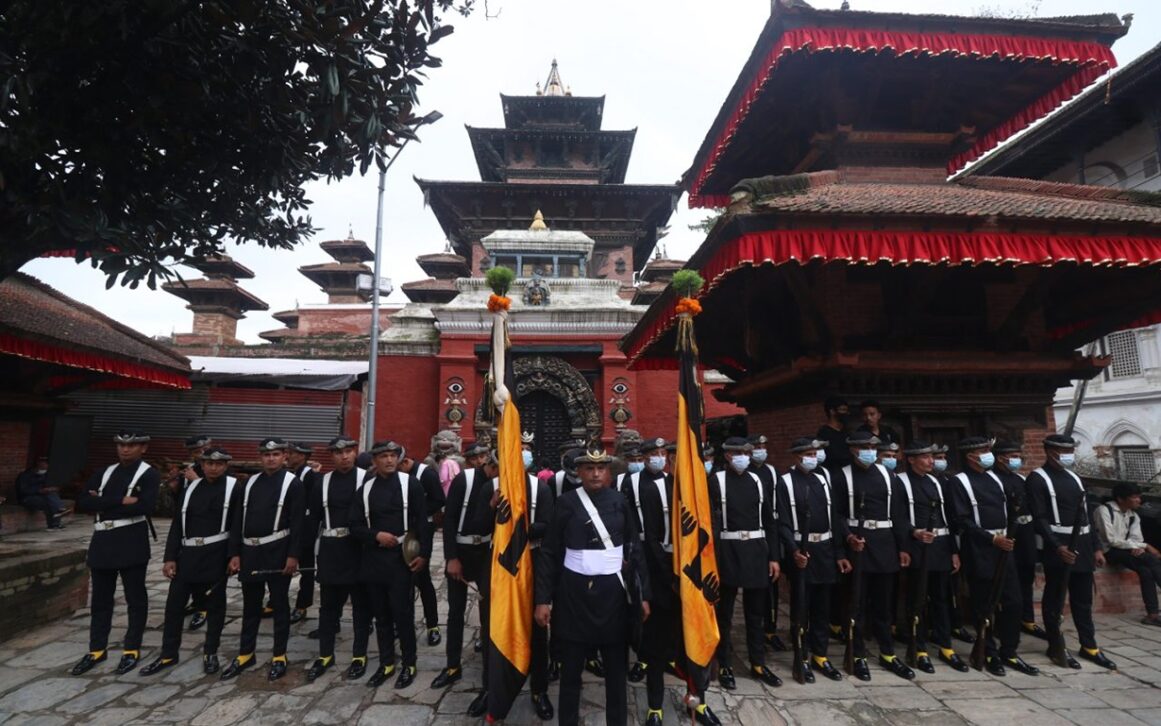
Kathmandu – The Taleju Bhawani Temple at Hanumandhoka Durbar Square, which opens only once a year on Maha Navami, welcomed thousands of devotees today. Worshippers queued from early morning to offer prayers and perform rituals.
Taleju Bhawani, revered as the patron deity of the Newar community, is also worshipped as a form of divine feminine power and is sometimes called Tulja. The goddess was brought to the Mul Chowk of Hanumandhoka on Phulpati day and will be returned to the main temple on Vijayadashami morning.
On the night of Maha Ashtami, the traditional Kalaratri Puja was performed in Mul Chowk, where 54 goats and 54 buffaloes were sacrificed following tantric rituals. This practice is believed to grant strength and protection for the functioning of the state.
Maha Navami is also marked by special worship at Dashain Ghars, Kot temples, and other Shakti Peeths across the country, with animal sacrifices and recitations from the Durga Saptashati (Chandi), Devi Bhagwat, and other scriptures.
The temple, normally will be closed to the public except today.
Kathmandu – On the ninth day of Bada Dashain and Navaratri, devotees across the country are performing rituals dedicated to Goddess Mahagauri, the eighth among the nine forms of Goddess Durga.
According to Vedic Sanatan tradition, Goddess Mahagauri is worshipped every year on Ashwin Shukla Ashtami. Normally, this falls on the eighth day of Navaratri, but this year, due to the extension of the lunar date (Chaturthi Tithi Vriddhi), the Nepal Panchang Nirnayak Samiti has determined that the worship should take place on the ninth day instead.
As part of Navaratri rituals, devotees recite sacred texts such as Durga Saptashati (Chandi) and Shrimad Devi Bhagwat at sites where Ghatasthapana was performed. It is a common belief that worshipping Goddess Mahagauri during this period brings strength, prosperity, and wisdom.
Today is Ghatasthapana, marked as the first day of Dashain. Dashain is considered to have officially started today. Navratri also begins today.Methodically, after the installation of Ghat or Ghada, the worship of Durga in the form of Shaktiswarupa is performed which is called Ghatasthapana. On the day of Vijaya Dashami, Prasad of Goddess Durga is accepted by anointing with the water of Purna Kalash installed today.
The auspicious time for Ghatasthapana is 9:13 am today.Ghatasthapana is performed today by worshipping Chitra Nakshatra owner Twashta ( Vishwakarma) and owner of Vaidhriti Yog Aditi, Mother of Gods. At the time of Chitra and Vaidhriti yoga, worship of Rudra, Surya, Soma and Mrityunjaya is performed along with Twashta and Aditi.Today, Sanatan Vedic Hindu religious people across the country keep Jamra(sacredly grown plants) in their houses and temples.
Seeds of barley are sown in the soil mixed with a little sand, inside a pooja room of the house or a clean place inside the house, placing a Diyo, Kalash and Ganesh. Recently, it has been found that rice, corn and wheat are also used along with barley while sowing Jamara. Jamara is worshipped every day until the last day of Navratri.
Seeds are grown in such a way that no light penetrates into them and the sprouts of this grain germinated for 10 days are used as Jamra.Jamara is offered as a blessing by elders on the tenth day of Dashain, which is known as Tika.
During Navratri, the three forms of Goddess Durga, Mahakali, Mahalakshmi and Mahasaraswati, are ritually invoked and worshipped. Mahakali is the symbol of power, Mahalakshmi is the symbol of wealth and opulence and Mahasaraswati is worshipped as the symbol of learning and wisdom.
The 15 days from Ashwin Shukla Pratipada to Purnima are called Durga Paksha and special worship is done on the occasion of Durga Paksha in the nine forms taken by Durga to kill the demons including Chanda, Mund, Shumbha, Nishumbha and Raktavija.
Shailaputri is worshipped on the first day of Durga Paksha, Brahmacharini on the second day, Chandraghanta on the third day, Kushmanda on the fourth day, Skandamata on the fifth day, Katyayani on the sixth day, Kalaratri on the seventh day, Mahagauri on the eighth day and Siddhidatri on the ninth day. These nine forms of Durga are also called Navadurga. Therefore, Dasai is celebrated as a symbol of the victory of truth over falsehood and divine power over demonic power.
Today onwards, the worship of Goddess Durga in the form of Shaktiswarupa begins according to the Vedic method, in the Dasainghar located in the Hanumandhoka Palace in Kathmandu.The culture of putting Jamra on the head on the day of Tika is considered an important part of Dashain, a great festival of Sanatan Vedic Hindus.
Kathmandu-Today, followers of the Vedic Sanatan Hindu faith are celebrating Bishwakarma Puja, honoring Lord Bishwakarma, revered as the divine creator of crafts, architecture, and technology.
According to religious belief, even in the age of the gods, Lord Bishwakarma is said to have created thousands of tools, machines, and vehicles. Following this tradition, Nepalese mark the day by worshiping machinery, industrial equipment, weapons, and vehicles in their factories, workshops, and homes.
Lord Bishwakarma is also regarded as the originator of Vastu Shastra (the ancient science of architecture). Vastu is explained as an ancient science that considers directions, constellations, angles, the five elements, and the shape of land. It is believed that houses built according to Vastu principles bring happiness, prosperity, and well-being.
On this day, idols of Lord Bishwakarma are installed and worshiped. The following day, these idols are ritually immersed in a nearby river or pond.
According to scriptures, Bishwakarma is considered the son of Lord Brahma, the creator of the universe.
This traditional cultural Jatra is celebrated for eight days, starting every year on the day of Bhadra Shukla Dwadashi in Hanumandhoka of Kathmandu. JATRA starts by worshipping Indra and ritually hoisting a lingo(ritual tree trunk) with the ritual flag on top of it.
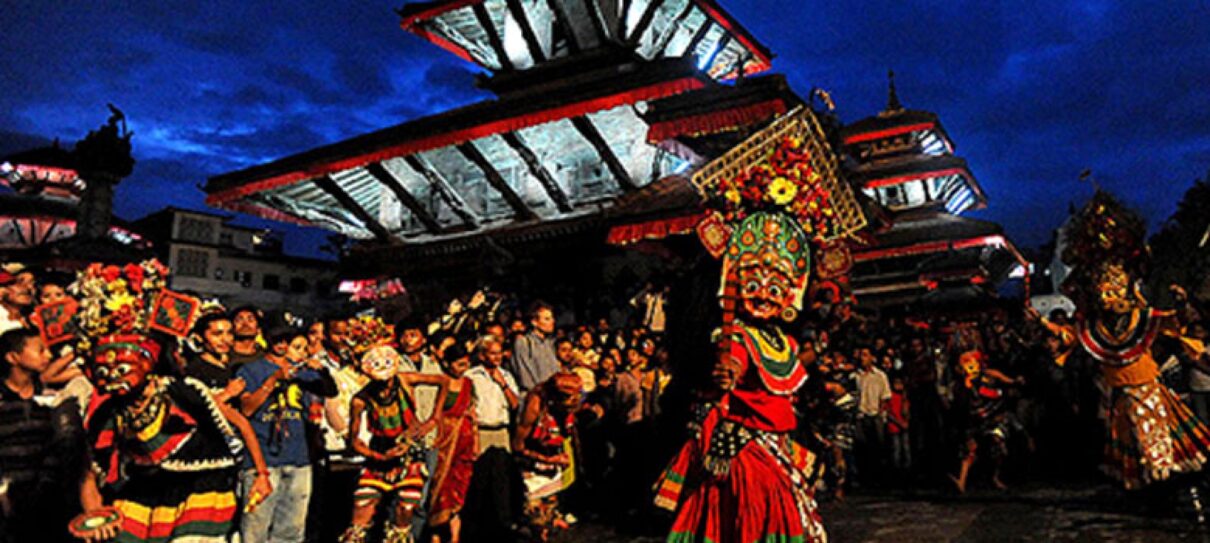
It can be seen that the method of Jatra celebration is also changing gradually as the generations pass over time. There are various stories about the beginning of Jatra in Nepali society. On the occasion of Indra Jatra, between Marusattal and Silyansattah in Marutol, a tall DABALI is built on top of four lions, and it is considered a symbol of Indra’s regime power. Indra Jatra is called ‘Yen Ya:’ in NEPAL BHASHA. ”Yen” means Kantipur city and ”Ya” means the main Jatra. During Indra Jatra, all the deities related to Indrajatra are also brought out for public display.
The Manandhar community has a tradition of picking up a lingo of 32 cubits length brought from the forest at Chitpol in Bhaktapur. In Hanumandhoka Durbar area, the lingo is ritually placed in front of the statue of Kalbhairav. The lingo is hoisted by firing cannons with traditional instruments, Guruju’s paltan and mangaldhun.
Indra is considered as the god of rain and season. The place of origin of this festival celebrated by the Newar community is considered to be Hanumandhoka palace area. This festival is celebrated for eight days by playing various instruments, dancing, singing and riding a chariot. Mainly the people of Newar community from Kathmandu,Bhaktapur and Lalitpur celebrate this occasion.
Kathmandu- According to the Vedic Sanatan tradition, Hindu women in Nepal celebrate the great festival of Haritalika Teej every year on the third day of the bright lunar fortnight in the month of Bhadra.
Teej is not just about fasting and worship. It is also a celebration of sisterhood and womanhood. On the eve of Teej, women gather with relatives and friends to enjoy a grand feast known as Dar. Dressed in bright red saris, adorned with jewelry and henna, they sing, dance, and share stories late into the night. The colors, songs, and dances create a vibrant atmosphere that reflects the strength and unity of women.
It is also customary for daughters and married women to visit their parental home on Teej. In earlier times, when travel was difficult, women especially used this occasion to return to their birth homes and spend joyful time with family. During those days, when social restrictions and illiteracy were widespread, daughters-in-law expressed their hardships through Teej songs, turning sorrow into shared joy through music and dance.
Religious belief holds that Goddess Parvati, daughter of the Himalayas, observed a strict fast to get Lord Shiva as her husband. Following this tradition, married women fast on Teej for the longevity of their husbands, family harmony, and a successful married life, while unmarried women fast with the wish of finding a husband like Lord Shiva.
Today, Teej continues to evolve. While it remains deeply spiritual, it is also celebrated as a festival of joy, identity, and empowerment. Women across Nepal and in Nepali communities abroad, mark the occasion with pride, keeping alive both tradition and togetherness.


 NP
NP