Nepal Rastra Bank eases loan rules for businesses hit by ‘Gen Z’ Protests

Kathmandu – Nepal Rastra Bank has directed banks and financial institutions to provide relief to industries and businesses affected by the recent ‘Gen Z’ protests.

According to the revised Integrated Directive 2081, issued on Friday (Sep 26), banks must offer loans to restart affected businesses at just 0.5% interest above the base rate until operations resume.

The central bank has also relaxed the rule requiring loans with a debt-to-equity ratio higher than 80:20 to be classified under the “watchlist” category. This exemption will apply for one year.

Nepal’s Public Debt Crosses Rs 2.74 Trillion :Per Capita Burden Rs 94,065

Kathmandu – Nepal’s public debt has exceeded Rs 2.74 trillion, according to the Public Debt Management Office. By the end of Bhadra (mid-September), the total public debt reached Rs 2.743 trillion. Based on Nepal’s 2021 population, the per capita debt burden stood at Rs 94,065 by that time.

At the end of Ashad (mid-July), per capita debt was Rs 91,688. Out of the total debt as of Bhadra, domestic borrowing accounted for Rs 1.281 trillion, while external borrowing stood at Rs 1.461 trillion. Public debt now makes up about 44.92 percent of Nepal’s Gross Domestic Product (GDP).

The share of domestic debt is 20.99 percent of GDP, and external debt is 23.93 percent. In terms of composition, domestic debt makes up 46.72 percent of the total, while external debt accounts for 53.28 percent.

In the first two months of this fiscal year, the government borrowed Rs 79.15 billion and repaid Rs 65.07 billion. However, the weakening Nepali currency has sharply increased the burden of external debt. Exchange rate fluctuations in Bhadra alone added an additional liability of Rs 55.23 billion. As a result, the debt that stood at Rs 2.674 trillion in Ashad surged close to Rs 2.74 trillion within two months.

The government has set a target to raise Rs 595.66 billion in public debt this fiscal year, of which Rs 362 billion is planned through domestic borrowing and Rs 233 billion through external sources. By Bhadra, the government had raised Rs 70 billion domestically and Rs 9.15 billion externally. This represents 19.34 percent of the domestic borrowing target and just 3.92 percent of the external borrowing goal.

Debt repayment also remains significant. The annual budget has allocated Rs 411.01 billion for debt servicing. By Bhadra, Rs 78.67 billion had already been spent, equivalent to 19.14 percent of the yearly allocation.

During this period, Rs 56.40 billion was paid as principal and Rs 11.27 billion as interest on domestic debt. For external debt, Rs 8.67 billion went to principal repayment and Rs 2.32 billion to interest. Altogether, the government paid Rs 65.07 billion in principal and Rs 13.60 billion in interest within the two months.

Nepal records 29.9% surge in remittance inflows in July

Kathmandu — In July alone, NPR 177,410,000,000 entered the country as remittances. This is a 29.9% increase from the same month last year. In July last year, remittance inflows were NPR 136,600,000,000.

In US dollar terms, remittance inflows rose 25% to USD 1,270,000,000 in July. Last year the dollar inflow rose 15.8% in the same month.

During the same period, 44,466 Nepalese received final labor approval for foreign employment (institutional and individual, new), and 23,644 people renewed their labor approval. In the same month last year, those numbers were 36,928 and 22,647, respectively.

The current account was in surplus by NPR 78,140,000,000 in July. In the same month last year the current account was in surplus by NPR 33,080,000,000. In US dollar terms, the current account surplus was USD 560,000,000 in the review month, up from USD 250,000,000 in the same month last year.

On the balance of payments, the post-clearance position was in surplus by NPR 89,300,000,000 in the first month of the fiscal year. A year earlier, the post-clearance position was in surplus by NPR 40,900,000,000. In US dollar terms that was USD 640,000,000 in the review period and USD 310,000,000 in the same month last year.

By the end of July, foreign exchange reserves reached NPR 2,806,040,000,000. At the end of Ashad 2082 the reserve was NPR 2,677,680,000,000. In US dollars, the reserve was USD 19,500,000,000 at the end of Ashad and rose 2.7% to USD 20,030,000,000 at the end of Shrawan.

Based on the first month’s imports in the current fiscal year, the reserves can cover 20.4 months of goods imports and 16.6 months of goods and services imports. The central bank set a target this year to hold reserves sufficient for 7 months of imports.

Inflation and price details:

  • Annual point-to-point consumer price inflation in July: 1.68% (last year 4.09%).
  • Food and beverage inflation: 2.28% (last year 6.17%).
  • Non-food and services inflation: 3.95% (last year 2.94%).

Selected food subgroups (annual point-to-point change):

  • Ghee and oil: +10.97%
  • Non-alcoholic beverages: +4.64%
  • Fruits: +3.01%
  • Vegetables: −18.56%
  • Spices: −4.81%
  • Fish and meat: −2.41%

Selected non-food subgroups (annual point-to-point change):

  • Miscellaneous goods and services: +10.60%
  • Education: +7.67%
  • Clothing and footwear: +6.84%
  • Furnishings and household equipment: +5.06%
  • Tobacco products: +4.68%
  • Insurance and financial services: −0.22%

Nepal Rastra Bank Sets $5,000 Cash Limit for travel: Bans Certain Indian Notes

Kathmandu – Nepal Rastra Bank (NRB) has announced new rules on carrying foreign currency. From now on, travelers entering or leaving Nepal can carry a maximum of 5,000 US dollars in cash. Any amount above this must be declared in advance with customs.

The bank has also banned the carrying and use of Indian currency notes of 200, 500, and 2,000 rupees. Nepali citizens are not allowed to take Indian currency to countries other than India. In addition, the use of old Indian notes of 500 and 1,000 rupees, already demonetised by the Government of India, remains strictly prohibited.

According to NRB, these rules are enforced under the Foreign Exchange (Regulation) Act 1962, the Money Laundering Prevention Act 2008, and a notice published in the Nepal Gazette. The government says the move is part of wider efforts to get Nepal removed from the Financial Action Task Force’s (FATF) grey list.

The FATF’s September 2023 report had pointed out that Nepal lacked a proper cash declaration system and warned of rising smuggling of cash, gold, and silver through its porous borders.

Govt to raise Rs 113 billion in domestic debt by mid-October

kathmandu – The government is set to raise Rs 113 billion in domestic debt by mid-October as part of its internal borrowing plan for the first quarter of the current Fiscal Year (FY) 2025/26.

According to a schedule released by the Public Debt Management Office (PDMO), the government will issue a total of 11 development bonds, each worth Rs 10 billion, with maturities ranging from three to eleven years. In addition, it plans to raise Rs 2.5 billion through Citizen Saving Bonds with a five-year maturity period, and Rs 500 million via Foreign Employment Saving Bonds.

The government’s plan to raise the debt comes amid mounting fiscal pressures driven by declining revenue and rising recurrent expenditures. In the second quarter (mid-October to mid-January), the government aims to borrow an additional Rs 85 billion internally — Rs 60 billion through development bonds and Rs 25 billion via treasury bills. The plan includes the issuance of five treasury bills of Rs 5 billion each, with maturities ranging from 28 days to one year, and six development bonds worth Rs 10 billion each, maturing in three to ten years.

From mid-January to mid-April 2026, the government plans to raise Rs 109 billion in internal debt. This includes Rs 56 billion through development bonds, Rs 50 billion through treasury bills, Rs 2.5 billion via Citizen Saving Bonds, and Rs 500 million through Foreign Employment Saving Bonds. For the final quarter of the fiscal year, the government plans to borrow another Rs 55 billion.

Of the total expenditure of Rs 1.964 trillion for FY 2025/26, the government plans to finance Rs 1.315 trillion through revenue collection. The remaining amount will be met through Rs 362 billion in domestic borrowing, Rs 233 billion in foreign loans, and Rs 53 billion in foreign grants. The government has allocated Rs 375.24 billion for interest payments and principal repayments on public debt.

By the end of FY 2024/25, Nepal’s total public debt had climbed to Rs 2.66 trillion, marking an increase of Rs 231 billion in just one year. With limited capacity to cover recurrent expenditure, the government has increasingly relied on both domestic and foreign loans to fund development and operational needs.

Former Finance Secretary Madhu Kumar Marasini warned of the economic consequences of rising debt. “The growing burden of interest and principal repayments has begun to affect public investment in development projects,” he said.

Meanwhile, the PDMO on Wednesday issued Development Bonds-2085 worth Rs 10 billion. The three-year maturity bonds will be sold through competitive bidding and can be traded in Nepal’s secondary market, according to the PDMO.

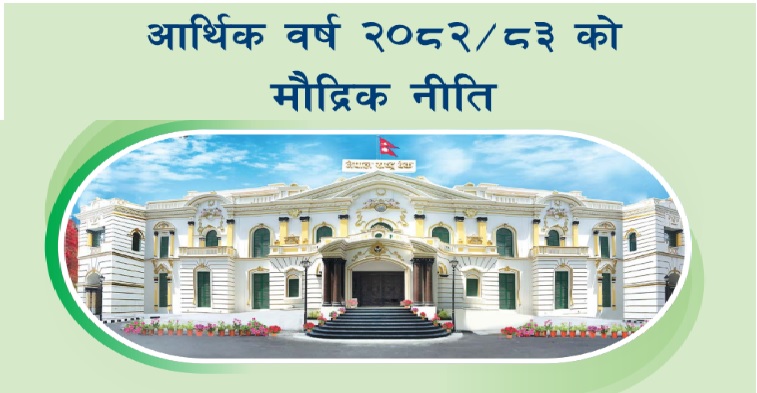
Monetary policy for the fiscal year 082/83 announced by Rastra Bank

Kathmandu- Nepal Rastra Bank has announced the monetary policy for the upcoming fiscal year 082/83 today. On Friday, Governor Dr. Bishwanath Poudel announced the first monetary policy of his tenure.

In the monetary policy announced by the National Bank, it is projected that credit to the private sector will expand by 12 percent for the upcoming year.

Similarly, the bank rate, which is the upper limit of the interest rate corridor, has been reduced from 6.5 percent to 6 percent and the deposit collection rate, which is the lower limit of the interest rate corridor, has been reduced from 3 percent to 2.75 percent. The policy rate has been reduced from 5 percent to 4.5 percent. Nepal Rastra Bank bonds will be issued as needed to make the structural liquidity management in the banking system effective. The limit of credit to be disbursed for construction/purchase of private residential houses will be increased from 20 million to 30 million. Arrangements will be made to maintain a loan-to-value ratio of up to 80 percent for such loans when building/purchasing a first home and up to 70 percent for others.

The guidelines on working capital loans will be revised as needed based on the nature of the business and the loan repayment-income cycle, including agriculture, small and cottage industries, education, health, sports, communication and media houses. The classification of existing loans and loan loss provisions will be studied and reviewed as needed. It has not been mentioned what kind of modifications will be made. Arrangements will be made to provide agricultural or commercial loans up to Rs. 1 million. Minimum loan loss will be provided during the grace period for loans up to 1 million rupees disbursed in this way. Loans disbursed up to 30 million rupees will be included in loans disbursed to small and medium enterprises and counted as loans disbursed in the designated sector. The arrangement related to capitalization of interest on loans disbursed in the energy production sector will be reviewed. The existing single customer loan limit for margin loans disbursed against shares by banks and financial institutions will be increased from 150 million rupees to 250 million rupees. Policy facilitation will be provided in the existing arrangement for blacklisting due to cheque dishonor.

Arrangements will be made to allow the amount of regulatory reserve created for non-banking assets to be counted as supplementary capital for two years after banks and financial institutions have accepted such assets. A draft of the necessary acts and rules will be formulated and submitted to the Government of Nepal for the establishment of an asset management company with the objective of assisting in the management of non-performing loans and non-banking assets of banks and financial institutions. In the context of the strengthening of the electronic payment system, the existing branch expansion policy of banks and financial institutions will be reviewed. The existing system for distributing dividends (cash or bonus) exceeding 15 percent per year by microfinance institutions will be reviewed. Loans up to 300,000 rupees disbursed to youth going for foreign employment, with or without collateral, can be counted as loans to the poor, and in the case of women, such a limit has been set at 500,000 rupees. Currently, there is a system to provide exchange facilities up to US$ 2,500 per visit to Nepali citizens traveling to countries other than India, but this exchange facility has been increased to US$ 3,000. In the context of the increasing contribution of remittance companies to the economy, such companies will be classified on the basis of capital and turnover. Legal and procedural arrangements will be made to establish ‘Neo Banks’ to expand financial access. Customer Identification (KYC) details of banks and financial institutions and other financial service providers will be facilitated through the national identity card. After the customer updates the details at any one bank, the necessary body will also be facilitated to develop infrastructure that can be obtained electronically.

The full text of the new monetary policy announced by the National Bank:

Those going abroad will be able to exchange up to $3,000

Kathmandu – Nepal Rastra Bank has revised and made new provisions related to foreign exchange management through the monetary policy for the upcoming fiscal year 082/83.

The monetary policy states that Nepali citizens traveling to countries other than India are currently provided with an exchange facility of up to $2,500 per visit, but this exchange facility will be increased to $3,000.

Similarly, the Rastra Bank has also stated that the currencies of countries where foreign exchange transactions are increasing, including Bangladesh and Sri Lanka, will be added to the list of convertible foreign currencies.

The monetary policy states that the exchange rate used in remittance transactions will be reviewed as needed and policy provisions will be made regarding interbank transactions in convertible foreign currencies. The Rastra Bank has also stated that arrangements will be made to manage foreign exchange risks through commercial banks to attract foreign investment.

The policy of amending the ‘Nepal Rastra Bank Foreign Investment and Foreign Debt Management Regulations, 2078’ has been adopted to facilitate the improvement of the economic and business environment and investment growth. The monetary policy also includes a provision to review the limit of cash foreign currency subject to customs self-declaration and to facilitate the provision of submitting details of foreign exchange held abroad in the name of Nepali citizens or institutions.

The monetary policy also mentions that the existing provisions related to gold import and sale-distribution will be reviewed. Similarly, in the context of the increasing contribution of remittance companies to the economy, it is stated that a provision will be made to classify such companies on the basis of capital and turnover.

Foreign exchange reserves increase: Foreign investment improves

Kathmandu: Although the country’s domestic economy is sluggish, there has been a good improvement in the external sector of the economy. According to the 6-month data published by the National Bank, more foreign exchange is entering the country than leaving it.

That is why the balance of payments situation is continuously in surplus. The size of remittances is increasing . The size of the country’s foreign exchange reserves has also increased significantly to 2316.84 billion. This has made it possible for the country to meet the import of goods and services for 14 months.

Especially, despite the government spending billions and holding an investment conference, it is a reality that foreign direct investment (FDI) has not been able to inflow. However, the latest data shows a slight improvement in FDI. As of December of the current fiscal year, 6.5 billion rupees of direct foreign investment (equity only) have been inflow. This is 43.14 percent or 1.96 billion rupees more than the same period of the last fiscal year. In the same period of the previous year, such direct foreign investment (equity only) had inflows of Rs 4.54 billion.

The country’s total foreign exchange reserves have increased by 13.5 percent to Rs 2.3 trillion 16 billion 84 million. This is the data up to Poush of the current fiscal year. In US dollars, such reserves have increased by 10.3 percent compared to Ashar and have reached Rs 16.84 billion. Of which, Nepal Rastra Bank has foreign exchange reserves of Rs 2.0 trillion 72.34 billion and banks and financial institutions (excluding Nepal Rastra Bank) have foreign exchange reserves of Rs 2.4 trillion 44.5 billion. The share of Indian currency in such reserves is 24.3 percent.

Overall, based on the six months of imports in the fiscal year 2081/82, the foreign exchange reserves held by the banking sector are sufficient to cover 17.3 months of goods imports and 14.4 months of goods and services imports, the Rastra Bank has said.

As foreign exchange inflows are more than outflows, the balance of payments position is in surplus of Rs 249 billion 260 million in the first six months. In the same period last year, the balance of payments position was in surplus of Rs 273 billion 520 million. In US dollar terms, the balance of payments position, which was in surplus of Rs 260 million in the same period last year, is in surplus of Rs 1.82 billion in the review period. Along with this, the country’s current account is in surplus of Rs 148 billion 170 million.

In the same period last year, it was in surplus of Rs 162 billion 560 million. In US dollar terms, it is in surplus of Rs 1.88 billion. Similarly, net capital transfer is Rs 4.29 billion.

NRB sets exchange rate for today

Kathmandu. According to the exchange rates fixed by the Nepal Rastra Bank for today, the prices of the UK pound sterling, Australian dollar, Singapore dollar, Saudi Arabian riyal, South Korean won, Kuwaiti dinar, and Bahraini dinar have increased.

Similarly, the prices of the European euro, Swiss franc, Canadian dollar, Japanese yen, Qatari riyal, Thai baht, and Swedish kronor have decreased, while the exchange rates of some foreign currencies have remained stable.

According to the fixed rates, the buying rate of one US dollar has been fixed at 136 rupees 56 paisa and the selling rate at 137 rupees 16 paisa.

The buying rate of one European Euro is 142.40 paisa and the selling rate is 143.03 paisa, the buying rate of one UK Pound Sterling is 171.80 paisa and the selling rate is 172.55 paisa, the buying rate of one Swiss Franc is 151.42 paisa and the selling rate is 152.09 paisa.

The buying rate of one Australian Dollar is 84.91 paisa and the selling rate is 85.29 paisa, the buying rate of one Canadian Dollar is 94.77 paisa and the selling rate is 95.19 paisa, the buying rate of one Singapore Dollar is 100.51 paisa and the selling rate is 100.95 paisa.

The buying rate of 10 Japanese yen is 8 rupees 65 paise and the selling rate is 8 rupees 69 paise, the buying rate of 1 Chinese yuan is 18 rupees 71 paise and the selling rate is 18 rupees 79 paise, the buying rate of 1 Saudi Arabian riyal is 36 rupees 37 paise and the selling rate is 36 rupees 53 paise, the buying rate of 1 Qatari riyal is 37 rupees 45 paise and the selling rate is 37 rupees 62 paise.

According to the central bank, the buying rate of 1 Thai baht is 4 rupees 01 paise and the selling rate is 4 rupees 02 paise, the buying rate of 1 UAE dirham is 37 rupees 18 paise and the selling rate is 37 rupees 34 paise, the buying rate of 1 Malaysian ringgit is 30 rupees 54 paise and the selling rate is 30 rupees 67 paise.

The buying rate of 100 South Korean won is 9 rupees 27 paise and the selling rate is 9 rupees 31 paise, the buying rate of 1 Swedish kronor is 12 rupees 41 paise and the selling rate is 12 rupees 46 paise, and the buying rate of 19 rupees 09 paise and the selling rate is 19 rupees 18 paise.

The National Bank has set the buying rate of one Hong Kong dollar at Rs 17.59 and the selling rate at Rs 17.67, the buying rate of one Kuwaiti dinar at Rs 443.16 and the selling rate at Rs 445.11, the buying rate of one Bahraini dinar at Rs 362.23 and the selling rate at Rs 363.82, the buying rate of one Omani rial at Rs 354.68 and the selling rate at Rs 356.24. Similarly, the buying rate of one Indian rupee has been set at Rs 160 and the selling rate at Rs 160.15.

The National Bank has stated that this exchange rate can be revised at any time as needed. The exchange rate set by commercial banks may differ and the updated exchange rate will be available on the central bank’s website.

NRB takes action against six banks and financial institutions

Nepal Rastra Bank has taken action against Global IME Bank, Prabhu Bank, Himalayan Bank, Muktinath Bikas Bank, Garima Bikas Bank and Reliance Finance for violating the rules of the Central Bank in the second quarter of the current financial year.

The central bank has directed these institutions to refund any amounts collected from customers that contravene established rules. Specifically, Global IME Bank is instructed to return funds to customers, as it allegedly charged premiums exceeding limits set in point No. 3(8) of the Integrated Directive-2079, a breach of NRB’s directives.

Prabhu Bank faces actions for its failure in classifying loans and maintaining systems to mitigate loan losses. Himalayan Bank is penalized for inaccurately calculating its capital adequacy ratio. The bank reportedly did not adhere to the central bank’s guidelines in deducting certain amounts from the primary capital and understated its risk-weighted assets, leading to a misrepresented higher capital adequacy ratio.

Muktinath Development Bank has been fined one million rupees for non-compliance with NRB’s policies and instructions. Additionally, Dr. Anand Prasad Shrestha, director of Garima Development Bank, and Kush Prasad Malli, director of Reliance Finance, have received official warnings for their institutions’ regulatory breaches.

Economic crisis will not be solved immediately: Finance Minister

Kathmandu: Finance Minister Dr. Prakasharan Mahat has said that it will take some time to completely solve the problems seen in the economy. Economist Mahat, who returned home on Sunday after participating in the joint annual meeting of the World Bank and the International Monetary Fund (IMF) held in Morocco, said in a press conference held at the Tribhuvan Airport that it will take some time to restore the long-standing problems in the economy.

He said that signs of improvement in the country’s economy have already started. Finance Minister Mahat said that on the sidelines of Morocco’s annual meetings, the participants discussed issues of collective and bilateral interest and also got the opportunity to network with the international community.

He said that there was also a discussion on the issues of financial governance, transparency and the need for reforms according to Nepali context and environment.

There is an arrangement that the finance minister will be the ex-officio governor of the World Bank and the governor of the National Bank of the IMF. Similarly, there is an arrangement that the Finance Secretary will be the alternate governor of the World Bank and the Joint Secretary of the International Financial Assistance Coordination Division will be the alternate governor of the IMF.

Government raising more than 23 billion domestic debt than the target

May 28, Kathmandu. In the current financial year (FY) 2079/80, the government is going to raise domestic debt 23 billion rupees more than the budget target. This year, the government has set a target of raising 2 trillion 40 billion rupees in domestic debt, but it is expected to raise 2 trillion 63 billion rupees by the end of June.

At a time when liquidity in the financial system is low and interest rates are high, the government is going to raise more loans than expected. The government’s preparations will put more pressure on liquidity and interest rates. Through the mid-term review of the budget, the government had set a revised target of raising domestic debt of 2 trillion 40 billion rupees. Prior to that, the budget of this financial year initially aimed to raise 2 trillion 56 billion domestic debt.

The National Natural Resources and Finance Commission recommends the domestic debt limit that the government can raise every year. The commission has recommended raising internal debt not to exceed 5 percent of the gross domestic product this year. In that way, the government has the facility to raise 2 trillion 69 billion in debt.

Due to the lack of liquidity in the market and the increase in interest rates, credit has not gone to the private sector as expected. The monetary policy of the current year aims to expand the credit flow to the private sector by 12.6 percent, but it has only expanded by 3.5 percent by mid April. In other words, from june last year to mid-April, 1 trillion 62 billion loans have gone from the financial system. Bankers say that loans to the private sector will not increase by more than 6 percent by mid July. According to the data of Nepal Rastra Bank, deposits have increased by 3.56 trillion till mid April,which is an increase of 7 percent compared to last FY

Although there is no large amount of credit in the private sector, there is no more liquidity in the market when the government increases the amount of internal credit. According to the data of Rastra Bank on May 23, the average loan-to-deposit ratio (CD) ratio of banks is 84.83 percent. Sunil KC, president of Nepal Bankers Association, says that although the average CD ratio of banks looks easy, there is no high liquidity situation. This week, banks had an average of 26 to 30 billion in liquidity.

The government has so far raised 2 trillion 4 billion 70 crores of internal debt. According to the National Debt Mobilization Schedule of the Rastra Bank Monetary Management Department, there will be talk of various tools to raise domestic debt worth 59.3 billion rupees.

Government moves to give India full rights to cross-border digital payment transactions

Preparations to be finalized during Prime Minister Dahal’s visit to India: under Indian Pressure

Government ready to give all the responsibility to Indian company Gateway Payment Services Pvt Ltd within the Unified Payments Interface (UPI) under the National Payments Corporation of India under Indian pressure.

.

The government has started preparations to hand over all rights of international digital payment transactions to India. The process of handing over to the Indian company has been decided upon during Prime Minister Pushpa Kamal Dahal’s visit to India.

Contrary to the written proposal made by the Nepal Rastra Bank to enter into a G2G agreement so that Nepal will be in charge of managing transactions between Nepal and India through digital wallets and QR codes, the government is going to hand over all financial transactions through digital wallets and QR codes to Indian company.

The government has ignored the proposal of the Rastra Bank, even though the officials of the Rastra Bank have drawn attention to the fact that the financial statements of the country will be directly accessible to the Indian company after the Indian company is in charge of the business towards Nepal.

Although Nepal Rastra Bank proposed to entrust the business to Nepal Clearing House Limited (NCHL), which was established as a joint venture between itself and banks and financial institutions of Nepal, the government directly appointed Gateway Payment Services Pvt. Ltd. as an agent of the Indian company and prepared to give all the responsibility. GPS has contracted to operate the Unified Payments Interface (UPI) system under the National Payments Corporation of India (NPCI).

It is said that under Indian pressure, the government is going to hand over the entire responsibility to the Indian company. Officials of the Rastra Bank have said that the officials of the Indian Embassy in Nepal have been giving pressure for this and the government has started preparations accordingly.

Government in the process of merger between Nepal Bank Limited and National Commercial Bank

The Ministry of Finance has formed a working group to study the merger between Nepal Bank Limited and National Commercial Bank.

After Nepal Rastra Bank instructed private sector banks to increase their paid-up capital or go for the merger, the government has also advanced the process of merger between the two government banks, Nepal Bank Limited and Rashtriya Commercial Bank.

Bhupal Baral, head of the financial sector management division of the ministry, has been assigned as the coordinator of the merger-related task force.

Currently, Nepal Bank’s paid-up capital is 14.69 billion rupees, while National Commercial Bank’s paid-up capital is 15.63 billion rupees. By the third quarter of the financial year, Nepal Bank has managed to collect deposits of 229 billion rupees and extended loans of 173 billion rupees.

Nepal Bank has made a profit of 1.78 billion 2.3 million rupees by the end of March, while the bank made a profit of 2.19 billion rupees during the same period last year. Bank’s bad loans are 4.16 percent. As the profit has decreased, the distributable profit of the bank has also decreased. In the middle of March, the distributable profit of the bank has been limited to 180 million. During the same period last year, the bank’s distributable profit was Rs 2.70 billion.

On the other hand, the National Commercial Bank has made a profit of 3.57 billion rupees in the third quarter of the current financial year. In the same period last year, the bank made a profit of Rs 2.61 billion. By the end of March, the bank has collected 302 billion deposits and disbursed loans of 225 billion rupees. Bank’s bad loans are 3.88 percent.

Nepal Rastra Bank selling 20 billion development bonds

April 20- Kathmandu – Nepal Rastra Bank has prepared to sell development bonds worth 20 billion rupees for the purpose of raising internal debt.

According to the Nepal Rastra Bank, the maturity period of the bond named ‘Development Loan 084 ‘T’ will be four years and the interest rate of the bond will be determined from bidding.

As mentioned in the notice of the Nepal Rastra Bank, the bond can be bid on 20th April until 3:00 in the afternoon, then the Bank will issue the bonds on Friday. The bond can be purchased by banks and financial institutions, insurance companies, organized organizations, and Nepali citizens.

The government, which has set a target of raising 2 trillion 56 billion rupees in domestic debt in the current financial year, has already raised 88 billion rupees in the third quarter of the current financial year .

Nepal’s banking sector is safe: Small shocks won’t affect it: Governor

Nepal Rastra Bank Governor Maha Prasad Adhikari has said that the condition of Nepal’s banks is safe and a small shock will not affect it.

Announcing the financial data for 8 months of the current fiscal year 2079/80, the governor said that the foreign exchange reserve is in a comfortable state and inflation is in a declining state.

He said that even though the bank’s interest rate is slightly higher, the base rate has been decreasing since February. He said that there is no need to despair as Nepal’s economy is improving, and that capital adequacy is 13 percent instead of 11 percent and non-performing loans are 2.63 percent.

Import restrictions extended until November

The cabinet meeting held today has decided to maintain the ban on the import of luxury goods such as vehicles and mobiles until November.

The decision made by the Council of Ministers in a meeting held today has decided to extend the ban as it ends today. As Nepal’s foreign exchange reserves declined, 10 items were banned from Baisakh 2079 BS., defining them as luxury goods. But out of those 10 items, only 4 items are currently banned. On Bhadra 14, 2079 BS., private vehicles except for ambulances, mobile phones above $300, motorcycles above 150 cc and alcohol were banned, and the meeting of the council of ministers held today has decided to extend it till November.

Earlier, the import of Kurkure chips and similar products, prepared liquor, cigarettes and tobacco products, diamonds, mobile phones, televisions above 32 inches, jeeps, cars,vans andmotorcycles above 250 cc, toys and palying cards was banned.

Nepali rupee becomes the weakest in history: Economy at risk

The buying price of one US dollar today is fixed at Rs 130.30 and the selling price is fixed at Rs 130.90. This is the first time in history that the Nepalese rupee has become so weak.

According to Nepal Rastra Bank data, the Nepalese rupee fell to a 3-digit exchange rate on January 28, 2014, for the first time, after a continuous fall out from a buying price of 58.50 rupees and a selling price of 59.05 rupees to a US dollar on October 8, 1977. The purchase price of one US dollar on January 28, 2014, was 100. 67 and the selling price was 101.27. In the middle, the Nepalese rupee again stabilized at a 2-digit exchange rate, but after about 11 months, it fell again to a 3-digit exchange rate in December 2014. The Nepalese rupee has been falling continuously since December 2014. Nepali rupee which has been depreciating by maintaining the exchange rate of 3 digits is getting weaker day by day. Today the buying price of one US dollar has reached 130.30 rupees and the selling price has reached 130.90 rupees.

At a time when central banks around the world are raising interest rates to control inflation The US Federal Reserve Bank has also increased the interest rate and the dollar is getting stronger. Also, due to the energy supply and crisis in the European market due to the Russia-Ukraine war, the euro has also become weaker compared to the dollar.

Also, it is said that the Nepalese rupee, which has maintained a stable exchange rate with the Indian currency, has weakened due to the decline in the Indian economy. However, the Indian economy, for the first time in history, became stronger in 2022, surpassing the UK to become the fifth largest economy in the world.

Overall, the import-oriented and dependent economy of Nepal, is seen to be losing more with the rise in the dollar. As the value of the dollar increases, it is seen that the debt obligations of the Nepalese government will also increase. It seems that Nepal’s economy is becoming a risk day by day, as it is being presented weakly in the world market due to lack of production-oriented economy, unnecessary foreign loans and unstable politics.

Monetary policy for fiscal year 2079/80


Nepal Rastra Bank today announced the monetary policy for the financial year 2079/80.
Nepal Rastra Bank’s Governor Maha Prasad Adhikari announced the monetary policy today through a press conference.

The announced new monetary policy has increased the bank rate from 7% to 8.5%.Similarly, the minimum limit of 40 million has been removed in share mortgage loans while the maximum limit of 120 million has been maintained .

Full Text of Monetary Policy:

Demonstration at Maitighar Mandla demanding the dismissal of the Governor

Student organizations belonging to the ruling coalition party have demonstrated at Maitighar Mandla demanding the dismissal of Nepal Rastra Bank’s Governor Mahaprasad Adhikari.

Today, on the third day of the demonstration students staged a cartoon demanding the dismissal of the governor at Maitighar Mandla. Student organizations protested against the governor saying that, Governor Adhikari so called M Adhikari has violated the Rastra Bank Act 2058 and has flouted the law and is active in destroying the country’s economy by being a member of the opposition party.

Under the pre-announced program, the Student Organizations have said that they will organize a protest program in colleges across the country tomorrow.

Prime Minister Deuba’s instruction to Governor Adhikari on monetary policy

During a meeting held in Baluwatar on Thursday morning, Prime Minister Deuba urged to bring a policy to improve the current economic situation. While the NRB is preparing to bring monetary policy, Prime Minister Deuba discussed the recent economic situation of the country with Governor Adhikari.

Governor Adhikari had replied to Prime Minister Deuba that the monetary policy has been prepared to address the current problems in the country’s economic sector. Governor Adhikari briefed Prime Minister Deuba on the economic situation in the country.

Minister for Industry, Commerce and Supplies Dilendra Prasad Badu and Minister for Communications and Information Gyanendra Bahadur Karki were present at the discussion. NRB is preparing to bring monetary policy in the first week of Shrawan.

Prime Minister Deuba is also handling the responsibility of the Ministry of Finance. Deuba has taken control over the ministry after Finance after Minister Janardan Sharma’s resignation, who was dragged into the investigation into irregularities in budget formulation.

Maoists demands investigation into NRB governor

Maoist central lawmakers have demanded an investigation into NRB Governor Maha Prasad Adhikari.

Maoist lawmakers have demanded an investigation into the case of Governor Adhikari,being a member of the UML’s Finance and Planning Department. However, it is unknown at this time that if he is the M Adhikari, a member of the UML’s Finance and Planning Department or not.

A questioned has been raised that,does Governor Maha Prasad Adhikari implement the policy of the government or follow the policy of the opposition when he is a member of the Finance and Planning Department of the CPN-UML.

The lawmakers have accused him for helping the main opposition in a planned manner by staying in the party discipline committee and deteriorating situation of the economy.

Economic Survey and Budget to be unveiled

The Economic Survey of the fiscal year 2022/23 is to be presented at the House of Representatives (HoR) on Saturday.

Though there was a pre-scheduled agenda for presenting Economic Survey in the parliamentary meeting on Friday, it was not materialized due to obstruction of CPN-UML, the main opposition party.

There is an arrangement for presenting the Economic Survey before the unveiling of upcoming year’s budget. Minister for Finance Janardan Sharma is scheduled to present the economic survey in the parliament on Sunday.

Likewise, Finance Minister Sharma will also present the annual budget for the fiscal 2022/23 in the joint meeting of federal parliament .

The Constitution has set Jestha 15 (May 29) as the date for presenting the budget in the federal parliament.

RSS

Continuation of Governor Adhikari in NRB

Continuing its interim order, the Supreme Court has ordered to keep the action against Governor Maha Prasad Adhikari of Nepal Rastra Bank as it is.

A joint bench of Justices Sapna Pradhan Malla and Tanka Bahadur Moktan upheld the earlier interim order. Earlier, a bench of Justice Hari Phuyal had issued a short-term interim order directing Governor Adhikari to return to work.

Concluding the three-day-long hearing, the Supreme Court upheld the old interim order. The Supreme Court will now regularly hear the original case. Until then, today’s order has paved the way for Governor Adhikari to remain in office.

Hearing on the governor’s case been scheduled for today

The case of Governor Maha Prasad Adhikari of Nepal Rastra Bank will be heard today.
As the hearing has been scheduled for today in the governor’s case, Judges Sapna Pradhan Malla and Tanka Bahadur Moktan are scheduled to appear in the joint sitting .

Governor Adhikari, who returned to his post with the interim order of the Supreme Court on April 19, was suspended by the government on March 8 and an investigation committee was formed on him.

The Supreme Court will decide whether to continue the interim order in today’s hearing , even if the governor has returned to work. If the interim order is continued, the governor will remain in office.

NRB to launch digital currency in domestic market

Although the government has not been able to legalize the use of virtual currency, Nepal Rastra Bank is preparing to introduce digital currency in the domestic market.

Many countries have started issuing digital currency to facilitate seamless transfer of value with lower transaction costs. Speaking at an event on Wednesday, NRB Deputy Governor Bam Bahadur Mishra said the central bank was ready to replace the use of physical currency with virtual currency. As India prepares to launch a digital version of its currency by the end of March 2023, Nepal Rastra Bank appears keen to bring in digital currency.

NRB has formed a task force to study the feasibility of implementing digital currency in Nepal. A committee has also been formed under the coordination of Deputy Governor Mishra to give necessary suggestions regarding the use of digital currency.

Russia cuts off gas supply to Poland and Bulgaria

Russia’s state-owned energy company Gazprom has said it will cut off Russian gas supplies to Poland and Bulgaria, two countries that have been supporting and providing military aid to Ukraine.

Russia has said it has cut off gas supplies to Poland and Bulgaria because of their continued military support to Ukraine and its reluctance to pay in rubles.

Russia’s move has been opposed by most European nations since the Kremlin proposed that Russian enemies pay in rubles. However, in response to the economic sanctions imposed on Russia, Russia demanded that the payment to be made in Russian rubles in every trade with Russia.

Oil and gas prices in the United States and European countries have risen to 40-year highs since Russia cut off supplies.

Government banned the import of 10 items till mid-July

The government has banned the import of 10 items after the foreign reserves declined rapidly during the economic crisis . The Ministry of Industry, Commerce and Supplies has published a notice, banning the import of 10 items including kurkure chips , alcohol, TV, mobile and motorcycles. The import of luxury consumer goods has been banned till mid-July.

The banned items includes kurkure,lays and similar other products, all types of ready-made liquor, cigarettes and tobacco products (except raw materials).

The import of diamonds (excluding industrial raw materials), mobile sets, color televisions (above 32 inches), jeeps, cars and vans, motorcycles with a capacity of more than 250 cc, all kinds of toys and playing cards are banned.

According to the notice, this provision does not apply in case of import through booking medium has been made before before 26th April, 2022. Similarly, diplomatic missions in Nepal can import these items for their own purposes.

Suspended governor filed writ petition against government

Suspended Governor Maha Prasad Adhikari has reached the Supreme Court with a case against the government. He has filed a writ petition at the apex court today alleging that the government has taken action against him illegally.

The government had also formed an inquiry committee with the suspension alleging that he was not able to work as planned and leaked confidential information.

Governor Adhikari had reached the Supreme Court yesterday seeking an interim order reversing the government’s decision and allowing him to continue working. After studying his writ petition, the apex administration registered his writ today.

Government intervened to destroy the entire country’s economic system: Bishnu Poudel

Stating that Finance Minister Janardan Sharma has interfered in the autonomy of Nepal Rastra Bank, CPN-UML Vice-Chairman Bishnu Poudel said that such a decision of the government would further collapse the country’s economy.

Speaking at a press conference organized by the UML on the country’s economy today, Poudel said, “The government has intervened to disrupt the country’s economic system by suspending the governor at a time when the country’s economic situation is weak and the economy needs to improve.”

He also said that if the government does not intervene positively, it will push the country into an economic crisis similar to that of Sri Lanka. Speaking at a press conference, he said that the speech of the Prime Minister or the Minister alone could not stop the current economic crisis.