China-US Extend Tariff Suspension by 90 Days

China and the United States have agreed to extend the suspension of higher tariffs on each other’s goods by 90 days, following talks at the China–US Economic and Trade Meeting in Stockholm. The decision came after US President Donald Trump signed an executive order delaying planned tariff hikes on Chinese imports until November 9.

In response, China’s Customs Tariff Commission announced it would match the move, suspending 24 percentage points of additional tariffs on certain US goods starting August 12, while retaining the remaining 10 percent rate. Both sides reaffirmed commitments made in earlier meetings in Geneva and London, and pledged to remove or suspend non-tariff countermeasures as agreed.

Chinese experts said the move underscores the principle of equality and reciprocity in bilateral trade relations. They noted that extending the tariff pause creates more favorable conditions for negotiations, market stability, and global economic cooperation.

As part of the agreement, China’s Ministry of Commerce will suspend measures against 16 US entities previously added to its export control list for 90 days and permanently remove restrictions on 12 others. Exporters to these entities must still apply for permits under Chinese export control laws.

Analysts say the extension reflects both sides’ desire to ease trade tensions, but warn it is a temporary step, urging a complete removal of tariffs for lasting stability.

China Slams US Over “Unsustainable” Tariffs on Brazil

China has strongly criticized the United States for imposing what it called “unsustainable” tariffs on Brazil, introduced by US President Donald Trump in response to the prosecution of former Brazilian President Jair Bolsonaro and Brazil’s ongoing cooperation within the BRICS bloc.

Chinese Foreign Minister Wang Yi said Beijing “firmly supports Brazil in defending its sovereignty and dignity” and “opposes unwarranted external interference” in its internal affairs. He pledged China’s backing for Brazil in resisting “bullying” tariff measures and strengthening cooperation among Global South nations, especially within the BRICS framework.

Speaking with Celso Amorim, a senior adviser to Brazilian President Luiz Inacio Lula da Silva, Wang said using tariffs as a political weapon violates the UN Charter, undermines WTO rules, and is “unpopular and unsustainable.”

In late July, Trump announced a 50% tariff on all Brazilian goods, citing threats to US national security and concerns over Bolsonaro’s prosecution for allegedly plotting a coup after his 2022 election defeat. Trump has also accused BRICS of seeking to weaken the US dollar’s global influence.

Lula dismissed Trump’s stance, saying he is not “the emperor of the world,” and proposed a BRICS meeting to formulate a joint response.

Trump has hinted at similar tariffs for China and earlier raised duties on India by 25%, criticizing both nations for importing Russian oil during the Ukraine conflict. Moscow rejected the threats, asserting that sovereign nations are free to choose their trading partners.

India responds to new Trump tariff

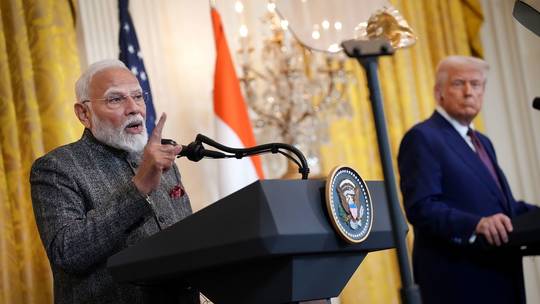
India has sharply criticized a new US tariff linked to its oil trade with Russia, denouncing the move “extremely unfortunate,” while pledging to protect its own national interests.

The White House announced an additional 25% levy on Indian imports on Wednesday, doubling the tariff burden it recently imposed on its major trading partner to 50%. The new duties are set to take effect in 21 days – in late August – according to an order signed by US President Donald Trump.

India’s Foreign Ministry condemned the move, noting Washington is targeting the energy security of the world’s most populous nation.

India’s oil “imports from Russia are based on market factors and done with the overall objective of ensuring the energy security of 1.4 billion people of India,” the ministry spokesperson said in a statement.

“We reiterate that these actions are unfair, unjustified and unreasonable,” the official added, pointing out that “several other countries” continue to trade with Russia in line with their national interests.

India had exposed the double standards of the Western nations earlier this week. In a strongly worded statement on Monday, New Delhi stressed that, while the US and EU condemn India’s defense and energy ties with Moscow, they both continue to trade with Russia at even higher levels.

US officials have hardened their rhetoric towards New Delhi in recent weeks, criticizing India’s close ties with Moscow. They have also accused the Asian country of “effectively” financing Russia’s conflict with Ukraine by purchasing large volumes of crude. India rejects the charge, insisting its energy policy is rooted in economic necessity and the welfare of its population.

Since the escalation of the Ukraine conflict in 2022, Russia has emerged as India’s top crude supplier, while India now exports large volumes of refined fuels – much of it made from Russian oil – to EU buyers.

Trump has threatened to impose 100% tariffs on countries that continue business with Russia unless Moscow agrees to a major peace deal with Ukraine. In response to such threats, Russia has said it believes “sovereign states should have, and do have, the right to choose their own trade partners,” as well as to pursue cooperation that suits their national priorities.

Trump hit india with 25% tariff and penalty for trade with Russia

The US will impose 25% tariffs on goods imported from India “plus an unspecified penalty” for buying Russian energy and weapons, President Trump has said.

In a post on his Truth Social platform, he said the measures would take effect from from 1 August, the US deadline for a trade deal. He described India as a friend whose “tariffs are far too high, among the highest in the world”.

He also criticised India’s purchases of Russian military equipment and energy “when everyone wants Russia to STOP THE KILLING IN UKRAINE”.

There was no immediate response from India, which has been negotiating a trade deal with the US for months. Last year, the US had a trade deficit of $45.8bn (£26.1bn) with India.

Trump issues 10% tariff threat to BRICS

President Donald Trump has claimed that BRICS is “fading out fast,” while warning that any attempts by the group to challenge the US dollar will be met with a harsh economic backlash.

Speaking at the White House on Friday, Trump denounced what he called BRICS’ attempts to weaken the dollar. “They wanted to try and take over the dollar, the dominance of the dollar… And I said, anybody that’s in the BRICS consortium of nations, we’re going to tariff you 10%.”

Trump stressed that Washington will spare no effort to preserve the dollar’s hegemony. “The reserve currency is so important. You know, if we lost that, that would be like losing a World War.”

Washington “can never let anyone play games,” Trump said, adding that he has decided to “hit them [BRICS] very, very hard.” “If they ever really form in a meaningful way, it will end very quickly,” he said.

Trump also claimed his threat to impose 10% tariffs on imports from the BRICS had completely derailed the group’s summit in Rio de Janeiro earlier this month. “They had a meeting the following day and almost nobody showed up,” he said.

However, the BRICS summit featured broad participation at the highest level. While China’s President Xi Jinping was absent from the meeting, his country was represented by Chinese Premier Li Qiang. Russian President Vladimir Putin was also absent, but addressed the summit remotely.

Brazil’s President Luiz Inacio Lula da Silva, India’s Prime Minister Narendra Modi, South Africa’s President Cyril Ramaphosa and Indonesia’s President Prabowo Subianto, as well as leaders from Egypt, Ethiopia, Iran, and the UAE attended in person.

In October, Russia’s Finance Minister Anton Siluanov stated that the share of national currencies in trade among BRICS countries has reached 65%, with the share of the dollar and euro plunging below 30%.

Earlier this week, Russian Foreign Minister Sergey Lavrov explained that BRICS countries are exploring dollar alternatives “to shield themselves from US arbitrariness.” 

However, Russian Deputy Foreign Minister Sergey Ryabkov has said that BRICS has never been meant as a rival to the US, although warning that “the language of threats and manipulation… is not the way to speak to members of this group.”