NP
NP
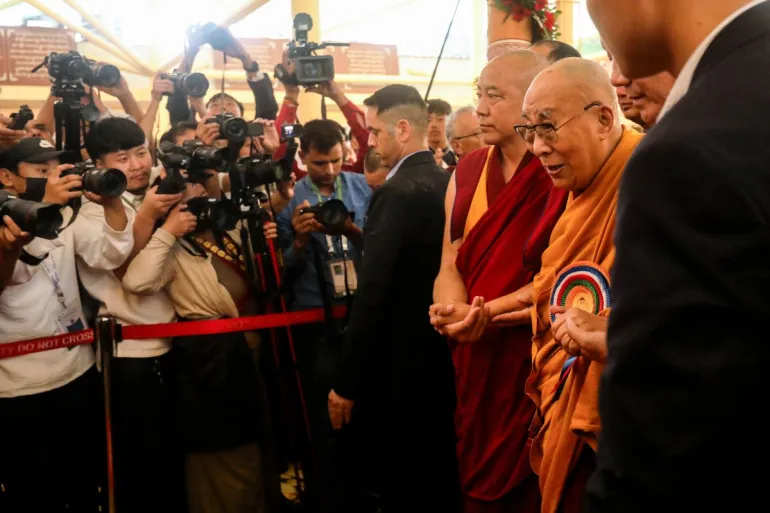
Born on July 6, 1935, in the modest village of Taktser in northeastern Tibet, Lhamo Thondup was identified at the age of two as the 14th reincarnation of the Dalai Lama, the highest spiritual authority in Tibetan Buddhism. Renamed Tenzin Gyatso, he was taken to Lhasa and formally enthroned in 1940. From a young age, his life was immersed in the study of Buddhist logic, scripture, debate, and metaphysics, a rigorous monastic education reserved for the tulkus of the Gelug school. By the age of fifteen, in 1950, he was thrust into political leadership just as the Chinese People’s Liberation Army began asserting control over Tibetan territory.
Following the defeat of the Republic of China and the establishment of the People’s Republic of China in 1949 under Mao Zedong, the new Communist regime declared its claim over Tibet, viewing it as part of a “unified motherland.” In 1951, under pressure and with little ability to resist militarily, Tibetan representatives signed the Seventeen Point Agreement. While China viewed it as a peaceful reunification, many Tibetans, including the monastic community and the aristocracy, considered it a coercive annexation. The young Dalai Lama initially tried to work within the framework, even visiting Beijing in 1954 and meeting Chairman Mao. However, by the mid-1950s, tensions were escalating rapidly. The promise of autonomy began to collapse under the weight of forced collectivization, suppression of religious institutions, and mass arrests. In March 1959, facing a popular uprising in Lhasa and fearing for his life as PLA troops encircled the capital, the Dalai Lama fled Tibet in secrecy. Disguised as a soldier, he crossed the treacherous Himalayas and reached India, where Prime Minister Jawaharlal Nehru offered him asylum.
From exile in Dharamshala, Himachal Pradesh, the Dalai Lama re-established the Tibetan government-in-exile, known as the Central Tibetan Administration. Over time, he shifted his role from political sovereign to spiritual guide, eventually renouncing any formal political power in 2011 and handing authority to a democratically elected Sikyong (Prime Minister). Nevertheless, he remained the moral and symbolic leader of Tibetans worldwide, preserving not only Tibetan Buddhist teachings but also acting as a bridge between East and West. Awarded the Nobel Peace Prize in 1989, the Dalai Lama earned global recognition for his steadfast commitment to nonviolence, even in the face of repression, and for championing dialogue, religious harmony, and compassion.
One of the most debated aspects of his leadership is the “Middle Way Approach,” a policy that seeks genuine autonomy for Tibet within the framework of the Chinese constitution, rather than demanding full independence. The Dalai Lama has argued that such a compromise would ensure cultural, linguistic, and religious preservation for Tibetans while maintaining political stability. However, this approach has not been universally embraced within the Tibetan diaspora. Many exiles and younger activists view it as too conciliatory, believing it concedes moral and historical legitimacy to China. Meanwhile, China rejects the Dalai Lama’s proposal outright, accusing him of promoting “separatism” under the guise of autonomy. His image, name, and teachings are banned across most parts of Tibet, and he remains one of Beijing’s most censored figures.
Yet, his spiritual stature continues to grow. The Dalai Lama’s influence transcends the confines of religion. He has engaged in dialogue with scientists on the nature of consciousness, introduced secular ethics into global educational discussions, and offered teachings across traditions that emphasize universal human values. His writings and public appearances have popularized Tibetan Buddhism in the West and inspired millions around the world, regardless of faith.
As he advances in age, the issue of his succession has become a focal point of global concern. In Tibetan tradition, the Dalai Lama reincarnates, and his next rebirth is identified by high lamas through a combination of visions, signs, and divinations. However, the Chinese government has declared that it will oversee and approve any future reincarnation—a move that contradicts centuries of Tibetan religious practice. The Dalai Lama has hinted he may reincarnate outside Chinese territory or may even end the lineage, a statement that has stirred controversy both inside Tibet and internationally. What he says, and doesn’t say, in this context is being closely monitored in Washington, New Delhi, and Beijing. The United States views him as a champion of human rights and a peaceful counterbalance to Chinese authoritarianism. India, which hosts the Tibetan government-in-exile, walks a delicate line—sympathetic to the Tibetan cause yet wary of further straining ties with China, especially amid ongoing border tensions. Beijing, meanwhile, continues to regard the Dalai Lama as a threat to national unity, regardless of his calls for dialogue and nonviolence.
Critically, the Dalai Lama’s global stature allows him to keep the Tibetan issue alive in international forums, even as geopolitical realities shift in China’s favor. His peaceful resistance has drawn praise, but real diplomatic momentum toward resolving the Tibetan issue has stalled. Critics argue that while his moral authority is unmatched, his political approach has yielded little concrete change within Tibet itself, where cultural suppression and surveillance continue. Some fear that after his passing, the Tibetan movement may fracture or lose global attention, especially if China attempts to appoint its own successor and sow division within Tibetan Buddhism.
Still, in a world increasingly defined by power politics, nationalism, and authoritarian resurgence, the Dalai Lama remains a unique figure—a symbol of spiritual resilience, humility, and the enduring pursuit of freedom without violence. His life embodies the story of a displaced nation, the cost of imperial ambition, and the possibility that compassion, even when exiled, can move the conscience of the world. Whether or not his vision for Tibet is ever realized, his legacy is certain: a bridge between cultures, a voice for the voiceless, and a reminder that moral authority can still shape the narrative in an age of geopolitical cynicism.