Trump and Netanyahu announce new Gaza Peace Plan:Urge Hamas to accept terms

US President Donald Trump and Israeli Prime Minister Benjamin Netanyahu have unveiled a new peace plan for Gaza, calling on Hamas to accept the terms or face further military action.

The proposal calls for an immediate halt to military operations. Within 72 hours, Hamas would release 20 living Israeli hostages and return the remains of more than two dozen believed dead, in exchange for the release of hundreds of detained Palestinians.

A copy of the 20-point plan has been handed to Hamas officials through Qatari and Egyptian intermediaries. The document states that Hamas will have no role in governing Gaza but leaves open the possibility of a future Palestinian state.

At a White House press conference, Trump called the plan “a historic day for peace,” while affirming US support for Israel if Hamas rejects the offer. Netanyahu echoed this, saying Israel “will finish the job” if Hamas fails to comply.

The Palestinian Authority welcomed the US efforts as “sincere and determined,” pledging cooperation with the US and regional partners to end the war, ensure humanitarian aid, and secure the release of hostages and prisoners.

The plan outlines steps including the destruction of Hamas weapons and tunnels, the exchange of remains on both sides, and the immediate entry of aid once an agreement is signed. Gaza would be temporarily administered by a technocratic Palestinian committee under the supervision of a new international body, the “Board of Peace,” to be led by Trump with former UK Prime Minister Tony Blair among its members.

Global leaders including UK Prime Minister Keir Starmer, French President Emmanuel Macron, and European Council President Antonio Costa expressed support for the proposal, urging Hamas to accept it as a step toward lasting peace.

The plan also promises staged Israeli withdrawals, reconstruction efforts, and an economic development program for Gaza. Unlike earlier positions, it does not call for Palestinians to leave Gaza but instead encourages rebuilding within the territory.

Hamas has said it is willing to review any proposal that could end the war but insists any deal must secure Palestinian rights, guarantee full Israeli withdrawal, and allow for an independent Palestinian state along 1967 borders.

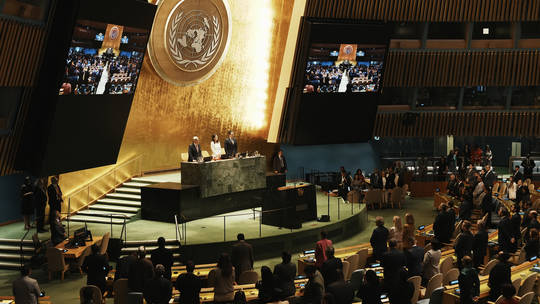
The announcement comes amid heavy criticism of Israel at the UN, where Netanyahu denounced recognition of a Palestinian state by several Western countries. His speech prompted a walkout by dozens of diplomats.

Trump rejects Israeli Annexation of West Bank : Pushes Gaza Peace Deal

Washington- US President Donald Trump said he will not allow Israeli Prime Minister Benjamin Netanyahu to annex the occupied West Bank. Speaking in the Oval Office, Trump stressed, “It’s not going to happen,” ahead of Netanyahu’s UN address.

Trump also claimed a Gaza deal is “pretty close,” adding he had spoken with Netanyahu and other Middle Eastern leaders. Palestinian President Mahmoud Abbas, addressing the UN by video, expressed readiness to work with global leaders on a French-backed peace plan.

Global pressure on Israel is rising, with the UK, Germany, and the UN warning that annexation would be “intolerable.” Several Western countries have recently recognised an independent Palestinian state, further isolating Israel.

Meanwhile, Gaza faces dire conditions. Over 65,000 Palestinians, including more than 18,000 children, have been killed in Israeli strikes since October 2023, according to Gaza’s health ministry. The UN says half a million people in Gaza face “catastrophic” starvation.

Israel has dismissed genocide accusations but faces growing international sanctions and trade restrictions.

Clashes erupt across Italy during Nationwide Pro-Palestinian protests

Rome- Thousands of Italians joined nationwide protests on Monday in solidarity with Palestinians, leading to violent clashes in several cities. The demonstrations, organized by trade unions, spread to nearly 80 towns and cities, with the largest turnouts in Milan and Rome.

In Milan, tensions escalated near the central station where protesters clashed with police, leaving about 60 officers injured. A group of masked protesters threw stones, smoke bombs, and metal objects, prompting police to respond with water cannons and tear gas. Similar unrest was reported in Bologna, where demonstrators blocked the city’s main ring road.

The strike brought together teachers, dockworkers, and students, disrupting public transport and operations at major ports in Livorno and Genoa. A metro line in Milan was shut down, and university students in Turin and Bologna blocked lecture halls. Protesters carried banners with slogans such as “Free Palestine” and “Let’s block everything.”

Prime Minister Giorgia Meloni condemned the violence in Milan as “shameful,” saying it undermined the cause of Gaza and only harmed Italian citizens. Milan’s mayor, Giuseppe Sala, also criticized the vandalism as unjustifiable.

The unrest came as debates over Palestinian statehood deepened in Europe. France formally recognized a Palestinian state on Monday, following similar moves by the UK, Canada, portugal and Australia. President Emmanuel Macron called the decision a “necessity,” supported by Belgium, Malta, and Luxembourg. Other European nations, including Spain and Norway, had already taken the step last year.

Italy’s government, however, has resisted recognition, calling it “counter-productive.” Opposition leader Elly Schlein accused Meloni of avoiding serious debate on Israel, criticizing her for giving lighthearted interviews instead of addressing parliament.

European leaders have toughened their tone toward Israel’s offensive in Gaza. EU Commission President Ursula von der Leyen recently urged an end to the “horrific events” in the enclave. While Germany remains a close ally of Israel, Chancellor Friedrich Merz has grown more critical of its actions, though Berlin insists Palestinian statehood recognition should come only at the end of a peace process.

Thousands flee Gaza city as Israel’s ground offensive escalates

GAZA-Thousands of Palestinians are fleeing Gaza City as Israel’s ground assault escalates. The Israeli military says the operation aims to defeat around 3,000 Hamas fighters and free hostages, but the offensive has triggered strong international criticism.

Gaza’s Hamas-run health ministry said Israeli strikes hit al-Rantisi children’s hospital three times, forcing half of its patients and families to flee. Other hospitals reported at least 35 killed across Gaza on Wednesday, mostly in the north. Israel said it is reviewing the hospital strike reports and claimed it hit more than 150 “terror targets” in two days.

Aid agencies, including Save the Children and Oxfam, warned of an “unconscionable” humanitarian crisis. The UN says 190,000 people have fled Gaza City since August, while Israel claims 350,000 have left, with about 650,000 still inside.

Palestinians are evacuating via donkey carts, cars, and on foot, but costs are soaring.Trucks cost around 3,000 shekels ($900), and tents 4,000 shekels. Many families say the “humanitarian area” in al-Mawasi is overcrowded and unlivable, with some forced to return north.

Meanwhile, families of 48 hostages held by Hamas protested in Jerusalem, saying Israel’s assault puts their relatives at risk. The offensive has been condemned by the UN rights chief, Saudi Arabia, and Pope Leo XIV, who called Gaza’s conditions “unacceptable” and urged a ceasefire.

A UN inquiry accused Israel of genocide, alleging targeted attacks on civilians, children, and cultural sites. Israel rejected the report as “distorted and false.”

Since the war began at least 64,964 people have been killed, nearly half of them women and children. The UN has already declared famine in Gaza City and warned the worsening offensive will deepen the catastrophe.

UN General Assembly Backs Two-State Solution for Israel and Palestine

New York – The United Nations General Assembly (UNGA) on Friday passed a resolution with overwhelming support in favor of a two-state solution to the Israel-Palestine conflict, explicitly excluding Hamas from future governance in Gaza.

The resolution, which is non-binding, received 142 votes in favor, 10 against, and 12 abstentions. Ukraine supported the motion, while Israel and the United States opposed it. The measure calls for Hamas to be disarmed and for a permanent settlement to the Gaza war based on the creation of separate states.

Israeli UN Ambassador Danny Danon dismissed the move as a “hollow gesture” and “not a serious attempt at peacemaking,” arguing it would prolong the war and “reward” Hamas rather than weaken it. Hamas has not issued a response to the resolution.

This is the strongest-worded UNGA resolution to date on Gaza, directly urging Hamas to relinquish control after nearly two decades of rule. Hamas rose to power after defeating Fatah in the 2006 election and seizing full control of Gaza the following year.

At the upcoming UNGA session on September 22, Britain, France, Canada, Australia, and Belgium are expected to follow suit. Russia has reiterated its stance that a two-state solution is the only viable path to de-escalation, continuing its long-standing recognition of Palestine since the Soviet era.

Houthis claim drone strike on Israel’s Ramon airport

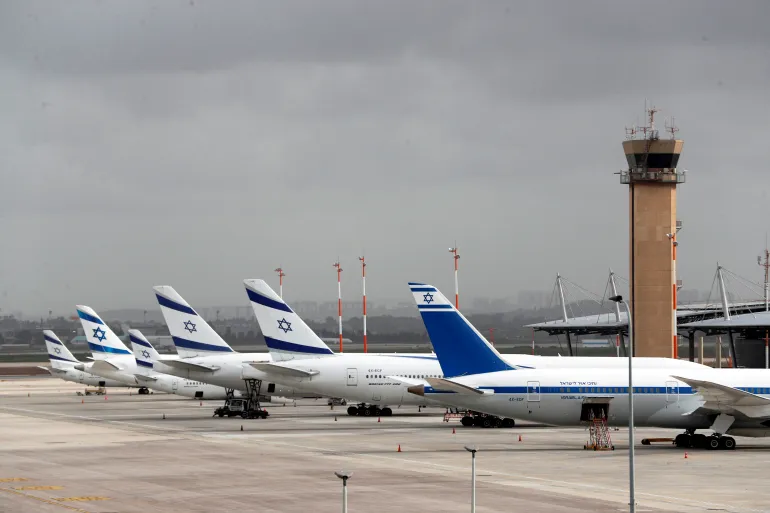
Yemen’s Houthi group has claimed responsibility for a drone attack on Israel’s Ramon Airport near the Red Sea city of Eilat, which injured two people and briefly halted airport operations on Sunday.

According to Houthi military spokesperson Yahya Saree, the drone hit the airport’s arrivals hall, forcing a two-hour suspension of flights. He said the strike was part of a wider drone campaign targeting several sites in southern Israel and warned of further escalation in support of Palestinians in Gaza. Saree declared that airports inside Israel “are unsafe and will be continuously targeted.”

The Israeli military confirmed that three drones were launched from Yemen, saying two were intercepted before reaching Israeli airspace. It did not provide details about the third drone. Israeli newspaper Haaretz reported that a 63-year-old man was injured by shrapnel, while a 52-year-old woman was hurt after falling. Both were taken to a hospital in Eilat, while others treated for panic attacks received medical care at the scene.

Israeli Army Radio said an initial probe found that the drone which struck Ramon Airport had not been detected by air force radar systems.

The Houthis have repeatedly launched missiles and drones at Israel since the Gaza war began in October 2023, describing their attacks as acts of solidarity with Palestinians. They have also targeted commercial ships in the Red Sea. In response, Israel has carried out airstrikes on Houthi-controlled areas in Yemen, including the strategic Hodeidah port.

Late last month, Israeli strikes killed several senior Houthi officials, including Ahmed al-Rahawi, the prime minister of the Houthi-backed government, along with other ministers and many civilians. In May, a Houthi missile landed near Israel’s main Ben Gurion Airport outside Tel Aviv, lightly injuring four people and prompting airlines to suspend flights for months. Israel later destroyed Sanaa International Airport in Yemen in retaliation.

Trump Proposes Trilateral Summit With Putin and Zelensky on August 22

Washington, August 17 – US President Donald Trump is seeking to hold a trilateral summit with Russian President Vladimir Putin and Ukrainian President Volodymyr Zelensky as early as August 22.

Following his meeting with Putin in Alaska on August 15, Trump reportedly informed Zelensky and several European leaders by phone that he wanted to bring the two sides together for direct talks.

It is reported that Trump suggested a potential peace deal under which Ukraine would cede remaining parts of the Donbass region to Russia, while a ceasefire along current frontlines and security guarantees for both Ukraine and Europe would be offered in exchange.

Trump and Putin met at the Elmendorf-Richardson military base in Alaska for about three hours, including private talks and a small-group discussion. The Russian delegation included Kremlin aide Yury Ushakov and Foreign Minister Sergey Lavrov, while the US side was represented by Secretary of State Marco Rubio and Special Presidential Envoy Steve Witkoff. Both leaders later said the talks focused on ending the war in Ukraine.

Calling the summit “very productive,” Trump later reached out to Zelensky, EU leaders, NATO Secretary General Mark Rutte, and European Commission President Ursula von der Leyen. He said Russia and Ukraine should move directly toward a final peace agreement, dropping his earlier insistence on a ceasefire first.

Trump and Zelensky are expected to meet at the White House on August 18. Trump has indicated that if those talks go well, he may arrange another round of discussions with Putin.

Recognition Is Not Enough — The World Must Stop Enabling Israel’s Genocide

As Canada, France, the United Kingdom, and Portugal prepare to recognize the State of Palestine at the United Nations General Assembly this September, the move is being hailed by some as a moral shift in global diplomacy. But let us be absolutely clear: recognition alone is no longer enough. It is the bare minimum. While Palestinians in Gaza are being starved, bombed, and exterminated in broad daylight, such gestures ring hollow unless they are accompanied by real, punitive measures against the aggressor—Israel.

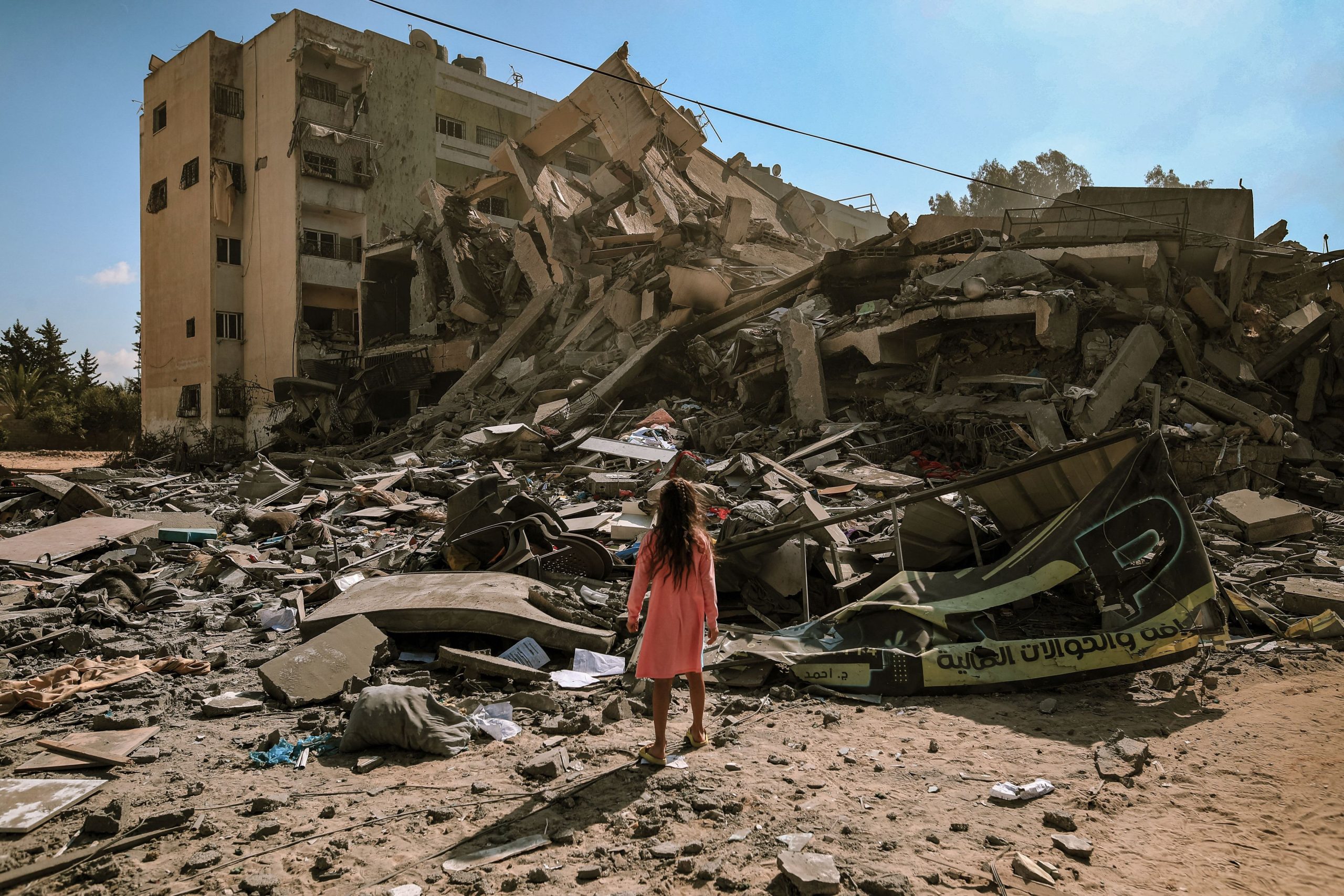
More than 60,000 Palestinians have been slaughtered by Israel since October 2023—many of them children, women, and the elderly. Gaza lies in ruins. Hospitals are levelled, ambulances are targeted, water pipelines have been destroyed, and food convoys are routinely blocked. Children are dying not only from airstrikes but from hunger and thirst. Entire generations are being wiped out while the so-called “international community” continues to deliberate over symbolism and semantics.

Meanwhile, Israel has released a new official map claiming all of historic Palestine as its own, eliminating even the illusion of a future Palestinian state. This is not just a rejection of the two-state solution; it is a declaration of colonial conquest. It is ethnic cleansing in real time, broadcast to the world, and shamelessly supported by billions in military aid from the West.

In this context, what does it mean for Western countries to “recognise” Palestine? It is like applauding a drowning man from the shore while refusing to throw a rope. It is diplomatic theatre designed to appease growing public outrage while maintaining the status quo—continued occupation, apartheid, and genocide.

Recognition, without consequences for Israel, is nothing more than complicity. These same countries that plan to vote for Palestinian statehood in September are the ones that sell Israel the weapons it uses to massacre civilians. They train Israeli forces, shield Israel from accountability at the International Criminal Court, and block ceasefire resolutions at the UN Security Council. Their recognition is coated in the blood of their own hypocrisy.

Let us not forget: over 140 countries already recognise Palestine. Has that stopped the bombings? Has that freed Gaza from blockade? Has that secured justice for the thousands buried under rubble? No. Because recognition without enforcement is meaningless. What Palestine needs is not another statement—it needs sanctions on Israel, an arms embargo, diplomatic isolation, and full criminal prosecution of Israeli leaders and military commanders for crimes against humanity.

Between now and September, and even after the UN vote, the killing will likely continue. Israel will ignore these symbolic recognitions as it always has, emboldened by the military and financial support it receives from the very countries now claiming to support Palestinian statehood. Worse, Israel may escalate its brutality even further to dismantle any trace of Palestinian governance before it can gain new legal ground through recognition.

As the world watches a slow genocide unfold, the real question is not whether Palestine deserves recognition. It is: how long will the world enable Israel to destroy it?

Palestine does not need empty declarations—it needs liberation. It needs justice, not charity. If countries like the UK, Canada, and France truly care about human rights, then recognising a Palestinian state must be the beginning of a complete rupture with Israeli apartheid and war crimes. Until they cut arms sales, impose sanctions, and demand accountability, their recognition is not an act of solidarity—it is an insult. The time for symbolic gestures is over. The world must choose: justice for Palestine or complicity in its destruction.

Palestine: From Ancient Homeland to Fragmented Nation

The land historically known as Palestine has been inhabited for millennia, serving as a crossroads of civilizations, cultures, and faiths. Its history predates the modern conflict by thousands of years and is deeply intertwined with the region’s strategic location and religious significance. Today, what was once a single geographic and cultural entity is fragmented into territories under occupation, blockade, and partial autonomy. Understanding the history of Palestine provides essential context for its current political and humanitarian crisis.

The earliest recorded history of Palestine dates back to ancient Canaanite and Philistine civilizations around 3000 BCE. Over the centuries, the region witnessed successive rules by ancient Israelites, Assyrians, Babylonians, Persians, Greeks, and Romans. The ancient Kingdoms of Israel and Judah existed intermittently in parts of this land, but after the Roman conquest and destruction of Jerusalem in 70 CE, the region was incorporated into the Roman Empire and later renamed Syria Palaestina after the Bar Kokhba revolt in 135 CE, a name meant to erase Jewish national identity. The term “Palestine” thus became widely used in classical antiquity to refer to the geographic area between the Mediterranean Sea and the Jordan River.

From the 7th century CE, following the Muslim conquest, Palestine became part of successive Islamic caliphates. Under the Umayyads, Abbasids, and later the Fatimids, the region thrived as an important center of trade and religious learning. During the Crusades, parts of Palestine were briefly controlled by European Christian kingdoms, but Muslim forces under Salah al-Din (Saladin) reclaimed the territory in 1187. By 1517, Palestine became part of the Ottoman Empire, where it remained for four centuries. Under Ottoman rule, Palestine was administratively divided into districts but retained its cultural and demographic continuity, with a population predominantly Arab and Muslim, alongside Christian and Jewish minorities who coexisted for centuries.

Modern Palestinian national identity began to take shape in the late Ottoman period, influenced by Arab nationalism and opposition to European colonial ambitions. However, Palestine’s fate dramatically changed after World War I. The collapse of the Ottoman Empire brought the region under British control through the British Mandate for Palestine (1920–1948), formalized by the League of Nations. The mandate period saw significant political and demographic transformation due to Britain’s support for the Zionist movement, enshrined in the Balfour Declaration of 1917, which promised to facilitate a “national home for the Jewish people” in Palestine. At that time, Arabs made up around 90 percent of the population, with Jews comprising about 10 percent.

Jewish immigration, driven by European persecution and later the Holocaust, increased sharply under British administration, with the Jewish population rising to roughly one-third by 1947. Tensions between the Arab majority, who sought independence, and the Jewish community, which sought a separate state, escalated into violence. Palestinian Arabs staged revolts, notably the 1936–1939 Arab Revolt, which Britain brutally suppressed. Britain’s eventual withdrawal from the mandate left Palestine in turmoil.

The United Nations Partition Plan of 1947 (Resolution 181) proposed dividing Palestine into a Jewish state (allocated 55 percent of the land) and an Arab state (45 percent), with Jerusalem placed under international administration. Jewish leaders accepted the plan, but Palestinian Arabs and neighboring Arab states rejected it, viewing it as unjust and illegitimate. Civil war erupted between Jewish and Arab forces even before the British left.

On May 14, 1948, Zionist leaders declared the independence of the State of Israel. In the ensuing war, Israel expanded its control to 78 percent of historic Palestine, far beyond the UN allocation. More than 700,000 Palestinians were expelled or fled from their homes in what Palestinians call the Nakba (Catastrophe). Over 400 villages were depopulated or destroyed, and the refugees were barred from returning despite UN Resolution 194 affirming their right of return.

The remaining 22 percent of Palestine—the West Bank, including East Jerusalem, and the Gaza Strip—fell under Jordanian and Egyptian control, respectively, until the 1967 Six-Day War, when Israel occupied these territories. Since then, Palestinian lands have been subjected to military occupation, settlement expansion, and annexation efforts. East Jerusalem was annexed by Israel in 1980, a move unrecognized by most of the international community. The Oslo Accords of the 1990s created the Palestinian Authority with limited self-rule in parts of the West Bank, while Gaza came under the control of Hamas in 2007 following an internal Palestinian political split.

Today, the territory of historic Palestine is divided into three main areas. Israel occupies 78 percent, recognized internationally as a state since 1948. The West Bank, formally under Israeli military occupation, is fragmented into zones, with more than 700,000 Israeli settlers living in illegal settlements built on Palestinian land. Gaza, a densely populated enclave home to over two million Palestinians, has been under a blockade by Israel and Egypt since 2007, with repeated wars devastating its infrastructure. Palestinians in East Jerusalem live under Israeli control with limited rights, while millions of Palestinian refugees remain stateless in camps across Lebanon, Syria, Jordan, and beyond.

The State of Palestine is recognized by more than 130 UN member states and has been a non-member observer state at the United Nations since 2012, but it lacks full sovereignty due to ongoing Israeli occupation and international political deadlock. Palestinians continue to demand their right to self-determination, the establishment of an independent state based on the 1967 borders with East Jerusalem as its capital, and the right of return for refugees, while Israel asserts security concerns and historical claims to the land.

The history of Palestine reveals that it was not an empty land awaiting statehood, but a vibrant society with deep-rooted communities and cultural heritage. Its fragmentation today is the direct outcome of colonial decisions, wars, and decades of occupation. What once existed as a single geographic and cultural homeland is now divided by walls, checkpoints, and borders, with Palestinians struggling to preserve their identity and right to statehood in the face of one of the world’s longest unresolved conflicts.

The history of Israel and Palestine is not merely a tale of two peoples competing for the same land; it is a story of deliberate political engineering by imperial powers that favored one national movement while erasing the rights of another. Britain’s role in shaping this tragedy cannot be understated—it used Palestine as a pawn in its colonial strategy, granting legitimacy and resources to the Zionist project while crushing Palestinian resistance with military force. The Balfour Declaration was not a neutral promise; it was a colonial endorsement that handed over a homeland that was not Britain’s to give. The result was not just the birth of a new state, but the catastrophic dispossession of an entire people, creating one of the largest refugee crises in modern history.

Today, the consequences of those imperial decisions still echo through every destroyed village, every refugee camp, every checkpoint, and every blockade. While Israel stands as a state born of determination and tragedy, it is equally a state born of privilege—privilege granted by British imperial power and cemented through wars of conquest. The ongoing occupation, settlement expansion, and denial of Palestinian rights are not new phenomena; they are continuations of a colonial legacy that treated Palestinian lives and sovereignty as expendable. History will remember this not only as a story of survival for one people but as a permanent stain of injustice against another—a reminder that statehood built on dispossession carries a moral debt that the world has yet to reckon with.

Palestine Beneath the Rubble: A nation fighting for Survival

Israel’s military campaign in Gaza and the occupied Palestinian territories has resulted in one of the most destructive and deadly conflicts of the modern era. What began as a response to a Hamas-led attack has evolved into what international observers, human rights groups, and legal experts describe as a wide-scale assault on civilian life, infrastructure, and the Palestinian national identity itself. Critics, international legal bodies, and humanitarian organizations argue that the scale and nature of the operations suggest a broader strategic doctrine—one aimed at gaining full control over Palestinian territories under a one-state vision, displacing Palestinians through what they describe as ethnic cleansing, and erasing their national identity.

As of mid-July 2025, Gaza’s Ministry of Health reports more than 58,600 Palestinian deaths, with over 139,000 wounded. Independent estimates from research groups, including The Lancet, suggest the true toll may exceed 70,000 to 80,000 when factoring in indirect deaths caused by trauma, starvation, and medical collapse. More than 59% of the dead are women, children, or elderly civilians. UN reports verify that 2,917 Palestinian children were killed in 2024 alone, with thousands more unverified but believed dead. The UN’s Commission of Inquiry documented that 403 of 564 schools in Gaza were struck, 85 destroyed entirely, and 742 people killed in UNRWA shelters. Nearly 90% of schools and universities, over 84% of health facilities, and half of Gaza’s religious and cultural sites have sustained damage or total destruction. Hospitals, water distribution points, churches, and mosques have been repeatedly hit by Israeli strikes, including a recent attack on July 17, 2025, on Gaza’s sole Catholic church, killing at least three civilians, including children and disabled residents, and wounding a priest known to have worked closely with Pope Francis. On July 13, a strike at a water-collection point killed ten people, mostly children.

Israel insists its military actions are defensive measures against Hamas militants allegedly embedded in civilian areas, citing both rocket attacks and supposed use of hospitals as militant bases. However, the International Criminal Court’s prosecutor has stated that many such claims, including Hamas’ use of hospitals as military strongholds, have been “grossly exaggerated.” The UN Commission of Inquiry, after reviewing more than 7,000 pieces of evidence, concluded that Israel’s actions amount to war crimes and crimes against humanity, including the crime of extermination, and that many strikes showed no military necessity or warning. The Commission has submitted findings to the ICC, which in November 2024 issued arrest warrants for Israeli Prime Minister Benjamin Netanyahu and Defense Minister Yoav Gallant over charges of war crimes and crimes against humanity, including deliberate starvation, indiscriminate bombing, and targeting civilians.

Beyond the carnage lies a deeper geopolitical concern. Many analysts, activists, and international legal experts now argue that Israel’s military operations are part of a broader strategy to eliminate the Palestinian presence in historic Palestine and replace it with a singular, Jewish-majority state. This claim is supported by comments from senior Israeli officials, proposals to build “humanitarian cities” on Gaza’s border—described by former Prime Minister Ehud Olmert as concentration camps—and ongoing efforts to expand settlements across the West Bank.

International observers argue that Israel’s military campaign is not solely about neutralizing Hamas but rather part of a wider policy to achieve demographic and territorial dominance. Proposals for “humanitarian cities” along Gaza’s border, described by former Israeli prime minister Ehud Olmert as “concentration camps,” fuel claims of permanent displacement. UN experts have warned that the forced relocation of Palestinians echoes the Nakba of 1948 and amounts to a new instance of ethnic cleansing. Scholars describe this as demographic engineering designed to secure Jewish majority control over all of historic Palestine, effectively dismantling Palestinian national identity. Human Rights Watch, Amnesty International, and Oxfam have labeled the destruction of civilian infrastructure and blockade-induced deprivation as genocidal and systematic. South Africa has filed genocide charges against Israel at the ICC, while a coalition of Global South nations, dubbed the Hague Group, has pledged to defend ICC and ICJ rulings and push for arms embargoes.

The humanitarian crisis remains catastrophic. UN findings show that child malnutrition in Gaza has more than doubled in three months, jumping from 5.5% to 10.2%. Over 1.9 million people are displaced, trapped in makeshift shelters with minimal access to food, water, or medical care. Aid agencies report repeated strikes on humanitarian convoys and refugee camps. Despite repeated international calls for a ceasefire, no comprehensive truce holds, and bombardment continues daily, even in designated safe zones.

The United Nations has consistently condemned Israel’s actions, demanding an immediate ceasefire and unimpeded humanitarian access. The UN Human Rights Council’s Commission has accused Israel of committing widespread war crimes and crimes against humanity, warning of atrocity crimes in progress. The UN Office of the High Commissioner for Human Rights has criticized Israel’s collective punishment measures, citing incidents such as a six-day offensive in March that killed 506 Palestinians, including 200 children. UN human rights rapporteurs have repeatedly warned that the destruction and displacement amount to mass ethnic cleansing, urging immediate international intervention.

Western governments remain divided. The United States continues to provide extensive military and financial support to Israel, opposing ICC actions and supplying almost $18 billion in security assistance since the war began. European responses vary, with some states pausing arms exports and expressing support for ICC warrants, while others resume funding to UNRWA and call for sanctions on illegal settlement expansions. The International Court of Justice has ruled Israel’s occupation and settlement policies unlawful under international law. Meanwhile, human rights organizations and legal experts worldwide are pressing for arms embargoes and accountability.

The Israeli government insists that its war is against Hamas, not Palestinians. But to, many in the international community, the systematic destruction of Gaza’s civilian life, infrastructure, and history—carried out under the guise of self-defense—reflects a broader campaign of erasure. With the death toll continuing to rise, ceasefire negotiations stalled, and legal processes grinding slowly forward, the conflict shows no sign of resolution. Critics argue that such justifications mask a long-term plan for territorial annexation and permanent displacement of Palestinians. What remains is a devastated population, a broken land, and a deepening sense among Palestinians that the war is not merely about territory or rockets, but about existence itself.

With the weight of overwhelming evidence, the devastation unfolding in Gaza can no longer be framed merely as collateral damage of war or a tragic by-product of self-defense. The systematic targeting of civilians, the relentless destruction of homes, hospitals, schools, and places of worship, and the forced displacement of nearly an entire population point to a deliberate strategy that transcends the fight against Hamas. What is happening is not just a military campaign; it is the slow erasure of a people from their land, a campaign of dispossession carried out under the banner of security. No justification can legitimize the mass killing of children, the starvation of families, or the leveling of entire neighborhoods. The international community’s tepid response and the open complicity of powerful Western nations only deepen the stain of this tragedy, allowing impunity to flourish while civilians pay the price in blood. History will remember this not as a war of defense, but as an assault on an entire population’s right to exist, and silence in the face of such crimes will forever remain a moral failure of our time.

The man behind decades of war: Benjamin Netanyahu’s long history of conflict

Benjamin Netanyahu, Israel’s longest-serving prime minister, has spent more than three decades positioning himself as the architect of Israel’s aggressive regional posture, leaving behind a legacy defined by repeated wars, interventions, and accusations of grave human rights abuses. Since his rise in the 1990s, Netanyahu has consistently framed Israel’s security in zero-sum terms, using overwhelming force against enemies real or perceived across Gaza, Lebanon, Syria, Iraq, and beyond, while leveraging perpetual conflict as a tool to maintain his grip on power despite repeated corruption scandals.

Netanyahu’s tenure has been marked by devastating wars on Gaza. In the wake of the Hamas-led attack on October 7, which killed around 1,200 Israelis and saw more than 240 hostages taken, Netanyahu launched a relentless campaign of bombings and siege tactics on Gaza. This operation cut off water, food, and fuel for over two million people, prompting accusations of collective punishment from humanitarian groups. By June 2025, Palestinian health authorities reported over 56,000 killed, including tens of thousands of children, and more than 130,000 injured. UN agencies, Médecins Sans Frontières, and the International Criminal Court described Israel’s use of starvation and systematic attacks on civilian infrastructure as war crimes, with the ICC issuing arrest warrants for Netanyahu and his defense minister in May 2024 for crimes against humanity, including murder and persecution.

But Gaza is only the latest chapter in Netanyahu’s pattern of warfare. Early in his first term (1996–1999), Netanyahu endorsed Operation Grapes of Wrath in Lebanon, where Israeli shelling killed over 100 civilians sheltering at a UN base in Qana. Throughout the 2000s and 2010s, he repeatedly vowed to destroy Hezbollah, telling Israeli voters and the international community that Israel would “return Lebanon to the stone age” if rockets were fired into Israel. After Hezbollah’s rise as a formidable force following the 2006 Lebanon war, Netanyahu’s threats and occasional airstrikes on Lebanon became a permanent feature of his military policy. His statements warning of “obliterating” Lebanon’s infrastructure if Hezbollah acts have stoked fears of a full-scale war that could engulf the region.

In Syria, Netanyahu has ordered hundreds of airstrikes since the Syrian civil war began in 2011, targeting Iranian forces and Hezbollah arms convoys. In 2018, he boasted publicly, “We have struck thousands of targets to stop Iran’s entrenchment in Syria and will continue to hit them anywhere in Syria and beyond,” setting a precedent for near-constant Israeli raids that have killed hundreds of fighters and civilians alike. These attacks have often destabilized ceasefires and complicated humanitarian efforts, with Syrian civilians paying a heavy price. In 2015, Netanyahu told voters that only he could “prevent Syria from becoming a base for Iranian terror that will burn the entire Middle East,” using the specter of endless conflict to rally support.

Netanyahu’s war calculus also extended to Iraq. In 2019, according to U.S. intelligence leaks, Israel launched covert airstrikes on Iraqi Popular Mobilization Forces depots, killing fighters and destroying infrastructure. Netanyahu publicly hinted at Israel’s involvement, declaring Israel would “strike Iranian assets wherever they are, including Iraq,” remarks that rattled Baghdad and raised the specter of a broader regional war.

In Yemen, Netanyahu accused the Iran-backed Houthis of plotting attacks on Israel from afar and threatened strikes on Yemeni soil. Meanwhile, he pressured Gulf Arab states into closer security pacts by painting Iran’s regional activities — in Bahrain, the UAE, and the wider Gulf — as existential threats requiring a de facto Israeli-Arab alliance under his leadership.

This bellicose approach found one of its starkest expressions in June 2025, when Israel launched Operation Rising Lion, a massive attack on more than 100 Iranian military and nuclear facilities. The assault killed at least 224 people, many civilians, and injured more than 1,000. Iran retaliated with missile strikes on Israeli cities that killed dozens, marking the most dangerous direct conflict ever between the two countries. Netanyahu framed the attack as vital to freeing Israeli hostages in Gaza and halting Iran’s nuclear ambitions, but the escalation prompted international condemnation and fears of a regional war spiraling out of control.

Throughout these wars, Netanyahu has used bombastic speeches and dramatic visuals — like his infamous 2012 UN presentation where he drew a red line on a cartoon bomb to warn of Iran’s nuclear program — to keep Israel’s population and allies focused on external threats. Critics argue these tactics are designed to distract from his domestic political and legal crises.

Netanyahu’s political survival has indeed depended heavily on these cycles of war. Since 2019, he has been on trial for three major corruption cases — Cases 1000, 2000, and 4000 — involving bribery, fraud, and breach of trust. In Case 1000, prosecutors accuse him of accepting luxury gifts worth nearly 700,000 shekels from billionaires such as Arnon Milchan and James Packer in return for political favors. In Case 2000, he allegedly negotiated a deal with the publisher of Yedioth Ahronoth newspaper for favorable coverage in exchange for undermining a rival outlet. In Case 4000, Netanyahu is accused of approving regulatory benefits worth hundreds of millions of dollars for telecom giant Bezeq’s owner, Shaul Elovitch, who then skewed Walla News coverage to favor him. Netanyahu has repeatedly delayed these trials, citing national security crises like Gaza and Iran, while denouncing the charges as part of a leftist conspiracy to topple him.

His domestic policies have only fueled polarization further. From 2022 to 2024, Netanyahu pushed sweeping judicial reforms that critics said would undermine Israeli democracy by stripping the Supreme Court of its power to check the government. Hundreds of thousands of Israelis took to the streets in some of the largest protests in the nation’s history. Under pressure, Netanyahu paused parts of the overhaul, but has vowed to revive it, framing the judiciary as an obstacle to the will of the people.

Meanwhile, Netanyahu has pursued settlement expansion in the occupied West Bank at an unprecedented pace, approving thousands of new housing units and further entrenching Israeli control in defiance of multiple UN Security Council resolutions. This expansion has intensified daily violence between settlers and Palestinians, stoking tensions that could explode into wider conflict at any moment.

Even as Israel reels from war with Iran, Netanyahu has continued to signal readiness for more aggression. His government has warned Hezbollah and Syria that Israel would not hesitate to strike again if it detected Iranian weapons transfers. His repeated threats that Israel will “do whatever it takes” to destroy Iranian capabilities, including in Syria and Lebanon, have deepened regional instability and left millions across the Middle East living in fear of the next Israeli operation.

Netanyahu’s defenders insist his tough policies have kept Israel safe, pointing to the normalization deals with some Arab states as proof of his strategic vision. But critics, including former Israeli military and intelligence officials, warn that his wars have radicalized new generations of militants across Gaza, Lebanon, Syria, Iraq, and Iran, and that his approach leaves Israel more isolated internationally while cementing cycles of hatred and violence that undermine its long-term security.

Despite repeated international condemnations and polls showing a majority of Israelis want him to step down, Netanyahu has kept power through alliances with ultra-nationalist and religious parties, along with a strategy of portraying himself as Israel’s irreplaceable defender. Yet with Gaza on the brink of famine, Iran vowing revenge, and a corruption trial still looming over his future, Netanyahu’s relentless focus on war as a means of political survival has pushed Israel and the Middle East to a level of instability not seen in decades. Without decisive action by both Israeli society and the international community, many fear Netanyahu’s legacy will be a region locked in endless war.

Genocide in Gaza: Ethnic Cleansing, Mass Murder, and State Terrorism Shielded by Global Powers

GAZA CITY — Gaza today stands as a testament to modern warfare’s most egregious moral and legal failures. Since Israel’s latest offensive began in October 2023, more than 56,000 Palestinians have been killed, including over 16,000 children, according to the Gaza Health Ministry and verified by international organizations such as the World Health Organization. Entire families have been erased. UN agencies estimate that over 80% of Gaza’s 2.3 million residents are displaced, living in tents or rubble without sanitation, electricity, or safe drinking water.

Journalists documenting these war crimes have themselves become targets: more than 200 journalists have been killed since October, according to the Committee to Protect Journalists, which calls Gaza “the deadliest place in the world for journalists.” Yet despite the risks, reporters, local media, and aid workers continue to expose the unprecedented scale of civilian suffering.

The physical devastation is staggering: the UN OCHA confirms that more than 60% of all residential buildings in Gaza have been destroyed or severely damaged. Over 130 schools, 36 hospitals and clinics, and every one of Gaza’s sewage treatment plants have been bombed, according to data compiled by OCHA. This has created not just a warzone, but an engineered humanitarian catastrophe in which disease and starvation now threaten more lives than bombs.

The destruction of Al-Shifa Hospital, Gaza’s largest medical facility, was particularly symbolic: once a lifeline for over 2 million residents, it has been bombed, raided, and permanently closed, leaving trauma patients to die untreated. These acts violate Articles 18 and 19 of the Fourth Geneva Convention, which explicitly prohibit attacks on medical facilities and staff.

Israel’s Defense Ministry has declared Gaza’s north a “safe-free zone,” where civilians have been ordered to leave but given no realistic path to safety. Human Rights Watch documented Israeli forces firing on civilians attempting to flee along supposed evacuation routes. Meanwhile, UNICEF has warned of an “imminent mass death of children” due to famine induced by Israel’s blockade — a clear use of hunger as a weapon of war.

These are not isolated incidents. The Israeli newspaper Haaretz and investigative outlet +972 Magazine have published evidence showing Israeli Prime Minister Benjamin Netanyahu’s government repeatedly approved Qatari cash transfers to Hamas in Gaza to keep it politically dominant and Palestinian society fractured — all while publicly condemning Hamas as terrorists. This longstanding policy allowed Israel to avoid negotiating a unified peace agreement with the Palestinians.

Netanyahu’s political incentives cannot be overstated. He is on trial for multiple corruption charges and has a track record of using Gaza escalations to rally nationalist voters, as documented by Israeli journalist Raviv Drucker. Every major war on Gaza under Netanyahu — 2008, 2012, 2014, and now 2023–2025 — coincided with political crises or elections, according to analyses by International Crisis Group and Carnegie Middle East Center.

Economic interests lie at the heart of Gaza’s tragedy. The offshore Gaza Marine gas field, discovered by British Gas in 2000, has an estimated 1 trillion cubic feet of natural gas. Israel has consistently blocked Palestinian development of these reserves. Reports by The Financial Times and Reuters show that control over these gas fields — potentially worth billions — is a major, underreported factor behind Israel’s refusal to allow any form of Palestinian sovereignty over Gaza.

On the ground, statements by Israeli leaders reveal genocidal intent. Israeli Minister of Heritage Amichai Eliyahu said in November 2023 that dropping a nuclear bomb on Gaza was “an option,” later telling Israeli radio that Gaza’s civilians were legitimate targets because they “raised murderers.” Finance Minister Bezalel Smotrich declared that “there are no innocent civilians in Gaza,” effectively endorsing mass killing. National Security Minister Itamar Ben-Gvir called for “voluntary emigration” of Gaza’s population — a euphemism for ethnic cleansing. These statements were widely reported in Israeli and international media, including The Times of Israel.

Meanwhile, Israel’s Western allies continue to enable and shield these crimes. The United States has provided Israel with over 40,000 precision bombs and missiles since October 2023, according to Pentagon arms export data analyzed by the Center for International Policy. President Joe Biden has repeatedly stated that “Israel has the right to defend itself” and signed a $14 billion supplemental military aid package in May 2024 to replenish Israeli stockpiles. US Ambassador to the UN Linda Thomas-Greenfield has vetoed four UN Security Council resolutions calling for a ceasefire, arguing that a ceasefire would “embolden Hamas.”

European governments have been complicit as well. Germany’s Chancellor Olaf Scholz publicly declared Germany’s “unconditional solidarity with Israel” (DW, October 2023) and authorized continued weapons exports despite evidence of war crimes. UK Prime Minister Rishi Sunak visited Israel and pledged full support, while British arms companies have increased shipments of components for Israeli drones, according to data from the UK Department for Business and Trade cited by Amnesty International.

Arab regimes have offered rhetorical condemnations but taken little concrete action. Egypt, despite controlling the only non-Israeli crossing into Gaza at Rafah, has cooperated with Israel’s blockade by limiting humanitarian aid flows and refusing to allow mass evacuations. Saudi Arabia and the UAE, eager to preserve normalization talks with Israel under the US-brokered Abraham Accords, have restricted protests and muted their diplomatic pressure. This silent complicity leaves Palestinians isolated even in the region that once claimed to champion their cause.

Meanwhile, the broader economic and geopolitical system profits from Gaza’s suffering. The Stockholm International Peace Research Institute’s latest 2024 report shows Israel is among the world’s top 10 arms exporters — and that wars like Gaza’s boost demand for “combat-proven” weapons worldwide. Israeli defense companies like Elbit Systems and Rafael have seen their stock prices surge since October 2023, driven by international orders for weapons tested during the bombardment.

What is happening in Gaza is not simply collateral damage or a tragic byproduct of conflict. It is a deliberate, systematic campaign of ethnic cleansing — a genocide that seeks to erase Gaza’s Palestinian population through starvation, bombardment, and forced displacement. It is mass murder carried out in full view of the world, and it is state terrorism, designed not just to defeat Hamas, but to annihilate the social fabric of Palestinian society. Shielded by the United States, supported by European powers, and enabled by Arab regimes more interested in political deals than human rights, this genocide continues with impunity.

This is the hardest truth: the world is witnessing the destruction of an entire people in real time — and powerful governments are not only failing to stop it but are directly complicit in the ethnic cleansing of Gaza.

Iran attacks US air base in Qatar

Iran has attacked United States forces stationed at the Al Udeid Air Base in Qatar, saying it was retaliating against the US strikes on Iran’s nuclear sites.

The attacks on Monday were confirmed by Iran’s Islamic Revolutionary Guard Corps (IRGC) in a statement addressed to the Iranian people.

Consecutive flares, coupled with loud explosions, were seen in Qatar’s capital, Doha, and other parts of the country.The IRGC, in its statement, said it launched a “powerful and devastating missile attack” as part of Operation Annunciation of Victory in response to the “blatant military aggression” by the US on Iran’s nuclear facilities.

The IRGC also said its “decisive action” sent a message to the White House and its allies that Iran would, “under no circumstances, leave any aggression against its territorial integrity, sovereignty, or national security unanswered”.

“US bases and mobile military assets in the region are not points of strength, but rather major vulnerabilities,” the statement warned.

Iran said it targeted the Al Udeid Air Base in Qatar because it “serves as the command centre of the US Air Force and is the largest strategic asset of the American terrorist army in West Asia”.

Tehran also noted that the missile strike was conducted away from residential areas in Qatar.

“This action does not pose any threat to the friendly and brotherly country, Qatar, and its noble people, and the Islamic Republic of Iran remains committed to maintaining and continuing warm and historic relations with Qatar,” Iran’s Supreme National Security Council said in a statement.

No evidence of nuclear threat from Iran – ex-UK ambassador

There’s no evidence that Iran poses a nuclear threat to Israel, former UK Ambassador to Iran Richard Dalton has said.

Israeli Prime Minister Benjamin Netanyahu claimed that Iran was on the verge of developing nuclear weapons shortly after Israel launched air strikes on Iranian territory last week.

Speaking to Sky News last week, Dalton said, “There is no evidence in the public domain” that Iran was on the brink of nuclear weaponization. He noted that US intelligence shows “no change in the basic assessment” that Tehran has decided “to develop nuclear weapons in accordance with their own defense doctrine, which is to eschew weapons of mass destruction.”

“So, we are entitled to disbelieve Netanyahu’s claims that there was some recent change in Iranian policy and behavior until evidence is put in the public domain,” Dalton said.

Israel began bombing Iran last Friday, claiming that the country was nearing the completion of a nuclear bomb. Iran denied the accusations and responded to the Israeli military operation with waves of drone and missile strikes on the Jewish state.

According to a Washington-based Iranian human rights group, the Israeli assault has so far killed 585 people, including 239 civilians, and wounded more than 1,300. Israel’s Government Press Office reported on Wednesday that Iran’s retaliatory missile attacks claimed the lives of 24 people, with 804 injured. It added that around 3,800 people have been evacuated from various areas due to ongoing tensions.

In 2015, Tehran signed the Joint Comprehensive Plan of Action, an international accord with the US and European powers that limited uranium enrichment in exchange for sanctions relief. In 2018, then-US President Donald Trump unilaterally withdrew from the deal, reimposing all sanctions and prompting Iran to gradually move away from its own commitments. Since then, the Iranian authorities have granted foreign inspectors from the International Atomic Energy Agency only limited access to its nuclear facilities.

Erdogan backs Iranian response to Israel

Iran has a legitimate right to respond to Israel’s attacks, Turkish President Recep Tayyip Erdogan has said, accusing West Jerusalem of engaging in “banditry and state terrorism.”

He also compared Israeli Prime Minister Benjamin Netanyahu to Adolf Hitler.

Israel began bombing Iran on Friday, claiming Tehran is nearing the completion of a nuclear bomb. Iran dismissed the accusations and retaliated to the Israeli military operation with waves of drone and missile strikes on the Jewish state.

“It is entirely natural, legitimate, and lawful for Iran to defend itself against Israel’s banditry and state terrorism,” Erdogan stated on Wednesday during a parliamentary group meeting in Ankara.

The Turkish president strongly criticized Israel’s leadership for its acts of aggression, claiming that Netanyahu has “long surpassed the tyrant Hitler in the crime of genocide.”

He also condemned the global inaction over Israel’s aggression in Gaza, seen by the UN rights committee as characteristic of genocide, stating that “the blood of massacred civilians, murdered babies, and children is splattered not only on the hands and faces of those who support Israel’s arrogance, but also on those who remain silent.”

Türkiye is doing “everything we can” to stop what he called “inhumane aggression” not only against Iran, but also Gaza, Syria, Lebanon, and Yemen, Erdogan insisted.

“Stopping Israel’s aggression is essential for the world and humanity,” he said.
Ankara is staying vigilant and “closely monitoring Israel’s terrorist attacks on Iran,” he said.

Russia has condemned the Israeli campaign as illegal and warned that strikes on Iran’s nuclear infrastructure could trigger a “nuclear catastrophe.” In a statement on Tuesday, the Russian Foreign Ministry said Israel’s attacks on peaceful atomic sites violate international law and threaten global stability.

US President Donald Trump, however, has backed Israel and demanded Iran’s “unconditional surrender.”

On Tuesday, he claimed that American forces and allies have achieved “complete and total control of the skies over Iran,” and said the US knew the location of Iran’s Supreme Leader Ayatollah Ali Khamenei, calling him an “easy target.”

Iran’s supreme leader warns Trump of ‘irreparable harm’ if US joins Israeli strikes

Iran’s supreme leader warns Donald Trump of “irreparable harm” if the US military intervenes in Tehran’s conflict with Israel. Ali Khamenei has responded to US President Donald Trump in a televised statement.

But this isn’t the first time he’s spoken to the US.Trump and Khamenei have been exchanging words online for some time now.

On Tuesday, Trump claimed to have “complete and total control of the skies over Iran”.

In another post on his Truth Social platform, he warned Khamenei: “We know exactly where the so-called ‘Supreme Leader’ is hiding. He is an easy target, but is safe there – We are not going to take him out (kill!), at least not for now… [but] our patience is wearing thin.”

A final post read: “UNCONDITIONAL SURRENDER!”Trump is considering joining Israel’s strikes on Iranian nuclear facilities, the BBC’s US partner CBS News reports.

In his own flurry of posts on X on Wednesday, Khamenei warned that the US entering the “war” is “100% to its own detriment”.

He also wrote that it isn’t “wise” to tell Iran to surrender, adding that they “will never surrender in response to the attacks of anyone”.

Another X post read: “With his [Trump’s] absurd rhetoric, he demands that the Iranian people surrender to him… The Iranian nation isn’t frightened by such threats.”

Trump says he wants Egypt and Jordan to take in Palestinians from Gaza

US President Donald Trump has said he wants Egypt and Jordan to take in Palestinians from Gaza.Trump said he had made the request to Jordan’s King Abdullah and planned to ask Egypt’s president too.

Describing Gaza as a “demolition site”, Trump said: “You’re talking about probably a million and a half people, and we just clean out that whole thing”. He added that the move “could be temporary” or “could be long-term”.

Meanwhile, Hamas has vowed to oppose any such action, and the comments will likely outrage Palestinians in Gaza, for whom it is their home. Jordan’s foreign minister said the kingdom was “firm and unwavering” in its rejection of displacing Palestinians.

Most of Gaza’s two million residents have been displaced in the 15 months of war with Israel, which has flattened much of Gaza’s infrastructure.

The United Nations has previously estimated that 60% of structures across Gaza have been damaged or destroyed, and it could take decades to rebuild.

More than two million Palestinian refugees, most of whom have been granted citizenship, live in Jordan, according to the UN. They are descendants of some of the approximately 750,000 Palestinians who fled or were forced from their homes in the conflicts surrounding the formation of Israel in 1948.

Thousands of Palestinians have fled to Egypt since the war with Israel began, but they are not recognised there as refugees.

In October 2023, Egypt’s President Abdel Fattah al-Sisi said he rejected any forced displacement of Palestinians into the Sinai peninsula, and that the only solution was an independent state for Palestinians.

Israeli settlers attack West Bank villages as aid trucks reach Gaza

Hours after Israel released 90 Palestinians as part of the Gaza ceasefire deal, Israeli settlers rampaged through two occupied West Bank villages north of Jerusalem, where Palestinian homes, a nursery and a local business were burned.

The Palestinian news agency Wafa reports that Israeli forces supported settlers during the overnight violence and dozens of Palestinians have been arrested in military raids in the West Bank,
A young child was among at least three Palestinians shot and killed by Israeli forces in Rafah, in southern Gaza, since the ceasefire took hold on Sunday.

The UN Office for the Coordination of Humanitarian Affairs said 915 aid trucks entered the Gaza Strip on Monday, the second day of the ceasefire deal.

Israel’s war on Gaza has killed at least 47,035 Palestinians and wounded 111,091 since October 7, 2023. At least 1,139 people were killed in Israel during the Hamas-led attacks that day and more than 200 were taken captive.

Palestinian prisoners freed by Israel after captives released in Gaza

Celebrations have erupted across the Gaza Strip after a much-awaited ceasefire came into effect following 15 months of war that turned much of the coastal Palestinian enclave to rubble.

The ceasefire came into effect at 11:15am local time (09:15 GMT) on Sunday after Hamas handed over a list of three female captives to be released as part of the deal to Israel through mediators.

Ninety Palestinian prisoners have been released as part of the first phase of a long-awaited ceasefire deal between Israel and Hamas.

Earlier, on Sunday, three Israeli hostages were released by Hamas to the Red Cross in Gaza City hours after a ceasefire began, before being handed to the Israeli military.

Palestinians in Gaza are returning to their homes and awaiting the delivery of much-needed food and medical assistance after Israeli forces finally ended their 15-month-long bombardment of the besieged enclave.

The first of a promised 600 aid trucks that will enter Gaza each day has arrived, as part of the first phase of the ceasefire.
Israel’s war on Gaza has killed at least 46,913 Palestinians and wounded 110,750 since October 7, 2023. At least 1,139 people were killed in Israel during the Hamas-led attacks that day and more than 200 were taken captive.

The Israel-Palestine Conflict

The Israel-Palestine conflict is one of the most enduring and contentious disputes in modern history. Rooted in religious, political, and historical complexities, this conflict has been a flashpoint for broader regional and international tensions in the Middle East for more than a century. While the broader Middle Eastern conflicts have evolved and changed over time, the Israel-Palestine dispute remains a central issue.

During the recent Israel’s war on Gaza has killed at least 45,805 Palestinians and wounded 109,064 since October 7, 2023. At least 1,139 people were killed in Israel during the Hamas-led attacks that day and more than 200 were taken captive and Both sides have already released prisoners under the first ceasefire agreement since the January 19, 2025, date, although doubts and questions remain about whether the war in Gaza will ever end completely or not.

One of the most significant developments in the current phase of the Israel-Palestine conflict is the involvement of the International Criminal Court (ICC). The court has been investigating alleged war crimes committed by both Israel and Hamas during the ongoing conflict. Of particular note is the ICC’s issuance of an arrest warrant for Israeli Prime Minister Benjamin Netanyahu, as well as other senior Israeli military and political figures, in connection with accusations of mass civilian killings.

The ICC’s inquiry centers on Israel’s conduct in Gaza, where airstrikes and ground operations have reportedly resulted in large numbers of civilian casualties. The Israeli military insists that its actions are aimed at neutralizing Hamas fighters and infrastructure, with strict rules of engagement intended to minimize civilian harm. However, the scale of the destruction in Gaza has led to widespread criticism from international human rights organizations, who argue that Israel’s actions may amount to disproportionate use of force and violations of international humanitarian law.

The allegations against Hamas are similarly grave, with the group accused of intentionally targeting Israeli civilians through rocket fire and other indiscriminate tactics. Human rights groups have condemned Hamas for using civilian areas in Gaza as bases for operations, thus endangering the lives of non-combatants.

The ICC investigation is ongoing, but it is a highly contentious issue. Israel does not recognize the court’s jurisdiction, arguing that the ICC is politically motivated and biased against it. The Israeli government has stated that it will not cooperate with the investigation, calling it a “war on the Jewish state.”

Taking a fact to all the current scenario of war let’s explore the key facts surrounding the conflict and examine its broader implications in the Middle East.

Historical Context of the Conflict

The origins of the Israel-Palestine conflict date back to the late 19th and early 20th centuries, when Jewish and Arab nationalist movements began to emerge in the Middle East. After the fall of the Ottoman Empire following World War I, Britain took control of Palestine under a League of Nations mandate, a region already home to both Arab and Jewish populations.

The situation became increasingly complex as Jewish immigration to Palestine grew, largely driven by the Zionist movement, which sought to establish a national homeland for Jews in their historic land of origin. This, however, clashed with the aspirations of the Arab population, who sought independence and self-determination in the same land.

In 1947, the United Nations proposed a partition plan to divide Palestine into separate Jewish and Arab states. While the Jewish community accepted the plan, the Arab states and Palestinian leaders rejected it, leading to the 1948 Arab-Israeli War. Following the war, Israel declared its independence, but the resulting territorial changes left hundreds of thousands of Palestinians displaced, creating a massive refugee crisis.

Key Events and Escalations

Over the decades, several wars and uprisings (intifadas) have occurred, with cycles of violence and peace attempts. Some key events include:

  • The 1967 Six-Day War: Israel captured the West Bank, Gaza Strip, and East Jerusalem, territories which Palestinians claim for their future state. This event greatly intensified the conflict and led to ongoing disputes over the status of these territories.
  • The Oslo Accords (1993-1995): A historic agreement between Israel and the Palestine Liberation Organization (PLO) aimed at achieving a two-state solution. While it marked a moment of hope, implementation stalled, and violence persisted.
  • The Second Intifada (2000-2005): A more violent uprising by Palestinians against Israeli occupation. The conflict resulted in significant casualties on both sides and a hardening of positions.
  • Recent Escalations: In recent years, flare-ups of violence, such as in Gaza, have continued. Tensions in Jerusalem, particularly around the status of holy sites, have also played a critical role in the periodic escalations.

Key Players in the Conflict

  • Israel: Founded as a Jewish state in 1948, Israel’s primary concern is ensuring its security while maintaining its identity as a Jewish homeland. The Israeli government is divided between those advocating for territorial concessions and those who believe in securing all of the land.
  • Palestinians: The Palestinian population, divided between those living in the West Bank, Gaza Strip, and the broader diaspora, seeks self-determination and the establishment of a Palestinian state. However, the leadership is split between Fatah, the governing party in the West Bank, and Hamas, which controls Gaza and is considered a terrorist organization by Israel and others.
  • International Influence: The United States has traditionally been one of Israel’s closest allies, while many Arab nations and organizations, including the Palestinian Authority and Hamas, have supported the Palestinian cause. Over time, shifts in global power dynamics and regional alliances (e.g., the Abraham Accords between Israel and several Arab nations in 2020) have added layers of complexity.

Underlying Issues

Several core issues lie at the heart of the Israel-Palestine conflict:

  • Borders and Territory: The primary disagreement centers on the borders of Israel and a potential Palestinian state. The 1967 borders, which encompass the West Bank and Gaza, are often cited as a basis for negotiations, but Israeli settlement activity in these areas has complicated the situation.
  • Jerusalem: Both Israel and Palestine claim Jerusalem as their capital. The city’s status is one of the most sensitive issues, as it holds deep religious significance for Jews, Muslims, and Christians.
  • Refugees: Millions of Palestinian refugees, who were displaced in 1948 and subsequent conflicts, remain in camps across the Middle East, with a significant number in Jordan, Lebanon, and Syria. They demand the right to return to their homes, which Israel rejects, fearing it would undermine the Jewish character of the state.
  • Security: Israel is primarily concerned with its security, especially given the history of violence from militant groups like Hamas and Hezbollah. Palestinians, on the other hand, face widespread displacement, military occupation, and restrictions on movement, which they view as an ongoing form of repression.

Humanitarian Impact

The conflict has resulted in profound humanitarian suffering. In Gaza, where Hamas governs, and in the West Bank, Palestinians live under difficult conditions, with limited access to basic services, high unemployment rates, and an inability to move freely. The cycle of violence has led to significant loss of life, especially among civilians, and left deep psychological scars. The blockade on Gaza, the expansion of Israeli settlements, and periodic military operations exacerbate the humanitarian crisis.

Israel, while experiencing security challenges such as rocket attacks from Gaza, also has to contend with international criticism regarding its military actions and settlement policies. Israel’s military responses, including airstrikes and ground operations in Gaza, often result in significant civilian casualties, leading to calls for accountability.

International Perspectives and Peace Efforts

Efforts to resolve the Israel-Palestine conflict have been ongoing for decades, with multiple peace initiatives attempting to find a two-state solution. Despite numerous UN resolutions, the intervention of international organizations, and peace talks, including the famous Camp David Accords (1978) and the Oslo Accords, a final resolution has not been reached.

The international community remains divided. Many Western countries, especially the United States, continue to support Israel’s right to defend itself, while also advocating for peace. On the other hand, much of the Arab world and several Muslim-majority countries support the Palestinians, sometimes through diplomatic means and at other times through direct support to militant groups. The broader Middle East is also affected by the conflict, with countries like Iran providing backing to groups like Hamas and Hezbollah, while other Arab nations have increasingly moved toward normalization of relations with Israel, as seen with the Abraham Accords.

Recent Developments and the Future

Recent developments have indicated a shift in dynamics, both regionally and internationally. The normalization of ties between Israel and several Arab nations has altered the diplomatic landscape. However, the conflict between Israel and the Palestinians remains unresolved.

There is growing international pressure to address the humanitarian crisis and move toward a viable peace process. The challenge lies in bridging the gaps between the security concerns of Israel and the political aspirations of the Palestinian people, while navigating the regional geopolitics that often fuel tensions.

Conclusion

The Israel-Palestine conflict is a multifaceted and deeply entrenched dispute with no simple solution. Overlapping claims to land, deeply rooted national identities, and competing religious and historical narratives create significant barriers to peace. However, international engagement and efforts toward diplomacy continue to shape the future of the region. A lasting peace, though elusive, remains a critical goal for the Middle East and for global stability.

Netanyahu says Gaza ceasefire won’t start until Hamas gives captives list

Israeli Prime Minister Netanyahu has ordered the Israeli military not to begin the ceasefire in Gaza, scheduled to start at 8:30 am (0630 GMT) until Hamas issues the names of the captives to be released, his office said.

“The prime minister instructed the IDF that the ceasefire, which is supposed to go into effect at 8:30 am, will not begin until Israel has the list of released abductees that Hamas has pledged to provide,” his office said in a statement on Sunday.

In a statement shortly afterwards, Hamas blamed the delay in handing over the names on “technical field reasons.” It said that it is committed to the ceasefire deal announced last week.And Hamas has reiterated it is committed to the cease fire, and then it will hand these names over as soon as they can.”

Gaza ceasefire deal to take effect on 19th January

Israel and Hamas have agreed a Gaza ceasefire and hostage release deal following 15 months of war, mediators Qatar and the US say.

Qatari Prime Minister Sheikh Mohammed bin Abdul Rahman Al Thani said the agreement would come into effect on Sunday so long as it was approved by the Israeli cabinet.

US President Joe Biden said it would “halt the fighting in Gaza, surge much needed-humanitarian assistance to Palestinian civilians, and reunite the hostages with their families after more than 15 months in captivity”.

The Israeli prime minister’s office said earlier there were “several unresolved clauses” but it hoped details could be finalised on Wednesday night. A Hamas official said it had approved the draft from mediators.

Palestinians in Gaza and Israeli hostages’ families celebrated the news, which will see 33 of the almost 100 hostages held by Hamas exchanged for Palestinian prisoners in Israeli jails over the first six-week phase of the ceasefire.

Israeli forces will pull back from populated areas of Gaza, displaced Palestinians will be allowed to begin returning to their homes, and hundreds of aid lorries will be allowed into the territory each day.

Negotiations for the second phase – which should see the remaining hostages released, a full Israeli troop withdrawal and a “sustainable calm” – would start on the 16th day of the ceasefire.

The third and final stage would involve the reconstruction of Gaza – something which could take years – and the return of any remaining hostages’ bodies.

The deal is expected to be approved by the Israeli cabinet, possibly as soon as Thursday morning, although the far-right national security minister has said he will vote against it.

Then the names of all the Palestinian prisoners due for release will be made public by the Israeli government, and the families of any victims will be given 48 hours to appeal.

The Israeli military launched a campaign to destroy Hamas in response to the group’s unprecedented attack on southern Israel on 7 October 2023, in which about 1,200 people were killed and 251 others were taken hostage.

More than 46,700 people have been killed in Gaza since then, according to the territory’s Hamas-run health ministry. Most of the 2.3 million population has also been displaced, there is widespread destruction, and there are severe shortages of food, fuel, medicine and shelter due to a struggle to get aid to those in need.

Israel says 94 of the hostages are still being held by Hamas, of whom 34 are presumed dead. In addition, there are four Israelis who were abducted before the war, two of whom are dead.

Israeli forces will pull back from populated areas of Gaza, displaced Palestinians will be allowed to begin returning to their homes, and there will be a surge in humanitarian aid.

Hamas agrees to free 34 hostages during first stage of deal with Israel

The Gaza-based Palestinian radical group Hamas has agreed to free 34 hostages from the list provided by the Israeli side within the framework of the first stage of a ceasefire deal on Gaza, the Asharq TV channel said, quoting a source in the movement.

According to the media outlet, the list, submitted by Israel and approved by Hamas, meets the criteria coordinated during the latest round of talks. It includes women, children and those in poor health being held hostage in the Gaza Strip. It was specified that the movement agreed to release these hostages but it needs about a week to determine whether they are alive.

The office of Israeli Prime Minister Benjamin Netanyahu stressed that the list was not prepared by Hamas but handed over by Israel last summer.

On January 5, Reuters said, quoting a Hamas representative, that the movement approved the list of 24 hostages it was ready to release within the framework of the agreement on Gaza. Later, Dmitry Gendelman, an adviser to the Israeli prime minister’s office, told that no such list was received by Israel from Hamas during talks.

At the end of November 2023, Hamas reported reaching an agreement with Israel, mediated by Qatar and Egypt, on a humanitarian truce which lasted a week. Israel managed to liberate 110 hostages during this time. On December 1, the Israel Defense Forces (IDF) accused Hamas of violating the ceasefire and announced renewed fighting in the Gaza Strip, which continues to this day. After several rounds of talks held in 2024 with the participation of Egypt, Qatar and the US, the parties to the conflict could not reach an agreement on the deal.

On January 2, Netanyahu’s office said that an Israeli delegation will soon travel to Qatar to resume the negotiations. The latest round of dialogue with Israeli representatives was held in Doha at the end of 2024.

Babies in gaza freezes to death as Israel attacks continue

  • Israeli forces have killed at least 88 Palestinians in a day across Gaza. They bombed the enclave more than 100 times in just three days, killing more than 200 Palestinians, with women and children making up a majority of the victims.
  • Meanwhile, another baby in Gaza has died of hypothermia – the eighth such death amid the Israeli genocide in the enclave.
  • US President Joe Biden proposes an $8bn arms sale for Israel, just two weeks before leaving office, ignoring widespread criticism over the mounting death toll in Gaza.
  • Israel’s Defense Minister Israel Katz confirms that indirect negotiations with Hamas have resumed in Qatar for the return of captives held in Gaza.
  • Israel’s war on Gaza has killed at least 45,805 Palestinians and wounded 109,064 since October 7, 2023. At least 1,139 people were killed in Israel during the Hamas-led attacks that day and more than 200 were taken captive.Aljazeera

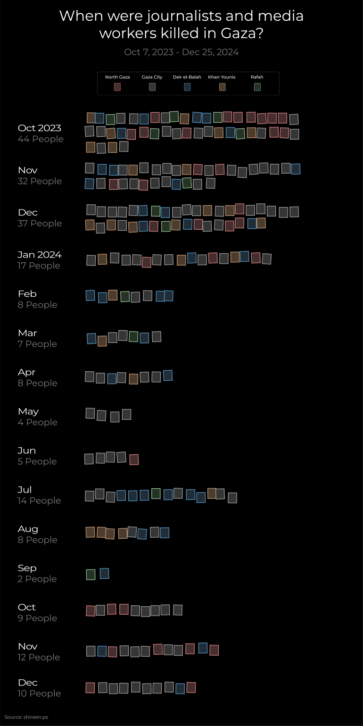
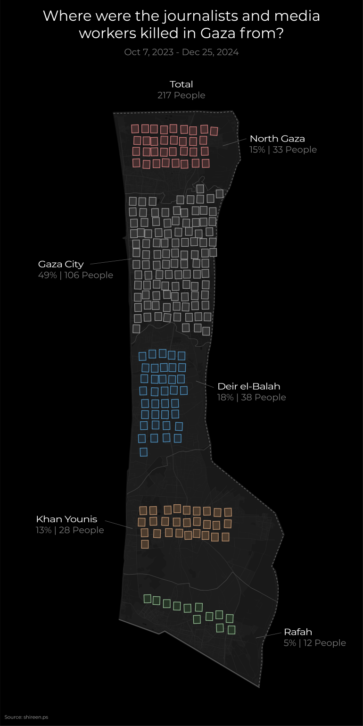
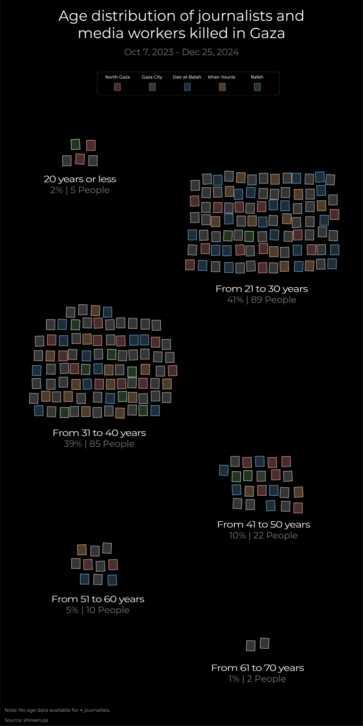
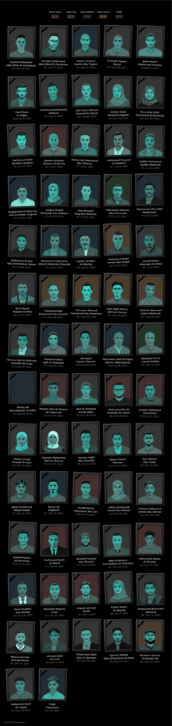
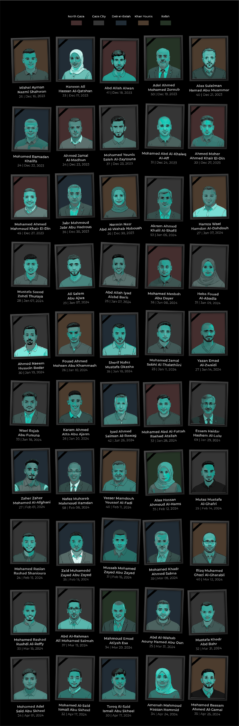
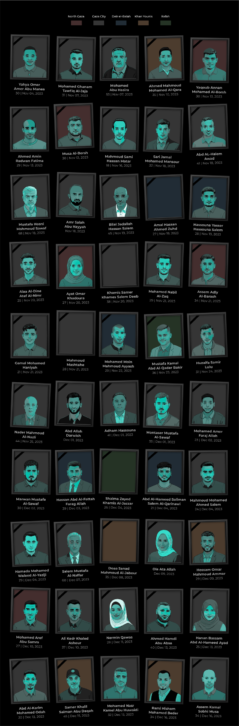
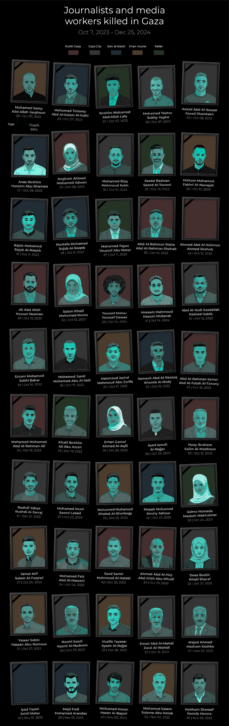
217 Journalists and media workers killed in Gaza

As the conflict in Gaza enters its 15th month, at least 217 journalists and media workers had been killed From October 7, 2023, to December 25, 2024.

More than 45,400 people have been killed and 108,000 injured. The war has been particularly marked by the challenges of reporting from a warzone in effect sealed off to reporters from outside Gaza, where reporting has been impossible at times — and far too often, deadly.

Despite these challenges, Palestinian journalists have continued to report the horrors of the war, serving as the world’s eyes and ears during one of the deadliest conflicts of the 21st century.

These most recent killings of journalists underscore the perilous environment in which media professionals are operating in Gaza. Simply put, this has been the worst conflict for journalists — ever.

The following list is a tribute to the journalists and media workers who have been killed in Gaza since October 7, 2023.

Tribute to all the Journalists

Israel attacks two Gaza hospitals:Dozens of patients await evacuation

In the north of the Gaza Strip, there are three barely functioning hospitals.One is the Indonesian Hospital, which has been completely evacuated yesterday. The other two include al-Awda Hospital and the Kamal Adwan Hospital.

Medical teams in al-Awda Hospital have confirmed the Israeli attack on the third floor of the facility that caused significant destruction. The medical teams are still there and operating within their capacity to provide medical treatment.In the Kamal Adwan Hospital, 65 patients are waiting for evacuation. They are completely besieged, and Israeli bombardment continues there.Victims are treated inside the Kamal Adwan hospital in Beit Lahia in the northern Gaza Strip, following Israeli strikes around the medical complex .Patients alongside the medical teams were forced to leave the besieged area through military checkpoints to Gaza City.

Israeli artillery has shelled the third floor of the al-Awda Hospital in northern Gaza’s besieged Jabalia refugee camp.The Israeli army has detonated remote-controlled explosives in the barely functioning Kamal Adwan Hospital in northern Beit Lahiya, injuring at least 20 patients and medical staff.Also in Beit Lahiya, Israeli soldiers are forcing wounded and sick people to leave the Indonesian Hospital, according to Gaza’s Health Ministry.At least 21 people have been killed and 51 injured across Gaza in the past 24 hours, according to the Ministry.A Civil Defence statement on Telegram says another rescue worker has been injured in a direct attack on the centre of the rescue service in the Daraj area of Gaza City.

Israel’s war on Gaza has killed at least 45,338 Palestinians and wounded 107,764 since October 7, 2023. At least 1,139 people were killed in Israel during the Hamas-led attacks that day, and more than 200 were taken captive.

Human Rights Watch has accused Israel of committing “acts of genocide” in Gaza

Human Rights Watch has accused Israel of committing “acts of genocide” in Gaza by deliberately depriving Palestinian civilians there of adequate access to water.

It says Israel’s actions include intentionally damaging water and sanitation infrastructure.

The campaign group says this has probably caused thousands of deaths, which it says is also tantamount to “committing the crime against humanity of extermination”.

Meanwhile, Israel rejected HRW’s report as “propaganda”.

The 179-page report says that “since October 2023, Israeli authorities have deliberately obstructed Palestinians’ access to the adequate amount of water required for survival in the Gaza Strip”.

It says Israel intentionally damaged infrastructure, including solar panels powering treatment plants, a reservoir, and a spare parts warehouse, while also blocking fuel for generators.

It says Israel also cut electricity supplies, attacked repair workers and blocked the entry into Gaza of repair materials.

“This isn’t just negligence,” said HRW executive director Tirana Hassan. “It is a calculated policy of deprivation that has led to the deaths of thousands from dehydration and disease that is nothing short of the crime against humanity of extermination, and an act of genocide.”

Israel launched a major military offensive in Gaza after Hamas attacked Israel on 7 October 2023, killing about 1,200 people and taking 251 others hostage.

At least 45,129 people have been killed in Gaza since the offensive began, according to the territory’s Hamas-run health ministry. It does not put a figure on the number who have died as a result of lack of access to water or other such causes.

Gaza massacre: 17 killed in missile attack on refugee camp

Israeli missiles aimed at Palestinians killed 17 Palestinians and wounded 80 others taking shelter in a school for displaced people in the Nussarat refugee camp, according to Gaza officials.

Earlier, Israel attacked the al-Mawasi camp, killing 90 people.

Brazilian President Luiz Inacio Lula da Silva condemned the “endless carnage” in Gaza and Israel’s “constant attacks” on so-called “safe zones”.

While the Israeli side is accusing Hamas of rejecting negotiations for a ceasefire, Izzat al-Rishek, a member of Hamas’s political office, said Israel’s rejection of ceasefire talks is false propaganda.

At least 38,443 people have been killed and 88,481 injured in Israel’s war on Gaza since October 7. The death toll in Israel from the October 7 Hamas-led offensive is estimated at 1,139, and dozens are still being held captive in Gaza.

Dozens of bodies found in Gaza City neighborhood

The bodies of dozens of Palestinians have been retrieved from the Tal al-Hawa neighbourhood after Israeli forces withdrew from parts of Gaza City, Palestinian rescue workers have said.

“The Gaza civil defence teams moved in to rescue survivors. They found dozens killed. Most of those killed are families, women, and children. Some bodies were eaten by dogs,” Gaza’s civil defence spokesperson Mahmoud Basal said on Friday.

At least 60 bodies were counted. Some bodies were buried on the spot. Others were taken to nearby hospitals.”

Israeli forces had entered the neighbourhood this week after ordering civilians to evacuate on Monday.

“Many bodies are still under the rubble. The Israeli forces are stationed nearby and the rescue efforts are interrupted regularly,” Basal said.

The discovery has come after Israeli forces withdrew from Gaza City’s Shujayea neighbourhood. On Thursday, Basal said civil defence teams recovered dozens of bodies from there, as well, adding that the neighbourhood has become uninhabitable.

“Documented testimonies” have been taken that Israeli forces opened fire on residents in the neighbourhood despite being located on designated evacuation routes, he said.
Home to more than a quarter of Gaza’s residents before the war, Gaza City was largely razed to the ground in late 2023, but hundreds of thousands of Palestinians had returned to homes in the ruins before Israel once again ordered them to leave.

Hamas, the Palestinian group that governs Gaza, accused Israeli forces of “atrocities” and called for international accountability. In a statement, the group accused Israel of committing “heinous abuses” in Gaza City.

“The atrocities revealed after the terrorist occupation army’s withdrawal from Tal al-Hawa in southwest Gaza City, after days of incursion and intense bombing that targeted all aspects of life, are war crimes of genocide and ethnic cleansing,” Hamas said.

It called on the UN and international community to take immediate steps to end a “war of extermination” that Israel is waging against Palestinians.