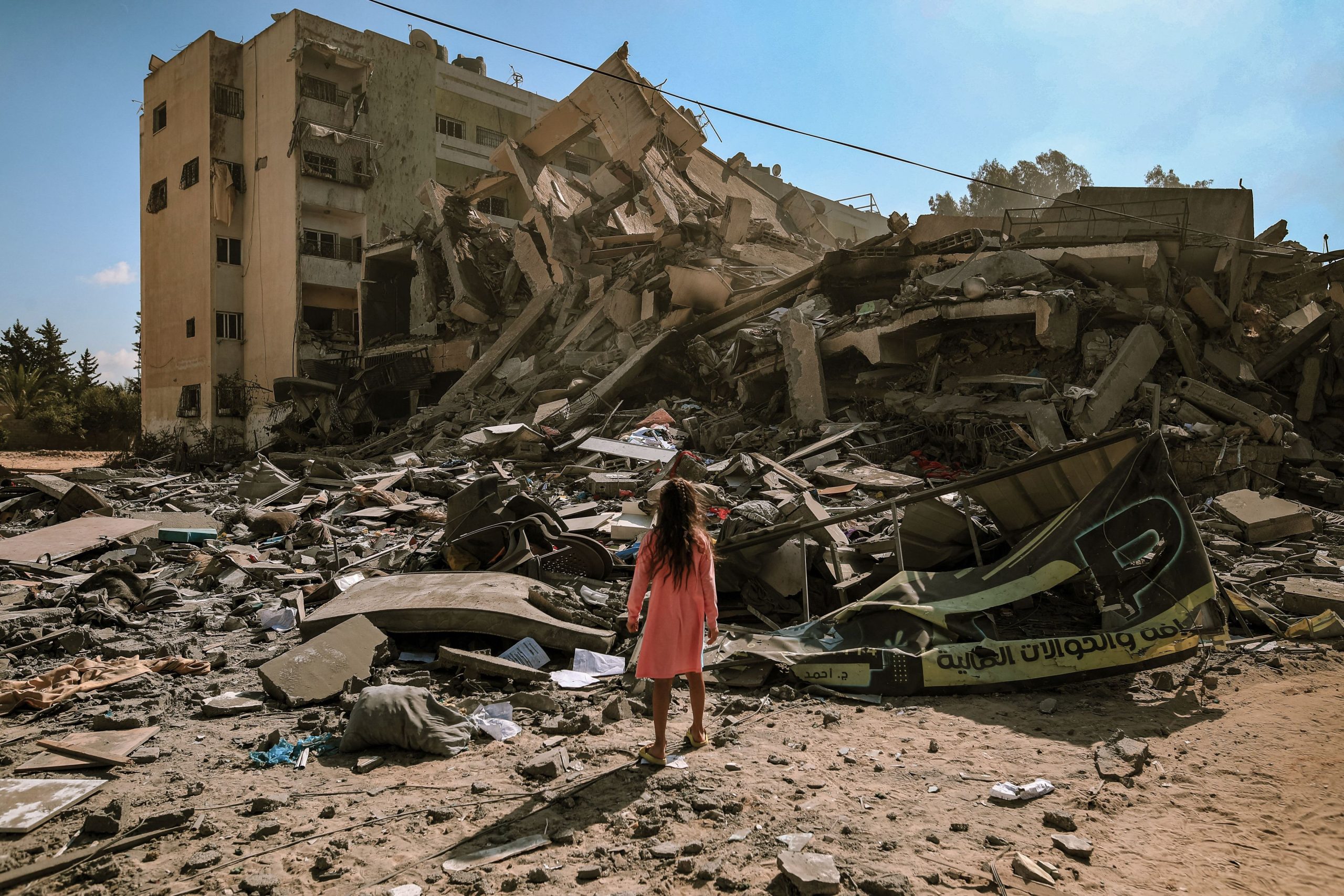
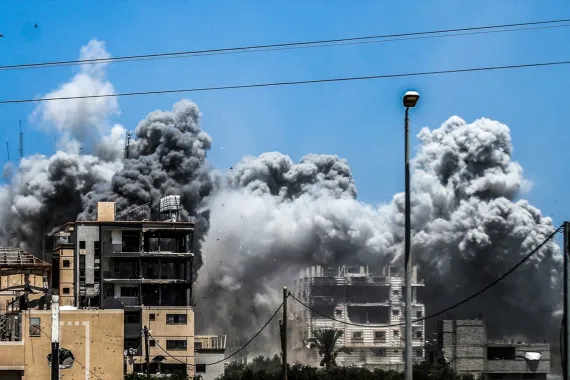
Gaza – More than 35 people were killed in Israeli strikes and gunfire on Saturday, according to hospital officials in Gaza.
At least 11 people, including women and children, died when a house in central Gaza was hit. Nine members of one family were also killed in Nuseirat refugee camp, and several others died while seeking aid in different parts of Gaza.
The Israeli military said its air force targeted around 120 sites across the Gaza Strip since Friday, including what it described as militant infrastructure and operatives. This follows Prime Minister Benjamin Netanyahu’s speech at the UN, where he declared Israel must “finish the job” against Hamas.
The intensified ground offensive is now centered on Gaza City, considered Hamas’s last stronghold. Hundreds of thousands have already fled the city, but many remain in worsening humanitarian conditions, with food shortages and collapsing health services.
Amid the violence, US President Donald Trump voiced optimism about a possible deal to release hostages and achieve a new ceasefire. Reports suggest the US has drafted a 21-point plan that includes a ceasefire, prisoner exchanges, and a pathway toward a Palestinian state, though Israel has rejected the statehood idea.
Since the conflict began more than 65,500 people have been killed in Israeli operations.
New York – Israeli Prime Minister Benjamin Netanyahu faced strong backlash at the United Nations General Assembly after condemning recent recognition of a Palestinian state by several Western countries. He called the move a “mark of shame,” claiming it sent the message that “killing Jews pays off.”
As Netanyahu began his speech, many officials and diplomats walked out in protest against Israel’s actions in Gaza, leaving him largely isolated on the world stage. At the same time, demonstrations against the war in Gaza were held outside in New York’s Times Square.
In recent days, the UK, France, Canada, Australia, and other countries formally recognized a Palestinian state. However, Netanyahu repeated that Israel would never accept a Palestinian state, insisting that most Israelis supported this stance.
His speech also drew criticism at home. Opposition leader Yair Lapid described Netanyahu’s remarks as those of a “tired and complaining” leader, while Yair Golan of the Israel Democrats party dismissed the address as “childish propaganda.”
Since Israel’s military campaign began on October 7, 2023, at least 65,549 Palestinians have been killed in Gaza, according to health authorities in the territory.
GAZA-Thousands of Palestinians are fleeing Gaza City as Israel’s ground assault escalates. The Israeli military says the operation aims to defeat around 3,000 Hamas fighters and free hostages, but the offensive has triggered strong international criticism.
Gaza’s Hamas-run health ministry said Israeli strikes hit al-Rantisi children’s hospital three times, forcing half of its patients and families to flee. Other hospitals reported at least 35 killed across Gaza on Wednesday, mostly in the north. Israel said it is reviewing the hospital strike reports and claimed it hit more than 150 “terror targets” in two days.
Aid agencies, including Save the Children and Oxfam, warned of an “unconscionable” humanitarian crisis. The UN says 190,000 people have fled Gaza City since August, while Israel claims 350,000 have left, with about 650,000 still inside.
Palestinians are evacuating via donkey carts, cars, and on foot, but costs are soaring.Trucks cost around 3,000 shekels ($900), and tents 4,000 shekels. Many families say the “humanitarian area” in al-Mawasi is overcrowded and unlivable, with some forced to return north.
Meanwhile, families of 48 hostages held by Hamas protested in Jerusalem, saying Israel’s assault puts their relatives at risk. The offensive has been condemned by the UN rights chief, Saudi Arabia, and Pope Leo XIV, who called Gaza’s conditions “unacceptable” and urged a ceasefire.
A UN inquiry accused Israel of genocide, alleging targeted attacks on civilians, children, and cultural sites. Israel rejected the report as “distorted and false.”
Since the war began at least 64,964 people have been killed, nearly half of them women and children. The UN has already declared famine in Gaza City and warned the worsening offensive will deepen the catastrophe.
GAZA- Prime Minister Benjamin Netanyahu and his security cabinet have pressed for a faster operation in Gaza, but the military has raised concerns. At a heated cabinet meeting , IDF Chief of Staff Eyal Zamir urged a ceasefire deal, warning that a rushed campaign could endanger hostages still held in Gaza and strain army resources.
This dispute follows earlier clashes between Zamir and Netanyahu, who has pushed the military to speed up plans to capture what he calls Hamas’ “last stronghold.” Some reservists have also expressed frustration, citing dissatisfaction over the lack of a clear strategy to secure victory or ensure the release of hostages.
Meanwhile, Tens of thousands of Israeli reservists have begun reporting for duty as the Israel Defense Forces (IDF) prepares for a new offensive to take full control of Gaza City . Israeli Army Radio said around 40,000 reservists were expected to be called up.
Israel’s latest Gaza City operation, launched last month, has targeted Hamas command centers, weapons stores, and tunnels built under civilian areas. More than 1,000 buildings have been destroyed, leaving many trapped under rubble and thousands homeless, according to Palestinian authorities.
Israel insists the offensive is vital for national security and aims to dismantle Hamas infrastructure.
The war began on October 7, 2023 has killed more than 62,000 and about 156,000 injured in Israeli strikes .
Ankara- Turkiye has announced a complete halt to trade and economic relations with Israel, along with restrictions on air and sea access, in response to Israel’s ongoing military campaign in Gaza.
Foreign Minister Hakan Fidan told parliament on Friday that Turkiye has shut its ports to Israeli ships and barred Turkish-flagged vessels from entering Israeli ports. He also said Israeli flights carrying weapons or ammunition are banned from Turkish airspace, while container ships with military cargo are no longer allowed to dock at Turkish ports.
Meanwhile, commercial carriers can still transit, but port authorities now require shipping agents to confirm that vessels have no Israeli links and are not transporting arms or hazardous goods.
An Israeli official told that Ankara had previously announced similar restrictions, but trade continued despite earlier bans.
Relations between Turkiye and Israel have sharply worsened since the Gaza war erupted in October 2023. Ankara accuses Israel of genocide, while President Recep Tayyip Erdogan has called Prime Minister Benjamin Netanyahu “the butcher of Gaza,” comparing his actions to those of Adolf Hitler, a charge Israel rejects.
GAZA- Israel launched a deadly strike on Nasser Hospital in southern Gaza on Monday, killing at least 21 people, among them six journalists, as well as medics and rescue workers. The attack further devastated the already crippled health system in the besieged enclave and drew global outrage.
The assault followed the “double-tap” pattern, where one strike is followed quickly by another. The first blast hit the hospital’s top floor. Minutes later, as journalists and rescuers rushed to help, a second strike struck the building, according to Dr. Ahmed al-Farra, head of the paediatrics department.
Journalists killed included Al Jazeera’s Mohammad Salama, Reuters cameraman Hussam al-Masri, freelance journalist Mariam Abu Daqqa, as well as Ahmed Abu Aziz, Moaz Abu Taha, and Palestinian correspondent Hassan Douhan. The attack also injured others and caused widespread panic among patients and civilians.
Press freedom groups condemned the strike, calling it part of a systematic targeting of journalists in Gaza. The Palestinian Journalists Syndicate described it as “an open war against free media,” while the Committee to Protect Journalists urged international accountability.
Israel’s government called the incident a “tragic mishap” and said an investigation was underway. Similar statements have been issued after previous strikes that killed journalists and civilians, but rights groups note that accountability has been absent.
The attack adds to a growing list of Israeli strikes on hospitals and media workers during nearly two years of war. Nasser Hospital, like al-Shifa Medical Complex and other facilities, has faced repeated bombardments and severe shortages of supplies and staff under Israel’s blockade.
The attack raises the death toll of Palestinian journalists killed in Gaza since October 7, 2023 to at least 273.
Kathmandu – The unfolding tragedy in Gaza City has reached an alarming stage, with famine now described as a “failure of humanity.” The worsening crisis reflects not only the relentless assault on the besieged population but also the shameful silence and complicity of the international community, particularly nations that claim to uphold democracy and human rights.
For months, Gaza has endured constant bombardment, blockade, and the collapse of its basic infrastructure. Food, medicine, and clean water have become scarce, leaving millions on the brink of starvation. Humanitarian organizations, including the United Nations, have repeatedly warned of “massive death and destruction,” yet the appeals have gone largely unanswered.
Instead of restraining the ruling administration in Tel Aviv, often described as the occupying authority, many powerful nations have extended political, military, and financial backing. This support, whether through weapons, diplomatic cover, or vetoes at the UN, has enabled the continuation of mass killings, forced displacement, and the targeting of civilian areas. Critics argue that this not only undermines international law but actively fuels what many observers and human rights groups are calling genocide.
The response from so-called democratic countries has been particularly disheartening. These governments, which often lecture the world on human rights and freedoms, have chosen strategic alliances over moral responsibility. Their inaction and selective outrage have left Gaza’s people isolated, stripped of protection, and abandoned to relentless suffering.
As famine spreads and the death toll climbs, the world is confronted with a painful truth: justice and humanity have been overshadowed by politics and power. Unless global leaders act decisively to halt the assault and ensure safe humanitarian access, history will remember this chapter as one of the darkest betrayals of modern times.
GAZA- Israeli Prime Minister Benjamin Netanyahu has openly declared that Israel will seize full control of Gaza, even if Hamas agrees to a ceasefire and a hostage deal. His remarks reveal that Israel’s goal is not peace, but the occupation of Palestinian land.
Netanyahu’s statement came as the Israel Defense Forces (IDF) launched the first stage of its operation to take Gaza City, which it labels a Hamas stronghold. Speaking to Sky News Australia, he said Israel would expel Hamas regardless of any agreement. “We’re gonna do that anyway. There was never a question,” he said.
He tried to justify his stance by citing US President Donald Trump’s earlier remarks, comparing Hamas in Gaza to Nazis in Germany. Netanyahu also claimed the war could end if Hamas disarmed and surrendered, while dismissing worldwide condemnation as “anti-Semitism.”
Meanwhile, the humanitarian toll continues to mount. UN Secretary General Antonio Guterres has again urged an immediate ceasefire, warning that the offensive will cause “massive death and destruction.” The Red Cross and other aid agencies have also called for a halt, as Palestinian deaths in Gaza since October 2023 have surpassed 62,000.
Global frustration with Israel’s actions is growing. Several countries are now preparing to officially recognize the State of Palestine.
Israel has launched the takeover of Gaza’s largest northern city, sending 60,000 additional reserve troops and extending the service of another 20,000 soldiers.
According to a military spokesman, Israeli forces are already active in the Zeitoun and Jabalia areas to prepare for a wider assault. The operation, approved by Defence Minister Israel Katz on Tuesday, will be presented to the security cabinet later this week.
The move has triggered rising criticism both inside Israel and abroad, with concerns that the deepening humanitarian and hunger crisis in Gaza could worsen. Critics also warn that the lives of remaining hostages may be put in greater danger as the military escalation expands.
IDF spokesman Brig. Gen. Effie Defrin said Wednesday that Israeli forces have reached the outskirts of Gaza City, calling it the first stage of the broader operation.
GAZA-Israel announced preparations to forcibly move Palestinians from “combat zones” in Gaza City to southern Gaza starting Sunday, days after launching a new offensive to seize the enclave’s largest urban center.
Army spokesperson Avichay Adraee said tents and shelter equipment would be transported through the Kerem Shalom crossing with support from the UN and aid groups, though the UN has not confirmed its role. It remains unclear if the relocation site will be Rafah, near Egypt.
The plan follows Prime Minister Netanyahu’s order to dismantle Hamas strongholds in Gaza City and al-Mawasi. The UN has warned that thousands already facing dire humanitarian conditions could be pushed past survival limits if the plan proceeds.
Islamic Jihad condemned the move as part of Israel’s “brutal attack” and called it a violation of international law.
Meanwhile, Israeli forces have intensified operations around Gaza City. Heavy strikes were reported in Zeitoun and Shujayea, while an Israeli drone attack in Zeitoun’s Asqaula killed people and wounded several others .
The UN Human Rights Office has denounced an Israeli airstrike in Gaza that killed six journalists, describing it as a serious violation of international law and urging immediate, unhindered access for media in the region.
The targeted strike on Sunday killed five Al Jazeera journalists — including well-known correspondent Anas al-Sharif, Mohammed Qreiqeh, Ibrahim Zaher, Mohammed Noufal, and Moamen Aliwa — as well as freelance journalist Mohammad al-Khaldi. Funerals drew large crowds in Gaza City on Monday.
Media watchdogs, Qatar, and the UK government condemned the attack. UK Prime Minister Sir Keir Starmer’s spokesman called for an independent investigation and stressed that journalists must be able to work without fear.
Reporters Without Borders labelled Sharif’s killing an assassination, while the Foreign Press Association accused the Israeli military of repeatedly branding Palestinian journalists as militants without credible proof. The Committee to Protect Journalists (CPJ) echoed this, citing a “documented pattern” of unsubstantiated accusations.
The Israeli military claims it found documents linking Sharif to Hamas, including rosters, training lists, and salary records, but has released only limited screenshots. No official explanation has been given for the deaths of the entire Al Jazeera crew.
According to CPJ, more than 200 journalists have been killed since Israel began its Gaza offensive in October 2023 — the deadliest period for journalists since CPJ began record-keeping in 1992.
International media access to Gaza remains restricted, forcing outlets to rely on local reporters for coverage.
Tel Aviv-Tens of thousands rallied in Tel Aviv, Jerusalem, and other cities to oppose Prime Minister Benjamin Netanyahu’s plan to take control of Gaza City. Organized by families of Hamas-held captives, the protests—among the largest since the war began—demand an immediate ceasefire, warning the operation could endanger hostages and escalate the conflict.
The demonstrations come after Netanyahu’s cabinet approved a plan to “conclude the war” by taking full control over gaza city. Critics at home and abroad warn the move risks a humanitarian crisis and further bloodshed.
Around 50 hostages remain missing in Gaza, with only about 20 believed alive since Hamas’ October 7, 2023 attack killed 1,200 and abducted 251 people. Meanwhile israeli attacks have killed more than 61,000 palestinian including women and children, leaving more than thousands of them injured.
Israeli Prime Minister Benjamin Netanyahu has said Israel intends to take full control of the Gaza Strip.
Netanyahu’s push for a full military takeover of Gaza has drawn sharp condemnation, with critics accusing him of escalating the war for political survival at the expense of civilian lives and hostage safety. Human rights groups warn the move would deepen the humanitarian catastrophe, violate international law, and risk mass displacement of Palestinians already on the brink of famine. Detractors say his strategy ignores viable alternatives, fuels further instability, and prioritizes personal and political interests over peace and the protection of both Israeli and Palestinian civilians.
The war has displaced most of Gaza’s population, with UN experts warning of famine and the WHO reporting record child malnutrition in July. Since the 7 October 2023 Hamas attack that killed 1,200 Israelis and took 251 hostages, Israel’s offensive has killed over 61,000 Palestinians, according to Gaza’s health ministry.
US President Donald Trump said the decision was “up to Israel,” while ceasefire talks remain stalled.
Israeli authorities are moving forward with plans to dramatically expand illegal settlements in the occupied West Bank, despite growing international condemnation and warnings that the move would destroy already moribund prospects for a two-state solution.
The Israeli government has set Wednesday as the date to discuss building thousands of new housing units in the E1 area, east of occupied East Jerusalem. The proposed expansion would link the large and illegal Ma’ale Adumim settlement with Jerusalem, effectively bisecting the West Bank and isolating Palestinian communities.
Israeli Prime Minister Benjamin Netanyahu’s far-right government also appears on the cusp of announcing its intention to occupy all of Gaza as its genocidal war on the besieged enclave rages on.
The E1 plan in the West Bank has long been criticised by the international community, including the European Union and successive United States administrations.
Israeli settlements in the West Bank and East Jerusalem are illegal under international law. The International Court of Justice, the top United Nations tribunal, reaffirmed that position last year, saying that Israel’s presence in the occupied Palestinian territories is unlawful and must end “as rapidly as possible”.
The plan would see nearly 1,214 hectares (3,000 acres) of Palestinian land stolen to build more than 4,000 settlement units, as well as hotels and roads connecting Ma’ale Adumim to West Jerusalem.
Palestinians say the project is part of broader efforts to “Judaise” East Jerusalem and entrench Israeli control over occupied territories in violation of international law.
Palestinian leaders seek the entirety of the West Bank, along with the Gaza Strip, and as a capital, East Jerusalem – areas Israel captured in the 1967 war – for their future state.
Currently, more than 500,000 settlers are living in the West Bank, and some 220,000 others in East Jerusalem.
As Canada, France, the United Kingdom, and Portugal prepare to recognize the State of Palestine at the United Nations General Assembly this September, the move is being hailed by some as a moral shift in global diplomacy. But let us be absolutely clear: recognition alone is no longer enough. It is the bare minimum. While Palestinians in Gaza are being starved, bombed, and exterminated in broad daylight, such gestures ring hollow unless they are accompanied by real, punitive measures against the aggressor—Israel.
More than 60,000 Palestinians have been slaughtered by Israel since October 2023—many of them children, women, and the elderly. Gaza lies in ruins. Hospitals are levelled, ambulances are targeted, water pipelines have been destroyed, and food convoys are routinely blocked. Children are dying not only from airstrikes but from hunger and thirst. Entire generations are being wiped out while the so-called “international community” continues to deliberate over symbolism and semantics.
Meanwhile, Israel has released a new official map claiming all of historic Palestine as its own, eliminating even the illusion of a future Palestinian state. This is not just a rejection of the two-state solution; it is a declaration of colonial conquest. It is ethnic cleansing in real time, broadcast to the world, and shamelessly supported by billions in military aid from the West.
In this context, what does it mean for Western countries to “recognise” Palestine? It is like applauding a drowning man from the shore while refusing to throw a rope. It is diplomatic theatre designed to appease growing public outrage while maintaining the status quo—continued occupation, apartheid, and genocide.
Recognition, without consequences for Israel, is nothing more than complicity. These same countries that plan to vote for Palestinian statehood in September are the ones that sell Israel the weapons it uses to massacre civilians. They train Israeli forces, shield Israel from accountability at the International Criminal Court, and block ceasefire resolutions at the UN Security Council. Their recognition is coated in the blood of their own hypocrisy.
Let us not forget: over 140 countries already recognise Palestine. Has that stopped the bombings? Has that freed Gaza from blockade? Has that secured justice for the thousands buried under rubble? No. Because recognition without enforcement is meaningless. What Palestine needs is not another statement—it needs sanctions on Israel, an arms embargo, diplomatic isolation, and full criminal prosecution of Israeli leaders and military commanders for crimes against humanity.
Between now and September, and even after the UN vote, the killing will likely continue. Israel will ignore these symbolic recognitions as it always has, emboldened by the military and financial support it receives from the very countries now claiming to support Palestinian statehood. Worse, Israel may escalate its brutality even further to dismantle any trace of Palestinian governance before it can gain new legal ground through recognition.
As the world watches a slow genocide unfold, the real question is not whether Palestine deserves recognition. It is: how long will the world enable Israel to destroy it?
Palestine does not need empty declarations—it needs liberation. It needs justice, not charity. If countries like the UK, Canada, and France truly care about human rights, then recognising a Palestinian state must be the beginning of a complete rupture with Israeli apartheid and war crimes. Until they cut arms sales, impose sanctions, and demand accountability, their recognition is not an act of solidarity—it is an insult. The time for symbolic gestures is over. The world must choose: justice for Palestine or complicity in its destruction.
At least 60,034 Palestinians have been killed by Israeli forces since the war in Gaza began in October 2023, according to the Gaza Health Ministry.
The grim figures were released on Tuesday. At least 62 Palestinians have been killed since Tuesday morning alone.
Meanwhile, the “worst-ever” famine is unfolding in Gaza, according to the latest report by the International Hunger Monitoring System, Integrated Food Security Phase Classification (IPC).
“Food insecurity has reached a critical level in most parts of the Gaza Strip, and severe malnutrition has persisted in Gaza City,” the report said.
“The crisis has now reached a critical and deadly level amid ongoing conflict, widespread displacement, severe restrictions on humanitarian access, and restrictions on essential services such as health care,” the report warned.
Food consumption has plummeted, with one in three people going days without food.
Malnutrition has risen sharply in the first half of July, with more than 20,000 children hospitalized for severe malnutrition between April and mid-July. More than 3,000 of them are severely malnourished.
The hunger crisis has reached all sections of Gaza. According to UN Women Executive Director Sima Bahous, one million women and girls in Gaza face the impossible choice of “starving to death or risking their lives in search of food.”
“This horror must end now,” Bahos wrote on social media. She called for the unhindered entry of humanitarian aid into Gaza, the release of hostages, and a permanent ceasefire.
Houthi rebels from Yemen’s Ansar Allah movement will carry out strikes on the vessels belonging to all companies working with Israeli ports within the reach of their weapons, the movement’s military spokesman Yahya Saree said.
“Yemen’s armed forces have made a decision to activate their military operations in support [of Palestinians] and begin implementing Phase Four of its naval blockade of the adversary, targeting all ships belonging to any company that deals with Israeli ports, regardless of nationality or destination and anywhere they can be reached by our missiles and drones,” the spokesman said as cited by the Houthi-controlled television channel Al Masirah.
Airdropped aid pallets hit tents and killed 11 Palestinian
Israel is doing little to help starving Gazans by airdropping food, according to Philippe Lazzarini, head of the UN Palestinian refugee agency (UNRWA).
The official dismissed the tactic as ineffective and urged Israel to lift its blockade of the densely populated enclave. His remarks came after the UN’s food aid program reported that 90,000 Palestinian women and children are suffering from malnutrition.
“Gaza airdrops will not reverse the deepening starvation. They are expensive, inefficient, and can even kill starving civilians. It is a distraction and screensmoke [sic],” Lazzarini wrote on X on Saturday, adding “a manmade hunger can only be addressed by political will.”
He called on Israel to “lift the siege” and guarantee safe access to humanitarian workers. “At UNRWA, we have the equivalent of 6,000 trucks in Jordan and Egypt waiting for the green light to get into Gaza,” he wrote.
“Driving aid through is much easier, more effective, faster, cheaper, and safer. It’s more dignified for the people of Gaza,” he added.
The Israel Defense Forces (IDF) said on Saturday that it had dropped seven pallets containing flour, sugar, canned food, and other supplies. The army pledged to provide safe passage for UN aid convoys and said “local humanitarian pauses” could be implemented.
The UN, relief groups, and several European governments have stepped up criticism of Israel in recent weeks, as the death toll in Gaza approaches 60,000.
Meanwhile,11 Palestinians have been injured due to aid airdrops in northern Gaza as one of the pallets fell directly on tents where displaced people are living, medical sources say.
But local sources in Gaza told Al Jazeera some of the aid pallets hit tents near al-Rasheed Road, a main road that runs along the coast of the enclave from north to south.
Many other pallets were dropped in areas far from the displacement sites in northern Gaza and close to where the Israeli military is stationed.
10 more Palestinians have starved to death in the besieged Gaza Strip, health officials say, as a wave of hunger crashes over the enclave.
The latest starvation deaths bring the death toll from malnutrition since Israel’s war began in October 2023 to 111, most of them in recent weeks.
At least 100 other Palestinians, including 34 aid seekers, were killed in Israeli attacks over the past 24 hours, Gaza’s Ministry of Health said on Wednesday.
The World Health Organization (WHO) said that 21 children under the age of five were among those who died of malnutrition so far this year. It said it had been unable to deliver any food for nearly 80 days, between March and May, and that a resumption of food deliveries was still far below what is needed.
In a statement, 111 organisations, including Mercy Corps, the Norwegian Refugee Council and Refugees International, said that “mass starvation” was spreading even as tonnes of food, clean water and medical supplies sit untouched just outside Gaza, where aid groups are blocked from accessing them.
The United Nations and aid groups trying to deliver food to Gaza say Israel, which controls everything that comes in and out, is choking delivery, while Israeli troops have shot dead hundreds of Palestinians close to aid distribution points since May.
The land historically known as Palestine has been inhabited for millennia, serving as a crossroads of civilizations, cultures, and faiths. Its history predates the modern conflict by thousands of years and is deeply intertwined with the region’s strategic location and religious significance. Today, what was once a single geographic and cultural entity is fragmented into territories under occupation, blockade, and partial autonomy. Understanding the history of Palestine provides essential context for its current political and humanitarian crisis.
The earliest recorded history of Palestine dates back to ancient Canaanite and Philistine civilizations around 3000 BCE. Over the centuries, the region witnessed successive rules by ancient Israelites, Assyrians, Babylonians, Persians, Greeks, and Romans. The ancient Kingdoms of Israel and Judah existed intermittently in parts of this land, but after the Roman conquest and destruction of Jerusalem in 70 CE, the region was incorporated into the Roman Empire and later renamed Syria Palaestina after the Bar Kokhba revolt in 135 CE, a name meant to erase Jewish national identity. The term “Palestine” thus became widely used in classical antiquity to refer to the geographic area between the Mediterranean Sea and the Jordan River.
From the 7th century CE, following the Muslim conquest, Palestine became part of successive Islamic caliphates. Under the Umayyads, Abbasids, and later the Fatimids, the region thrived as an important center of trade and religious learning. During the Crusades, parts of Palestine were briefly controlled by European Christian kingdoms, but Muslim forces under Salah al-Din (Saladin) reclaimed the territory in 1187. By 1517, Palestine became part of the Ottoman Empire, where it remained for four centuries. Under Ottoman rule, Palestine was administratively divided into districts but retained its cultural and demographic continuity, with a population predominantly Arab and Muslim, alongside Christian and Jewish minorities who coexisted for centuries.
Modern Palestinian national identity began to take shape in the late Ottoman period, influenced by Arab nationalism and opposition to European colonial ambitions. However, Palestine’s fate dramatically changed after World War I. The collapse of the Ottoman Empire brought the region under British control through the British Mandate for Palestine (1920–1948), formalized by the League of Nations. The mandate period saw significant political and demographic transformation due to Britain’s support for the Zionist movement, enshrined in the Balfour Declaration of 1917, which promised to facilitate a “national home for the Jewish people” in Palestine. At that time, Arabs made up around 90 percent of the population, with Jews comprising about 10 percent.
Jewish immigration, driven by European persecution and later the Holocaust, increased sharply under British administration, with the Jewish population rising to roughly one-third by 1947. Tensions between the Arab majority, who sought independence, and the Jewish community, which sought a separate state, escalated into violence. Palestinian Arabs staged revolts, notably the 1936–1939 Arab Revolt, which Britain brutally suppressed. Britain’s eventual withdrawal from the mandate left Palestine in turmoil.
The United Nations Partition Plan of 1947 (Resolution 181) proposed dividing Palestine into a Jewish state (allocated 55 percent of the land) and an Arab state (45 percent), with Jerusalem placed under international administration. Jewish leaders accepted the plan, but Palestinian Arabs and neighboring Arab states rejected it, viewing it as unjust and illegitimate. Civil war erupted between Jewish and Arab forces even before the British left.
On May 14, 1948, Zionist leaders declared the independence of the State of Israel. In the ensuing war, Israel expanded its control to 78 percent of historic Palestine, far beyond the UN allocation. More than 700,000 Palestinians were expelled or fled from their homes in what Palestinians call the Nakba (Catastrophe). Over 400 villages were depopulated or destroyed, and the refugees were barred from returning despite UN Resolution 194 affirming their right of return.
The remaining 22 percent of Palestine—the West Bank, including East Jerusalem, and the Gaza Strip—fell under Jordanian and Egyptian control, respectively, until the 1967 Six-Day War, when Israel occupied these territories. Since then, Palestinian lands have been subjected to military occupation, settlement expansion, and annexation efforts. East Jerusalem was annexed by Israel in 1980, a move unrecognized by most of the international community. The Oslo Accords of the 1990s created the Palestinian Authority with limited self-rule in parts of the West Bank, while Gaza came under the control of Hamas in 2007 following an internal Palestinian political split.
Today, the territory of historic Palestine is divided into three main areas. Israel occupies 78 percent, recognized internationally as a state since 1948. The West Bank, formally under Israeli military occupation, is fragmented into zones, with more than 700,000 Israeli settlers living in illegal settlements built on Palestinian land. Gaza, a densely populated enclave home to over two million Palestinians, has been under a blockade by Israel and Egypt since 2007, with repeated wars devastating its infrastructure. Palestinians in East Jerusalem live under Israeli control with limited rights, while millions of Palestinian refugees remain stateless in camps across Lebanon, Syria, Jordan, and beyond.
The State of Palestine is recognized by more than 130 UN member states and has been a non-member observer state at the United Nations since 2012, but it lacks full sovereignty due to ongoing Israeli occupation and international political deadlock. Palestinians continue to demand their right to self-determination, the establishment of an independent state based on the 1967 borders with East Jerusalem as its capital, and the right of return for refugees, while Israel asserts security concerns and historical claims to the land.
The history of Palestine reveals that it was not an empty land awaiting statehood, but a vibrant society with deep-rooted communities and cultural heritage. Its fragmentation today is the direct outcome of colonial decisions, wars, and decades of occupation. What once existed as a single geographic and cultural homeland is now divided by walls, checkpoints, and borders, with Palestinians struggling to preserve their identity and right to statehood in the face of one of the world’s longest unresolved conflicts.
The history of Israel and Palestine is not merely a tale of two peoples competing for the same land; it is a story of deliberate political engineering by imperial powers that favored one national movement while erasing the rights of another. Britain’s role in shaping this tragedy cannot be understated—it used Palestine as a pawn in its colonial strategy, granting legitimacy and resources to the Zionist project while crushing Palestinian resistance with military force. The Balfour Declaration was not a neutral promise; it was a colonial endorsement that handed over a homeland that was not Britain’s to give. The result was not just the birth of a new state, but the catastrophic dispossession of an entire people, creating one of the largest refugee crises in modern history.
Today, the consequences of those imperial decisions still echo through every destroyed village, every refugee camp, every checkpoint, and every blockade. While Israel stands as a state born of determination and tragedy, it is equally a state born of privilege—privilege granted by British imperial power and cemented through wars of conquest. The ongoing occupation, settlement expansion, and denial of Palestinian rights are not new phenomena; they are continuations of a colonial legacy that treated Palestinian lives and sovereignty as expendable. History will remember this not only as a story of survival for one people but as a permanent stain of injustice against another—a reminder that statehood built on dispossession carries a moral debt that the world has yet to reckon with.
Israel’s military campaign in Gaza and the occupied Palestinian territories has resulted in one of the most destructive and deadly conflicts of the modern era. What began as a response to a Hamas-led attack has evolved into what international observers, human rights groups, and legal experts describe as a wide-scale assault on civilian life, infrastructure, and the Palestinian national identity itself. Critics, international legal bodies, and humanitarian organizations argue that the scale and nature of the operations suggest a broader strategic doctrine—one aimed at gaining full control over Palestinian territories under a one-state vision, displacing Palestinians through what they describe as ethnic cleansing, and erasing their national identity.
As of mid-July 2025, Gaza’s Ministry of Health reports more than 58,600 Palestinian deaths, with over 139,000 wounded. Independent estimates from research groups, including The Lancet, suggest the true toll may exceed 70,000 to 80,000 when factoring in indirect deaths caused by trauma, starvation, and medical collapse. More than 59% of the dead are women, children, or elderly civilians. UN reports verify that 2,917 Palestinian children were killed in 2024 alone, with thousands more unverified but believed dead. The UN’s Commission of Inquiry documented that 403 of 564 schools in Gaza were struck, 85 destroyed entirely, and 742 people killed in UNRWA shelters. Nearly 90% of schools and universities, over 84% of health facilities, and half of Gaza’s religious and cultural sites have sustained damage or total destruction. Hospitals, water distribution points, churches, and mosques have been repeatedly hit by Israeli strikes, including a recent attack on July 17, 2025, on Gaza’s sole Catholic church, killing at least three civilians, including children and disabled residents, and wounding a priest known to have worked closely with Pope Francis. On July 13, a strike at a water-collection point killed ten people, mostly children.
Israel insists its military actions are defensive measures against Hamas militants allegedly embedded in civilian areas, citing both rocket attacks and supposed use of hospitals as militant bases. However, the International Criminal Court’s prosecutor has stated that many such claims, including Hamas’ use of hospitals as military strongholds, have been “grossly exaggerated.” The UN Commission of Inquiry, after reviewing more than 7,000 pieces of evidence, concluded that Israel’s actions amount to war crimes and crimes against humanity, including the crime of extermination, and that many strikes showed no military necessity or warning. The Commission has submitted findings to the ICC, which in November 2024 issued arrest warrants for Israeli Prime Minister Benjamin Netanyahu and Defense Minister Yoav Gallant over charges of war crimes and crimes against humanity, including deliberate starvation, indiscriminate bombing, and targeting civilians.
Beyond the carnage lies a deeper geopolitical concern. Many analysts, activists, and international legal experts now argue that Israel’s military operations are part of a broader strategy to eliminate the Palestinian presence in historic Palestine and replace it with a singular, Jewish-majority state. This claim is supported by comments from senior Israeli officials, proposals to build “humanitarian cities” on Gaza’s border—described by former Prime Minister Ehud Olmert as concentration camps—and ongoing efforts to expand settlements across the West Bank.
International observers argue that Israel’s military campaign is not solely about neutralizing Hamas but rather part of a wider policy to achieve demographic and territorial dominance. Proposals for “humanitarian cities” along Gaza’s border, described by former Israeli prime minister Ehud Olmert as “concentration camps,” fuel claims of permanent displacement. UN experts have warned that the forced relocation of Palestinians echoes the Nakba of 1948 and amounts to a new instance of ethnic cleansing. Scholars describe this as demographic engineering designed to secure Jewish majority control over all of historic Palestine, effectively dismantling Palestinian national identity. Human Rights Watch, Amnesty International, and Oxfam have labeled the destruction of civilian infrastructure and blockade-induced deprivation as genocidal and systematic. South Africa has filed genocide charges against Israel at the ICC, while a coalition of Global South nations, dubbed the Hague Group, has pledged to defend ICC and ICJ rulings and push for arms embargoes.
The humanitarian crisis remains catastrophic. UN findings show that child malnutrition in Gaza has more than doubled in three months, jumping from 5.5% to 10.2%. Over 1.9 million people are displaced, trapped in makeshift shelters with minimal access to food, water, or medical care. Aid agencies report repeated strikes on humanitarian convoys and refugee camps. Despite repeated international calls for a ceasefire, no comprehensive truce holds, and bombardment continues daily, even in designated safe zones.
The United Nations has consistently condemned Israel’s actions, demanding an immediate ceasefire and unimpeded humanitarian access. The UN Human Rights Council’s Commission has accused Israel of committing widespread war crimes and crimes against humanity, warning of atrocity crimes in progress. The UN Office of the High Commissioner for Human Rights has criticized Israel’s collective punishment measures, citing incidents such as a six-day offensive in March that killed 506 Palestinians, including 200 children. UN human rights rapporteurs have repeatedly warned that the destruction and displacement amount to mass ethnic cleansing, urging immediate international intervention.
Western governments remain divided. The United States continues to provide extensive military and financial support to Israel, opposing ICC actions and supplying almost $18 billion in security assistance since the war began. European responses vary, with some states pausing arms exports and expressing support for ICC warrants, while others resume funding to UNRWA and call for sanctions on illegal settlement expansions. The International Court of Justice has ruled Israel’s occupation and settlement policies unlawful under international law. Meanwhile, human rights organizations and legal experts worldwide are pressing for arms embargoes and accountability.
The Israeli government insists that its war is against Hamas, not Palestinians. But to, many in the international community, the systematic destruction of Gaza’s civilian life, infrastructure, and history—carried out under the guise of self-defense—reflects a broader campaign of erasure. With the death toll continuing to rise, ceasefire negotiations stalled, and legal processes grinding slowly forward, the conflict shows no sign of resolution. Critics argue that such justifications mask a long-term plan for territorial annexation and permanent displacement of Palestinians. What remains is a devastated population, a broken land, and a deepening sense among Palestinians that the war is not merely about territory or rockets, but about existence itself.
With the weight of overwhelming evidence, the devastation unfolding in Gaza can no longer be framed merely as collateral damage of war or a tragic by-product of self-defense. The systematic targeting of civilians, the relentless destruction of homes, hospitals, schools, and places of worship, and the forced displacement of nearly an entire population point to a deliberate strategy that transcends the fight against Hamas. What is happening is not just a military campaign; it is the slow erasure of a people from their land, a campaign of dispossession carried out under the banner of security. No justification can legitimize the mass killing of children, the starvation of families, or the leveling of entire neighborhoods. The international community’s tepid response and the open complicity of powerful Western nations only deepen the stain of this tragedy, allowing impunity to flourish while civilians pay the price in blood. History will remember this not as a war of defense, but as an assault on an entire population’s right to exist, and silence in the face of such crimes will forever remain a moral failure of our time.
At least 70 Palestinians, including 36 people near food aid sites in Rafah, killed in Israeli attacks across Gaza today.
World Food Programme (WFP) said thousands of Palestinians in Gaza are on the “verge of catastrophic hunger” with one in three people in the enclave not eating for days at a time.
Hamas said Israel rejected a ceasefire proposal that would have seen the release of all remaining captives held in Gaza, and pledged it was prepared for a lengthy war if there is no deal.
Israel’s war on Gaza has killed at least 58,667 people and wounded 139,974. An estimated 1,139 people were killed in Israel during the October 7 attacks, and more than 200 were taken captive.
The Israeli army said its air force launched 90 strikes over the past day across the besieged Gaza Strip, which is just 365sq km (140sq miles) in size.
It claimed it hit what it called military compounds and underground infrastructure, without providing evidence or details of the locations.
In recent days, Israeli forces have hit tents sheltering displaced Palestinians in al-Mawasi after ordering Palestinians to move there, as well as Gaza’s only Catholic church in Gaza City.


 NP
NP