Russia denies plans to attack EU or NATO : Warns of decisive response to any aggression

United Nations – Russian Foreign Minister Sergei Lavrov has said that Moscow has no plans to attack NATO or European Union countries but warned of a decisive response if Russia faces aggression.

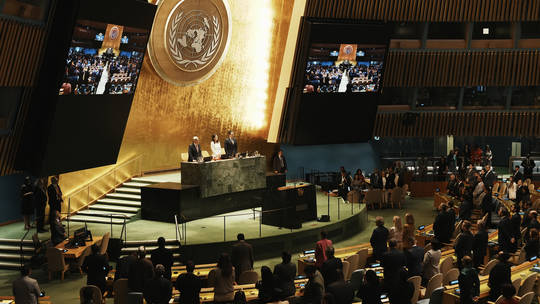
Speaking at the UN General Assembly on Saturday, Lavrov accused Western nations of making threats against Russia increasingly common. He stressed that President Vladimir Putin had repeatedly debunked claims that Russia intends to attack NATO or the EU.

Lavrov also criticized Israel, saying that while Moscow condemned the Hamas-led 7 October 2023 attacks, there was no justification for Israel’s large-scale killings of Palestinians in Gaza or for plans to annex the West Bank. He accused Israel of using its campaign against Hamas to justify airstrikes on other Middle Eastern countries.

On Iran, Lavrov condemned the West after a Russia and China led effort to delay the reinstatement of sanctions failed on Friday. He called the decision to reimpose restrictions illegal.

Lavrov’s remarks come amid growing tensions in Europe. Estonia recently accused Russia of violating its airspace, while NATO air defense operations were carried out in Poland in response to drone incursions. Denmark has also reported drones over its airports but has not linked them directly to Moscow.

Meanwhile, US President Donald Trump suggested that NATO nations should shoot down Russian aircraft if they enter allied airspace. NATO has warned it will use all necessary military and non-military tools to defend itself.

Lavrov also commented on US-Russia relations, saying the current US administration appeared interested not only in addressing the Ukraine conflict realistically but also in seeking pragmatic cooperation without an ideological stance.

In closing, Lavrov criticized Western recognition of a Palestinian state, questioning the timing and suggesting that some countries had waited so long because they hoped there would be no one and nothing left to recognize.

Netanyahu Isolated at UN as Leaders walk out

New York – Israeli Prime Minister Benjamin Netanyahu faced strong backlash at the United Nations General Assembly after condemning recent recognition of a Palestinian state by several Western countries. He called the move a “mark of shame,” claiming it sent the message that “killing Jews pays off.”

As Netanyahu began his speech, many officials and diplomats walked out in protest against Israel’s actions in Gaza, leaving him largely isolated on the world stage. At the same time, demonstrations against the war in Gaza were held outside in New York’s Times Square.

In recent days, the UK, France, Canada, Australia, and other countries formally recognized a Palestinian state. However, Netanyahu repeated that Israel would never accept a Palestinian state, insisting that most Israelis supported this stance.

His speech also drew criticism at home. Opposition leader Yair Lapid described Netanyahu’s remarks as those of a “tired and complaining” leader, while Yair Golan of the Israel Democrats party dismissed the address as “childish propaganda.”

Since Israel’s military campaign began on October 7, 2023, at least 65,549 Palestinians have been killed in Gaza, according to health authorities in the territory.

World leaders converge in New York as UN turns 80 amid Global challenges

New York – The high-level week of the 80th United Nations General Assembly session begins in New York on Tuesday, bringing together around 150 heads of state and government along with foreign ministers.

Over the week, world leaders will debate pressing global challenges, including peacebuilding, sustainable development, human rights, gender equality, artificial intelligence regulation, combating infectious diseases and mental health issues, and tackling climate change.

This year’s assembly marks the UN’s 80th anniversary, under the theme “Better Together: 80 Years and More for Peace, Development, and Human Rights.” Representatives from all 193 UN member states, along with the Vatican, Palestine, and the European Union, are taking part.

The general debate began with speeches by UN Secretary-General Antonio Guterres and Annalena Baerbock, president of the 80th session. Brazilian President Luiz Inacio Lula da Silva will be the first among world leaders to take the floor, which is a tribute to a long-standing tradition. It dates back to the fact that it was a representative of this Latin American state, Oswaldo Aranha, the then Brazilian foreign minister, who led the work of the first and second special sessions of the General Assembly in 1947. The Brazilian president will be followed by US President Donald Trump.

About 30 speakers from different countries are scheduled to speak on the first day and on the second day, there will be about 40 speakers, including the presidents of France, Ukraine, Finland and Slovakia.

Russia will be represented by Foreign Minister Sergey Lavrov, who will speak on September 27 and will be also taking part in multilateral meetings within the framework of BRICS, the CSTO, the Group of Twenty and the Group of Friends in Defense of the UN Charter. According to Russian Foreign Ministry spokeswoman Maria Zakharova, Lavrov will also hold numerous bilateral and multilateral meetings, including the US.

UN General Assembly Backs Two-State Solution for Israel and Palestine

New York – The United Nations General Assembly (UNGA) on Friday passed a resolution with overwhelming support in favor of a two-state solution to the Israel-Palestine conflict, explicitly excluding Hamas from future governance in Gaza.

The resolution, which is non-binding, received 142 votes in favor, 10 against, and 12 abstentions. Ukraine supported the motion, while Israel and the United States opposed it. The measure calls for Hamas to be disarmed and for a permanent settlement to the Gaza war based on the creation of separate states.

Israeli UN Ambassador Danny Danon dismissed the move as a “hollow gesture” and “not a serious attempt at peacemaking,” arguing it would prolong the war and “reward” Hamas rather than weaken it. Hamas has not issued a response to the resolution.

This is the strongest-worded UNGA resolution to date on Gaza, directly urging Hamas to relinquish control after nearly two decades of rule. Hamas rose to power after defeating Fatah in the 2006 election and seizing full control of Gaza the following year.

At the upcoming UNGA session on September 22, Britain, France, Canada, Australia, and Belgium are expected to follow suit. Russia has reiterated its stance that a two-state solution is the only viable path to de-escalation, continuing its long-standing recognition of Palestine since the Soviet era.