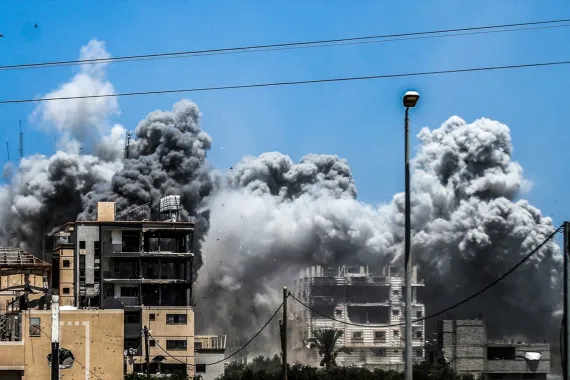
As Trump announce 60-day Gaza ceasefire, Israeli minister says Gaza war must continue

Israel has agreed to the “necessary conditions” to finalise a 60-day ceasefire in Gaza, US President Donald Trump has said.

During the proposed deal, “we will work with all parties to end the War”, Trump said in a post on Truth Social, without detailing what the conditions are.

“The Qataris and Egyptians, who have worked very hard to help bring Peace, will deliver this final proposal. I hope… that Hamas takes this Deal, because it will not get better — IT WILL ONLY GET WORSE,” Trump wrote.

Israel’s ambassador to the United Nations Danny Danon said that Israel was “absolutely” ready for a ceasefire, but it was not immediately clear whether Hamas would accept the conditions of the proposed deal.

Meanwhile,Israeli Finance Minister Bezalel Smotrich has said that the war in Gaza must continue until “a decisive victory” is achieved, rejecting calls for a ceasefire or negotiated settlement.

Speaking at a press briefing , Smotrich said Israel was “in the midst of a campaign against a crushed terrorist organization” and warned that there would be “no greater danger” to the country’s future than halting the operation prematurely.

“This war must end in a decisive victory for many generations to come, without agreements, without mediators,” he said.

The man behind decades of war: Benjamin Netanyahu’s long history of conflict

Benjamin Netanyahu, Israel’s longest-serving prime minister, has spent more than three decades positioning himself as the architect of Israel’s aggressive regional posture, leaving behind a legacy defined by repeated wars, interventions, and accusations of grave human rights abuses. Since his rise in the 1990s, Netanyahu has consistently framed Israel’s security in zero-sum terms, using overwhelming force against enemies real or perceived across Gaza, Lebanon, Syria, Iraq, and beyond, while leveraging perpetual conflict as a tool to maintain his grip on power despite repeated corruption scandals.

Netanyahu’s tenure has been marked by devastating wars on Gaza. In the wake of the Hamas-led attack on October 7, which killed around 1,200 Israelis and saw more than 240 hostages taken, Netanyahu launched a relentless campaign of bombings and siege tactics on Gaza. This operation cut off water, food, and fuel for over two million people, prompting accusations of collective punishment from humanitarian groups. By June 2025, Palestinian health authorities reported over 56,000 killed, including tens of thousands of children, and more than 130,000 injured. UN agencies, Médecins Sans Frontières, and the International Criminal Court described Israel’s use of starvation and systematic attacks on civilian infrastructure as war crimes, with the ICC issuing arrest warrants for Netanyahu and his defense minister in May 2024 for crimes against humanity, including murder and persecution.

But Gaza is only the latest chapter in Netanyahu’s pattern of warfare. Early in his first term (1996–1999), Netanyahu endorsed Operation Grapes of Wrath in Lebanon, where Israeli shelling killed over 100 civilians sheltering at a UN base in Qana. Throughout the 2000s and 2010s, he repeatedly vowed to destroy Hezbollah, telling Israeli voters and the international community that Israel would “return Lebanon to the stone age” if rockets were fired into Israel. After Hezbollah’s rise as a formidable force following the 2006 Lebanon war, Netanyahu’s threats and occasional airstrikes on Lebanon became a permanent feature of his military policy. His statements warning of “obliterating” Lebanon’s infrastructure if Hezbollah acts have stoked fears of a full-scale war that could engulf the region.

In Syria, Netanyahu has ordered hundreds of airstrikes since the Syrian civil war began in 2011, targeting Iranian forces and Hezbollah arms convoys. In 2018, he boasted publicly, “We have struck thousands of targets to stop Iran’s entrenchment in Syria and will continue to hit them anywhere in Syria and beyond,” setting a precedent for near-constant Israeli raids that have killed hundreds of fighters and civilians alike. These attacks have often destabilized ceasefires and complicated humanitarian efforts, with Syrian civilians paying a heavy price. In 2015, Netanyahu told voters that only he could “prevent Syria from becoming a base for Iranian terror that will burn the entire Middle East,” using the specter of endless conflict to rally support.

Netanyahu’s war calculus also extended to Iraq. In 2019, according to U.S. intelligence leaks, Israel launched covert airstrikes on Iraqi Popular Mobilization Forces depots, killing fighters and destroying infrastructure. Netanyahu publicly hinted at Israel’s involvement, declaring Israel would “strike Iranian assets wherever they are, including Iraq,” remarks that rattled Baghdad and raised the specter of a broader regional war.

In Yemen, Netanyahu accused the Iran-backed Houthis of plotting attacks on Israel from afar and threatened strikes on Yemeni soil. Meanwhile, he pressured Gulf Arab states into closer security pacts by painting Iran’s regional activities — in Bahrain, the UAE, and the wider Gulf — as existential threats requiring a de facto Israeli-Arab alliance under his leadership.

This bellicose approach found one of its starkest expressions in June 2025, when Israel launched Operation Rising Lion, a massive attack on more than 100 Iranian military and nuclear facilities. The assault killed at least 224 people, many civilians, and injured more than 1,000. Iran retaliated with missile strikes on Israeli cities that killed dozens, marking the most dangerous direct conflict ever between the two countries. Netanyahu framed the attack as vital to freeing Israeli hostages in Gaza and halting Iran’s nuclear ambitions, but the escalation prompted international condemnation and fears of a regional war spiraling out of control.

Throughout these wars, Netanyahu has used bombastic speeches and dramatic visuals — like his infamous 2012 UN presentation where he drew a red line on a cartoon bomb to warn of Iran’s nuclear program — to keep Israel’s population and allies focused on external threats. Critics argue these tactics are designed to distract from his domestic political and legal crises.

Netanyahu’s political survival has indeed depended heavily on these cycles of war. Since 2019, he has been on trial for three major corruption cases — Cases 1000, 2000, and 4000 — involving bribery, fraud, and breach of trust. In Case 1000, prosecutors accuse him of accepting luxury gifts worth nearly 700,000 shekels from billionaires such as Arnon Milchan and James Packer in return for political favors. In Case 2000, he allegedly negotiated a deal with the publisher of Yedioth Ahronoth newspaper for favorable coverage in exchange for undermining a rival outlet. In Case 4000, Netanyahu is accused of approving regulatory benefits worth hundreds of millions of dollars for telecom giant Bezeq’s owner, Shaul Elovitch, who then skewed Walla News coverage to favor him. Netanyahu has repeatedly delayed these trials, citing national security crises like Gaza and Iran, while denouncing the charges as part of a leftist conspiracy to topple him.

His domestic policies have only fueled polarization further. From 2022 to 2024, Netanyahu pushed sweeping judicial reforms that critics said would undermine Israeli democracy by stripping the Supreme Court of its power to check the government. Hundreds of thousands of Israelis took to the streets in some of the largest protests in the nation’s history. Under pressure, Netanyahu paused parts of the overhaul, but has vowed to revive it, framing the judiciary as an obstacle to the will of the people.

Meanwhile, Netanyahu has pursued settlement expansion in the occupied West Bank at an unprecedented pace, approving thousands of new housing units and further entrenching Israeli control in defiance of multiple UN Security Council resolutions. This expansion has intensified daily violence between settlers and Palestinians, stoking tensions that could explode into wider conflict at any moment.

Even as Israel reels from war with Iran, Netanyahu has continued to signal readiness for more aggression. His government has warned Hezbollah and Syria that Israel would not hesitate to strike again if it detected Iranian weapons transfers. His repeated threats that Israel will “do whatever it takes” to destroy Iranian capabilities, including in Syria and Lebanon, have deepened regional instability and left millions across the Middle East living in fear of the next Israeli operation.

Netanyahu’s defenders insist his tough policies have kept Israel safe, pointing to the normalization deals with some Arab states as proof of his strategic vision. But critics, including former Israeli military and intelligence officials, warn that his wars have radicalized new generations of militants across Gaza, Lebanon, Syria, Iraq, and Iran, and that his approach leaves Israel more isolated internationally while cementing cycles of hatred and violence that undermine its long-term security.

Despite repeated international condemnations and polls showing a majority of Israelis want him to step down, Netanyahu has kept power through alliances with ultra-nationalist and religious parties, along with a strategy of portraying himself as Israel’s irreplaceable defender. Yet with Gaza on the brink of famine, Iran vowing revenge, and a corruption trial still looming over his future, Netanyahu’s relentless focus on war as a means of political survival has pushed Israel and the Middle East to a level of instability not seen in decades. Without decisive action by both Israeli society and the international community, many fear Netanyahu’s legacy will be a region locked in endless war.

Genocide in Gaza: Ethnic Cleansing, Mass Murder, and State Terrorism Shielded by Global Powers

GAZA CITY — Gaza today stands as a testament to modern warfare’s most egregious moral and legal failures. Since Israel’s latest offensive began in October 2023, more than 56,000 Palestinians have been killed, including over 16,000 children, according to the Gaza Health Ministry and verified by international organizations such as the World Health Organization. Entire families have been erased. UN agencies estimate that over 80% of Gaza’s 2.3 million residents are displaced, living in tents or rubble without sanitation, electricity, or safe drinking water.

Journalists documenting these war crimes have themselves become targets: more than 200 journalists have been killed since October, according to the Committee to Protect Journalists, which calls Gaza “the deadliest place in the world for journalists.” Yet despite the risks, reporters, local media, and aid workers continue to expose the unprecedented scale of civilian suffering.

The physical devastation is staggering: the UN OCHA confirms that more than 60% of all residential buildings in Gaza have been destroyed or severely damaged. Over 130 schools, 36 hospitals and clinics, and every one of Gaza’s sewage treatment plants have been bombed, according to data compiled by OCHA. This has created not just a warzone, but an engineered humanitarian catastrophe in which disease and starvation now threaten more lives than bombs.

The destruction of Al-Shifa Hospital, Gaza’s largest medical facility, was particularly symbolic: once a lifeline for over 2 million residents, it has been bombed, raided, and permanently closed, leaving trauma patients to die untreated. These acts violate Articles 18 and 19 of the Fourth Geneva Convention, which explicitly prohibit attacks on medical facilities and staff.

Israel’s Defense Ministry has declared Gaza’s north a “safe-free zone,” where civilians have been ordered to leave but given no realistic path to safety. Human Rights Watch documented Israeli forces firing on civilians attempting to flee along supposed evacuation routes. Meanwhile, UNICEF has warned of an “imminent mass death of children” due to famine induced by Israel’s blockade — a clear use of hunger as a weapon of war.

These are not isolated incidents. The Israeli newspaper Haaretz and investigative outlet +972 Magazine have published evidence showing Israeli Prime Minister Benjamin Netanyahu’s government repeatedly approved Qatari cash transfers to Hamas in Gaza to keep it politically dominant and Palestinian society fractured — all while publicly condemning Hamas as terrorists. This longstanding policy allowed Israel to avoid negotiating a unified peace agreement with the Palestinians.

Netanyahu’s political incentives cannot be overstated. He is on trial for multiple corruption charges and has a track record of using Gaza escalations to rally nationalist voters, as documented by Israeli journalist Raviv Drucker. Every major war on Gaza under Netanyahu — 2008, 2012, 2014, and now 2023–2025 — coincided with political crises or elections, according to analyses by International Crisis Group and Carnegie Middle East Center.

Economic interests lie at the heart of Gaza’s tragedy. The offshore Gaza Marine gas field, discovered by British Gas in 2000, has an estimated 1 trillion cubic feet of natural gas. Israel has consistently blocked Palestinian development of these reserves. Reports by The Financial Times and Reuters show that control over these gas fields — potentially worth billions — is a major, underreported factor behind Israel’s refusal to allow any form of Palestinian sovereignty over Gaza.

On the ground, statements by Israeli leaders reveal genocidal intent. Israeli Minister of Heritage Amichai Eliyahu said in November 2023 that dropping a nuclear bomb on Gaza was “an option,” later telling Israeli radio that Gaza’s civilians were legitimate targets because they “raised murderers.” Finance Minister Bezalel Smotrich declared that “there are no innocent civilians in Gaza,” effectively endorsing mass killing. National Security Minister Itamar Ben-Gvir called for “voluntary emigration” of Gaza’s population — a euphemism for ethnic cleansing. These statements were widely reported in Israeli and international media, including The Times of Israel.

Meanwhile, Israel’s Western allies continue to enable and shield these crimes. The United States has provided Israel with over 40,000 precision bombs and missiles since October 2023, according to Pentagon arms export data analyzed by the Center for International Policy. President Joe Biden has repeatedly stated that “Israel has the right to defend itself” and signed a $14 billion supplemental military aid package in May 2024 to replenish Israeli stockpiles. US Ambassador to the UN Linda Thomas-Greenfield has vetoed four UN Security Council resolutions calling for a ceasefire, arguing that a ceasefire would “embolden Hamas.”

European governments have been complicit as well. Germany’s Chancellor Olaf Scholz publicly declared Germany’s “unconditional solidarity with Israel” (DW, October 2023) and authorized continued weapons exports despite evidence of war crimes. UK Prime Minister Rishi Sunak visited Israel and pledged full support, while British arms companies have increased shipments of components for Israeli drones, according to data from the UK Department for Business and Trade cited by Amnesty International.

Arab regimes have offered rhetorical condemnations but taken little concrete action. Egypt, despite controlling the only non-Israeli crossing into Gaza at Rafah, has cooperated with Israel’s blockade by limiting humanitarian aid flows and refusing to allow mass evacuations. Saudi Arabia and the UAE, eager to preserve normalization talks with Israel under the US-brokered Abraham Accords, have restricted protests and muted their diplomatic pressure. This silent complicity leaves Palestinians isolated even in the region that once claimed to champion their cause.

Meanwhile, the broader economic and geopolitical system profits from Gaza’s suffering. The Stockholm International Peace Research Institute’s latest 2024 report shows Israel is among the world’s top 10 arms exporters — and that wars like Gaza’s boost demand for “combat-proven” weapons worldwide. Israeli defense companies like Elbit Systems and Rafael have seen their stock prices surge since October 2023, driven by international orders for weapons tested during the bombardment.

What is happening in Gaza is not simply collateral damage or a tragic byproduct of conflict. It is a deliberate, systematic campaign of ethnic cleansing — a genocide that seeks to erase Gaza’s Palestinian population through starvation, bombardment, and forced displacement. It is mass murder carried out in full view of the world, and it is state terrorism, designed not just to defeat Hamas, but to annihilate the social fabric of Palestinian society. Shielded by the United States, supported by European powers, and enabled by Arab regimes more interested in political deals than human rights, this genocide continues with impunity.

This is the hardest truth: the world is witnessing the destruction of an entire people in real time — and powerful governments are not only failing to stop it but are directly complicit in the ethnic cleansing of Gaza.

Lebanon says 15 killed by Israeli forces after withdrawal deadline missed

Israeli soldiers have killed 15 people and wounded more than 80 in southern Lebanon, the Lebanese health ministry says, as the Israeli military remained in parts of the country after the expiration of a deadline for their withdrawal, and Hezbollah’s removal from the area.

On Sunday morning, thousands of residents returned to towns and villages along the border, despite warnings by the Lebanese and Israeli armies, and the UN, that the region remained unsafe.

Israel said the 60-day ceasefire agreement with Hezbollah had not been fully implemented, and it remained unclear how many of its soldiers remained in Lebanon or how long they would stay.

According to the Lebanese health ministry, Israeli forces attacked people as they tried to enter locations that were still under occupation. The Lebanese army said one of its soldiers had been killed and another wounded by Israeli fire.

The Israeli military said it had fired “warning shots in multiple areas” of southern Lebanon, without specifying if people had been hit, and apprehended several people it claimed posed an “imminent threat”.

The ceasefire deal, which was brokered by the US and France and put an end to 14 months of conflict, stipulated the withdrawal of Israeli troops and the removal of Hezbollah fighters and weapons from southern Lebanon. At the same time, thousands of Lebanese soldiers were expected to be deployed to the area where, for decades, Hezbollah has been the dominant force.

A Western diplomatic official familiar with the negotiations, who spoke on the condition of anonymity, said Israel had said it needed more time to destroy Hezbollah’s infrastructure in southern Lebanon, and that the initial plan was for a 30-day extension.

In recent days, Hezbollah’s TV station Al Manar appeared to encourage people to return south and, in some places, convoys arrived waving the yellow and green flag of the group.

The passing of the ceasefire deadline is the first major test for the new Lebanese president, army chief Joseph Aoun, who is keen to bring stability to a country exhausted by multiple crises.

In a statement issued on Sunday, he said Lebanon’s “sovereignty and territorial integrity are non-negotiable”, adding that he was “following this issue at the highest levels”.

The conflict escalated last September, leading to an intense Israeli air campaign across Lebanon, the assassination of Hezbollah’s senior leaders and a ground invasion of southern Lebanon. The offensive killed around 4,000 people in Lebanon – including many civilians – and led to the displacement of more than 1.2 million residents.

On Friday, the office of the Israeli prime minister said the withdrawal outlined in the ceasefire was “conditioned on the Lebanese army deploying in southern Lebanon and fully and effectively enforcing the agreement, while Hezbollah withdraws beyond the Litani”, a river about 30km (20 miles) from the the unofficial border between Lebanon and Israel known as the Blue Line.

“Since the ceasefire agreement has yet to be fully enforced by the Lebanese state, the gradual withdrawal process will continue, in full coordination with the US,” the statement said.

In a statement on Saturday, the Lebanese army said it continued to “implement the plan to enhance deployment” in areas along the border, but that there had been “delays in some stages due to the Israeli enemy’s procrastination in withdrawing, complicating the army’s deployment mission”.

There has been no immediate reaction from Hezbollah. On Thursday, the group said failure to comply with the deadline would be a “blatant violation of the agreement, an infringement on Lebanese sovereignty, and an entry into a new phase of occupation”.

However, the statement did not say how the group would respond if Israeli troops remained in the country.

This is possibly an indication of the delicate position the group finds itself in. The Iranian-backed militant, political and social movement was severely weakened in the conflict with Israel, although it continues to enjoy significant support among Shia Muslims in Lebanon.

The ceasefire deal was widely considered as a surrender by the group, after it saw its infrastructure and weapons arsenal depleted and hundreds of fighters and key figures killed, including long-time leader Hassan Nasrallah.

Despite some violations before the withdrawal deadline, the truce put an end to the violence which caused billions of dollars in destruction and damage, allowing thousands of residents to return to their homes in Lebanon.

If it decides to resume its attacks, Hezbollah will face opposition from critics, who had accused the group of dragging Lebanon into a war that was not in the country’s interests, and possibly even from some of its own supporters.

Earlier this month, Lebanon’s parliament was able to elect a president after more than two years of political impasse blamed by critics on the group.

Aoun has promised ambitious reforms to rebuild state institutions long plagued by corruption, revive the collapsed economy after years of crisis, and the right to monopolise the possession of weapons, which would mean trying to curb Hezbollah’s military power.

It remains unclear whether the army is able – and willing – to do so, amid concerns that any action against the group could spark internal violence.

Israel’s stated goal in its war against Hezbollah was to allow the return of about 60,000 residents who had been displaced from communities in the country’s north because of the group’s attacks, and to remove it from areas along the border.

Hezbollah launched its campaign the day after the Hamas attacks on southern Israel on 7 October 2023, saying it was acting in solidarity with Palestinians in Gaza.BBC

Hamas accuses Israel of violating Gaza ceasefire agreement

The Palestinian movement Hamas has accused Israel of violating the ceasefire agreement in the Gaza Strip by continuing to prevent displaced persons from returning to the northern part of the enclave.

“Hamas and mediators are monitoring Israel’s actions, which prohibit displaced persons from returning from southern Gaza to their homes in the north – this constitutes a violation of the ceasefire agreement,” the movement said in a statement on its Telegram channel.

Hamas also noted that it hopes, along with mediators, “to reach a solution that would allow displaced persons to return” to the northern regions of Gaza.

Iran to take tough measures in retaliation for the killing of the Hamas leader

There have been signs that Iran will take tougher measures in retaliation for the killing of Hamas leader Ismail Haniyeh.

Israel has not commented directly on the attack that killed Ismail Haniyeh in Tehran on Wednesday morning. Still, Israeli Prime Minister Benjamin Netanyahu has said that Israel had succeeded in hitting back at its enemies in recent days, pointing to the killing of Hamas leader Ismail Haniyeh and the killing of a senior Hezbollah commander in Lebanon shortly before the Tehran attack. A few hours before Hanieh’s murder, Israel also killed senior Hezbollah operative Fuad Shukr in Beirut.

Meanwhile, Hamas’ armed wing said the death of Haniyeh, seen as the overall leader of the Hamas group, would “take the fight to a new dimension” and have far-reaching consequences. However, it has not been decided how Iran will respond to the killing, and it is indicated that it may further promote the war in the Middle east countries. Haniyeh, who played a key role in negotiating a cease-fire in Gaza, was killed hours after attending the swearing-in ceremony of Iran’s new president, Massoud Pezheshkian.

Thus, in the middle of the growing conflict in the Middle east, the United States has advised its citizens not to travel to Lebanon, while the British Foreign Secretary has asked citizens to leave the country. Also, many international airlines have canceled their flights in that area.

On October 7, attack on Israel killed about 1,200 people. Since the conflict , Israel started the war to destroy Hamas.

Israel’s war on Gaza live: Dozens killed in Israeli raids on Gaza, Yemen

Dozens of Palestinians have been killed as Israel’s bombardment continues across the Gaza Strip, including 12 people in three separate attacks on the Nuseirat refugee camp, according to civil defense crews.
In Yemen, at least three people were killed and 87 wounded in Israeli air attacks that targeted an oil storage facility and power plant in the port city of Hodeidah, officials said. Israeli raids also caused injuries in southern Lebanon.
The Israeli attacks come as countries called for an end to Israel’s occupation of Palestinian territory following a “landmark” ruling from the International Court of Justice (ICJ).
At least 38,919 people have been killed and 89,622 wounded in Israel’s war on Gaza. The death toll in Israel from Hamas-led attacks on October 7 is estimated at 1,139 with dozens of people still held captive in Gaza.