Minister Ghising held a courtesy meeting with Chinese Ambassador

Kathmandu — Minister for Energy, Water Resources and Irrigation, Physical Infrastructure and Transport, and Urban Development, Kulman Ghising, held a courtesy meeting with Chinese Ambassador to Nepal, Chen Song, on Wednesday at the Ministry of Physical Infrastructure and Transport in Singha Durbar.

During the meeting, Ambassador Chen congratulated the newly appointed minister and extended best wishes for his tenure. Discussions focused on Nepal–China road and power transmission connectivity, progress of road and electricity projects contracted to Chinese companies, cooperation in the energy sector, implementation of projects supported by Chinese aid, and prospects for Chinese investment.

Minister Ghising highlighted the importance of the Kathmandu–Kodari (Araniko) and Syaprubensi–Rasuwagadhi roads as vital but vulnerable trade routes due to landslides and fragile terrain. He requested Chinese technical assistance to repair and permanently maintain these roads.

He also urged the immediate start of work on the Kalanki–Basundhara section of the Ring Road expansion funded by Chinese grants, pushed for advancing another cross-border transmission line through Kimathanka to strengthen Nepal’s power market, and stressed the need to accelerate hydropower projects along the Arun River corridor.

Furthermore, he raised concerns over delays in the Kamala–Kanchanpur project contracted to a Chinese company, and sought support to speed up the Narayanghat–Butwal and Muglin–Pokhara road expansion works.

Ambassador Chen assured that China remains committed to supporting Nepal in its priority development areas. The meeting was also attended by ministry secretary Keshav Kumar Sharma, chief of Development Assistance Coordination and Quality Division Sushil Babu Dhakal, Director General of the Department of Roads Bijay Jaishi, and officials from the Ministry of Foreign Affairs.

Nepal at the crossroads of international power struggle

Kathmandu – Within hours of Indian Prime Minister Narendra Modi’s phone call to congratulate Sushila Karki on her appointment as Nepal’s interim prime minister, the Chinese and American ambassadors in Kathmandu arrived at Singha Durbar for courtesy meetings. The sequence of visits, coming from three of the world’s most influential powers, has been read in diplomatic circles as a sign that Nepal’s political shift is being closely watched far beyond its borders. For a small Himalayan nation caught between India and China and increasingly courted by the United States, such simultaneous attention is rarely accidental.

The timing alone carries geopolitical weight. India has long held a dominant influence in Nepal, bound by geography, trade and cultural ties. By reaching out first, New Delhi signaled its intent to reaffirm those links and remind Kathmandu of its historic partnership. China’s ambassador, by arriving immediately after, conveyed Beijing’s determination not to let Nepal slip further into India’s orbit. And the United States, which has invested heavily in development projects and the controversial Millennium Challenge Corporation compact, underscored that its strategic interests in South Asia extend well beyond New Delhi.

For Nepal, the sudden convergence of attention highlights the delicate balance it must maintain. Prime Minister Karki takes office at a fragile moment, with protests still fresh, elections scheduled for early next year, and the state under pressure to restore both political order and economic confidence. How her government handles these early overtures may set the tone for the next phase of Nepal’s foreign policy.

Each of the three powers has its own motives. India is anxious to keep Nepal firmly within its strategic fold, ensuring that no major infrastructure or security arrangement tilts decisively toward Beijing. It is particularly sensitive about transit routes, cross-border energy trade and unresolved border disputes. China, on the other hand, has steadily expanded its footprint in Nepal through roads, hydropower projects and Belt and Road Initiative commitments, while watching closely how Nepal manages issues linked to Tibet. The United States, meanwhile, has emphasized democracy, governance and transparency, but it also sees Nepal’s location as strategically valuable in the context of rising Chinese power in Asia.

The visits also expose the risks Nepal faces. If it leans too far toward one capital, it risks alienating another. Accepting large-scale projects without proper safeguards could saddle the country with unsustainable debt or compromise sovereignty. At the same time, failing to seize the moment could mean losing opportunities for investment, infrastructure and energy exports that the country badly needs.

President Ram Chandra Poudel recently urged unity and good governance as guiding principles for the country, and those same principles apply to foreign policy. Nepal’s challenge is to convert this influx of attention into tangible benefits without allowing itself to become a pawn in wider geopolitical rivalries. That will require clear priorities, transparent negotiation and above all a firm insistence that Nepal’s sovereignty and national interest come first.

The simultaneous outreach by India, China and the United States to Prime Minister Karki is not simply a coincidence of protocol. It is a reminder that Nepal, though small, occupies a strategic crossroads that matters deeply to the world’s major powers. How karki’s government responds could shape not only the country’s external relations but its internal stability and future trajectory.

Oli and Xi Pledge Stronger Nepal–China Cooperation under BRI Framework

Kathmandu- Prime Minister KP Sharma Oli and Chinese President Xi Jinping have pledged to advance mutually beneficial cooperation in the coming days, according to the Embassy of Nepal in Beijing. President Xi reaffirmed China’s continued support to Nepal and expressed commitment to work together at bilateral as well as multilateral forums such as the United Nations and the Shanghai Cooperation Organization (SCO).

The Embassy stated that Xi promised ongoing assistance to Nepal and reiterated China’s pledge to implement the high-quality Belt and Road Initiative (BRI) projects already agreed upon. Prime Minister Oli, on his part, requested President Xi’s support for Nepal’s full membership in the SCO, as Nepal currently holds only dialogue partner status.

Xi highlighted that the BRI has brought the peoples of Nepal and China closer, noting that the two countries are bound by mountains and rivers, and have shared a friendship for generations. He said that the 70 years of bilateral ties have been marked by a history of good neighborliness and trust.

During the talks, Oli drew Xi’s attention to the need for faster implementation of 10 agreed projects under the BRI and sought further cooperation in areas such as fertilizer supply, petroleum exploration, human resource development, climate resilience, and strengthening people-to-people ties. He also urged China to help reopen blocked border points, according to Oli’s economic advisor Dr. Yubaraj Khatiwada. Xi reportedly assured support in helping Nepal transform from a landlocked to a land-linked country and pledged to facilitate smooth border operations.

According to the Chinese Foreign Ministry, Oli stated that Nepal–China relations have withstood tests and challenges, becoming stronger over time. He reaffirmed Nepal’s commitment to the “One China Policy,” opposition to “Taiwan independence,” and assured that Nepali soil will never be used against China’s interests. Oli emphasized Nepal’s dedication to development and expressed readiness to strengthen cooperation with China in trade, investment, agriculture, science and technology, tourism, and climate change while jointly building the BRI.

Xi expressed China’s willingness to upgrade the traditional friendship with Nepal and promote a new phase of strategic partnership for development and prosperity. He stressed enhancing strategic mutual trust, supporting each other’s core interests, deepening win–win cooperation, and advancing the BRI together.

Xi further assured that China will continue supporting Nepal’s industrial development and believes that the BRI will boost connectivity in ports, roads, energy grids, aviation, and communication. He noted that cooperation under the BRI should also extend to industry, agriculture, livestock, renewable energy, environmental protection, oil and gas, artificial intelligence, education, healthcare, law enforcement, and security.

PM Oli Holds Bilateral Meeting with Chinese President Xi Jinping

Kathmandu — Prime Minister KP Sharma Oli met with Chinese President Xi Jinping. The meeting took place at the Tianjin Guest House in China, where Oli had arrived to attend the Shanghai Cooperation Organization (SCO) Summit.

During the discussion, the two leaders talked about bilateral relations and cooperation between Nepal and China.

Oli was welcomed by senior Chinese officials, as well as China’s Ambassador to Nepal, Dr. Krishna Prasad Oli, and other dignitaries including Chen Song.

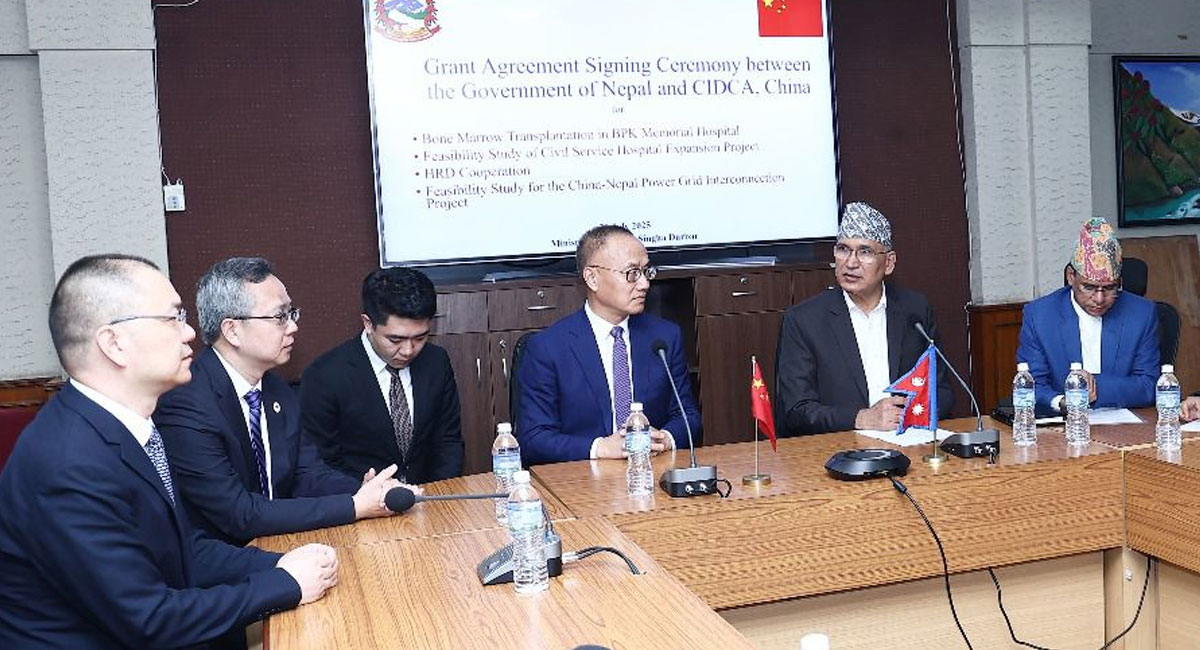
China to support for 4 projects in Nepal: MoU signed between 2 countries

Kathmandu – MoU has been signed between China and Nepal extending the supports for four different projects in Nepal.

China is set to reconstruct flood-damaged structures in Rasuwagadhi .During a meeting with Deputy Prime Minister and Finance Minister Bishnu Prasad Poudel, Chairman of the China International Development Cooperation Agency Chen Xiaodong said that China will assist in the reconstruction of flood-damaged physical structures in Rasuwa.

During the meeting, Chairman Xiaodong informed that necessary assistance will be provided for the reconstruction of physical structures and that the customs process will be carried out quickly.

A memorandum of understanding (MoU) has been signed for the construction of a bone marrow transplantation project and a feasibility study for the expansion of the Civil Servants Hospital at the BP Koirala Memorial Cancer Hospital in Bharatpur, Chitwan.

A bone marrow cancer treatment center spread over an area of 1,834 square meters will be constructed at the BP Koirala Memorial Cancer Hospital in Bharatpur and the necessary machinery will be installed. This will make a significant contribution to the treatment of bone marrow cancer. Similarly, a feasibility study will also be conducted for the expansion of the Civil Servants Hospital. The implementation of these two agreements is expected to make a significant contribution to the health sector of Nepal.

On this occasion, a memorandum of understanding (MoU) was signed between Nepal and China on human resource development. This will give 1,270 government employees the opportunity to participate in bilateral and multilateral seminars organized by various organizations in China. This will make a significant contribution to the capacity building of employees.

Similarly, the feasibility study memorandum for the construction of the Rasuwagadhi-Kerung cross-border transmission line was signed by Hitendradev Shakya, Executive Director of Nepal Electricity Authority, and the Chairman of SIDCA. This will move forward the feasibility study work related to the construction of the Rasuwagadhi-Kerung transmission line.

There are few countries trying to play in Nepal-China relationship: CPC Deputy Minister Haiyan

Sun Haiyan, Deputy Minister of the International Department of the Communist Party of China (CPC), said that other countries are trying to play the game in relation to Nepal and China.

While interacting with the leaders of various political parties in Kathmandu during her three-day visit to Nepal, Haiyan said that the political relations between the two countries are good and that some other countries do not want to see this.She said that the reason for visiting Nepal and holding joint consultations with political parties is to improve the relationship between the two countries.She said that the heads of state of both the countries are trying to strengthen the relationship and the signing of the memorandum of agreement has also strengthened the relationship between the two countries.”We need to work on how to improve China-Nepal relations and cooperate in the new era”, she said.

She also pointed out the need to do homework on the role of political parties to strengthen the relationship between Nepal and China. A lot of Chinese tourists have come to Nepal. Nepal must also have felt this,” she said, “but we should not rely only on one area. Before I came to Nepal, when I discussed with the Chinese entrepreneur, I mentioned the need to invest in Nepal. But for that, there is a need for policy reform here.In addition, she said that not only because of the Covid-19, but also because of various reasons, the projects in Nepal with Chinese investment are being delayed.

“We have to sit down and solve it. We should have more cultural exchanges. We are working in accordance with the desire to give more scholarships to Nepali students,” she said. “We understand that projects are necessary in Nepal for livelihood as well. We are working for that too. But for that, policy reform is necessary. The people here should get that.’We have to work together to face the difficulties. Cooperation should be made more practical, she said.

She emphasized on building Chinese-style development and implementing BRI.Similarly, Chinese ambassador to Nepal Chhan Sang said that it is necessary to consult on how to further advance the relationship between Nepal and China.In addition, he said that China is ready to help Nepal and Nepal should work to solve the policy problems.

Congress wants to cooperate with China: Shashank Koirala

Kathmandu- Nepali Congress leader Dr. Shashank Koirala has said that they want to cooperate with China.

He said that the Congress wants to cooperate with China in an interaction program held in Kathmandu with Sun Haiyan, Deputy Minister of the International Department of the Communist Party of China (CPC).

Stating that China’s economic development is commendable, he said that Nepal wants to cooperate in development.

Remembering China’s support during the earthquake in Nepal and during the Covid, leader Koirala said that Nepal-China relations are based on Panchsheel.

BRI implementation plan to be signed soon: Home Minister Shrestha

Kathmandu – Deputy Prime Minister and Home Minister Narayankaji Shrestha has said that Nepal and China will sign the implementation plan of the ‘Belt and Road Initiative’ ‘soon’. However, he did not say anything about when and how to do this.

Nepal and China signed a memorandum of understanding on BRI in 2017, but no project under it has been implemented for nearly seven years.

Addressing a program of the Silk Road Youth Forum and the South Asian Cooperation Conference, Shrestha said that only after signing the implementation plan, they will proceed to the implementation phase.

Stating that the Belt and Road Initiative, which aims to enhance connectivity and promote economic cooperation, has opened new avenues of cooperation between the two countries, he said that infrastructure development is the cornerstone of Nepal-China cooperation.

“China’s assistance in building important infrastructure such as roads, bridges, and energy projects has played an important role in leading Nepal towards economic growth and stability, and the increased connectivity through these projects will not only strengthen bilateral relations but also contribute to the broader vision of regional cooperation and integration,” he said.

The signing of the BRI implementation plan between Nepal and China has been one of the main agendas since the beginning of 2020, but due to differences between the two sides on the modality of investment, an agreement has not been reached.

“China’s BRI has emerged as a transformative force to shape the economic landscape of South Asia,” Shrestha said. “BRI’s emphasis on connectivity, infrastructure development and financial support is seamlessly aligned with the development aspirations of nations in the region.”

Shrestha said, “The Belt and Road Initiative is not just about building roads and bridges. It is also about creating pathways to shared prosperity. The economic corridor envisioned by the BRI has the potential to open up new markets, facilitate trade and spur economic growth. For nations like Nepal that reside in the heart of the Himalayas, these initiatives open up possibilities for expanded connectivity that can transform the economic landscape.

Silk Road Youth Forum Vice President and Secretary General Yan Dongping, Madhyapur Thimi Municipality Deputy Mayor Vijaykrishna Shrestha, Chinese Embassy Commercial Counselor Xie yu, Matrika Poudyal, Foreign Affairs Institute Spokesperson Tsetan Namgyal and others were present in the program. Aneka Rebecca Rajbhandari, Assistant Professor of Jawaharlal Nehru University’s Center for Inner Asian Studies, Raunab Singh Khatri and Hou Shixin, among others, shed light on various aspects of Nepal-China relations.

Signing of cooperation agreement between TU and the Chinese university

Kathmandu – A five-year memorandum of understanding has been signed between Tribhuvan University (TU) and University of Electronics Science and Technology of China (USTC).

Acting Vice-Chancellor of Tribhuvan University Dr Shivalal Bhusal and UEFA Vice-Chancellor Zheng Yong signed the agreement at Tribhuvan University Kirtipur. Prof. Chiranjeevi Khanal, head of Tribhuvan University’s Department of Mass Communication and Journalism and Professor Hong of UEFA signed the agreement.

Bhusal, Acting Vice-Chancellor of TU, expressed his belief that there will be a close cooperation between the two universities in the coming days. The representative of USTC, Prof. Hang Hong, said that he will provide his best support in the field of study and research.

Prof. Khanal, who initiated the agreement, said that there is an agreement between the two universities for long-term cooperation and this agreement will be useful for enabling mutual benefit and academic cooperation based on the principle of mutual equality. According to the agreement, scholars, researchers and teaching staff and students will be exchanged whil Workshops and seminars will be organized jointly.

Chinese military team in Kathmandu

Kathmandu- Chinese high military team has arrived in Kathmandu.

A team led by the Tibet Military Commander of the Chinese People’s Liberation Army, Major General Yui , has landed at the Tribhuvan International Airport on Air China flight number 437.

The team was welcomed at the Tribhuvan International Airport Major General Sagar Bahadur Thapa and Brigadier General Sunil Shrestha.

According to Information Officer and Assistant Rathi Krishna Prasad Bhandari of the Nepali Army, the Chinese military team, which is on an official visit, is scheduled to meet with Chief of Army Staff Prabhuram Sharma and others. Border security, military relations between the two countries will be discussed during the meeting. The 8-member military team led by Major yui will return to the country on the 3rd of Bhadra 2080 BS.

Agreement to open export from Tatopani from May 18

An agreement has been reached between China and Nepal to open export through the Tatopani border connecting Nepal and China.

It is said that 6 points have been agreed upon to open the border from May 18th in the discussion held between Nepal and Chinese government officials.

According to Chief District Officer of Sindhupalchok, Ramesh Neupane, after a sufficient discussion between the border security regarding ‘cross border crime’, and other management issues, there has been a discussion and oral agreement on the opening of the border crossing from 1st of May.

On the other hand, despite the agreement to open the export through Tatopani, the locals have expressed disappointment that the physical infrastructure in Tatopani is not fully prepared and the 26 km road section of the Kodari highway connecting the border is still damaged. Locals were also not so happy as exports only being allowed through Tatopani been agreed while Kerung is fully operational .

Chairman of the Chinese People’s Congress Li Zhanshu returns home

The Chinese People’s Congress President Li’s delegation, which was on a four-day visit to Nepal, has returned home today.

The Nepalese team including Speaker Agni Sapkota saw them off at Tribhuvan International Airport today.

During the visit, President Li met with Speaker Sapkota, Prime Minister Deuba, President Bhandari and other political party leaders.

During the visit of the Chinese team, a bilateral memorandum of understanding on inter-parliamentary cooperation was also signed between China and Nepal.

Six-point agreement between Nepal and China

A six-point memorandum of understanding has been signed between Nepal and China.

Speaker Agni Prasad Sapkota from Nepal and Chinese National People’s Congress President Li Zhansu signed the memorandum of understanding.

The MoU was signed during a program held at the Federal Parliament Building, New Baneshwor. In the MoU, which also mentions the issue of BRI, both sides agree to strengthen and develop mutual trust, respect each other’s independence, sovereignty and geographical integrity, respect each other’s freely chosen social system and development path, and support each other’s core interests and important concerns.

Agreement Letter:

Chinese People’s Congress President Li arriving Nepal today

Chinese Communist Party (CPC) Standing Committee, National People’s Congress Chairman, Li Zhanshu will be arriving in Nepal today. The government has made special security arrangements for the visit of Li, a confidant of Chinese President Xi Jinping.

Lee, who is coming to Nepal via Russia and Mongolia, is scheduled to return to China via South Korea from Nepal. Lee’s 100-member jumbo tour team, which includes 6 minister-level leaders, is about to arrive in Nepal on a special plane. According to the Chinese Constitution, Li is second in rank and third in the Communist Party of China (CPC).

President Lee will hold a bilateral meeting with Speaker Agni Prasad Sapkota today. During the bilateral talks, the Parliament Secretariat has informed that an agreement is being made between the Federal Parliament of Nepal and the National People’s Congress of China regarding bilateral cooperation and exchange of visits. Speaker Sapkota will host a dinner in Lee’s honor today. President Lee is scheduled to meet Prime Minister and Congress President Sher Bahadur Deuba, National Assembly Speaker Ganesh Timilsena and Foreign Minister Narayan Khadka on Tuesday.

President Lee will meet President Bidhya Devi Bhandari at Sheetal Niwas on Wednesday. On the same day, UML President KP Sharma Oli and Maoist Center President Pushpa Kamal Dahal are also scheduled to meet separately. According to the Ministry of Foreign Affairs, Lee is scheduled to return from Nepal on Thursday.

Important agreement between Nepal and China

An important agreement has been reached between Nepal and China in the field of infrastructure development, including the expansion of the Rasuwagadhi-Kerung cross-border railway.

During the delegation-level talks between Narayan Khadka and his counterpart Wang Yi on Wednesday, the Ministry of Foreign Affairs said that there was an agreement to increase cooperation in the fields of trade, connectivity, investment, health, tourism, poverty alleviation, agriculture, disaster management, education, culture and people-to-people interaction.

In a meeting with Foreign Minister Khadka, the Chinese Foreign Minister announced that the pre-feasibility study of the Kerung-Kathmadu railway will be completed with a subsidy, the ministry said.

Similarly, the construction of electrical transmission across the Nepal-China border was also discussed in the meeting.

According to the Ministry of Foreign Affairs, Wang has also promised financial support for the construction of electrical transmission lines. Earlier, during Wang’s visit to Nepal, it was agreed to extend the period of pre-feasibility study of the Nepal-China cross-border electrical transmission line by two years. According to the Nepal Electricity Authority, homework is being done to proceed with the pre-feasibility study. But the two sides have yet to agree on its format.

During the talks, Chinese Foreign Minister Wang announced 15.5 billion rupees (800 million Chinese Yuan) in aid to Nepal for 2022.

Nepal’s commitment to one China policy

In the bilateral meeting, Foreign Minister Khadka said that Nepal strongly supports the one China policy. He assured that Nepalese land will not be used against China.

Similarly, Wang reiterated his unconditional support for Nepal’s sovereignty, independence and geographical integrity. He also said that China will continue to help Nepal according to the development needed and priorities of the Nepalese government.

Foreign Minister Khadka to visit China

Foreign Minister Narayan Khadka is scheduled for a three-day official visit to China on Tuesday.

Foreign Minister Khadka is going to visit China at the invitation of Chinese Foreign Minister Wang Yi, according to a statement released by the Ministry of Foreign Affairs. The Ministry has mentioned that Foreign Minister Khadka will be visiting China from the 9th to11th of August.

On the 10th of August, there is a delegation-level bilateral discussion between the two ministers in Qingdao, the eastern city of Shandong Province. Foreign Minister Wang Yi will also be hosting a banquet in honour of Khadka and the members of the delegation, while there is a repatriation program on the 11th.

China’s objection to Dean Thompson’s remarks

The Chinese embassy in Nepal has retaliated by denying the statement made by US Ambassador nominee Dean Thompson at a hearing of the US Senate Foreign Relations Committee that the MCC had been passed by the Nepali parliament despite the China’s disinformation.

A statement issued by the spokesperson of the Chinese embassy in Nepal said that the remarks of the US side were completely baseless and they not only condemned China but also insulted Nepal and its people.

The Millennium Challenge Corporation (MCC) Compact has been hotly debated between Nepal and the United States, and the Nepali Parliament has passed a “explanatory declaration” specifically stating that Nepal’s constitution will be above the Compact and other related agreements. The declaration states that Nepal will not be part of any US military alliance, including the Indo-Pacific Strategy. It is also said that the government of Nepal and the people of Nepal have done legitimate work in favor of the national interest to protect their sovereignty and independence.

China firmly believes that in pursuing international development cooperation, the principle of mutual respect and equality should be maintained, the sovereignty and people’s will of the relevant countries should be fully respected, and the internal affairs of any country should not be interfered with, and no coercive diplomacy, and certainly the sovereignty of other countries for selfish gains. And the statement states that there should be no violation of interests.

The statement said that as Nepal’s friendly close neighbor and development partner, China would protect Nepal’s sovereignty, independence and national interest and help the Nepalese people to choose their own path of development freely and contribute to Nepal’s socio-economic development.

Meeting between President Bhandari and Chinese leader Jianchao at Shital Niwas

President Bidhyadevi Bhandari and Liu Jianchao, head of the International Relations Department of the Chinese Communist Party, held a courtesy meeting at the President’s residence today.

On the last day of his four-day visit, Jianchao arrived at Shital Niwas today for a courtesy call on the President. During the meeting, President Bhandari said that the relations between Nepal and China were historic and that Nepal would move forward in its development process with its neighbors and allies.

Chinese leader Jianchao, on the other hand, said that he had come to Nepal to expand relations between all political parties of Nepal and that China-Nepal relations were developed on the basis of friendship, and mutual benefit.

Earlier, Jianchao met with the Prime Minister, Foreign Minister and leaders of other political parties.

Chinese foreign minister returning home today

The Chinese Foreign Minister is scheduled to return home at 3 pm today.

Chinese Foreign Minister Wang Yi, who is on a visit to Nepal, will pay a courtesy call on President Bidhyadevi Bhandari at 10 am today, according to a Foreign Ministry source.

He is also scheduled to hold talks with former Prime Minister KP Sharma Oli and Pushpa Kamal Dahal Prachanda today. The Chinese Foreign Minister is scheduled to hold talks with Chairman of the main opposition party CPN-UML Oli from 11:10 am to 11:40 am.

At the end, Chinese Foreign Minister Wang will meet with Chairman of the ruling CPN-Maoist Central Committee Prachanda from 11:45 to 12:15 p.m.

According to foreign sources, the 25-member delegation, led by Foreign Minister Wang, includes two Chinese assistant ministers and senior government officials. Chinese Ambassador to Nepal Hou Yanqi also attended the high-level meeting.

Earlier on Saturday, Wang Yi met with Prime Minister Sher Bahadur Deuba and Foreign Minister Khadka.