Former President Bhandari calls for new Government formation through constitutional process

Former President Bidhya Devi Bhandari has stated that the government should be formed in coordination between the President and the Speaker of the House.

Issuing a statement on Thursday, Bhandari said, “After the resignation of the Prime Minister and its approval by the President, the government is in a caretaker position. However, we still have institutions like the President and the elected Parliament as provided by the Constitution. Therefore, at this moment, the process of forming a new Council of Ministers must move forward through constitutional procedures, coordinated by the President and the Speaker of the House. In this process, the President should take the initiative.”

She stressed that the solution must come from within the framework of the Constitution. “This Constitution stands as a symbol of the sacrifice, dedication, and struggle of the Nepali people. It is also one of the finest Constitutions. Hence, even in such a difficult political situation, we must move forward by upholding the spirit and values of the Constitution and finding a way out through its provisions,” she said.

Bhandari further noted that the concerns of the Gen Z movement must be addressed with seriousness. “The current political problem must be resolved from within the Constitution. While doing so, we must pay serious attention to the demands and aspirations expressed by the Gen Z generation,” she stated.

She cautioned that the enthusiasm of Gen Z should not be undermined by any decision that could harm the democratic system. “I firmly believe that although social media was shut down, suffocating Nepali society, Gen Z has imagined a freer, more democratic, and progressive Nepal. Therefore, no decision should be taken that harms their democratic spirit or undermines the principle of people’s sovereignty,” Bhandari emphasized.

Former President Bhandari Emphasizes Empowering Women for Leadership and National Growth

Parsa — Former President Bidhya Devi Bhandari has said that the time has come to prove that women are equally capable of leading society. She made this remark while addressing the inaugural session of the “Women: Power, Dedication, and Dignity” National Women’s Conference 2082, organized by the Birgunj Chamber of Commerce and Industry on Saturday in Birgunj.

Bhandari pointed out that women’s contributions have not yet received the recognition they deserve. She emphasized that society must now create an environment where women can confidently lead, run businesses, and drive social transformation.

Highlighting women’s continuous role in building families, business, education, healthcare, and social progress, she said that women are not only part of change but also the foundation of overall development. She noted that women’s growing involvement in business and entrepreneurship in trade hubs like Birgunj strengthens not only individual success but also the national economy.

Bhandari called for greater respect and encouragement for women entrepreneurs, urging them to inspire future generations by overcoming gender inequality, prejudice, and barriers. She stressed that institutional recognition of women’s strength, sacrifice, and dedication is essential to achieve equality, sustainable development, and a prosperous Nepal.

She also underlined Nepal’s potential, citing its natural resources, skilled manpower, and cultural diversity. She said sustainable use of these resources could help build a self-reliant economy. To reduce the growing trade deficit, she recommended import substitution policies and promotion of domestic industries in agriculture, herbal and Ayurvedic products, small and medium enterprises, tourism, energy, and information technology. According to her, this would stabilize the economy and create more jobs.

Speaking about the role of Birgunj in economic development, she said proper management of the Birgunj-Pathlaiya industrial corridor, Simara Special Economic Zone, and Sirsiya Dry Port could make the area a strong industrial hub. She also highlighted the agricultural potential of Bara district, mentioning fish farming, banana cultivation, sugarcane, vegetables, and grain production, along with the tourism opportunities at Simraungadh, Gadhimai Temple, and Parsa National Park.

Bhandari warned about the impact of uncontrolled exploitation of the Chure region, which has increased floods, erosion, and desertification in the Terai, lowering groundwater levels and harming agriculture and livelihoods. She also raised concerns about sugarcane farmers not getting fair prices or timely payments, which discourages farmers and affects agro-based industries.

She further pointed to the problem of loan sharks exploiting people in the Terai-Madhes and urged the government to strictly regulate lending practices, simplify complaint procedures, ensure transparency, and provide affordable loans for poor families.

On the issue of cooperatives, she said many people lost their savings due to unsafe investments lured by high-interest promises. She suggested transparency, strict regulation, compensation for victims, and institutional reforms as urgent measures.

Bhandari’s Party Membership Will Not Be Renewed

Kathmandu: Prime Minister and CPN-UML Chairperson KP Sharma Oli has said that former President Bidhya Devi Bhandari’s party membership will not be renewed.

Speaking at a party program held in Chyasal on Friday, Oli clarified that since Bhandari had renounced her party membership to become president, it cannot be renewed now. He reiterated that the allegation of him revoking her membership was false. Referring to Bhandari’s claim of having receipts for renewal, Oli remarked that merely misleading staff into issuing receipts does not validate membership renewal.

According to him, Bhandari has been gathering election losers and dissatisfied members to form a faction within the party. He said it was unimaginable for someone who had already served as president twice to create problems inside the party. He also accused her of organizing gatherings against the party in the name of celebrating Madan Bhandari’s birthday, while siding with discontented groups.

Oli stated, “Those who are always dissatisfied with the party, who never speak in its favor, and those who have lost elections in various party organizations are being gathered to form a crowd of disgruntled people.”

UML instructs to send suggestions on statute amendment by Bhadra 10th

Kathmandu – The CPN-UML has directed to send suggestions on the proposed statute amendment by Bhadra 10th.

Subordinate committees and members will have to send their suggestions in writing on the statute amendment proposal to the party central office by Bhadra 10th, and the suggestions received will be discussed in the central committee meeting before the statutory general convention and necessary decisions will be taken.

In the inter-party directive issued by the party, the subordinate committees have also been instructed not to discuss and debate further about former President Bidya Devi Bhandari.

The inter-party directive states, “Honorable former President Bidya Devi Bhandari should remain respected as the pride of the nation. She should not enter active politics. The CPN (UML) should not make a person who is the leader of the entire nation a cadre. The former President should remain respectfully as the pride of the nation’s republic. She is the jewel of the nation. She is also our jewel. The process of renewing her membership is not approved .

Bidhya Bhandari’s Comeback Bid Exposes UML’s Democratic Hypocrisy

Former President Bidhya Devi Bhandari appears poised for a political comeback, and her re-entry into active politics has already sent shockwaves through the CPN UML. What should have been a routine internal debate has now spiraled into a larger question: Does Nepal’s political system truly respect constitutional rights, or are personal ambitions and party power struggles rewriting democratic norms?

Bhandari’s attempt to return to active politics has thrown Nepal’s largest communist party into turmoil—and exposed the deep contradictions in its democratic credentials. The party’s decision to bar Bhandari from political involvement is being sold as a defense of “institutional dignity,” but it reeks far more of political insecurity than principle.

The central committee, under the firm grip of Chairman K.P. Sharma Oli, argues that a former president, as a symbol of national unity, should not descend into partisan politics. The logic may sound noble, but it is neither constitutionally grounded nor politically honest. The Nepali constitution guarantees every citizen the right to political participation. There is no clause—explicit or implied—that strips former presidents of this right once they leave office. If anything, preventing a citizen from exercising this fundamental freedom undercuts the very democratic values Oli claims to uphold.

Bhandari, who served two terms as Nepal’s first female president, seems unwilling to be quietly sidelined. Her close allies have already signaled that they will challenge the decision legally and politically, framing it as a direct attack on constitutional rights. This is not just a matter of one woman’s political ambition; it is a litmus test for Nepal’s democracy. If a former head of state can be stripped of her basic political rights by a party decree, what hope is there for ordinary party members?

Inside the UML, dissent is already spilling out. Senior leaders like Surendra Pandey, Yubaraj Gyawali, and Karna Thapa have broken ranks, accusing the leadership of violating constitutional principles for political convenience. The party is slowly dividing into two camps—one rallying behind Oli’s hardline stance and the other sympathetic to Bhandari’s right to return. District committees and central secretariat members are reportedly polarized, with many grassroots leaders quietly expressing their support for Bhandari. The coming months, particularly the party’s general convention, could turn this ideological fault line into a full-blown power struggle.

What’s really at stake here is not just Bhandari’s comeback. It is the question of whether political parties in Nepal are prepared to live by the democratic values they preach. Oli’s move suggests that constitutional rights are negotiable when they threaten entrenched power. If Bhandari succeeds—through the courts or through sheer political momentum—it will be a rare victory for internal party democracy in a country where leaders often behave as though they own their parties. If she fails, it will reinforce a dangerous precedent: that party leadership, not the constitution, decides who gets to participate in politics.

The controversy surrounding Bhandari’s political comeback is more than a personal or partisan matter; it is a test of Nepal’s democratic maturity. Can a political party legitimately restrict the constitutional rights of its members under the guise of “institutional dignity”? As the legal and political battles unfold, the UML stands at a crossroads. Either it will embrace internal pluralism, allowing leaders like Bhandari to contest power through democratic means, or it will tighten its grip in ways that undermine the very principles it claims to defend. The outcome of this confrontation will shape not only UML’s future but also send a powerful message about the state of democracy in Nepal.

The UML can dress up its decision in the language of “respect for the presidency,” but the reality is harder to disguise. This is about control, not principle. Nepal’s democracy will be judged not by how it treats its powerful leaders but by whether it allows even the most powerful to enjoy the same basic rights as everyone else. Bhandari’s fight—whether you like her politics or not—has now become a fight for that principle.

UML Central Committee meeting passes eight-point resolution including statute amendment

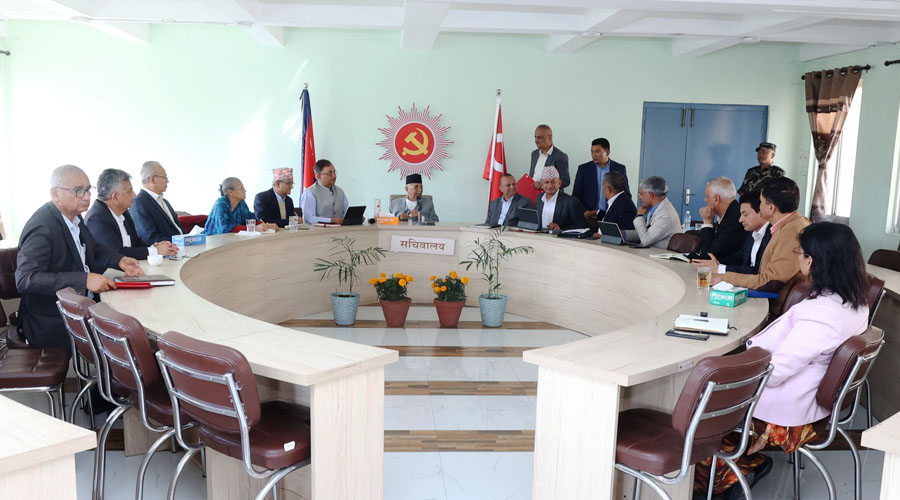
Kathmandu — The ninth meeting of the Nepal Communist Party (UML) Central Committee, held for two days at the party’s central office, Chyasal, under the chairmanship of party chairman and Prime Minister KP Sharma Oli, has passed an eight-point resolution on contemporary political activities in the country, government effectiveness, and the statutory general convention, among other contemporary issues.

It has been decided that the proposal regarding the statute amendment, incorporating the suggestions received from the members of the Central Committee, will be sent to the party’s provincial and district committees for further suggestions.

In the meeting, Vice-Chairman Bishnu Prasad Poudel presented the proposal regarding the statute amendment, while General Secretary Shankar Pokharel informed about the organizational work.

Similarly, the meeting has decided to express high respect to former President Bidya Devi Bhandari. 264 members expressed their views in the meeting.

Bhandari’s membership dispute in UML ‘pending’

Kathmandu – The two-day Politburo meeting of the CPN-UML has decided not to take any immediate decision by keeping the dispute over the renewal of former President Bidhya Devi Bhandari’s party membership as ‘pending’. The meeting saw a heated debate between leaders close to Chairman KP Sharma Oli and those pro-Bhandari. The Oli faction has been claiming that Bhandari’s membership renewal is against the statute, while the Bhandari faction has argued that the membership is automatically renewed, explaining the statute.

Informing a press conference after the meeting, the party’s publicity department chief Rajendra Gautam said that since the membership dispute is based on Articles 8 and 9 of the party statute, no conclusion could be reached at the time and it has been kept ‘pending’. According to him, Article 8 (3) of the statute stipulates that a person who has renounced party membership and assumed a constitutional position must re-join the party only through a new process, based on which the Oli faction has been saying that Bhandari’s membership renewal is not in accordance with the statute. Bhandari had resigned from the party membership before assuming the presidency, and therefore, she can only re-apply through a new process. Therefore, they claim that her renewal in 2081 Baisakh is procedurally incomplete and therefore controversial.

However, Bhandari’s side has presented it from a completely different angle. According to them, Article 9 (3) of the statute provides that if a member is given special responsibility by the party—even if he or she is not in any body of the party committee or organization—their membership will automatically remain. According to Bhandari’s pro-party leaders, Bhandari was on special responsibility of the party even when she was president, and therefore her membership will remain. Kashinath Adhikari, head of the organization department, has said that Bhandari renewed her membership in 2081 Baisakh by paying the prescribed fee, and this was done according to the legal process like all other members. Bhandari herself has also clarified that her membership has been renewed and that there is no obstacle to her return to active politics.

The Politburo meeting was not only about the membership dispute, but also important decisions regarding the amendment of the statute. The meeting proposed removing the age limit of 70 and maintaining the system of allowing the same person to hold the same post for two terms. Political analysts believe that this decision has paved the way for Chairman Oli to become the chairman again in the upcoming general convention. The Oli faction has interpreted this decision to amend the statute under Oli’s leadership as a strategy to secure its long-term leadership, while Bhandari faction leaders are considering it as a continuation of Oli’s efforts to maintain sole control over power.

Bhandari’s pro-membership leaders have portrayed the membership dispute as a planned move by the Oli faction, alleging that it was raised with the aim of obstructing Bhandari’s active political role. According to them, the dispute was raised in this way because the balance of power within the party could change after Bhandari returns to the UML and Oli’s long-term leadership could be challenged. In this regard, Bhandari faction leaders have accused the Oli faction of planning to sideline Bhandari.

Meanwhile, factionalism within the party has become apparent. Sources say that leaders from both sides exchanged accusations and debated for a long time in the Politburo meeting. In the meeting, some neutral leaders suggested resolving the dispute by clearly explaining the provisions of the statute. However, due to the strong stance of both factions, no concrete conclusion could be drawn immediately and therefore, it is understood that the membership dispute has been kept ‘pending’.

This amendment to the statute of the UML and the membership dispute have made the upcoming general convention of the party even more interesting. The debate has already started on the question of whether Oli’s leadership will be restored at the general convention or a new force will emerge. Bhandari’s entry into active politics is expected to further intensify the factionalism within the party and this will shift the balance of power in the UML in a new direction.

According to political analysts, even if Oli secures his leadership through the amendment to the statute, Bhandari’s activism is sure to challenge his dominance. Since Bhandari is not only a former president but also an old and influential leader within the party, there is a strong possibility that a new equation may emerge in UML politics after her return. Meanwhile, some leaders have even warned that the conflict between Oli and Bhandari will be fatal for the party’s unity and future in the long run.

In the current situation, it is clear that this dispute within the UML has increased polarization within the party and brought a new wave of possibilities for leadership change.

Constitutional Head of State Returning to Party Politics is inappropriate: Pradeep Gyawali

Kathmandu- Referring to former President Bidhya Devi Bhandari, CPN-UML Deputy Secretary General Pradeep Gyawali has said that it is not appropriate for a person who has become a constitutional head of state to return to party politics.

At a press conference organized in Butwal, he made this statement while responding to a question from journalists about whether former President Bidhya Devi Bhandari is going to return to UML. In fact, a few days ago, at a press conference held in Biratnagar, Bhandari herself had said that if the country and the people felt the need, she could return to party politics for the country and if so, she would return to the UML party.

Speaking at a press conference, Deputy Secretary General Gyawali said that the ordinance brought by the government to ensure economic transformation and good governance has shown enthusiasm in the private sector and the bill to regulate social media registered in Parliament will keep everyone in dignity, maintain press freedom, and protect everyone from misinformation. He said that the current coalition has been formed for stability in the country and the government has worked to dispel some of the frustration.

PM Oli meets former President Bhandari

Kathmandu- Prime Minister KP Sharma Oli met with former President Bidya Devi Bhandari at her residence in Budhanilkantha, Kathmandu.

In the meeting, which lasted for about two hours, PM Oli and former president Bhandari discussed about the latest political activities of the CPN-UML and contemporary issues, the Prime Minister’s Secretariat has stated.

Investment Facilitation Bill approved by President Paudel

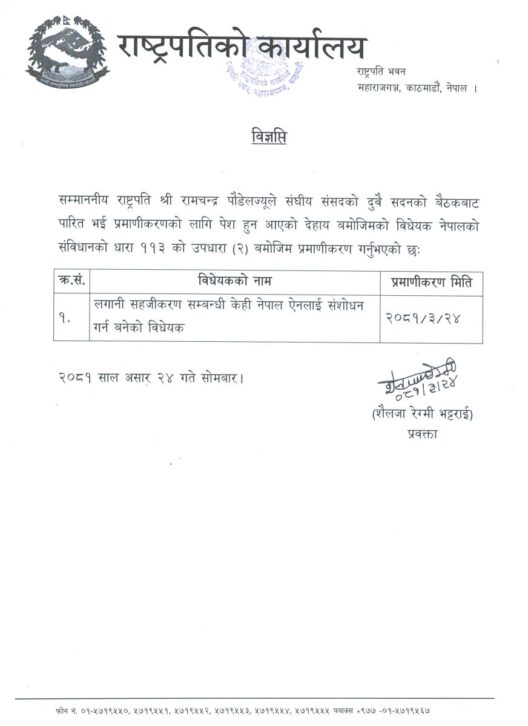
Kathmandu: President Ramchandra Paudel has approved the ‘Bill to amend some Nepal Acts related to investment facilitation’.

According to the statement issued by the spokesperson of the President’s Office, Shailaja Regmi Bhattarai, the bill, which was passed by both houses of the Federal Parliament in accordance with Article 113 (2) of the Constitution, was approved by President Paudel on Monday.

Those who pushed the country to violence are in power: Former President Bhandari

Kathmandu – Former President Bidya Devi Bhandari has expressed doubt that the victims of the armed conflict will get justice as those who pushed the country into violence are leading the power.

Speaking at the unveling ceremony of the book, ‘Nepal Human Rights 2024’ organized by the Informal Sector Service Center (INSEC) in Kathmandu on Monday, she said, “It is important to focus on completing the rest of the peace process as soon as possible, keeping the victims at the center.” But, what is ironic is that the people who led the country to the violence once, is now ruling the country, which undoubtly raise a serious question on serving justice to the country and the innocent victims.

Noting that even after 18 years of the Comprehensive Peace Agreement, the victims have not been able to get justice, she clarified that the sensitive issue of transitional justice should not be used by anyone as a means to achieve their own interests.

President Bhandari in Mustang

President Bidya Devi Bhandari has reached Mustang today by helicopter of the Nepalese army.

President Bhandari will visit Muktinath and unveil the statue of Lord Buddha and lay the foundation stone of the Lord Bishnu statue.

The security arrangements of the area have been tightened for the security of the President who reached Mustang to unveil the 35 feet tall statue of Lord Buddha in Ranipauwa.

President Bidhya Devi Bhandari tested positive for Corona

President Bidhya Devi Bhandari has contracted corona infection. According to the hospital, President Bhandari, who is being treated at the Maharajgunj University Teaching Hospital, has tested positive for Corona.

President Bhandari was admitted to the teaching hospital on Friday for treatment after suffering from a persistent fever, headache and vomiting. Initially, it was suspected that she was infected with dengue, but the hospital confirmed that she was infected with the coronavirus.

President’s approval to mobilize troops for the election

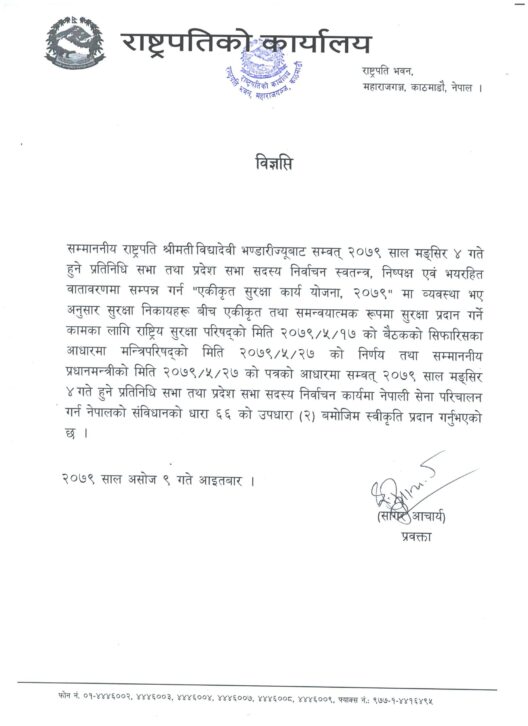
President Bidya Devi Bhandari has approved the deployment of the army for the upcoming elections.

In a statement signed by the spokesperson of the President’s office, Sagar Acharya, it has been mentioned that “The honourable President, Mrs Bidya Devi Bhandari, has requested that the House of Representatives and Provincial Assembly elections to be held in a free, fair and fear-free environment as per the provisions of the “Integrated Security Action Plan, 2079”. Based on the recommendation of the meeting of the National Security Council, the decision of the Council of Ministers and the honourable Prime Minister, the work of providing security in an integrated and coordinated manner between the agencies has been approved. It has been mentioned that approval has been given in accordance with sub-section (2) of Article 66 of the Constitution of Nepal to mobilize the Nepali Army for the election of members of the House of Representatives and Provincial Assembly.

Supreme Court issued a show cause order to President’s Office

The Supreme Court has issued a show cause order in the name of the Office of the President while hearing a writ petition against the President’s action registered in the Supreme Court for not validating the Citizenship Bill.

A single bench of Justice Hari Prasad Phuyal ordered the President’s Office to submit reasons for not validating the Citizenship Bill. Five writ petitions against the President’s action were taken up together today.

Nepal will not participate in any military alliance: President Bhandari

Addressing a program organized by the Chinese People’s Association for Peace and Disarmament through video, President Bidhya Devi Bhandari has said that Nepal wants to have friendly relations with all countries equally and will not participate in any military alliance.

President Bidhya Devi Bhandari has stated that Nepal’s foreign policy is based on a non-alignment foreign policy, the principle of Panchsheel and mutual benefit.

President Bhandari wished for world peace and disarmament and said that the international community should help economically weak and poor countries to establish world peace.

According to the President’s Office,President Bhandari also wished peace day to the international community from Nepal, the birthplace of Lord Gautam Buddha.

President Bhandari didn’t ratify the citizenship bill

The Citizenship Bill sent by the Parliament to President Bidhya Devi Bhandari has not been verified for the second time either.

After the bill passed by the Parliament for the second time, the time to verify the Citizenship Bill, submitted to the President through the Speaker, has exceeded 15 days on Tuesday night at 12:00. There is a constitutional provision that the President must verify the bill coming for re-verification within 15 days.

The Citizenship Bill, which was sent for verification for the first time, was returned to Parliament for reconsideration by President Bidhya Devi Bhandari. The returned Citizenship Bill passed without any amendment, was actually sent to the President’s Office for re-certification for the second time and even could not be verified after exceeding the time limit.

A source close to the President said, “According to the Constitution, the President is the protector of the Constitution. So the President should be responsible, even for every full stop and commas of the Constitution. The constitution has not given the right to the top leaders of the alliance to decide on the bill sitting on Baluwatar, which the president actually sent to the parliament for reconsideration and the provisions of the bill were not reconsidered even though they were suggested to be corrected by referring to the clauses that were against the constitution.So, the President might have exercised her rights to protect the Constitution in respect of the Bill.”

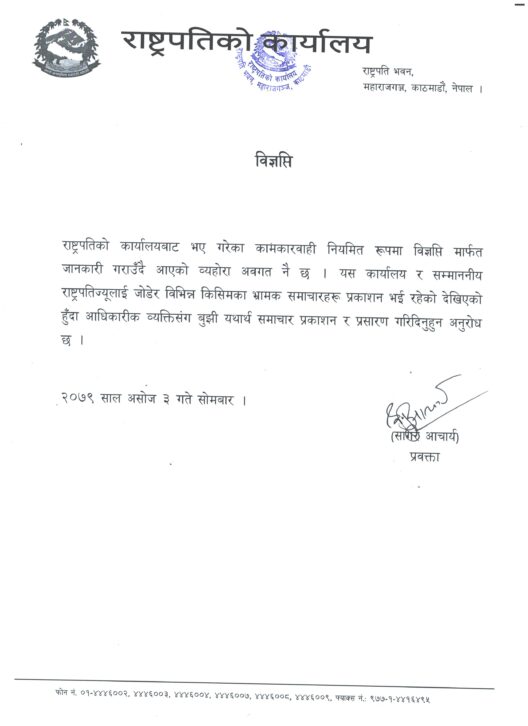
Not to publish and broadcast misleading news using the name of the President

The President’s Office has requested not to publish and broadcast any kind of misleading news by linking the name of the President and the Presidential office.

Today, the President’s Office has issued a statement objecting to the publication-broadcasting of various types of misleading news by linking the name of the President and the Presidential office. It has been said that the President’s Office is regularly informing about the actions taken by the President’s Office and requested that the news be published and broadcast only after understanding with the official.

In a statement issued by the spokesperson of the President’s office, Sagar Acharya, it is mentioned that ” various types of misleading news are being published in connection with this office and the Honorable President .”

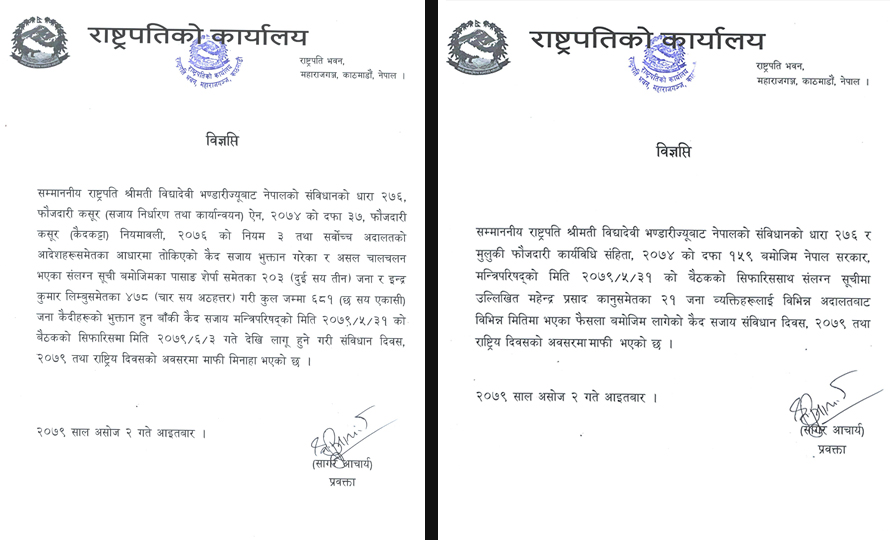
General pardon by the President on Constitution Day

President Bidhya Devi Bhandari has reduced the imprisonment of 681 prisoners and pardoned the sentences of 21 people on the occasion of Constitution Day 2079 and National Day

According to the Criminal Offenses Act of Article 276 of the Constitution, Article 37 of 2074 and Rule 3 of the Criminal Offenses Regulations of 2076, and according to the order of the Supreme Court, the president can waive the imprisonment of prisoners on the recommendation of the Council of Ministers. According to the provision, the sentence of 681 prisoners from different prisons in the country has been reduced and pardoned.

Similarly, according to Article 276 of the Constitution, Article 159 of the Civil Criminal Procedure Code, 2074, the President’s Office informed that the sentences of 21 prisoners were pardoned on the recommendation of the Council of Ministers.

President Bandari appointed Ambassador to Malaysia and Myanmar

President Bidya Devi Bhandari has appointed Harishchandra Ghimire as ambassador to Myanmar and Dilliraj Poudel as ambassador to Malaysia.

The spokesperson of the President’s Office has informed that, According to Article 282 of the Constitution of Nepal, they have been appointed ambassadors on the recommendation of the Council of Ministers.

Similarly, it has been informed that the President has appointed ambassador to Britain Gyan Chandra Acharya as a non-resident ambassador for Malta and ambassador to US Sridhar Khatri as a non-resident ambassador for Costa Rica.

Citizenship Bill sent to the President for re-verification

The Citizenship Bill returned to Parliament for reconsideration by President Bidya Devi Bhandari has been passed without any amendments and sent to the President’s Office for re-verification.

The Citizenship Bill passed by the National Assembly and the House of Representatives was certified by Speaker Agni Prasad Sapkota and sent to the President’s Office for re-verification.

There is a constitutional provision that the bill coming for re-verification must be verified by the President within 15 days. President does not hold any legal right to return the bill that came for re-verification.

The returned Citizenship Bill in today’s Parliament session

The 55th meeting under the House of Representatives’ eleventh session is today at 11 am.


According to the Secretariat of the Parliament, the matter of informing about the Citizenship Bill, which was returned with a message from the President, has been included in today’s Parliament meeting agenda.

In the first number of the possible agenda of today’s meeting of the House of Representatives, it is mentioned that the Secretary of the House of Representatives will inform regarding the return of the Citizenship Bill with a message for reconsideration from the Honorable President.

Full text of the Citizenship Bill with a return message from the President:

What will happen to the Citizenship Bill?

The Citizenship Bill, which was passed by the House of Representatives and the National Assembly and submitted to the President for verification by Speaker Agni Prasad Sapkota, has been sent back to the Parliament.
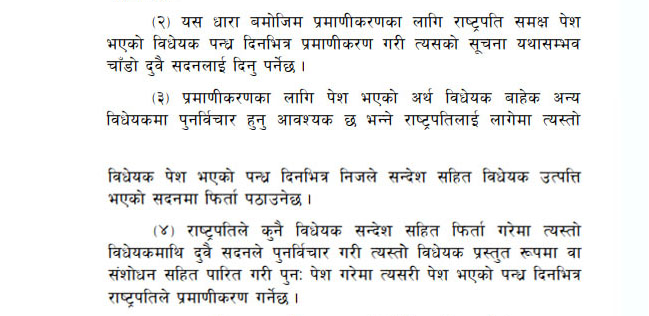
President Bidya Devi Bhandari has said that the Citizenship Bill needs to be reconsidered, and the question has been raised as to what will happen to the Citizenship Bill, which has been sent back to Parliament. However, according to the legal provisions specified in the Constitution of Nepal, if any bill other than the Finance Bill submitted to the President for verification needs to be reconsidered, the President can send the bill back to the Parliament in accordance with Article 113, Clause 3 of the Constitution.

Now, regarding the bill sent back by the President, it has been explained in Article 113 of the Constitution of Nepal, Clause 4: “If the President returns a bill with a message, both Houses will reconsider such a bill and pass it as presented or resubmitted with amendments, the President shall certify it within fifteen days of its submission.”
Now, based on this provision of the constitution, the House of Representatives and the National Assembly can again submit the bill with the old format or amendments to the President for verification. It has been explained that the bill coming for re-verification will be verified by the President within 15 days.But the president is not given the legal right to return the bill that came for re-certification.

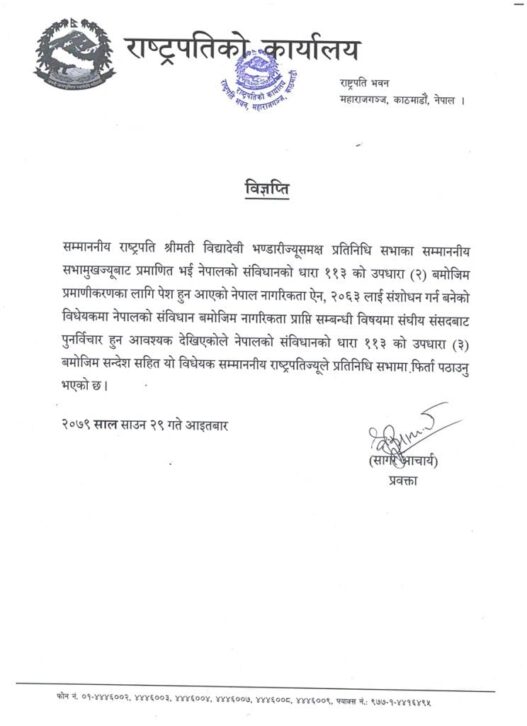
The Citizenship Bill is back in Parliament

The Citizenship Bill, which was passed by the House of Representatives and the National Assembly and submitted to the President for verification by Speaker Agni Prasad Sapkota, has been sent back to the Parliament.

It is mentioned in the statement issued by the President’s Office that President Bidhya Devi Bhandari has sent it back to the Parliament saying that it is necessary to reconsider the Citizenship Bill.

In a statement issued by the President’s Office, it is mentioned that the bill to amend the Nepalese Citizenship Act 2063, which was submitted for verification in accordance with Article 113, Clause 2 of the Constitution of Nepal, has been sent back to the House of Representatives along with a message in accordance with Article 113, Clause 3 of the Constitution of Nepal.

Meeting between President Bhandari and Chinese leader Jianchao at Shital Niwas

President Bidhyadevi Bhandari and Liu Jianchao, head of the International Relations Department of the Chinese Communist Party, held a courtesy meeting at the President’s residence today.

On the last day of his four-day visit, Jianchao arrived at Shital Niwas today for a courtesy call on the President. During the meeting, President Bhandari said that the relations between Nepal and China were historic and that Nepal would move forward in its development process with its neighbors and allies.

Chinese leader Jianchao, on the other hand, said that he had come to Nepal to expand relations between all political parties of Nepal and that China-Nepal relations were developed on the basis of friendship, and mutual benefit.

Earlier, Jianchao met with the Prime Minister, Foreign Minister and leaders of other political parties.

President Bhandari appoints ambassadors to three countries

On the recommendation of the Council of Ministers, President Bidhya Devi Bhandari has appointed Nepali Ambassador to the three countries.

President Bhandari has appointed Nepali ambassadors to Oman, Saudi Arabia and Sri Lanka.

According to the Office of the President, Dornath Aryal has been appointed for Oman, Nawaraj Subedi for Saudi Arabia and Vasudev Mishra for Sri Lanka.

Congratulatory message of the President on Republic Day

On the occasion of the 15th Republic Day, President Bidhya Devi Bhandari has expressed her best wishes to move forward on the path of achieving prosperity including social justice by further strengthening national unity.

In a congratulatory message issued on the occasion of Republic Day, President Bhandari wished happiness, peace and prosperity to all the Nepalese at home and abroad.

The message says, “On this historic day, I would like to express my heartfelt best wishes, with the expectation that the country’s geographical integrity, national sovereignty, independence and national unity will be further strengthened and motivated to move forward on the path of social justice and prosperity.” The real message of the republic is to bring meaningful and positive change in the lives of the people and move Nepal forward as a developed nation with a strong and self-reliant economy.

President Bhandari paid a heartfelt tribute to the martyrs who sacrificed their precious lives for the establishment of a democratic republic.

Five ordinances issued by the President

President Bhandari has issued five ordinances in accordance with Article 114, Clause 1 of the Constitution of Nepal and on the recommendation of the Council of Ministers.

President Bhandari has ratified Ordinance-2078 to amend the Sexual Violence Act, Ordinance to amend some Acts related to Criminal Offenses and Criminal Procedure-2078 and Social Security (First Amendment) Ordinance-2078.

Similarly, acid and hazardous chemicals (regulations) 2078 and Nepal Police and state police (operation, supervision and coordination) First Amendment 2078 have been certified, according to a statement issued by the Office of the President.