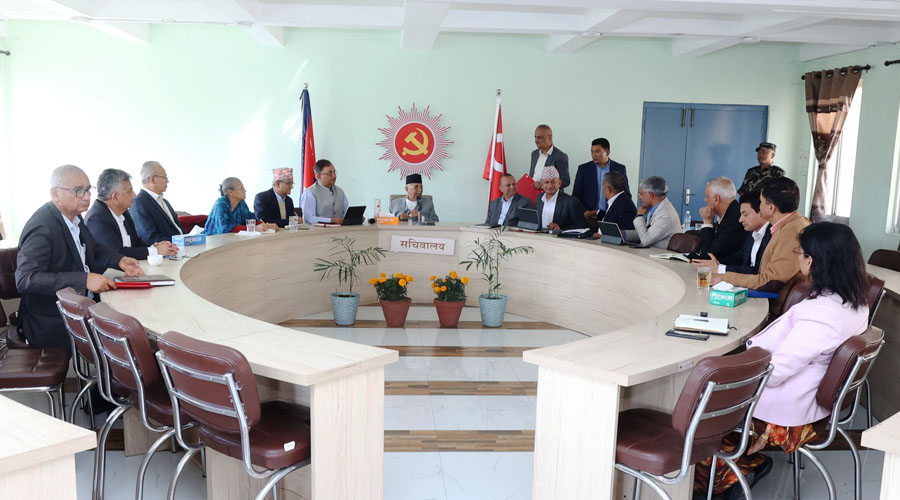
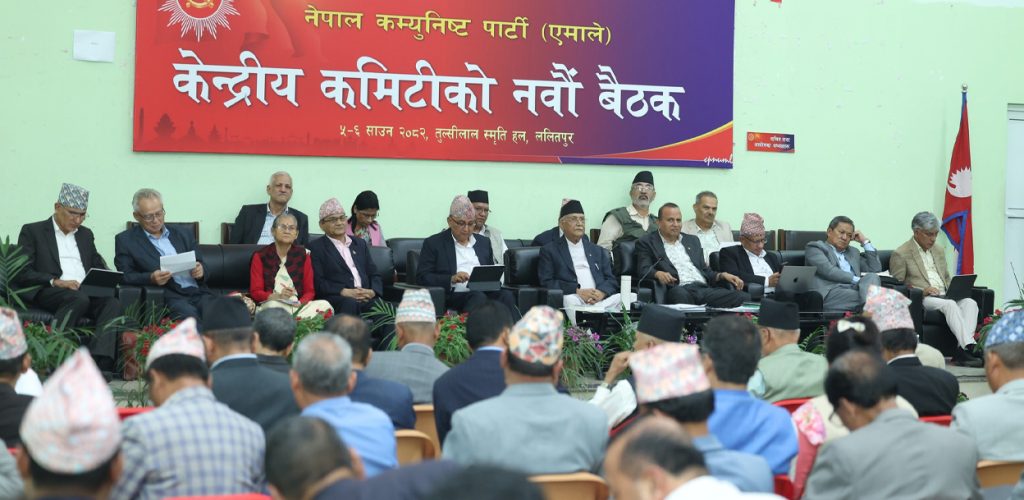
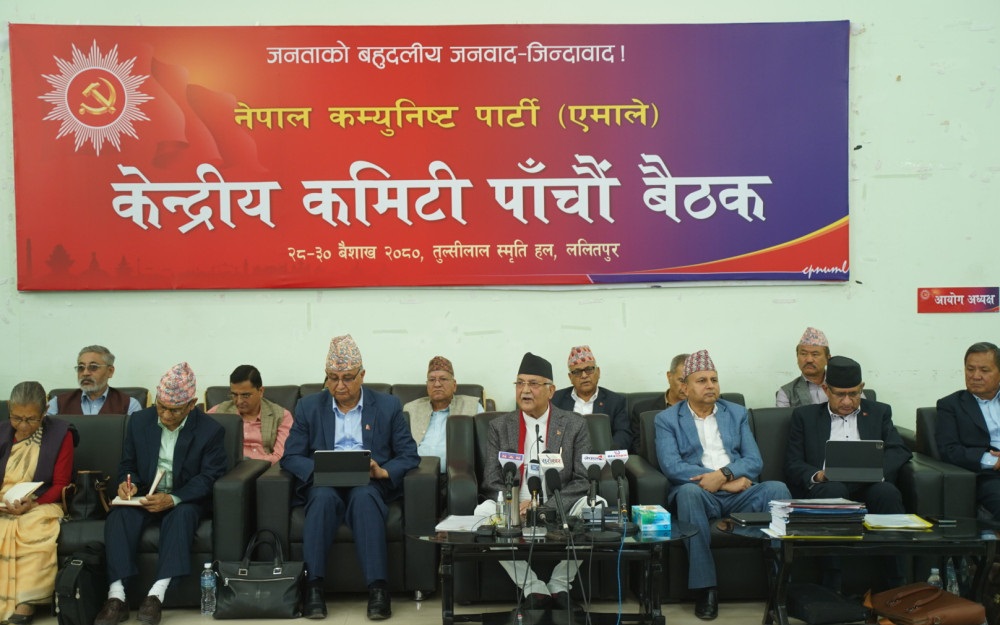
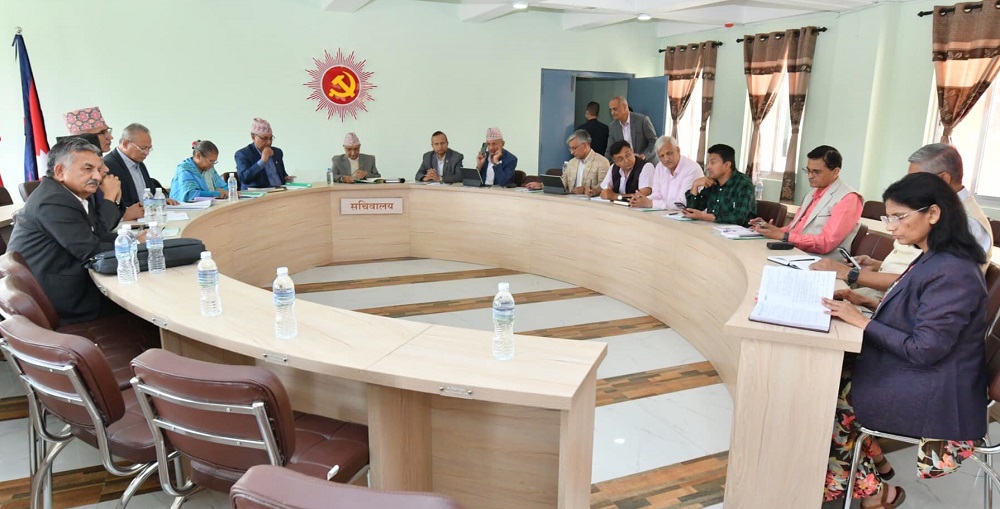
Kathmandu – The two-day Politburo meeting of the CPN-UML has decided not to take any immediate decision by keeping the dispute over the renewal of former President Bidhya Devi Bhandari’s party membership as ‘pending’. The meeting saw a heated debate between leaders close to Chairman KP Sharma Oli and those pro-Bhandari. The Oli faction has been claiming that Bhandari’s membership renewal is against the statute, while the Bhandari faction has argued that the membership is automatically renewed, explaining the statute.
Informing a press conference after the meeting, the party’s publicity department chief Rajendra Gautam said that since the membership dispute is based on Articles 8 and 9 of the party statute, no conclusion could be reached at the time and it has been kept ‘pending’. According to him, Article 8 (3) of the statute stipulates that a person who has renounced party membership and assumed a constitutional position must re-join the party only through a new process, based on which the Oli faction has been saying that Bhandari’s membership renewal is not in accordance with the statute. Bhandari had resigned from the party membership before assuming the presidency, and therefore, she can only re-apply through a new process. Therefore, they claim that her renewal in 2081 Baisakh is procedurally incomplete and therefore controversial.
However, Bhandari’s side has presented it from a completely different angle. According to them, Article 9 (3) of the statute provides that if a member is given special responsibility by the party—even if he or she is not in any body of the party committee or organization—their membership will automatically remain. According to Bhandari’s pro-party leaders, Bhandari was on special responsibility of the party even when she was president, and therefore her membership will remain. Kashinath Adhikari, head of the organization department, has said that Bhandari renewed her membership in 2081 Baisakh by paying the prescribed fee, and this was done according to the legal process like all other members. Bhandari herself has also clarified that her membership has been renewed and that there is no obstacle to her return to active politics.
The Politburo meeting was not only about the membership dispute, but also important decisions regarding the amendment of the statute. The meeting proposed removing the age limit of 70 and maintaining the system of allowing the same person to hold the same post for two terms. Political analysts believe that this decision has paved the way for Chairman Oli to become the chairman again in the upcoming general convention. The Oli faction has interpreted this decision to amend the statute under Oli’s leadership as a strategy to secure its long-term leadership, while Bhandari faction leaders are considering it as a continuation of Oli’s efforts to maintain sole control over power.
Bhandari’s pro-membership leaders have portrayed the membership dispute as a planned move by the Oli faction, alleging that it was raised with the aim of obstructing Bhandari’s active political role. According to them, the dispute was raised in this way because the balance of power within the party could change after Bhandari returns to the UML and Oli’s long-term leadership could be challenged. In this regard, Bhandari faction leaders have accused the Oli faction of planning to sideline Bhandari.
Meanwhile, factionalism within the party has become apparent. Sources say that leaders from both sides exchanged accusations and debated for a long time in the Politburo meeting. In the meeting, some neutral leaders suggested resolving the dispute by clearly explaining the provisions of the statute. However, due to the strong stance of both factions, no concrete conclusion could be drawn immediately and therefore, it is understood that the membership dispute has been kept ‘pending’.
This amendment to the statute of the UML and the membership dispute have made the upcoming general convention of the party even more interesting. The debate has already started on the question of whether Oli’s leadership will be restored at the general convention or a new force will emerge. Bhandari’s entry into active politics is expected to further intensify the factionalism within the party and this will shift the balance of power in the UML in a new direction.
According to political analysts, even if Oli secures his leadership through the amendment to the statute, Bhandari’s activism is sure to challenge his dominance. Since Bhandari is not only a former president but also an old and influential leader within the party, there is a strong possibility that a new equation may emerge in UML politics after her return. Meanwhile, some leaders have even warned that the conflict between Oli and Bhandari will be fatal for the party’s unity and future in the long run.
In the current situation, it is clear that this dispute within the UML has increased polarization within the party and brought a new wave of possibilities for leadership change.


 NP
NP