Government announces strict spending cuts to Curb unnecessary Expenses

Kathmandu – The Ministry of Finance has introduced a series of decisions aimed at reducing unnecessary public spending and improving capital expenditure management.

According to the decision, meeting allowances for government staff will be scrapped, officials using private residences will not be entitled to housing allowances, and personal secretaries provided to lawmakers and political appointees will no longer be funded. Except for technical positions, no new posts will be created, and overlapping structures at federal, provincial, and local levels will be eliminated.

Foreign trips at government expense will be restricted, allowing only essential visits. Delegations led by the head of state or government at international conferences will be limited to a maximum of 10 members, while other delegations can include only up to three officials.

Key measures include:

  • Freezing budgets of approved projects that have not started and restricting use of funds outside their original purpose.
  • Halting transfer of federal projects to provincial and local levels until further review.
  • Limiting contingency funds to 100% for projects under Rs 10 million and 2% for projects above Rs 10 million.
  • Stopping creation of new programs in the 2082/83 budget year.
  • Cutting all meeting allowances for government officials.
  • Restricting consultancy services unless expertise is unavailable within the government.
  • Banning new vehicle purchases for political and administrative officials, with a directive to repair and reuse old vehicles.
  • Prohibiting government offices from building unnecessary infrastructure and requiring reuse of existing equipment like furniture and computers.
  • Halting temporary or contract-based staff hiring beyond approved positions.
  • Stopping additional security guards or perks for officials beyond what is legally mandated.

The ministry said these measures are designed to promote fiscal discipline, reduce wasteful spending, and ensure that capital expenditure is used effectively.

Finance Ministry order sparks unrest at SEBON

Kathmandu – A letter sent by the Ministry of Finance has triggered unrest at the Nepal Securities Board (SEBON), leading employees to stage a protest and lock the office.

The ministry instructed SEBON to recover all funds disbursed through procedures deemed unlawful and to treat the amounts as government dues. Following this directive, employees launched an agitation, shutting down the office in defiance.

The letter, sent on Ashwin 2, directed enforcement of a Revenue Secretary–level decision regarding SEBON’s Employee Welfare Fund and Employee Security Fund. It further ordered the immediate annulment of the working procedures governing these funds, citing violations of multiple laws including the Securities Act 2006, Legislative Act 2004, Government of Nepal (Allocation of Business) Rules 2017, and SEBON Employee Service Rules 2011.

The ministry also directed SEBON to begin recovery of past payments made under these unlawful procedures and instructed that any future financial decisions must first secure prior approval from the Ministry of Finance.

Finance minister Rameshwor Khanal’s ‘complaint emailbox’ mechanism proves effective within hours

Kathmandu – Finance Minister Rameshwor Khanal’s newly launched “Complaint Emailbox” system, aimed at hearing and resolving public grievances directly, has shown quick results.

Khanal shared on Tuesday that within just six hours of launching the mechanism, he had already received 166 emails. He said the goal is to end the public’s compulsion of rushing to Singha Durbar to resolve their issues.

According to Khanal, about two dozen emails have already been answered, and action has been initiated on most of them. He assured that the remaining emails will also be responded to as quickly as possible.

The minister expressed confidence that this system will help ordinary citizens and institutions address their problems without the hassle of physically visiting government offices in Singha Durbar.

Complaints against delays and bribery in Finance Ministry bodies can now be filed directly to minister

Kathmandu – Employees working under institutions and bodies of the Ministry of Finance can now be reported directly to Finance Minister Rameshwar Khanal if they are found causing delays, exerting undue pressure, or demanding bribes. Complaints can be lodged through email or a hotline.

The ministry announced that any issues such as employees failing to perform required duties, engaging in misconduct, creating obstacles in service delivery, or demanding bribes can be directly reported to the Finance Minister’s email or the ministry’s complaint email.

In addition, a toll-free hotline 18105000410 has been set up where complaints can be filed directly by phone.

Finance Minister reshuffles responsibilities of three Joint Secretaries

Kathmandu – Finance Minister Rameshwar Khanal has reassigned the responsibilities of three joint secretaries within the ministry.

Mahesh Acharya has been appointed head of the Financial Sector Management and Institution Coordination Division, replacing Seventhak Pokharel, who has now been moved to lead the Fiscal Federalism Coordination Division.

Similarly, Mahesh Baral, previously chief of the Fiscal Federalism Division, has been transferred to head the Public Financial Management Training Center. Before this change, Joint Secretary Acharya was leading the training center.

The reshuffle took effect on Sunday, according to ministry spokesperson Tank Prasad Pandey.

Finance Ministry releases Rs 9.80 Billion for concessional loan interest subsidy

Kathmandu – The Ministry of Finance has released Rs 9.80 billion to cover the long-delayed interest subsidies on concessional loans. The amount was disbursed to Nepal Rastra Bank on Saturday.

For a long time, banks and financial institutions had stopped issuing new concessional loans because the subsidy amount had not been released, forcing borrowers to pay higher interest rates.

According to a letter from the Finance Ministry, under the approved annual program of fiscal year 2082/83 (2025/26), funds allocated for the second quarter were adjusted to the first quarter, and the subsidy amount for concessional loans provided in the past seven quarters has now been settled through this release.

With the government clearing most of the outstanding subsidy payments, the possibility of banks and financial institutions resuming concessional loan distribution has increased.

Finance Minister Khanal’s first decision to cut small projects

Kathmandu – Newly appointed Finance Minister Rameshwor Khanal has taken the first decision to not implement piecemeal projects after assuming office.

He has said that expenses will be cut by not implementing the piecemeal plan due to the unpreparedness and the need to address the demands of the youth and hold elections.

Nepal on the verge of ‘grey list’ in money laundering

Kathmandu- Nepal, which is at risk of money laundering, is finally in danger of going to ‘listing’. The third round of mutual evaluation of Nepal on money laundering prevention is currently underway. This evaluation has passed the monitoring stage and has now reached the stage of deciding whether to list or not. It will be finalized next month. High-ranking officials participating in the evaluation processes have pointed out the risk of Nepal being listed. If it is listed for money laundering, the country’s international image and assistance will be affected.

Countries that do not formulate and implement adequate policies and laws on money laundering prevention are placed on the medium-level monitoring list (grey list) of the Financial Action Task Force (FATF). In 2002, Nepal became a member of the Asia Pacific Group on Money Laundering (APG), a part of the international mechanism on money laundering, FATF. Since then, Nepal has issued the Money Laundering Prevention Act in 2008. However, even after so many years, Nepal has not been able to show its work in line with international commitments regarding the prevention of money laundering. Due to which, the risk of Nepal being placed on the grey list is increasing.

There are various stages of the ‘listing’ of anti-money laundering. In the first stage, countries that are seen as weak in terms of preventing money laundering are listed on the grey list. This is the first stage of ‘listing’. If there is no improvement even after this, the FATF will take steps up to the blacklist. Experts say that if it is listed for money laundering, it will have a negative impact on foreign investment, the country’s international image and the economy.

17 years ago, on the day the Anti-Money Laundering Act was promulgated in 2064, the Department of Money Laundering Investigation organized the first National Anti-Money Laundering Day at the Nepal Administrative Training Institute (Staff College) on Monday. At the event, Nepal Rastra Bank Governor Maha Prasad Adhikari also said that Nepal’s monitoring period for mutual evaluation has ended and it is now in the listing stage. According to him, Nepal’s monitoring period report will be submitted at the upcoming Financial Action Task Force (FATF) conference. He indicated that Nepal is at risk of listing. “Even if the listing is done, there is a lot of groundwork ready to come out of it,” he said while speaking at the program. “We have the law. It is a matter of us stakeholders implementing it effectively.”

Government raising 10 billion rupees in internal debt

Kathmandu- The government has prepared to raise 10 billion rupees in internal debt. The Public Debt Management Office under the Ministry of Finance is going to raise 10 billion rupees by selling and issuing 10-year development bonds 2091.

According to a notice issued by the Public Debt Management Office, the bonds will be sold through auction on Magh 15 and issued on Magh 18.

The office has stated that banks and financial institutions, non-bank financial institutions, insurance companies and Nepali citizens can participate in the auction of the bonds.

Government unable to provide salary allowances and pensions to the employees

Government struggling to afford food for prisoners

The government is now in a situation where it is unable to provide regular salaries, allowances, and pensions to employees.

Salaries, allowances and pensions of thousands of employees have been stopped in the current financial year. Some of the existing employees have not received the salary and allowances since February and the retired employees have not received the amount due to pension. Due to a lack of finances, the state has not been able to provide even the funds for regular food expenses to the prisoners.

At present, according to government statistics, the number of teachers receiving pensions is 51,308. Among them, more than 30,000 teachers have not received their pension for the month of March. Bishnu Prasad Kharel, Head of the Pension Management Office, has informed us that the teachers’ pensions have been stopped as the Ministry of Finance has not disbursed the funds.

Similarly, the spokesperson of Nepal Police, Dipendra GC, has informed that there is insufficient fund to pay salaries to 131 units out of the total 486 units of Nepal Police.

Not only that, the government has not been able to provide expenses even for regular foods to about 27,000 prisoners across the country. According to Chakrapani Pandey, Director General of the Prison Management Department, the government has not provided the required funds for the food expenses to the inmates in the country.

According to the spokesperson of the Financial Comptroller General’s Office, Shambhu Prasad Marasini, a total of 7 trillion 2 billion 120 million revenue has been collected by Wednesday. While during this period 7 trillion 21 billion 20 million rupees have been spent on salary and allowances of employees and other administrative expenses. According to this calculation, nearly 19 billion rupees more than the income of the state has been spent only on salary allowances and pensions of the employees.

It seems that the government, which has set a target of collecting revenue of 14 trillion 58 billion 600 million in the current financial year, has collected only about 50 percent of the total estimated amount even after 9 months of the current financial year. The country has reached a situation where the revenue collected by the government cannot even cover the salaries and administrative expenses of the employees.

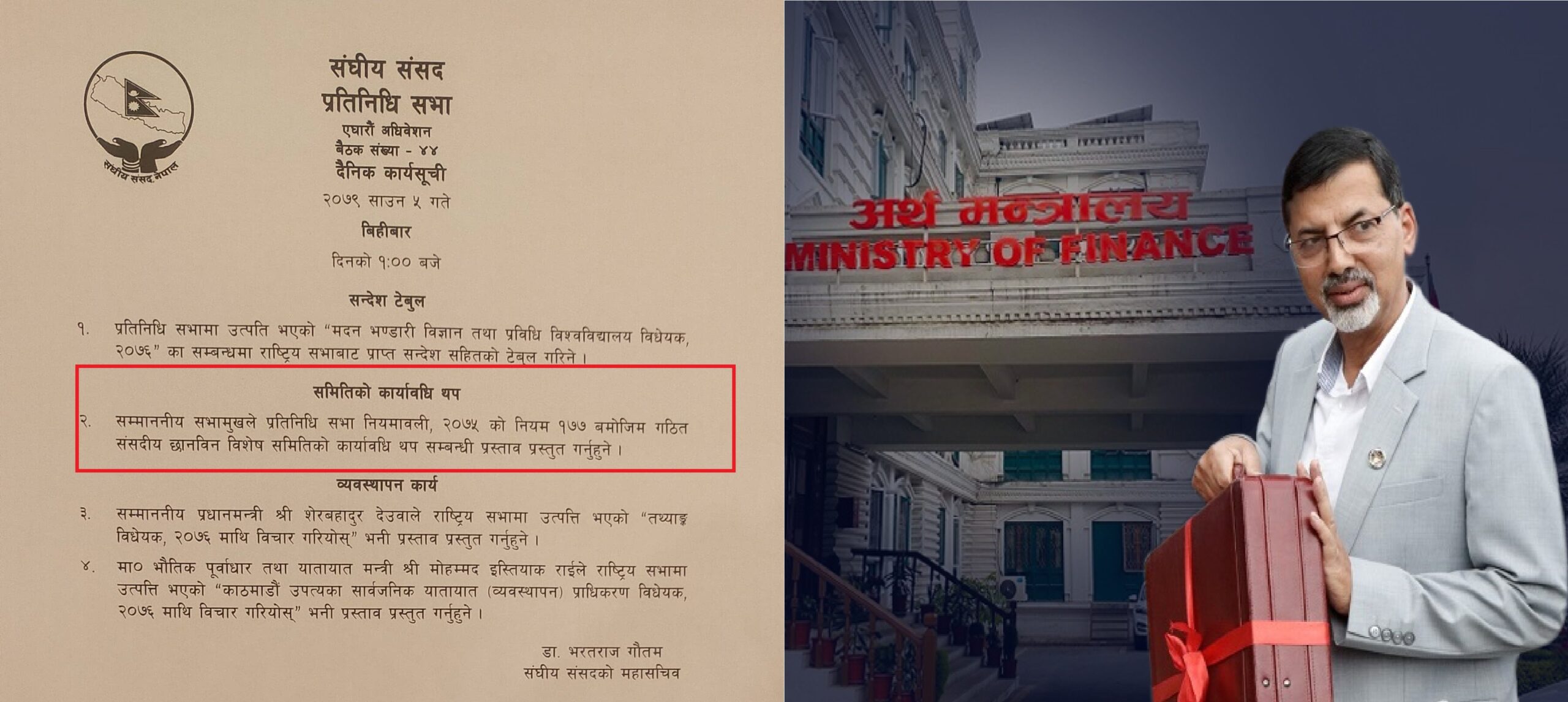
Preparations to extend the deadline for Parliamentary Inquiry Committee

The process of extending the deadline of the parliamentary special inquiry committee has been initiated which is investigating the alleged involvement of unauthorized persons in the preparation of the budget

As the parliamentary special inquiry committee has not been able to complete the work within the specified period, Speaker Agni Prasad Sapkota is likely to provide more time to the committee in today’s Parliament meeting. Earlier, 10 days time was provided for the investigation.
Surendra Aryal, secretary of the committee have requested that the required time be extended.He also said that the CCTV footage has been sent to the police to recover it and it is not yet decided when the report will come.

During the investigation, the committee questioned the outgoing Finance Minister Sharma for about 3 hours today. He has denied the allegation that other than the concerned officials of the Ministry of Finance were involved in the budget preparation.

Investigation Committee to take the statement of Janardhan Sharma today

The Special Investigation Committee of the House of Representatives is going to take a statement from Janardan Sharma, who resigned after it was revealed that unauthorized persons were involved in the budget preparation.

The parliamentary special committee formed to investigate the involvement of unauthorized persons in budget preparation has already taken statements from 10 officials under the Ministry of Finance. During the statement, the officials of the ministry has denied that unauthorized persons had entered during the budget preparation.

Before the statement, the committee requested to provide the CCTV footage , but the Ministry of Finance did not provided the footage saying that, the footage will remain only for 13 days and the others will be deleted automatically.
Amid various discussions and debates that the CCTV footage may have been deleted to destroy the evidence, the investigation committee is going to send the CCTV footage to the forensic lab under the Nepal Police to recover it. However, the police said whether the CCTV footage can be recovered or not depends on the condition of the hard disks.

Amid all these incidents, the investigation committee will take a statement from Janardan Sharma today. According to the course of events, the committee has not been able to gather any such concrete evidence against Sharma even if the statement taken with the officials of the Ministry of Finance is to be considered as the basis. However, what Sharma will say in today’s statement has become a matter of interest.

Parliament sitting obstructed demanding for investigation committee on Finance Minister Sharma

Stating that the explanation of Finance Minister Janardan Sharma regarding the involvement of unauthorized persons in the Ministry of Finance during the preparation of the budget was not satisfactory, the main opposition party UML has obstructed today’s meeting of the House of Representatives demanding formation of a parliamentary inquiry committee.

Finance Minister Sharma said that the allegation are false and fictitious. He also clarified that the budget was formulated by a committee headed by the Secretary of the Ministry of Finance and the Secretary of Revenue and he also acted in accordance with the responsibilities given to him.

Meanwhile, UML chief whip Bishal Bhattarai said that CPN UML would not allow the parliament to function until a parliamentary committee is formed to investigate the issue.

Internal discussions within the party to recall FM Sharma

Regarding the recall of Finance Minister Jarnadan Sharma Internal discussions have started within the CPN-Maoist center.

Representatives of the Maoist center are now engaged in internal discussions on the issue of recalling Finance Minister Sharma, who has been repeatedly dragged into controversy. It has been learned that the issue has been discussed for more than two hours after Chairman Prachanda called Finance Minister Sharma to his private residence Khumaltar after the UCPN (Maoist) was dragged into a controversy over the issue of action of the Finance Minister.

Removal of sharma was demanded earlier too, who has been repeatedly criticized for his role in the governor’s suspension and for his controversial remarks. However, after the government being criticized for the budget,now internal discussions have started for sharma’s removal.