Army Chief consults former Chiefs and Commands amid current situation

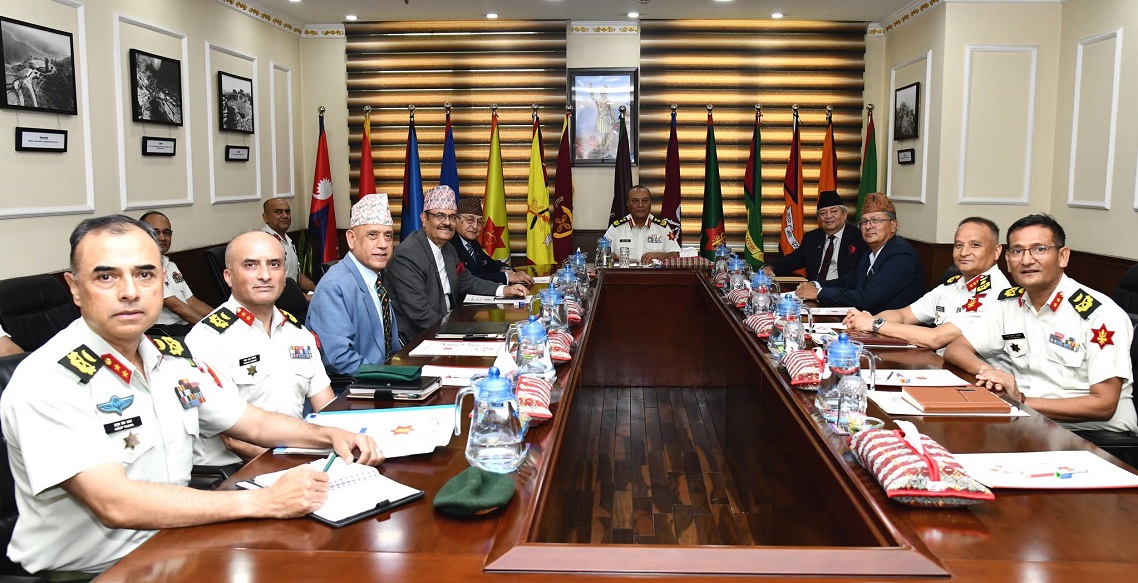
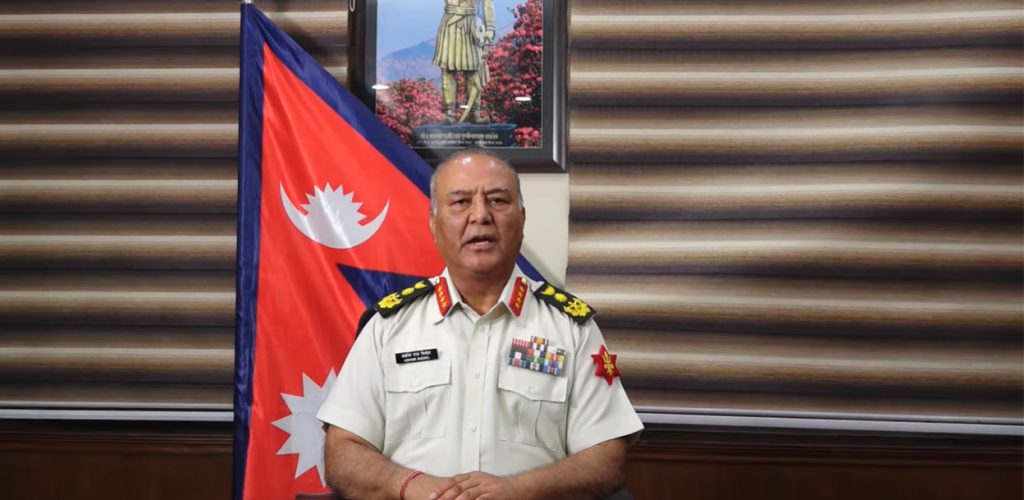
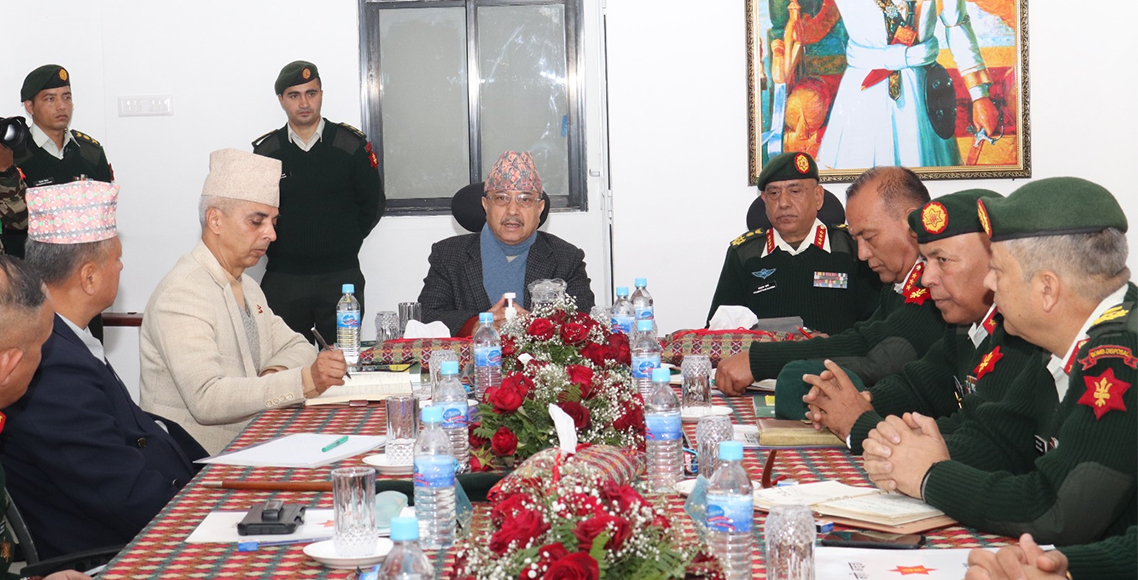
Kathmandu – Chief of Army Staff Ashokraj Sigdel held discussions with former Army Chiefs regarding the recent developments and the current situation.

The meeting took place at the Army Headquarters, where Sigdel sought their views on the role of the Nepal Army during such circumstances.

Heads of various departments, directorates, and divisions of the Nepal Army also gathered at the Army Headquarters. In addition, a virtual coordination meeting was conducted with division commanders.

According to the Directorate of Public Relations and Information, division commanders and departmental heads presented reviews of their responsibilities, work progress, and provided suggestions.

The session concluded with closing remarks from Chief of Army Staff Sigdel and Chief of General Staff Lieutenant General Pradeep Jung KC.

As per the Army’s annual work plan, the coordination meeting of division commanders is held twice a year. This was the first such meeting since recent changes in the commanders’ responsibilities.

1,276 Rifles and Pistols Looted: Nearly 100,000 Bullets Missing During “Gen-Z” Protests

Kathmandu — The “Gen-Z” protests, marked by police crackdowns and subsequent violence, led to widespread arson and vandalism targeting police posts across the country. Over two days of unrest, 74 people, including three police personnel, lost their lives, while around 200 others remain hospitalized.

An internal report prepared by Nepal Police revealed that 1,276 rifles and pistols were looted during the protests. In addition, 98,491 rounds of ammunition are unaccounted for. The report notes that a high-level investigation is necessary to determine how many of the missing rounds were used by police and how many were stolen.

The report also shows a shortfall of 1,315 rubber bullets, though police have not clarified how many were actually used. Official figures confirm that within two days, security forces fired 2,220 rounds into the air and launched 3,223 tear gas shells.

Nepal Army issues curfew order

Kathmandu-The Nepal Army’s Public Relations and Information Directorate has announced that a curfew order has been issued.

The curfew currently in effect will remain in effect throughout the country until 5 p.m. and the curfew order will continue until 6 a.m. tomorrow, the army has stated.

Army patrols Kathmandu: Citizens urged not to leave their homes unless necessary

Kathmandu – The Nepali Army has started patrolling the streets of Kathmandu following the Gen Z movement. After the human loss and physical infrastructure was damaged during the movement, the Nepali Army took over the responsibility of security of the country by leading peacekeeping operations from 10 pm last night.

The army is urging the public not to leave their homes unless it is emergency . However, the army has allowed people in need to move out freely after questioning and checking the identity cards.

Nepal Army urged to report arson, looting or any other incident on public property

Kathmandu – The Nepal Army has provided an emergency number to immediately report arson, looting or any other incident on public property.

For which, the Nepal Army’s emergency contact numbers can be called 01-5979223,01-5979000 and 01-5979224.

The army has moved forward with all security agencies and protest groups to take action against those who vandalize public and private property in various parts of the country.

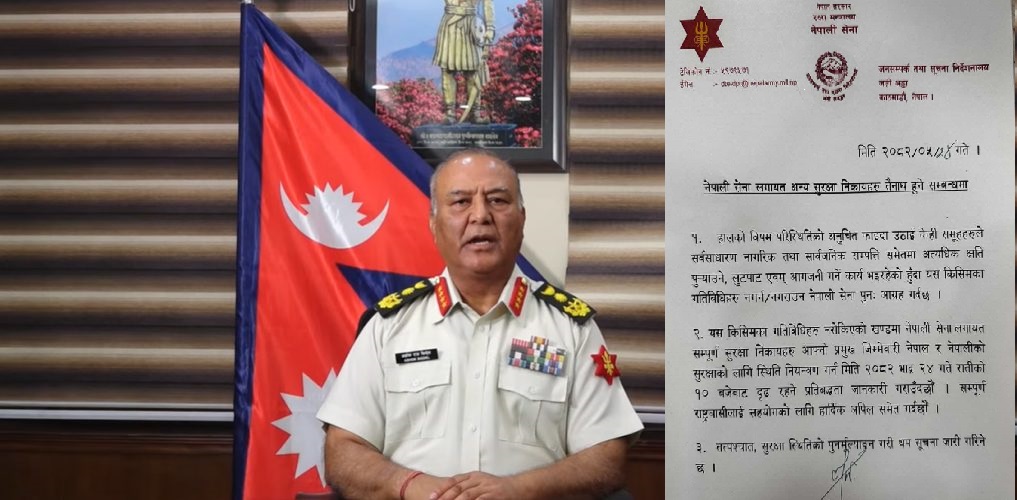
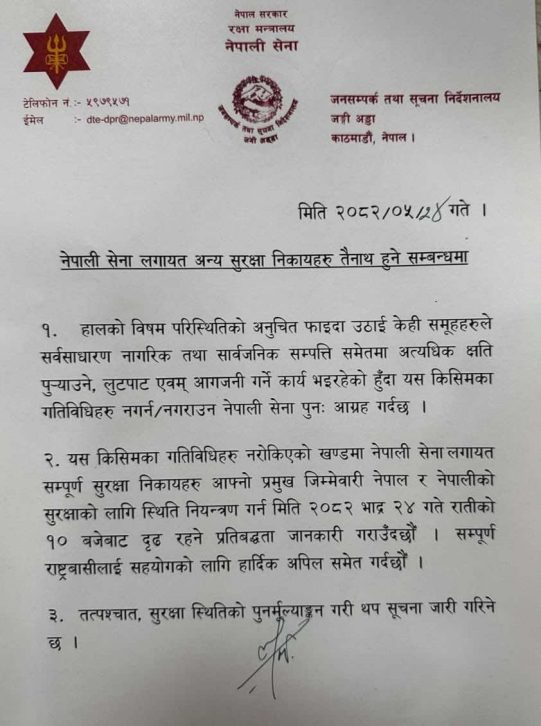
Nepal Army to take charge of security from 10 pm tonight

Kathmandu — With protests continuing throughout Tuesday and late into the night, the Nepali Army has called for an immediate halt to looting, arson, and related acts.

In a statement issued by the Directorate of Public Relations and Information, the Army warned that if such activities are not stopped, all security forces, including the Nepali Army, will be deployed from 10 PM.

The statement noted that some groups have been exploiting the tense situation to cause serious damage to civilians and public property. It urged all citizens to cooperate in bringing the situation under control.

The Army also stated that the security situation will be reassessed and further information will be released accordingly.

Chandra Kuber Khapung appointed as Inspector General of Nepal Police

Kathmandu – AIG Khapung, former Chief of the Central Investigation Bureau (CIB) of the Police, has been appointed as the Inspector General of Nepal Police (IGP) as per the decision of the Council of Ministers of the Government of Nepal.

With this decision, Khapung will assume responsibility as the 32nd Inspector General of Nepal Police from Bhadra 18. Born in Tehrathum, Khapung joined the police service in 2052 BS.

55-year-old Khapung has previously held positions including Chief of Security to the Prime Minister, serving twice in the United Nations Mission in Haiti (UN), and Chief of Personnel Administration at the Police Headquarters.

He has received security-related training from Italy, Korea, Vietnam and China.

Ruling Party Pulls Back on Police Service Rule Amendments

Kathmandu – The ruling party has backed off from amending Nepal Police regulations to remove the 30-year service limit for officers, citing delays in obtaining consent from the Public Service Commission and concerns over potential court challenges.

Inspector General of Police (IGP) Deepak Thapa is set to retire in a week. Earlier, the government had prepared to remove the 30-year service provision under Rule 127 (g) of the Police Regulations 2071. However, according to a senior Home Ministry official, the process was not advanced as top leaders realized it might not succeed. Preparations for the amendment had started two weeks ago, but a lack of clarity from the government caused delays.

“The Police Regulations can only be amended with the opinion of the Ministry of Law and mandatory consent from the Public Service Commission. With no amendment, IGP Thapa and Additional IGPs Tek Prasad Tamang and Sudip Giri, among others, will retire on 18 Bhadra due to service limits.

In March 2014, the Supreme Court issued a directive against arbitrarily amending police service tenure through regulations, instructing that service and retirement matters be settled through legislation rather than regulations. Although the government presented the Nepal Police Bill in Parliament seven months ago, it has not yet been finalized. When the government attempted to amend regulations while the bill was still under discussion in the Parliamentary State Affairs and Good Governance Committee, it raised concerns.

The Police Bill, tabled on 15 Magh 2081, proposes removing the 30-year service limit, allowing retirement based solely on position tenure or age limit. Currently, the regulations stipulate a four-year term, 30-year service limit, or age 58 for the IGP, with retirement based on whichever comes first. Additional IGPs and DIGs have a 56-year age limit and five-year term, while SSPs and SPs have a 55-year age limit and six- and ten-year terms respectively. Critics argue that including service and term provisions in the regulations has made transfers, promotions, retirements, and career development in the police force non-transparent.

Changes in Police Bill: Pension at 16 years, IGP’s age limit at 60

Kathmandu- The Ministry of Home Affairs has made extensive changes to the Police Bill registered in Parliament. The Police Bill, which includes a provision to provide pension to lower-level police officers at 16 years, removing the 30-year service requirement, has been registered in Parliament. Similarly, the bill has reduced the marks given by the promotion committee and increased the marks for performance evaluation and seniority.

As per the demand of lower-level police employees, it is mentioned that ASI, SI and senior SI will get monthly pension for life after completing 18 years of service and senior constables and police officers below that will get the pension after16 years of service. However, Section 57 of the bill states that pension will be provided only after completing 20 years of service from the date of appointment to the service.

Similarly, the bill proposes to increase the retirement age of Inspector General of Police to 60 years, Additional Inspector General of Police and Deputy Inspector General of Police to 59 years, Senior Superintendent of Police and Superintendent of Police to 58 years, Deputy Superintendent of Police and Police Inspector to 57 years, Senior Deputy Inspector of Police, Deputy Inspector of Police and Police Assistant Inspector to 54 years, Senior Constable of Police, Police Constable, Police Assistant Constable and Police Constable to 51 years and Police Attendant to 55 years.

Similarly, under the provision of tenure, IGP and AIG have been given three years, DIG has five years, SSP has eight years and SP has ten years, while the tenure limit has not been specified for other posts.

Similarly, the bill has increased the marks given by the promotion committee by reducing the marks for performance evaluation and seniority.

Earlier, there was a provision that the promotion committee could give a maximum of 7.5 marks out of a hundred whole marks in promotion. It has been reduced to 3 points. The police have proposed that the score be reduced on the grounds that there was manipulation in the promotion as the promotion committee has too much discretionary power. Similarly, the performance evaluation has been given 50 out of 100 marks. Earlier, it was mentioned that a maximum of 40 marks could be given for performance. While there were 22 marks for seniority, it has been increased to 27. The score for educational qualification has been reduced. Previously, there were 10 marks, now 5 marks are given to non-gazetted employees and 7 marks are given to gazetted employees. The score for training has also been changed, and instead of 7.5 marks, 10 marks are given to non-gazetted employees and 5 marks are given to gazetted employees. The 8 marks for experience working in a geographical area have been removed, while the 5 marks for challenging or special responsibilities have been retained.

Military fund should be used in a welfare sector : Defense Minister

Kathmandu – Deputy Prime Minister and Defense Minister Purna Bahadur Khadka has suggested to use the money accumulated in the Military Welfare Fund for the purpose of getting maximum return. While inspecting the military welfare directorate on Sunday, he opined that the funds should be invested in plans and programs to provide more economic and social security to the beneficiaries.

The assets of the Soldier Welfare Fund have reached over 82 billion 66 million rupees. According to the headquarters of the Nepal Army, the fund has a cash balance of 75 billion 905 million rupees and has invested 6 billion 750 million rupees in various programs till the end of last December.

Jangi Adda also informed that more than 3 thousand people got direct employment from the educational institutions, health treatment facilities and other activities run under the Directorate of Military Welfare. The fund has given the data that more than 1 billion 250 million is directly contributing to the country’s revenue.

“I would like to draw attention to be careful to prevent the funds from being invested in risky areas and to mobilize them in more profitable and productive activities that contribute to the economic and social development of the country,” he said.

Deputy Prime Minister Khadka also suggested that the funds should be used to expand quality health and education services to Nepali soldiers and dependent families in the future.

Various welfare and income-generating programs are being coordinated and operated from the funds established for the greater welfare of the Nepali Army and dependent families.

Established in the year 2032, the fund is a contribution-based non-profit welfare program organization.

At the call of the United Nations, a part of the money received for deployment as a peacekeeping force in various conflict-affected countries of the world is also deposited in the fund.

Officers including Chief of Army Staff Prabhuram Sharma, Defense Secretary Kiran Sharma also participated in the inspection and discussion program.

Meeting between Chief of Army Staff Sharma and Indian Army Chief Pandey

A meeting has been held between Chief of Army Staff Prabhuram Sharma and Indian Army Chief General Manoj Pandey.

Pandey, who is on a five-day visit to Nepal, had a meeting at Jangi Adda today with the commander in chief of Nepal army Prabhuram Sharma. According to the Directorate of Public Relations and Information of the Nepali Army, bilateral interests and mutual relations were discussed in the meeting. It is said that this kind of meeting will strengthen the mutual relationship between the armies of the two countries. On that occasion, Pandey also planted trees in the main building complex of Jangi Adda.

Pandey will be honoured with the status of the commander in chief of the Nepal Army by President Bidya in a special ceremony at Sital Niwas today.

Indian Army Chief General Pandey arrived in Kathmandu

Indian Army Chief General Manoj Pandey has arrived in Kathmandu. Rathi Balkrishna Karki of the Nepalese Army welcomed the Indian military delegation led by Pandey at the Tribhuvan International Airport.

Pandey will be honoured with the status of the commander in chief of the Nepal Army by President Bidya Devi Bhandari tomorrow. According to the tradition between the Nepal Army and the Indian Army, the status of the honorary chief of the commander will be provided to each country’s chief of the army staff.

It is said that there will be a courtesy meeting with Prime Minister Sher Bahadur Deuba on Tuesday.

Pandey who arrived in Kathmandu with a five-member team will pay homage to the BIR ISMARAK at SAINIK MANCH Tundikhel, inspect the military base and hold discussions with the Chief of Army Staff Prabhuram Sharma.

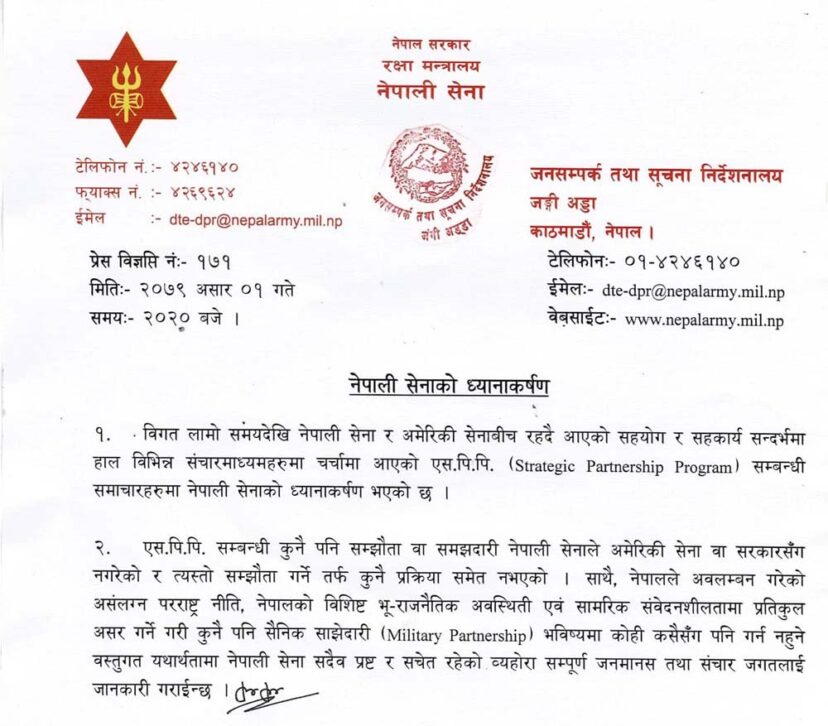
No Agreement been made on State Partnership Program : Nepal Army

The Nepal Army has stated that it has not entered into any agreement with the United States regarding the State Partnership Program (SPP).

The Directorate of Public Relations and Information of the Nepal Army has issued a press release today stating that it has drawn its attention to the media reports about the SPP. The statement said that the Nepal Army had not entered into any agreement or understanding with the US military or the US government regarding the SPP and that there is no process to reach such an agreement in the coming days.

The statement also said that the military has always been clear and vigilant that no military agreement should be reached with anyone in the future that would adversely affect Nepal’s non-aligned foreign policy, Nepal’s unique geopolitical position and strategic sensitivities.

Meanwhile,the US embassy said that in 2015 and 2017, the then Chief of Army Staff Rajendra Chhetri had applied to join the SPP twice and the offer was accepted in 2019.

2 million financial assistance to the family of security personnel who dies on election duty

The government has decided to provide financial assistance of Rs 2 million to the families of security personnel those who die while on election duty.

The cabinet meeting held on Sunday morning decided to provide Rs 2 million financial assistance to the families of the security personnel, including temporary police personnel, on the proposal of the Home Ministry.

The meeting also decided that the government will bear the expenses incurred for the treatment of the security personnel injured during the election. The meeting has also decided to provide allowance to the temporary police personnel deployed in the Himalayan district as per the normal police officer.

Interrupted domestic flight service resumes at Tribhuvan International Airport

Regular domestic flights have resumed from Tribhuvan International Airport after no bombs or any other suspicious items were found.

Although international flights were not disrupted, domestic flights at the airport were suspended after an unidentified person called and claimed a bomb at the domestic terminal.

A search operation was launched by a team of Nepal Army, Armed Police Force and Nepal Police along with a trained dog, following a phone call from an unidentified person who allegedly came from a Pakistani number. However, security forces did not find any bombs or any other suspicious objects during the search and the airport has also started domestic flights.

All domestic flights were disrupted for about an hour after 10 a.m. today.

Total of 11.9 million ballot papers printed for 53 districts

The Election Commission has informed that 11.9 million ballot papers have been printed for the local level election.

The commission said that the number of ballot papers has been printed for 53 districts till today. The Election Commission is printing ballot papers at Janak Education Materials Center.

The commission is preparing to print 19.4 million ballot papers for the local elections. This time the number of voters at the local level is 17.7 million 33 thousand 723.

Initially, ballot papers are being printed for remote districts and later for accessible districts. The ballot papers printed for the inaccessible have to be transported at the beginning with security, the commission said.
The Election Commission has informed that the security responsibility for the transportation of ballot papers has been given to the Nepal Army as they are sensitive materials.

Spokesperson Poudel said that the security of other election materials would be provided by the police. The commission has also informed that preparations are being made to send ballot papers by helicopter to the districts where it is not possible to send ballot papers by land.

Commission has sent a letter to the Ministry of Home Affairs for the transportation of other election materials and the police will provide security with necessary coordination. Spokesperson Poudel also said that the Election Commission is monitoring the transportation of election materials through GPS. He said, “An employee of the commission goes to transport the election materials. Employee’s mobile has GPS tracking system.

President’s approval to mobilize army in local level election

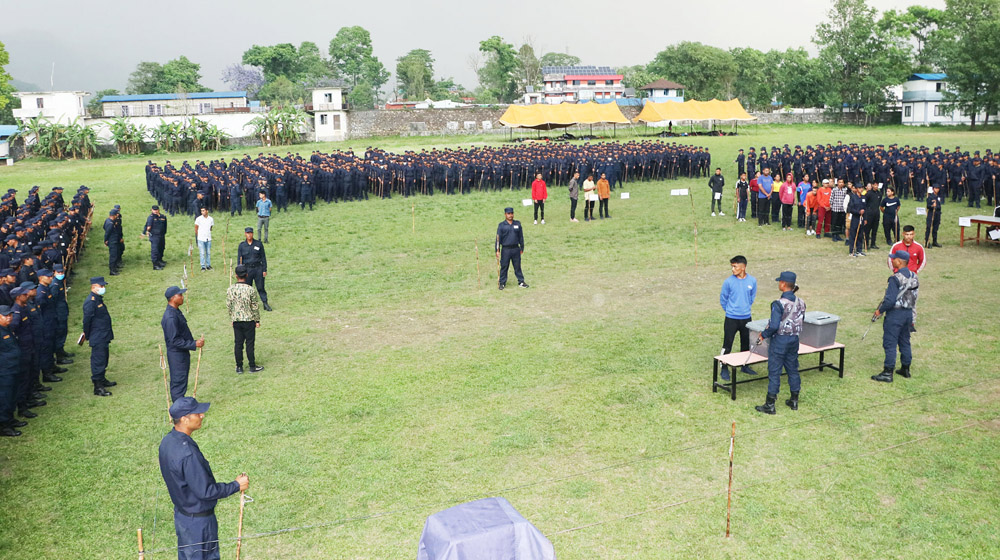
President Vidyadevi Bhandari has given approval to mobilize Nepal Army for the upcoming local level election security. Elections are being held in one phase all over the country .

In a statement issued today , Sagar Acharya, spokesperson of the President’s Office, said that Prime Minister Sher Bahadur Deuba had recommended to President Bhandari for the approval to mobilize the army for the election. In order to conduct the election in a free, fair and fearless environment, a meeting of the Central Security Committee chaired by Home Minister Bal Krishna Khand passed the ‘Local Level Election Integrated Security Plan-2078’ with the deployment of Army, Police, Armed Police force, National Investigation Department and temporary police. Accordingly, a blueprint has been drawn up for the integrated and coordinated operation of the security agencies.

Following the decision of the Security Committee meeting, the National Security Council meeting had recommended to the Council of Ministers to mobilize the army . Following the same decision, Prime Minister Deuba had recommended to President Bhandari for approval of the mobilization of the army for election security purposes with the approval of the Council of Ministers.

With the approval of President Bhandari to mobilize the army, the way has been opened for the deployment of the army for security at 753 local levels.